Tag: government

  • PM Lee’s National Day Rally Speech Puts A Malay Family In The Spotlight As Exemplary

    PM Lee’s National Day Rally Speech Puts A Malay Family In The Spotlight As Exemplary

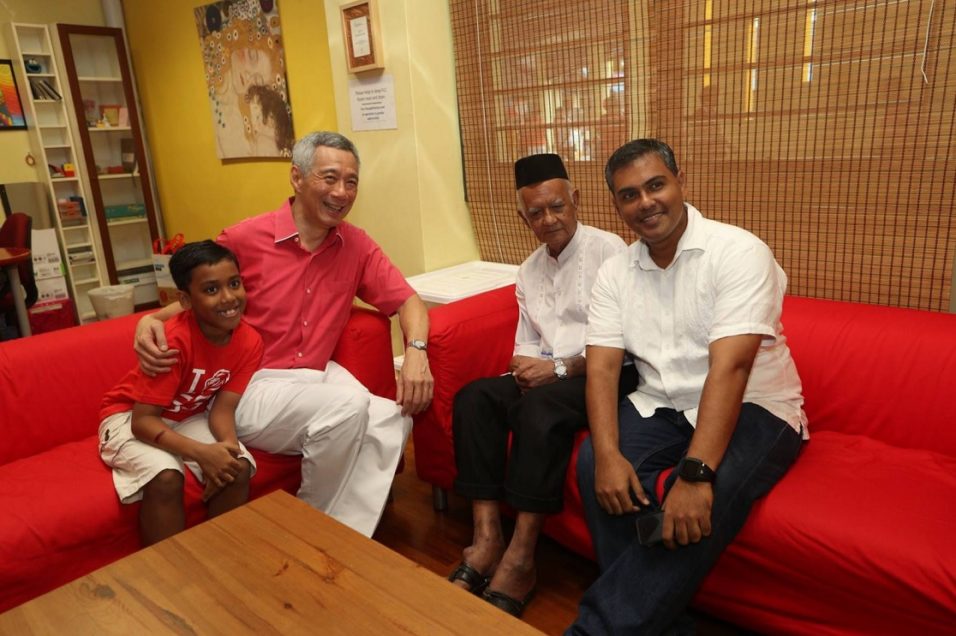
    In January, I presented Edusave Awards to my residents in Teck Ghee. One family I met moved me.

    I presented an Edusave Merit Award to Adam, a student from Teck Ghee Primary School. After the ceremony, I met Adam’s father, Aziz. He showed me an old photo of him, receiving an SBC House Union Bursary from me in 1986! So I have presented awards to father and son, 31 years apart! It was a special moment for Aziz, Adam, and also for me.

    I also met the grandfather, Ahmad, who was a gardener with SBC, the old Mediacorp. That is why Aziz qualified for the Bursary all those years ago.

    It is my Government’s duty to build for our future, so that every family can be like Ahmad, Aziz and Adam. This is the Singapore of the last half century: Every generation striving and building for the next, keeping our eye on tomorrow and investing in our children. Undaunted by challenges, but instead working together to overcome obstacles, seize every opportunity and realise a bright future for all of us.

    Thank you and Good Night!


    Source: Lee Hsien Loong / MCI

  • Australian Senator Pauline Hanson Wears Burqa To Parliament In Bid To Ban Them

    Australian Senator Pauline Hanson Wears Burqa To Parliament In Bid To Ban Them

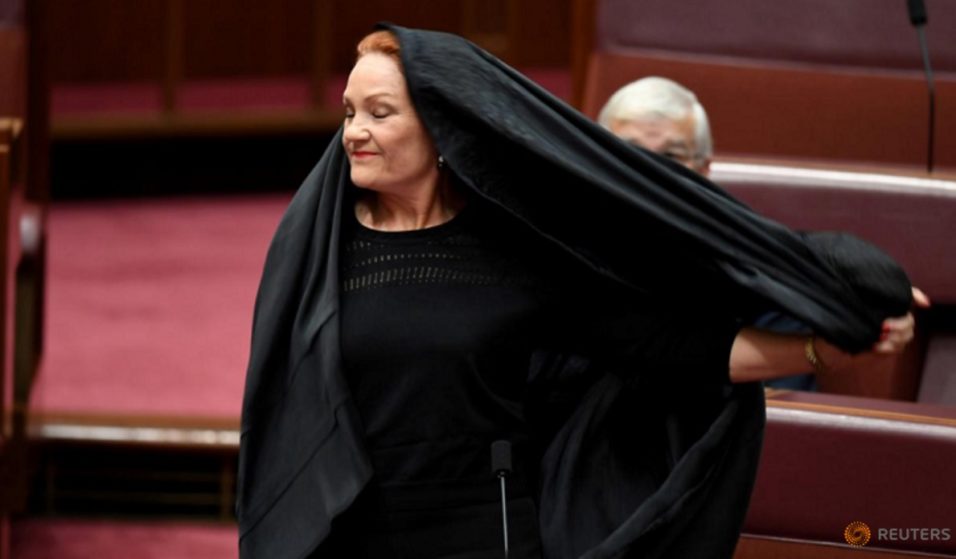
    Australian far-right senator Pauline Hanson wore a burqa to parliament on Thursday (Aug 17) as part of her campaign to ban the all-enveloping garment worn by some Muslim women, drawing a quick rebuke from the government and Muslims.

    Hanson sat in her seat in the assembly for about 20 minutes covered by the black burqa before removing it to call for them to be banned in public for national security reasons.

    “I’m quite happy to remove this because this is not what should belong in this parliament,” Hanson, who leads the far-right One Nation party, told the Senate.

    “If a person who wears a balaclava or a helmet in to a bank or any other building, or even on the floor of the court, they must be removed. Why is it not the same case for someone who is covering up their face and cannot be identified?”

    Hanson, who first rose to prominence in the 1990s because of her strident opposition to immigration from Asia and to asylum seekers, has in recent years campaigned against Islamic clothing and the building of mosques.

    Her party has four senators, which gives it influence in parliament when closely contested legislation is being voted on.

    Attorney-General George Brandis rebuked Hanson.

    “I am not going to pretend to ignore the stunt that you have tried to pull today by arriving in the chamber dressed in a burqa,” he said, drawing applause from members of the Senate.

    “We all know that you are not adherent of the Islamic faith. I would caution and counsel you with respect to be very, very careful of the offence you may do to the religious sensibilities of other Australians.”

    Adel Salman, vice president of the Islamic Council of Victoria state, said Hanson’s action was “a mockery of her position”.

    “It is very disappointing, but not surprising as she has sought to mock the Islamic faith time and time again.”


    Source: http://www.channelnewsasia.com

  • Indonesia: Giant Statue Of Chinese God Covered Up With Sheet In Indonesia After Upsetting Local Muslims

    Indonesia: Giant Statue Of Chinese God Covered Up With Sheet In Indonesia After Upsetting Local Muslims

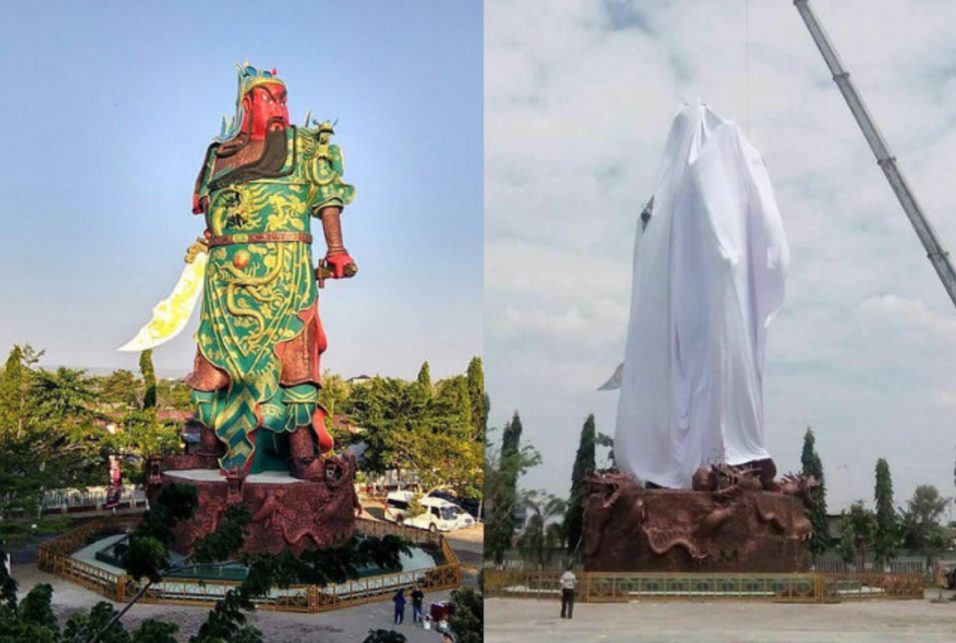
    A colossal statue of a Chinese god has been unceremoniously covered up by a giant white sheet in Indonesia after upsetting the local Muslim population

    The giant god-turned-ghost is Guan Yu, a heroic Three Kingdoms era general who was later immortalized as a folk deity in China. The 30.4-meter-tall statue reportedly cost 2.5 billion Indonesian rupiahs ($187,000) to build and was funded by private donations to the Kwan Sing Bio Temple in Tuban, East Java.

    It was publicly unveiled last month at a ceremony held inside the temple that was attended by prominent local politicians. Billed as the largest statue of Guan Yu in Southeast Asia, it was hoped that the colossus might help to attract more tourists to the city.

    Instead, so far, the giant statue has attracted only outrage from the locals of Tuban, who are predominately Muslim. Online, many argued that the statue was an affront to Islam and the local people of Indonesia, claiming that it showed how the Chinese were in fact in control of Indonesia’s government. Others claimed that the statue was built on public land and without the proper building permits — despite the fact that the statue was entirely built on land owned by the temple.

    The decision to cover up the statue was made last weekend by the temple’s management following consultation with a governmental organization, the Forum of Religious Harmony, which is tasked with ensuring peace between different religious groups in the country, as a way of calming down the situation.

    However, local Muslims have said that merely covering up Guan Yu is not good enough, vowing that if the government does not take action to tear down the statue, then they will do it themselves, holding rallies outside governmental buildings this week to urge local authorities to demolish the ancient warrior god.

    Didik Muadi, the leader of the protests, told the local news site Tempo that the statue of the Chinese god should be torn down and replaced with one honoring Indonesia’s national heroes who helped fight for independence, though he is apparently fine with the temple erecting a statue to their god… just so long as it isn’t so big.

    “Actually we can allow them to build the statue, just not as high as it was and it should be in the temple, not outside,” he said, adding that “We are tolerant.”

    Sounds like Didik should really avoid ever paying a vist to the waterfront of Hubei’s Jingzhou city.


    Source: shanghaiist.com/

  • Commentary: Native Born Singaporean Personally Offended By What Happened In McPherson

    Commentary: Native Born Singaporean Personally Offended By What Happened In McPherson

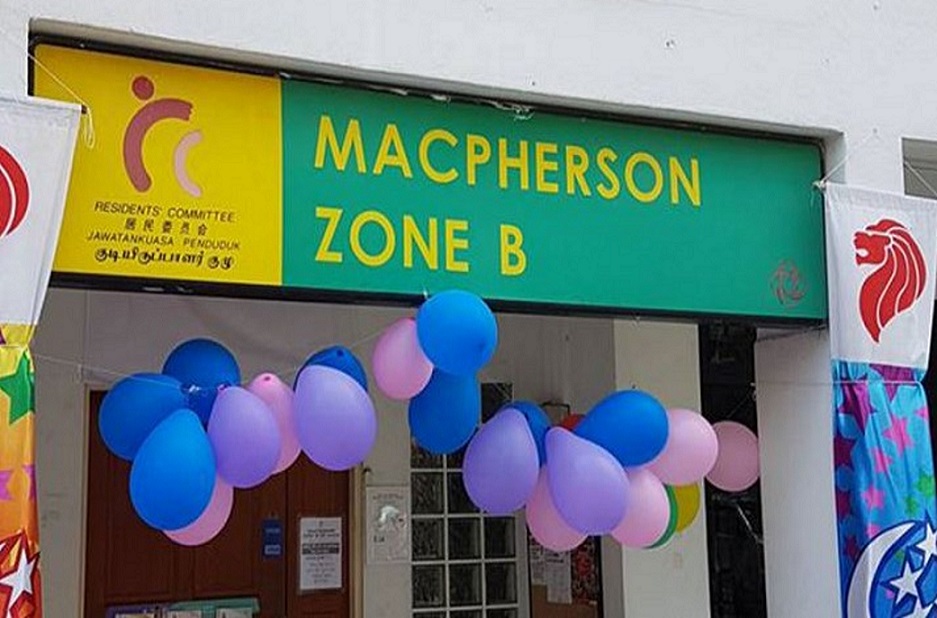
    As a native born Singaporean , I am personally most offended by what happened in McPherson over the Open House Organised by the RC.

    For this scandalous incident to happen in a PAP ward will lend weight to the suspicion of many Singaporeans that the PAP favour New Citizens over indigenous Singaporeans . Even before this scandalous incident, many Singaporeans already felt government policies discriminated them in favour of New Citizens and that they had become refugees in their own country.

    I am not against New Citizens but I demand that all Singaporeans be treated equally!

    I do not accept the reasons given by the RC for this scandalous incident. Grassroot leaders should have known it was highly insensitive to have treated Singaporeans in this manner. And given the huge influx of New Citizens into our country , their advisor which was Ms Tin Pei Ling herself should have ensured that the RCs in her constituency treated all Singaporeans, including New Citizens, equally . Merely saying that she was upset over the incident is a totally inadequate response.

    A statement from Project Freedom founder Lim Tean.


    Source: Tean Lim

  • Tan Cheng Bock’s Constitutional Challenge Dismissed By High Court

    Tan Cheng Bock’s Constitutional Challenge Dismissed By High Court

    The High Court has dismissed former presidential hopeful Tan Cheng Bock’s application contesting the legitimacy of the upcoming reserved Presidential Election (PE).

    Justice Quentin Loh’s decision on Friday (Jul 7) in favour of the Government maintains the status quo – that only Malay candidates are eligible to stand in the next PE, due in September.

    Dr Tan has until next Wednesday to file a notice of appeal.

    Dr Tan, a Member of Parliament for 26 years (1980–2006), ran unsuccessfully for President in 2011. In March 2016, he announced his intention to run again, but amendments to the Constitution passed late last year have precluded him from doing so.

    Dr Tan filed an application in May challenging the basis of the Government’s decision to reserve the next PE for Malay candidates and called for the September election to be an “open” one.

    Under new rules, if there is not a President from a particular racial community for five consecutive terms, then the next term will be reserved for a President from that community.

    DR TAN’S CHALLENGE TO PARLIAMENT’S “UNCONSTITUTIONAL” DECISIONS

    In an affidavit before the High Court, Dr Tan questioned the Government’s decision to count President Wee Kim Wee as Singapore’s first elected President.

    President Wee was appointed in 1985 by the Government of the day.

    The Elected Presidency as we know it – where Singaporeans vote for their President – was legislated in 1991, in the middle of President Wee’s second term.

    Dr Tan, who was represented by Senior Counsel Chelva Retnam Rajah, argued that the decision to count five terms from President Wee’s was “unconstitutional”.

    The first popularly elected President was Ong Teng Cheong, Dr Tan said, and if the Government had started counting from President Ong’s term, this year’s PE would not have to be a reserved one.

    Dr Tan also argued that only the terms of Presidents elected by Singaporeans to serve six-year terms should be counted. President Wee was not popularly elected, and served two terms of four years.

    PARLIAMENT’S DECISION A “POLICY” ONE, OUT OF COURT’S HANDS: JUDGE

    In a 68-page judgement released on Friday (Jul 7), Justice Loh agreed with the AGC that “nothing” in the Constitution limits Parliament’s power to “start the count from the term of office of a popularly elected President”.

    “(The Constitution) is both a duty-imposing and power-conferring rule. It expressly imposes a duty on Parliament to specify (the first elected President) and implicitly gives Parliament the power to do so,” Justice Loh said.

    The Constitution also “does not only refer to Presidents elected by the citizens of Singapore for terms of six years”, the judge said. It could also refer to Presidents, like President Wee Kim Wee, who were elected by Parliament for four-year terms, he added.

    The “plain language” of the Constitution “only refers to the person who holds the ‘office of the President’ without any words to draw a distinction between Presidents who were elected by Parliament, and those who were elected by citizens”, Judge Loh said.

    “Ultimately, since (the Constitution) does not fetter Parliament’s power … Parliament’s choice of (the first elected President) is a policy decision which falls outside the remit of the courts.”

    DR TAN “SELFISHLY” TRYING TO “UNDERMINE” MULTIRACIAL PRESIDENCY

    In court documents obtained by Channel NewsAsia, the Attorney-General’s Chambers accused Dr Tan of “running a case that is entirely self-serving”.

    “(Dr Tan) is advancing a strained interpretation of the Constitution so that he can apply to stand as a candidate in the coming (PE).

    “His motives are purely selfish and he has shown no regard for the principle of multiracial representation which Parliament intended to safeguard,” Deputy Attorney-General (DAG) Hri Kumar Nair said.

    In written submissions to the High Court, DAG Nair defended the Government’s decision to count President Wee Singapore’s first elected President.

    The Constitution “does not impose any requirement on which President, or which category of Presidents the Legislature must choose or choose from”, he said.

    DAG Nair added the Legislature has powers “to end the hiatus for any community sooner rather than later”, and that Dr Tan’s bid “undermines the longstanding imperative for multiracial representation in the office of the President, which the reserved election framework seeks to safeguard”.

    NO DIFFERENCE WHETHER PRESIDENT IS ELECTED BY PARLIAMENT OR BY THE PEOPLE: JUDGE

    Apparently in agreement with the AGC, Justice Loh said: “In my judgement, the recent constitutional amendments reflect a re-emphasis on the President’s unifying role and the conviction that, in order for the President to fulfil that role, that office must reflect the multi-racial character of our country.

    “From the perspective of ensuring multi-racial representation in the Presidency in view of the President’s symbolic role, it makes no difference whether the President was elected by the electorate or by Parliament. In either case, the President’s capacity to symbolise Singapore is undercut if the occupants of the office do not reflect our multi-racial composition.”


    Source: CNA