Tag: government

  • Shanmugam: Trust The Govt To Be Efficient With Its Use Of Money

    Shanmugam: Trust The Govt To Be Efficient With Its Use Of Money

    As the Government spends more in areas such as healthcare, it also needs more revenue, said Home Affairs and Law Minister K Shanmugam at a dialogue with residents on Sunday (March 5).

    “Money is not going to come from the sky… We have to pay for what we use, and we just have to trust the Government to be efficient with its use of the money,” he said.

    He was responding to a resident’s question about what would happen if the Government received less net investment income than what was projected.

    The resident was one of about 160 women who attended a health talk organised by Nee Soon GRC, in collaboration with the National Healthcare Group Polyclinics, to mark International Women’s Day on Wednesday (March 8).

    Mr Shanmugam and Nee Soon GRC MP Lee Bee Wah spoke about the Budget 2017 announcements before the health talk.

    Mr Shanmugam added: “As a family, you have to spend less than what you earn. As a country, we have to learn to spend less than what we have. With all the rising costs and rising expenditure, we need to look at where the extra money (needed) is going to come from.”

    He also explained the need for the 30 per cent increase in water tariffs – the first in 17 years – which was announced last month.

    He pointed out that one- and two-room HDB households will not see any nett increase at all, while for most other HDB flats, the nett increase will only be between $2 and $11 per month.

    During the health talk, residents learnt how to manage their food intake and exercise, to stay healthy even as they age. Ms Lee said: “Women are the centres of many workplaces, families and communities, but they can only do so if they stay healthy. I hope this talk (provides) our female residents the information to protect themselves against diseases, and live a happy and long life.”


    Source: ST

  • I’m From Low Income Family How Can I Get $9,806 Help From Government Schemes?

    I’m From Low Income Family How Can I Get $9,806 Help From Government Schemes?

    The survey also showed that households living in one-room and two-room HDB flats received more government transfers than those in larger flats or landed property.

    On average, resident households in one-room and two-room HDB flats received $9,806 per household member from various government schemes in 2016. This was almost double the average of $4,168 received per household member across all housing types.

    straightforward i frm low income, my wife look after my 3 childrens.for me i work dispatch.  altho we low income but we are happy as family.sometime wen i haf xtra i buy mcdonalds happy meal for my childrens bday.

    simple life is ok for us.as long i can send my childrens to school its ok whatever struggle is ok and we always pray to Him.

    what it is we will be syukur for the $9806 they say is give to people stay in 1 and 2 rm flat.not to be ungrateful what help we get now but the 9k is mean very much for us.what is the guideline for people who get that?


    Didi

    Reader Contribution

  • Is Government A Person? Court Rules On Anti-Harassment Law Provision

    Is Government A Person? Court Rules On Anti-Harassment Law Provision

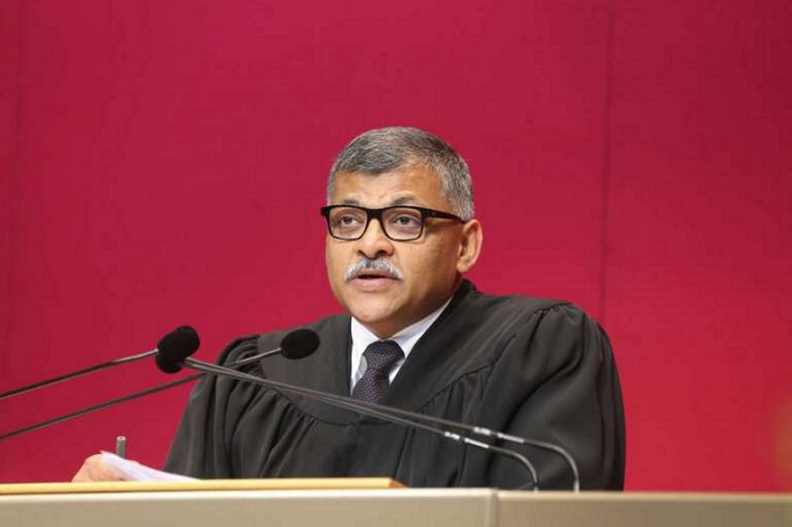
    In a rare split decision, the Court of Appeal ruled, 2-1, that the Government cannot invoke an anti-harassment law that allows persons to stop the publication of false statements against them.

    Chief Justice Sundaresh Menon was the sole dissenting judge, in a case that hinged on the narrow legal question of whether the Government could be considered a “person” under Section 15 of the Protection from Harassment Act.

    Under the provision, a person who is a victim of a false statement can seek relief by asking the court to order that the statement not be published unless it drew attention to the truth.

    In a written judgment released yesterday, Judges of Appeal Chao Hick Tin and Andrew Phang ruled that the law applied only to human beings.

    However, Chief Justice Menon disagreed. He concluded that the Government does fall within the scope of “person” under the law and is able to apply under the provision for relief.

    The decision arose in a case in which the Attorney-General had invoked the law against five individuals who ran socio-political site The Online Citizen (TOC) as well as Dr Ting Choon Meng, co-founder of medical device firm MobileStats Technologies.

    MobileStats had sued the Ministry of Defence (Mindef) in 2011 for infringing its patent for a mobile emergency medical station. The suit was eventually dropped.

    In January 2015, TOC published an interview with Dr Ting, in which he made various allegations against Mindef.

    The ministry responded on its Facebook page, refuting his allegations that it had knowingly infringed his patent and that it had dragged out court proceedings to wear him down financially.

    TOC published Mindef’s statement in full and provided a link to it from the offending article.

    The next month, the A-G sought a court order that the allegations cannot be published without a notification that they were false and that Mindef’s statement gave the truth.

    In May 2015, a district judge found Dr Ting’s statements to be false and granted the A-G’s ap- plication.

    TOC, represented by Mr Eugene Thuraisingam, and Dr Ting, represented by Mr Choo Zheng Xi, appealed to the High Court, arguing that Mindef cannot apply for such an order as the Government is not a “person” under the provision.

    Judicial Commissioner See Kee Oon agreed, ruling that only human beings are entitled to apply for such court orders.

    The A-G then appealed to the Court of Appeal, Singapore’s highest court, arguing that there was no clear parliamentary intent to exclude the Government from the protection of the Act.

    The A-G argued that the objective of the provision was to deal with false statements and not merely harassment, so the Government and corporate entities have the right to invoke the law.

    Delivering the court’s majority decision, Justice Phang referred to parliamentary debates in which Law Minister K. Shanmugam talked about giving people a “lower tier” remedy against falsehoods.

    Justice Phang said it was clear that the minister’s focus was solely on human beings, pointing to the many references to “victims” and “harassment” in his speech.

    No references were made with regard to the rights of other entities, he noted.

    Justice Phang added that even if the majority accepted that the law applies to Mindef, they did not think it was “just and equitable” to grant an order against TOC and Dr Ting.

    He noted that TOC had provided a balanced view.

    “Additionally, Mindef was anything but a helpless victim. It is a government agency possessed of significant resources and access to media channels.”

    Through his lawyer Mr Choo, Dr Ting said he was glad that this episode was concluded.

    Mr Thuraisingam said his clients are “happy that the position they have taken has been vindicated by the High Court and the majority of the Court of Appeal”.


    Source: ST

  • Tricky, but necessary, to build resilience against security threats

    Tricky, but necessary, to build resilience against security threats

    Terrorism and radicalisation will be an inescapable part of our lives from here on, and the main threats for 2017 and beyond should be divided into two parts.

    The first is the foreign fighter blowback. With the so-called Islamic State (IS) suffering reverses on the battlefield in Iraq and Syria, many South-east Asian fighters will return home to Indonesia and Malaysia. They may also seek new safe havens such as in the southern Philippines.

    In addition, they will seek to leverage issues which give them propaganda mileage that can reinvigorate their social media campaigns — such as the plight of the Rohingya.

    And we should not be so quick to assume that it is simply South-east Asian fighters we will need to reckon with. One cannot discount the possibility of a wider movement of battle-hardened Uighur veterans who, for various reasons, cannot return to their home countries elsewhere.

    For some sense of what is likely to happen with these returnees, we can look to Europe, where Western fighters have been trickling home for some time now.

    Many are embittered by their experiences and disillusioned by the depravity of the IS; but some have come back even more determined to wreak havoc, and even more radicalised.

    There is no reason to suppose that a similarly mixed scenario should not play out in South-east Asia.

    RADICALS OF ANY FAITH

    The second threat is radicalisation in general. We have to accept that this is not simply an issue of Islamist radicalisation. Religious revivalism is increasingly present in other major faiths.

    Radicals inhabit the fringes of all these. And the sobering fact is that we live in a future where all sorts of individuals are going to be “radicalised” in some form or other — even those without strong religious convictions.

    We should not forget that we have had an individual, a Singapore citizen, who has tried to join Kurdish militia to fight IS. Whatever his motivations — and there is some suggestion of alienation and wanting to do good — we need to understand that, in future, all sorts of people are going to want to fight for causes, or else take up some form of muscular activism.

    This will be a rising trend and these impulses, if not managed, will lead to schisms within societies.

    Terror networks can be interdicted and taken down. Security services are actually pretty good at this sort of thing. However, what all of us need to get our heads around is the rising tide of intolerance and, more precisely, tolerance for intolerance.

    This is the second big issue we need to face. It is a phenomenon that did not start in South-east Asia, but it is creeping in. Traditional forms of syncretistic religious practice that have existed here for centuries (if not longer) are being replaced by a more hardline, less inclusive type of observance.

    This type of feeling is fuelled by social media. As Foreign Affairs Minister Vivian Balakrishnan said last year: “We now live in a world of fragmented echo chambers — we hear what we want to hear, we ignore what we don’t want to hear, or inconvenient truths are not heard.

    “And in fact, from an academic point of view, this leads to a ‘shallowing’ of discourse, a world in which there is a dearth of deep thought and cogent discussion across diverse perspectives. You get a more monochromatic world and a narrowing of minds.”

    Singapore will have to maintain its values of multiculturalism and tolerance. These will be increasingly valued in an era where these are becoming rare commodities (and, indeed, in an era where these qualities are persecuted in some quarters).

    It is my view that Singapore will increasingly come to be seen as a beacon, not simply on account of good policymaking, which we have, but because parts of the world and our immediate environment are becoming increasingly insalubrious.

    A POST-TRUTH WORLD

    The echo chambers that Dr Balakrishnan and other leaders have talked about suggest a milieu in which people can choose simply to hear what they want to hear. This is especially problematic for a number of reasons.

    One is that state and non-state actors are increasingly taking advantage of various mechanisms to subvert the truth and to peddle their own information, which may actually be quite distant from the facts. These may all the more easily be lapped up by groups of people within society who, for some reason or the other, might be susceptible to this kind of subversion.

    Consider, for example, the masterful information-operations campaign that Russia has waged in Ukraine. There was a cyber takedown of the power grid, but more importantly was the media (including social media) manipulation and distortion of information which led many to believe the Russian point of view.

    Seen from that point of view, what Russia had done was an entirely legitimate protection of Russian minorities living under persecution. The real point is, of course, that information had been bent and twisted to a level where no one was sure where fact ended and fiction began.

    As commentators have increasingly observed, we live in a post-truth world. One could also argue that Russia did something very similar in the United States election. Why not? A state can nowadays accomplish aims allied to its self-interest that promise outcomes that are much more certain than diplomacy and much less costly than warfare.

    BEWARE THE SLOW-BURN ATTACK

    The people of Singapore, therefore, should not assume that the “attack”, when it does come, will be a mass-casualty terror incident. This is what our agencies routinely hold drills for.

    But the attack might equally be a cyber takedown — either a hacking attempt (and at least one government ministry, the Foreign Affairs Ministry, has suffered a major cyber hack) or some seemingly low-level but nonetheless persistent and insidious cyber effort to chip away at the resilience of our people.

    The basic point is that, while keeping a wary lookout for Black Swans, we need to be aware of slow-burn issues too — particularly the kind that amount to attempts to sap away at the will of a people until the nation is itself shrivelled from within.

    How do we counter this? Part of the answer lies in critical thinking — the ability to ruthlessly interrogate source material that comes before us. In this, the post-truth era, those digital natives who grow up knowing — either instinctively or through some form of instruction — the difference between the objective facts and fake news will have an intrinsic advantage over others.

    A great deal will also boil down to resilience. This could be divided into two kinds. The Government has succeeded in hardening the obvious targets in Singapore and, over the past 10 years or so, focusing some attention on the “bounce-backability” of society.

    The second part is more tricky but achievable. This has to do with how our society coheres and prevents fissures from forming after an event. This next leg is about a certain toughness and resolve that we need to develop more of.

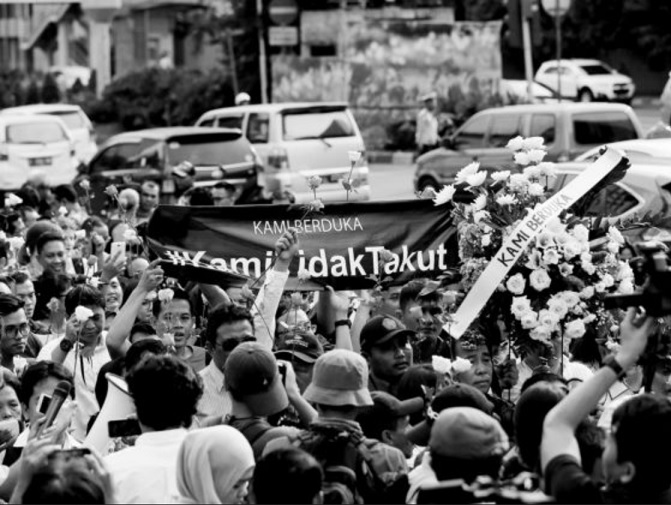
    Consider, for example, what happened after terror incidents and attacks worldwide. The Sydney hostage-taking in December 2014 was followed by a dignified viral campaign, “I’ll Ride with You”, to show solidarity with Australian Muslims. The Charlie Hebdo attacks in Paris in January 2015 saw the ground-up viral campaign “Je Suis Charlie”, while the Jakarta attacks in January 2016 saw the hashtag #KamiTidakTakut (Bahasa Indonesia for “We are not afraid”) go viral.

    Each of these was seen to be a grassroots event and response. Do the people of Singapore have the wherewithal and gumption to rise up, to come together with dignity, resilience and resolve, and with minimal government intervention? Whether and how we can we can do this will be a telling indicator of the shape or form in which we make it to SG100.

    ABOUT THE AUTHOR:

    Dr Shashi Jayakumar is a Senior Fellow and head of the Centre of Excellence for National Security at the S Rajaratnam School of International Studies, Nanyang Technological University.


    Source: Today

  • Myanmar detains cops over Rohingya abuse video

    Myanmar detains cops over Rohingya abuse video

    YANGON • Myanmar’s government yesterday said it has detained several police officers over a video apparently showing Rohingya civilians being beaten, a rare admission that the authorities may have carried out abuses against the Muslim minority.

    Tens of thousands of people from the persecuted ethnic group – loathed by many of Myanmar’s Buddhist majority – have fled a military operation in Rakhine province launched after attacks on police posts in October.

    Bangladesh says some 50,000 Rohingya have crossed its borders over the past two months. Many have brought harrowing accounts of rape, murder and arson at the hands of Myanmar’s security forces. Their stories have raised global alarm and galvanised protests against Myanmar’s de facto leader, Ms Aung San Suu Kyi, who has been accused of not doing enough to help the Rohingya.

    Her government has said troops are hunting militants behind deadly raids on police border posts, denying claims of atrocities and launching a dogged information campaign against reports of abuse.

    However, the authorities yesterday pledged to take action “against police officers who allegedly beat villagers during area clearance operations on Nov 5 in Kotankauk village”.

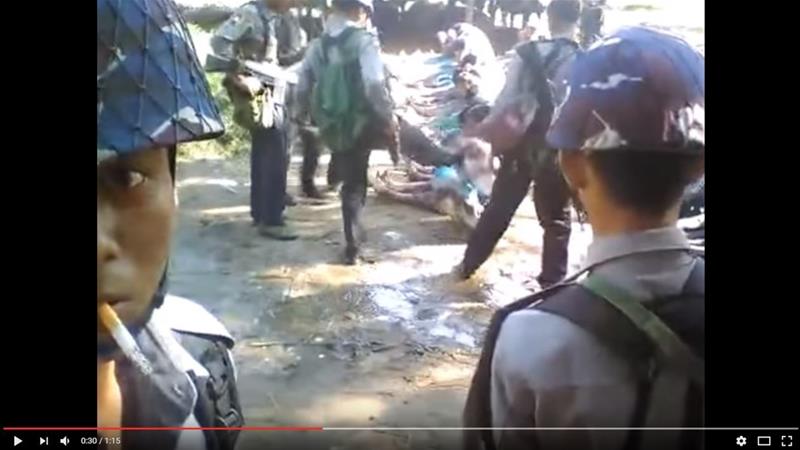
    Ms Suu Kyi’s office named four officers who were involved in the operation, including constable Zaw Myo Htike, who filmed the “selfie-style” video.

    “Those who (were) initially identified were detained,” it said in a statement. “Further investigations are being carried out to expose other police officers who beat villagers in the operation.”

    Dozens of videos have emerged apparently showing security forces abusing Rohingya, but this is the first time the government has said it will take action over them.

    The footage shows police hitting a young boy on the head as he walks to where dozens of villagers are seated in rows on the ground, hands behind their heads. Three officers then start attacking one of the men, beating him with a stick and kicking him repeatedly in the face.

    A Rohingya activist contacted by Agence France-Presse said the footage had been verified by a refugee from the nearby camp, Shilkhali.

    Around 600 people have been detained since the military operation, according to state media, including six who have died in police custody.

    Buddhist-majority Myanmar has long discriminated against the stateless Rohingya, who rights groups say are among the most persecuted people in the world.

    More than 120,000 have been trapped in squalid displacement camps since violence erupted in 2012 in Rakhine, where they are denied citizenship, access to healthcare and education.

    More than a dozen Nobel laureates wrote to the UN Security Council last week urging action to stop the “human tragedy amounting to ethnic cleansing and crimes against humanity” in northern Rakhine.

    Last month, UN rights commissioner Zeid Ra’ad Al Hussein criticised the government’s “callous” handling of the crisis, describing it as “a lesson in how to make a bad situation worse”.

    Under Myanmar’s junta-era Constitution, Ms Suu Kyi’s civilian administration has limited power over the army, which maintains control of the defence, home and border ministries.


    Source: The Straits Times