Tag: government

  • A Look At Ng Chee Meng And His Powerful Family

    A Look At Ng Chee Meng And His Powerful Family

    Ng Chee Meng is touted as a potential candidate for the People’s Action Party (PAP). He and his brothers hold key positions in government. Take a look at where they are.

    The Ng Family


    Ng Chee Meng has just resigned as the Chief of Defence Force. Before he was the Chief of Defence Force, he was also the Chief of Air Force.

    This is a position he succeeded from his older brother, Ng Chee Khern, who was also the Chief of Air Force. Later, Chee Khern became the Director of the Security and Intelligence Division, and is now the Permanent Secretary of Defence Development.

    Their younger brother, Ng Chee Peng was the Chief of Navy. He is now the CEO of the CPF Board.

    Together, all three Ng brothers were the Chief of Defence Force, Chief of Air Force and Chief of Navy – they controlled military positions over the land, air and sea.

    Older brother Chee Khern is now a Permanent Secretary at the Ministry of Defence. Younger brother Chee Peng is now the CEO of the CPF Board. Our defence and CPF are in their hands.

    Chee Meng is expected to run for the PAP and would be the highest-ranking military officer to run for election. He could even potentially become a prime minister. This means that he could head the government.

    If so, the Ng family would control the government, the military and our CPF.

    This is the Ng Family.


    Source: Temasek Review

  • Walid J. Abdullah: If I Were  A Politician…

    Walid J. Abdullah: If I Were A Politician…

    As a political science major, I get the following question whenever i tell people what i study: ‘so you want to be a politician?’ I don’t. But if i was one, this is how my first press conference would sound like.

    Walid: Hello everyone (while carrying a random baby of some resident). I am Walid, a son of simei (‪#‎sonofsimei‬, since every politician needs a hashtag). I have stayed here for the most part of my life and know the place very well.

    Reporter: So what is your plan for Simei?

    Walid: I intend to build a mega mall here! This will serve the needs of the residents here, young and old.

    Reporter: Erm, but residents of Simei do not need another mall. They already have Eastpoint.

    Walid: Good leadership is not about doing what the people want; it is about doing what is right. I am
    not a populist.

    Reporter: How much would it cost?

    Walid: Around $100 million. But the eventual expenses may even triple and be in the range of $300 million.

    Reporter: What???? In any other job, a person who exceeds the budget three times over would be sacked!

    Walid: You must not look at the tangibles only. Look at the intangibles.

    Reporter: Erm, ok. So what is your stance on political participation?

    Walid: I am a firm believer in freedom of expression. Everyone should be able to state their opinions on anything. There are no sacred cows.

    Reporter: How would you respond to some claims of racial discrimination by some residents?

    Walid: That is a provocative question that can disrupt our social harmony. If you want to ask such questions, please drop your pen and paper, and join politics to contest against us.

    Reporter: But you just said we must be free to express ourselves.

    Walid: Not unconditionally. These Western notions of freedom are not applicable to societies like ours. And you journalists have a part to play; don’t just write everything. Make sure Singaporeans read the ‘right’ thing.

    Reporter: What are some of the concerns that have been raised by residents?

    Walid: We understand that the residents have many concerns. We will continue to seek ways to address them. Meanwhile, we will continue to have dialogues with the relevant stakeholders.

    Reporter: Are there mistakes that your predecessors have made?

    Walid: Let us not harp on the past. Let us move on.

    Reporter: Final question Walid, as a son of Simei, will you be contesting here?

    Walid: It does not really matter where I contest. Let us look at the bigger picture.

    #sonofsimei


    Source: Walid J. Abdullah

  • ST Correspondent: Government Should Help Beef Up SMRT Resources To Fix Problems

    ST Correspondent: Government Should Help Beef Up SMRT Resources To Fix Problems

    In an opinion piece in the Straits Times on Thursday, 09 July, the newspaper’s Senior Transport Correspondent, Christopher Tan, says “apologies from the operator, regulator or the Government” over Tuesday’s island-wide MRT shut-down “are beginning to sound glib and hollow.”

    However, Mr Tan also suggested that “the Government should step in to help beef up resources required for SMRT to make things right quickly.”

    In Parliament in February, the Government revealed that in total, S$40 billion would have been spent on the PTOs over the next 10 years, that is S$4b a year. (See here: “Parliament: Government spends $4b a year on transport infrastructure and subsidies“.)

    Do you think it is prudent for the Government to pour in even more resources into SMRT, resources which ultimately will have to come from commuters and taxpayers?

    Click to enlarge


    Source: www.theonlinecitizen.com

  • 90% Of People Polled Say They Will Vote For Opposition

    90% Of People Polled Say They Will Vote For Opposition

    “90% of those polled say they will vote for opposition”.  That’s the kind of sensational headline that will grab the attention of the reader.  That’s what my unrepresentative poll results indicate.  Hopefully, you have, by now, picked yourself up after falling off your chair.
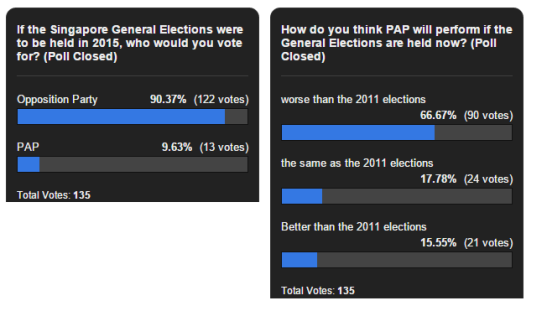
    Poll results

    I had carried out an online poll that attracted 135 persons to vote.  It is a small sample and hardly indicative of the actual voting pattern in the country.  My readers are, quite obviously, largely opposition voters.  So, the 90% vote in favour of the opposition is indicative of the profile of my readers rather than being indicative of how Singaporeans are likely to vote.  From the outset, I had no intention to find out about the level of support for PAP.  My little survey was motivated by a recent research finding released by Blackbox Research that indicated that 80% of Singaporeans felt that PAP would either perform better or the same as the last elections if elections are to be held now.  Blackbox went on to conclude that “the PAP are now in the box seat to improve on their 2011 election result”.

    I was a little skeptical about the conclusion.  My gut instinct is that there is a general perception right now that either PAP will perform better or the same as the last elections and this perception is largely a result of pessimism among individuals that would themselves vote for the opposition anyway.  Poll results that indicate that there is a perception as to how PAP will perform are not at all indicative of how those that were polled would themselves vote.  So, Blackbox Research’s findings are neither here nor there.  My conversations with friends (who are largely opposition voters) after the passing of LKY has provided me with anecdotal evidence that there is a high degree of pessimism in the opposition camp.  Three factors loom large in the assessment of many opposition voters:

    1.   LKY’s death and the propaganda overdose following that

    2.   SG50 celebrations and the feel good factor that is likely to be generated (with taxpayers footing the bill)

    3.   WP’s continuing legal troubles with Town Council management.

    It stands to reason that middle ground voters may veer back to the PAP (as it happened in 1997) or there may be a stalemate and we may not see any change between 2011 and 2015 in terms of the popular vote.

    Given the negative sentiments among opposition voters, it is quite inevitable that Blackbox Research’s findings indicate a low 20% stating that they thought PAP will perform worse than in 2011. My view is that their research should not be interpreted to indicate that there will in fact be a vote swing towards the PAP.  Blackbox didn’t ask the crucial question: “Who would you vote for?”

    If that question had been asked, we might have ended up with a result that indicates 35% to 40% stating that they would vote opposition and nevertheless 80% stating that PAP would perform better or the same.  The other problem with the Blackbox findings is that they don’t indicate the percentage that stated that PAP would perform better and those that stated that it would perform the same.

    My poll was done to show that there exists a deviation among opposition voters.  There are a significant number of opposition voters that would vote for opposition but are nevertheless pessimistic about the general outcome in the current elections.  Among the 135 that voted, 90% would have voted for the opposition but only 66% felt that PAP would do worse.  This strongly attests to the fact that even in my small sample of 122 opposition voters, there must have been a significant percentage that were pessimistic about the opposition’s chances in the coming elections.

    There is a percentage deviation of 23% between the actual votes by opposition voters and the perception of improvement in the opposition performance.  In the course of the two weeks that I kept the poll open, at various stages of voting I saw this voting-perception deviation fluctuate from a low of 15% to a high of 25%.  For the most part, the percentage was hovering between 20% to 25%.

    I wouldn’t be surprised if the findings of Blackbox Research are somewhat tainted by the fact that there exists this voting-perception deviation.  I suspect that it does exist at a national level.  So, whilst my small sample yielded a 23% deviation, at the national level this figure is bound to be different (higher or lower) but without data, it is impossible to arrive at any conclusion.  Blackbox didn’t ask the crucial question as to which party would those polled vote for.  All we have is a finding that indicates that only 20% think that PAP will do worse.  This does not mean that only 20% will vote for the opposition.  It indicates, merely, the existence of a certain degree of pessimism among those that would vote for the opposition.  It is not inconceivable that we might have had 40% of those polled intending to vote for the opposition with a large number of them feeling that PAP will perform the same or better (thereby contributing to the statistics provided by Blackbox).

    Another problem with the Blackbox Research findings is that they have conveniently failed to indicate the percentage of those that think that there will be no difference in the voting and those that think that PAP will do better.  I wouldn’t be surprised if the actual figures were along the following lines (speculating, of course):

    50% –  PAP will perform better

    30% –  PAP will perform the same

    20% –  PAP will perform worse

    We don’t know why Blackbox chose not to give a breakdown of the ‘better’ and ‘same’ categories.

    For Blackbox to make the assertion that PAP is in the box seat to improve on its performance in 2011 is a rather bold step.  Another research firm, BMI Research, whilst being generally positive on the outlook for the PAP, did not venture to assert that the vote share will improve.  “While it is difficult to ascertain whether or not the PAP’s vote share will fall again in the upcoming election, the party’s ability to form a strong majority in the parliament is virtually assured,”  Personally, I think that a general election this year is not going to threaten PAP’s majority in Parliament.  The only thing that we are really speculating about is the increase or decrease in their vote share.

    For those in the opposition camp that feel a little despondent after reading the Blackbox report, they should brush aside polls like these as they serve only to measure voter perception rather than how those voters would in fact vote.  There is bound to be a deviation between the two.  For those in the PAP camp, they would be well advised to avoid being too complacent.  Don’t underestimate the actual anger and dissatisfaction on the ground.


    Source: https://article14blog.wordpress.com

  • Is PAP Still Relevant Today?

    Is PAP Still Relevant Today?

    Dear Editors,

    Last time PAP members fought for Singaporeans’ rights. Dr. Tan Cheng Bock push for us to be able to use our CPF to fund higher education because it was good investment for the future. It was small things like that which cause us to improve our lives. Let’s think about it really.

    At that time, parents won’t be financially strained from university fees and the result of having a better educated workforce also helped boost Singapore’s knowledge-based transformation in that era. People are thankful and voted for Dr. Tan for 5 terms with average 77%. Now people are angry!
    Today, PAP has changed and now spend more than $240 million a year of taxpayer’s money on scholarships and tuition grants to foreign student. Locals have to suffer from the opportunity costs of a 2-year NS and they are burdened with loans long after graduation.

    Look at all these millionaire ministers who don’t even talk sense because they are too disconnected with the ground thanks to their million dollar salaries. How will they add value to the policy making processes as compared to those people in parliament in the 1980s who are so much more hands on?

    Some netizen said that opposition movement was censored by PAP and LKY so badly that no one had the balls to act as a check on their “20/20” lack of foresight. Even as PAP try to make changes after GE2011, BTO is still not affordable and country still have infrastructural strain like crowded MRT.

    PAP government and their supporters have also start to act arrogant and self-entitled. They have spoken on high grounds and as can be seen in their “words of wisdom” like Tin Pei Ling and Koh Poh Koon. If you are paying top dollar for such quality of people then it really becomes a cruel joke!

    Nicholas-Seth Leong who himself is no big deal degrade MRT commuters as “common people” and “peasants” just because he had to take the MRT. Later he was so embarrassed that he had to deactivate his FB after people found out that he drove and old Honda Civic anyway.

    It’s like choosing to work for a company which not only the bosses are incompetent, damn show off but also push all the work and blame to you, talk down on you all the time and then when things go well they enjoy the rewards themselves, receive high bonus while they don’t care about you at all!

    Why do we need such people? If PAP cannot improve our lives then maybe time to vote them out.

    Joseph
    A.S.S. Contributor


    Source: www.allsingaporestuff.com