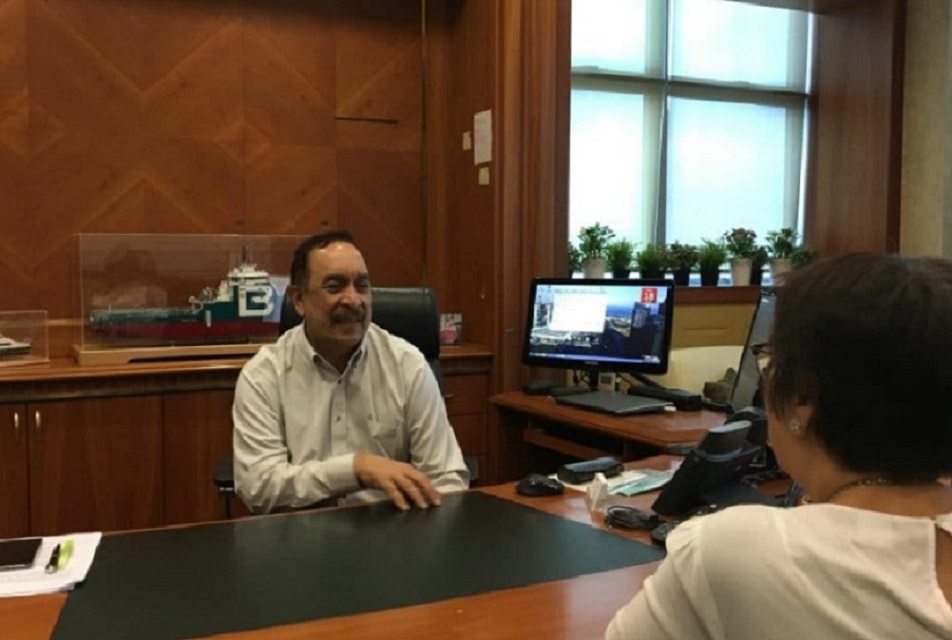
Like his rival contender, Mr Salleh Marican, Mr Farid Khan, 62, his is a rags-to-riches story that has made the rounds of media publications. He stopped school when he was 13 years-old to support his family. He worked his way through jobs like cleaning toilets, and cutting grass before ending up in the marine sector as a captain’s steward on a ship when he turned 21. Now, he’s chairman of a regional marine sector company with a shareholder’s equity of US$300 million (S$407 million).
Jokingly, I said that a scion of some billionaire family would do well to stay out of the presidential fray given the sterling background credentials of the two potential candidates. It is a story that he hopes would resonate with the populace – a poor boy made good who is now trying to serve his country. But why president? The answers came out readily: about being asked to serve, having reached the stage of life when he can put aside family and business cares, and deciding to heed the call of duty. A man, he said, had asked him if he was willing to die for his country. He said he would and the man retorted: “Then why are you afraid to serve?”
He laughs easily. He is a tall, strapping man who would dignify any room of people. He looks the part but can he play the part? Over an hour, we ranged over several issues.
His suitability as president
He laments that the private sector qualification threshold has been set so high. At $500 million shareholder equity, few companies would cross the bar. Even his French employer, Bourbon, which deals in offshore oil and gas marine services like freight and cargo, has only four times as much in shareholder equity at 1.2 billion euros last year. But he thinks his appointments in other companies would help raise the numbers. What else would he bring before the Presidential Elections Committee? He cited his international links. As the chairman of Bourbon Offshore Asia, he is used to talking business with foreigners.
He also stressed his non-partisan, independent stance. Clearly, he is no Establishment figure. He meets government officials only at business events, has never been to the Istana or even spoken to any previous presidents besides saying “hi’’ to the late President S R Nathan whom he bumped into while jogging in East Coast Park. He has no party political connections, not with the People’s Action Party nor the Workers’ Party, both of which were said to have courted Mr Salleh.
It led me to think about whether he knew enough of the workings of government to be able to talk to the Prime Minister and his Cabinet as equals. Several times, he bumped his fists together, saying that he was not in favour of a confrontational relationship. He saw himself as a representative of the people and that should be the chief consideration for any G executive who has to deal with him. He saw himself as mediator or adviser.
What would he do, for example, if he objects to the G’s choice of a key appointment holder? “I would approach a different way. If you want me to decide, give me three good names. And to the best of my judgement, I will make the decision. If I’m not sure, I ask my Council of Presidential Advisors (CPA).”
That is how business is usually done, he said. He would after all be advised by his CPA. Who are the three he would name to be part of the eight member council, we asked. He said it would depend on what sort of expertise was lacking in the council, which also has three members nominated by the Prime Minister, one by the Chief Justice, and one by the Chairman of the Public Service Commission. Thinking aloud, he thought a constitutional expert would be useful given his own inexperience in the area, “a good financial guy” with knowledge of global finance and someone very strong in social work.
We got into a tangle over the constitution.
Did he think the provisions on the presidency should be entrenched? He confessed that he was unclear about why the G was balking on this and it would be something to discuss if he was elected president.
He was also asked about the late President Ong Teng Cheong’s open squabble with the G on the extent of his powers in 1999. Mr Farid said the elected presidency was a new concept then. As a former PAP man, Mr Ong had to play a “completely independent” role as President, which was then “quite uncharted territory”. Personally Mr Farid thought the G felt “challenged” by Mr Ong’s approach. Maybe his approach was “right” at that point in time, but for himself Mr Farid would ask questions in a “little bit different way”.
As much as he is “is diligently going to watch the reserve”, it’s “quite difficult” if the G is asked for “each and every detail” he said. Instead, he would get input from the G and ask how a financial crisis for example can be managed, rather than for the detailed value of every asset.
He was on firmer ground on the subject of the reserves, ticking off on his fingers the number of times presidential assent has been sought and given. Like in Oct 2008 during the global financial crisis when former President S R Nathan approved a $150 billion guarantee on all bank deposits in Singapore to be backed by past reserves. It was not used. And three months later, when Mr Nathan gave the G approval to draw on $4.9 billion of reserves to fund the Jobs Credit Scheme and the initiative which helped certain companies have greater access to credit. In the end, $4 billion was drawn and the sum returned to the coffers by Feb 2011. He said his “confidence is high because of that”.
Given the G’s track record in financial management, he reckons the President’s “job is little bit easier” because he’s “sure there is a mechanism in place”. And that is what he wants to know more about: “the kind of mechanisms you have in place, rather than how much money you have inside the bank”, he said.
Role of president
At his maiden press conference on July 11, his comment that there was a “thin line’’ between what a President can do or not do had raised eyebrows. Asked to elaborate, he clarified that while the “the scope and responsibility of the president is quite clear”, it was easy to cross the line. Not that he had any intention of doing so. For him, it was a clear line. He would stay out of the business of government, but would advocate social issues, like strengthening the trust between different races and religions, help the needy and youth at risk, and strengthening families.
What about his statement that he would get involved in countering radicalisation of Muslims? Would this not be dipping his toes in controversial waters, given the range of Muslim thought and practice? “Not really. I’m more into the perception of Islam, on radicalism where not everybody is like that… make sure that other [communities] do not isolate them.” And this is not about protecting the Muslim community alone because radicalism affects all Singaporeans, he said.
As a Muslim, he follows the Shafi’i jurisprudence, which is the predominant school of thought in the Malay community, unlike Pakistan which generally follows the Hanafi school. He is active in Masjid Tentera Diraja at Clementi Road, next to the National University of Singapore (NUS), which has a youth-at-risk programme that he supports financially. Annually, about 70 to 80 youths are supported through the mosque. Whether it’s through providing them with positive role models or help with finding jobs, “somebody needs to be there, to hold their hand, bring them in”, said Mr Farid.
His multi-racial credentials
He was prepared for questions on a reserved presidency. He said that as a non-Chinese, he has to “thank the government” for ensuring minority representation in the highest office of the land. He was looking forward to a more crowded arena, so that the people can see that the community was throwing up enough qualified choices for them to pick from.
And he would have run even if this was an “open’’ election. Why not the last time? Because he was still building his company and raising a family with two children.
What about charges that he was trying to get into office through the back door? “In fact the bar has been raised much higher compared to PE2011. The only difference is that this time round it has been reserved for the Malay community. To convince the other races, that is the difficult part. I can see that. But if I’m independent, non-political, I care for all Singaporeans… you can see my team, it’s a mixture of a races.
“I always want to look at positive impact than negative. If the door is open, go down there, don’t throw stones from outside… Find out what exactly is the true intention. If the intention is minority representation, that is a noble thing.”
His chief asset on the multi-racial front is his work in Careers@Maritime programme at Mendaki SENSE which he started in mid-2013. He made clear that G-aligned or not, the platform “can reach a lot of people” at the grassroots level. So “take the politics out of it, and see how we can use the platform to benefit the people”. A year into the programme he lobbied for it to be opened to all races. His committee had members of various races who also reached out to the Chinese self-help group CDAC, Indian self-help group Sinda and The Eurasian Association.
Still, he acknowledges that “it will be tough” to campaign because he’s a “very private person” and “not many people know” him. Those who do, know him as a nice man, he said, a point he made several times. Which made us wonder how he would fare in the hurly-burly of an election campaign, however staid and sedate, and if he could stand up to personalities in the G if elected.
When we mentioned that it was like jumping from a private to a public swimming pool, he replied with a hearty laugh: “But I can swim ah, I’m a good swimmer.”
May things go swimmingly for Mr Farid.
Source: http://themiddleground.sg