Tag: haram

  • Grabhitch Driver With Pet Chihuahua Strikes Again

    Grabhitch Driver With Pet Chihuahua Strikes Again

    The next time you GRABCAR / GRABSHARE / GRABHITCH – please do becareful.

    Hi all. Wanna bring your attention to this – especially ladies. (PLEASE SHARE THIS)

    grabhitch-driver

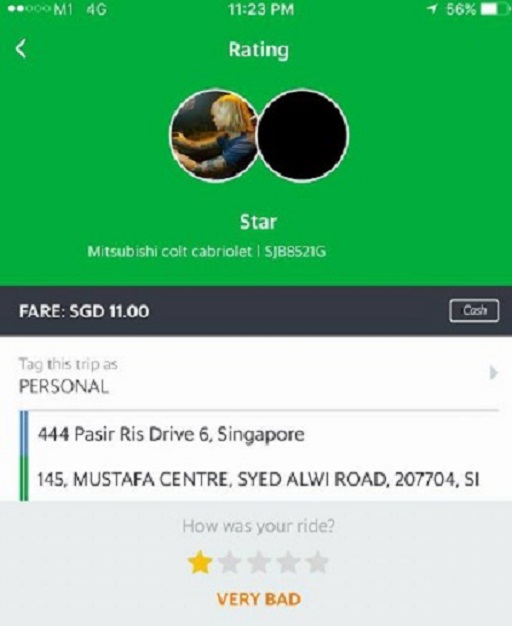
    My friend and i booked grabhitch yesterday (02/01/2017) at about 2250 hours from 444 PASIR RIS DRIVE 6 to MUSTAFA CENTRE. Awhile later, we got a driver. While waiting for the driver at the foot of the block, my friend received an incoming call from the driver directing us to go to level 2 of the carpark which was just right behind the block.

    Not thinking anything was amiss, we went. Upon reaching, we saw this blonde tatooed guy with a CHIHUAHUA barking aggresively – non-stop. He told us to quickly get in the car.

    As i recalled reading an article about an incident between a grab driver, his pet and his passenger, i told my friend to not board the car. We told him politely that i am not comfortable taking his car, with his aggresive barking chihuahua. We also said to him that he should inform us first if he is bringing a pet with him to check if we were comfortable with it or not.

    He then replied, “FUCK OFF, IF YOU ARE NOT COMFORTABLE THEN DON’T HITCH OR GRAB!!” We were both stunned. I told him that the only reason I am not comfortable with it was because his dog was barking aggressively throughout the 8 to 10 minutes we were there. We have the right to refuse the ride because he did not inform us that we will be grab hitching with a chihuahua. He asked us to get lost and made rude and sarcastic remarks.

    Not wanting to aggravate him further, we walked off. I called grab customer service and told her about the situation and she said that she will write a report about the driver.

    Definitely, the WORST driver with an ULTIMATE SHIT ATTITUDE ever.

    Driver Name: STAR
    Car: MITSUBISHI COLT CABRIOLET – SJB8521G


    Source: Danial Botak

  • Grain: Restoran Online Halal, Tawarkan Makanan Sihat

    Grain: Restoran Online Halal, Tawarkan Makanan Sihat

    BERITAMediacorp: Hasrat untuk mencipta pengalaman makanan yang menyeronokkan mendorong empat orang sahabat untuk membangunkan perniagaan restoran secara online, bernama Grain.

    Grain mendapat sijil halal sekitar dua bulan lalu (Sep 2016), setelah dua tahun dibuka.

    Perniagaan itu kini berwajah baru dengan khidmat laman web dan aplikasi mudah alih yang memudahkan pelanggan untuk menempah makanan yang sihat.

    Antara makanan sihat yang ditawarkan termasuk Ayam Kampung Segar Panggang (Grilled Farm Fresh Chicken), Ikan Salmon Norwegian (Norwegian Salmon) dan Labu Kayu Manis (Cinnamon Pumpkin).

    Usaha itu juga dimanfaatkan di tengah-tengah persaingan antara khidmat penghantaran makanan online lain di Singapura sekarang ini.

    PENGALAMAN MAKAN YANG MENYELURUH

    Ketua Pegawai Eksekutif (CEO) serta pengasas bersama Grain, Encik Yong Yi Sung, memberitahu bahawa syarikatnya ingin memberikan pengalaman makan yang menceriakan para pelanggan.

    “Pengalaman makan yang menyeronokkan adalah lebih daripada sekadar makanan. Kami menyertakan maklumat makanan, bahan-bahan dan nilai pemakanan bersama makanan yang ditempah. Dan, bagi pelanggan kali pertama, kami juga memberikan kad sambutan kepada mereka,” kata Encik Yong kepada BERITAMediacorp.

    “Kami menyediakan pengalaman pelanggan dari hujung ke hujung yang menyeluruh, dari memilih bahan-bahan hingga ke penghantaran makanan oleh kakitangan Grain sendiri,” tambahnya.

    Grain menawarkan pilihan makanan Asia, makanan sihat dan pencuci mulut. Ini termasuklah hidangan Nasi Ayam Samsui (Samsui Chicken Rice), Daging Thai dengan Daun Selasih (Thai Basil Beef) dan Salada Ayam Thai (Thai Chicken Salad).

    KOLABORASI BERSAMA RESTORAN HAJAH MAIMUNAH

    Grain turut bekerjasama dengan Restoran Hajah Maimunah sepanjang minggu lalu untuk menyediakan hidangan Rendang Daging Hjh Maimunah dengan Urap dan Nasi Perang Ubi Bit.

    Encik Yong memberitahu BERITAMediacorp: “Kami mencari rakan kongsi yang berkongsi falsafah yang sama iaitu untuk menawarkan makanan yang enak dan bermutu tinggi. Grain juga tidak menggunakan makanan yang dibekukan atau diproses.”

    “Hajah Maimunah menepati ciri itu dan kami sebulat suara memilih hidangan rendang daging untuk kolaborasi selama seminggu itu,” jelasnya.

    Grain menawarkan dua pilihan menu- menu tetap dan menu yang ditukar setiap minggu. Buat masa ini, syarikat itu hanya menyediakan hidangan dan khidmat hantar makanan untuk makan tengahari.

    KONSEP RESTORAN ‘CLOUD’

    Encik Yong turut mendedahkan bahawa keinginan mereka untuk membuka sebuah restoran online disebabkan harga sewa tanah yang semakin tinggi.

    “Membuka restoran secara online adalah pilihan lebih baik daripada di sebuah kawasan khusus kerana kami dapat berada di mana sahaja.

    “Malah, kami menggelar syarikat kami sebagai ‘restaurant on the cloud’ atau restoran dengan ruang simpanan online,” kata Encik Yong.

    MATLAMAT ‘RESTORAN TERBESAR TANPA KEDAI’

    Grain kini mempunyai sekitar 60 orang kakitangan termasuk 15 orang cef di dapur mereka yang terletak di Bangunan Makanan Tee Yih Jia.

    Menurut Encik Yong, mereka juga berharap dapat mencapai sasaran yang besar dalam masa lima tahun.

    “Persaingan di kalangan khidmat hantar makanan semakin sengit, tetapi kami bukan hanya menyediakan servis itu. Kami berbeza daripada khidmat tersebut.

    “Dalam masa lima tahun, kami berharap dapat menjadi restoran yang terbesar tanpa sebuah kedai yang fizikal,” katanya.

    Khidmat makanan Grain tersedia menerusi laman www.grain.com.sg atau aplikasi telefon bijak.

    Source: http://berita.mediacorp.sg

  • McDonald’s Malaysia: Only Halal-Certified Cakes Can Be Brought Into Our Restaurants

    McDonald’s Malaysia: Only Halal-Certified Cakes Can Be Brought Into Our Restaurants

    KUALA LUMPUR, Dec 29 — McDonald’s Malaysia today confirmed a policy restricting customers from bringing cakes that are not halal-certified into its restaurants.

    In a statement to Malay Mail Online, the fast food chain explained that the measure was necessary to safeguard its own halal status.

    Malay Mail Online had contacted the firm to verify a notice posted at one of its restaurants that said birthday cakes that are brought in must have an accompanying halal certification or logo.

    “This is in line with fulfilling requirements of our halal certification,” it said.

    The chain added that although it has a policy barring outside food and drinks in its premises, it made allowances for birthday cakes served at parties held at its restaurants.

    But it added that these must be demonstrably halal, either through certification or logo.

    “This condition is critical to preserve the integrity of our halal certification,” it added.

    The fast food giant said that it would continue to “strictly uphold” all standards regarding food quality, safety and halal so that all customers can enjoy their products with “peace of mind.”

    Halal certification is under the purview of the Department of Islamic Development Malaysia (Jakim).

    The prevalence of its certification as an indicator of a food item’s suitability for consumption is such that the absence of its logo regularly raises Muslim concerns about the item.


    Source: www.themalaymailonline.com

  • Bolehkah Orang Islam Mengucapkan ‘Merry Christmas’?

    Bolehkah Orang Islam Mengucapkan ‘Merry Christmas’?

    Adakah Haram Hukumnya mengucapkan Selamat Hari Natal/Christmas & Tahun Baru kerana ada dlm Hadith Nabi?

    “Barang Siapa yg Meniru, Mengucapkan Selamat kpd Agama Lain Bererti ia Telah Kafir & Neraka Janahamlah Tempatnya” (HR.Bukhari Muslim)

    sebarkan sebelum terlambat..

    Jawapan:

    Assalamualaikum.

    Hadis di atas PALSU, TIADA ASALNYA. Ia tidak wujud dalam Sahih al-Bukhari dan Muslim.

    Pereka hadis di atas sedang melakukan dosa yang sangat besar. Dia menipu menggunakan nama Rasulullah s.a.w, bahkan dia menipu menggunakan nama Imam Al Bukhari dan Muslim.

    Adapun hukum mengucapkan Merry Christmas, Dr Rozaimi berpegang ia terlarang kerana mempunyai unsur keredhaan kepada sambutan kuffar.

    Hanya boleh wish dengan ucapan yang tiada unsur tersebut.


    Source: Dr. Ustaz Rozaimi Ramle – Hadith

  • Pakistan Has A Drinking Problem

    Pakistan Has A Drinking Problem

    Pakistan was recently mesmerized by a bottle of Scotch whisky. On Oct. 30, as hundreds of supporters of the opposition party Pakistan Tehreek-e-Insaf (P.T.I.) were making their way to the capital Islamabad, with the declared intent of shutting down the city, the police searched the car of a P.T.I. politician and discovered a bottle of Johnny Walker Double Black.

    Most Pakistanis had not seen a bottle of whisky in the news in a long time. Although there’s no ban on showing alcohol in the media, the subject rarely comes up in TV news. But this one bottle of whisky, waved around by a policeman, was broadcast on a loop. It became an emblem of the opposition’s immorality.

    The politician claimed it contained honey. Yet later that evening, on a current affairs TV show, he put a sobering question to the other guests, “Which one of you doesn’t drink?” Complete silence.

    If they said yes, they’d be implicating themselves. If they said no, nobody would believe them. For Muslims in Pakistan, drinking alcohol is prohibited and talking about it is taboo. Drinking and denying it is the oldest cocktail in the country.

    It wasn’t always like this. The country was founded in 1947 by Mohammed Ali Jinnah, who was known to indulge in the occasional drink. Alcohol shops and bars were banned in 1977 by Prime Minister Zulfikar Ali Bhutto, a person who had publicly proclaimed, “Yes, I do drink alcohol, but at least I don’t drink the blood of the poor.”

    That year, facing protests over an allegedly rigged election that his party had won, Mr. Bhutto decided to declare prohibition. He probably believed that he and his comrades would continue to enjoy their Scotch in private. He was hanged two years later.

    Since those days, Pakistan’s rich have continued to enjoy their liquor at home and members’ clubs, but the less privileged have been persecuted and flogged, and are at risk of being imprisoned, for possessing and consuming alcohol.

    It’s true that most people in Pakistan don’t drink because they are Muslim. But many more don’t drink because they are Muslim and poor. Nobody abstains from drinking because it’s prohibited by law.

    When alcohol was banned by Mr. Bhutto, an exception was made for non-Muslims. They would be issued licenses and allotted a quota. Non-Muslim visiting foreigners would be able to order a drink in their hotel rooms, but the hotels would make them fill out a form saying they needed the alcohol for medicinal purposes.

    In the province of Sindh, where I live, licensed shops, usually called wine stores, have operated even since prohibition. The stores are supposed to sell only to non-Muslims, but they don’t discriminate. Owners have to pay off the police, though, and any dispute can result in the shops having to close down.

    The laws can be cruel and absurd. Last summer, the local police in Karachi banned liquor stores from keeping freezers, in order to stop consumers from buying a cold beer. Apparently chilled beer was a threat to our faith and to peace, but warm beer was just warm beer.

    In late October, a High Court judge ordered the closure of all these stores after accepting a petition that said alcohol is prohibited not only in Islam but in Christianity and Hinduism, too. This ban means that only those who can afford imported liquor will keep buying from a flourishing network of bootleggers.

    Others will have to buy one of the many versions of moonshine brewed all over the country, which routinely blind and kill consumers. Two years ago, when liquor stores were shut in Sindh over the Eid holiday, more than 25 people died after drinking home-brew. Survivors report that if the stuff doesn’t kill you or blind you, it isn’t that bad.

    Members of Parliament and law enforcers and industrialists and bureaucrats and young professionals and even some religious scholars can drink with impunity. A taxi driver trying to score a beer on the go risks a jail term or losing his eyesight to moonshine.

    It’s a law-and-order issue, you see. The rich drink in their own homes and frolic or puke on their own lawns, but the assumption is that if the poor get drunk in public spaces, they’ll make a nuisance. Which is why those who can afford fine scotches can also afford to give everyone else lectures about our religious duties. It seems that those who suck the blood of poor people want to make sure it’s not tainted with cheap alcohol.

    No wonder Pakistanis go to any lengths to ensure they’re not seen drinking, even when they smell like a barrel of liquor. I once had dinner with a 74-year-old grandfather who sipped from his spiked bottle of cola but worried that one of the children at the table would get their Pepsis mixed up with his.

    I’ve tried to interview my neighborhood liquor-shop owner, but he has discouraged me. There are enough problems in Pakistan, why don’t you write about them? But is this Bombay Sapphire knockoff you’re selling any good? How would I know? he said, I have never had a drop. Not even for medicinal purposes.

    Source: The New York Times