Tag: Islam

  • Bersatu Menghalang Musuh Islam

    Bersatu Menghalang Musuh Islam

    Umat Islam di Malaysia perlu bersatu dalam politik di belakang pemerintah bagi menghalang musuh Islam menghancurkan negara ini.

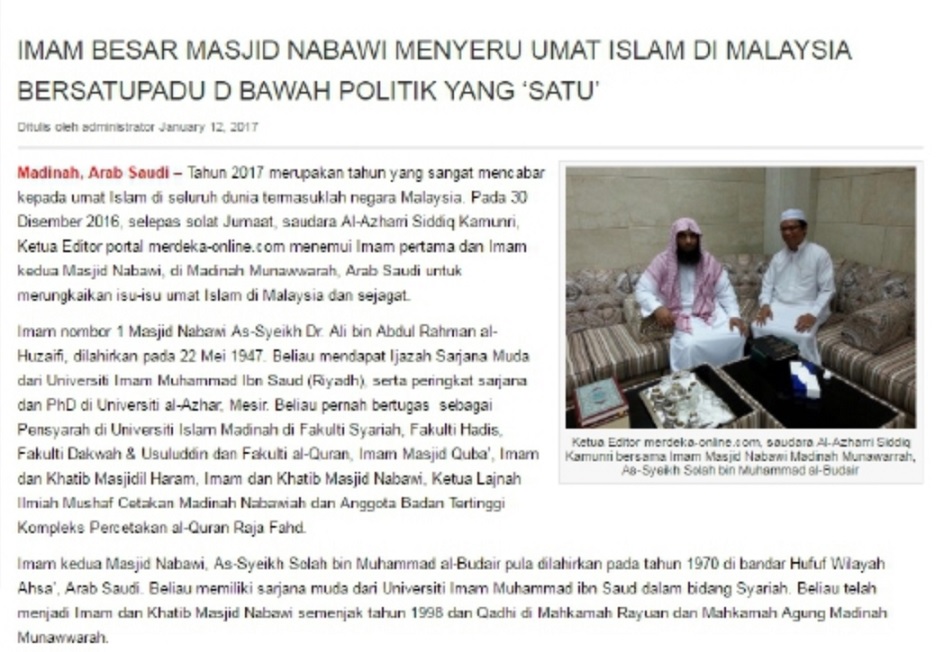
    Imam 1 Masjid Nabawi, As-Syeikh Dr Ali Abdul Rahman al-Huzaifi, dan Imam keduanya, As-Syeikh Solah Muhammad al-Budair, berkata demikian dalam temu bual bersama Ketua Editor portal merdeka-online.com, Al-Azharri Siddiq Kamunri, baru-baru ini.

    Kedua-dua imam itu berkata, jarum musuh Islam tidak dapat dilihat dengan mata kasar, namun akan bermaharajalela sebaik memerintah.

    “Ketika itu penyesalan sudah tidak berguna lagi. Lihatlah negara sunnah yang hancur seperti Iraq, Yaman dan Syria.

    “Umat Islam di Malaysia dinasihatkan jangan berpecah-belah disebabkan politik kerana ia adalah punca perpecahan dalam kalangan umat Islam dan merosakkan hubungan sehingga boleh bermusuh,” kata mereka dalam portal merdeka-online.com.

    Mereka berkata, Perdana Menteri, Datuk Seri Najib Razak tidak bimbang jika berada di pihak yang benar kerana Allah akan membantu kerja yang mulia.

    Katanya, Nabi sendiri diuji dengan fitnah dan musuh yang mahu membunuh.

    “Dalam pemerintahan, pemimpin dan Kerajaan Malaysia perlu istiqamah, bersabar dan bertawakal kepada Allah kerana musuh Islam tidak akan berhenti memfitnah sehingga pemimpin dan negara Islam dijatuhkan serta dihancurkan,” katanya.

    Mereka turut mengucapkan tahniah kepada kerajaan kerana mengharamkan Syiah di Malaysia.

    “Usaha membendung ajaran Syiah perlu diteruskan. Syiah adalah kumpulan jahat yang boleh menghancurkan negara,” katanya.

    Source: bharian

  • Paderi Agung Itali Jangka Eropah Bakal Jadi Benua Muslim

    Paderi Agung Itali Jangka Eropah Bakal Jadi Benua Muslim

    Itali pada masa akan datang akan menjadi salah sebuah negara Muslim. Kenyataan itu dikatakan Paderi Agung negara itu Monsignor Carlo Liberati.

    Menurut beliau, bukan saja Itali tetapi juga seluruh benua Eropah. Ini disebabkan banyaknya pendatang dari negara-negara Muslim yang masuk ke benua tersebut.

    Paderi Emeritus dari bandar Pompeii juga menyatakan perkara yang sama.

    “Dalam masa 10 tahun, kami akan menjadi Muslim kerana kebodohan kita sendiri. Itali dan Eropah hidup sebagai penyembah berhala dan atheis,” kata Paderi Emiritus ditukil Daily Mail pada Sabtu (14 Jan).

    Menurut beliau, jumlah orang yang mempunyai agama di Itali mengalami penurunan mendadak sejak para pendatang masuk ke benua Eropah.

    Itali menjadi tujuan utama 330,000 pendatang Muslim. Kebanyakan daripada mereka berasal dari Afrika, Timur Tengah dan Asia.

    Jumlah Muslim di Itali sekarang ini naik mendadak seramai 2 juta orang pada akhir tahun 2015, menurut data statistik rasmi Itali.

    Source: BeritaMediacorp

  • Islam Is A Woman-Friendly Religion

    Islam Is A Woman-Friendly Religion

    There is widespread Islamophobia in the world today and Islam, that literally means ‘peace’, is continually vilified. The religion has perhaps come under maximum criticism for its alleged mistreatment of women. However, Muslim women feel that Islam is at the forefront of gender justice and it has been misinterpreted by proponents of patriarchy to subjugate women over the ages.

    An equal Quran

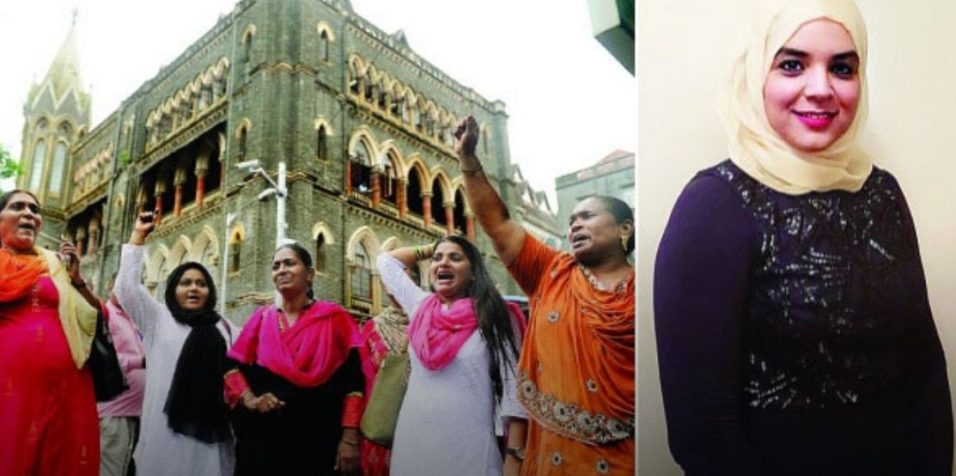
    Zakia Soman of the Bharatiya Muslim Mahila Andolan (BMMA) says, “The Holy Quran says man and woman are equal in the eyes of Allah and will be rewarded equally for their good deeds on the Day of Judgement. They will also be punished equally for their bad deeds.” Soman is the co-founder of BMMA that has been at the forefront of fighting for women’s rights and recently emerged victorious in securing for women the right to enter the sanctum sanctorum of the Haji Ali Dargah in Mumbai.

    She says Islam never discouraged women from gaining an education or working. “Prophet Muhammad’s first wife, Bibi Khadija, ran a multi-national business empire spread across Syria, North Africa and Arabia. His other wife, Aisha, was renowned for her knowledge of the law. She was a teacher and also played an important socio-political role by making public speeches, meeting representatives of different factions in a bid to secure consensus and keeping the community together after the Prophet’s death. How could that have been possible if women were considered inferior to men,” asks Soman.

    Hijab of liberation

    Sahar Suhail Deshmukh, who was born in Saudi Arabia, grew up in Canada, and now lives in England, agrees that Islam is misunderstood. She points out that modest dressing is prescribed for both men and women in Islam. Deshmukh who has been willingly wearing a hijab since she was 16 says she feels judged for following her religious beliefs. “People look at my hijab and feel I’m oppressed. They don’t understand how liberating it is to wear a hijab or even a burqa. I don’t have to worry about constantly adjusting my clothes so that nothing is showing when I bend or sit down. I don’t have to worry about distractions like styling my hair. My hijab sets me free and I feel more focused when I wear it,” explains Deshmukh.

    Islam empowers women

    “Islam was one of the first religions to officially encourage widow remarriage,” says Deshmukh, who insists Islam is a feminist religion. It empowers women by laying down the law with respect to women’s rights regarding property, marriage, divorce, wages and division of domestic responsibilities. “It is a well-documented fact that Prophet Muhammad shared domestic duties with his wives and advised husbands to do everything in their power to ease their wives’ burdens,” points out Deshmukh. She says Mehr is the best example of the feminist side of Islam. “It is a form of financial security for a woman in case of her husband’s death or if she is ousted from her marital home or any other kind of crisis,” explains Deshmukh.

    Misunderstood customs

    There are some outright misogynist practices such as Halala and Mutah. In Halala, if a couple gets second thoughts after divorce and they wish to reunite, the woman must first marry another man, consummate the marriage, get divorced and only then can she remarry her first husband. Soman informs that this was a custom that evolved without any sanction or mention in the Quran.

    Mutah, or temporary marriage, was a custom for soldiers who were away from their wives. Over time it has been misused and young girls have been forced into this form of temporary marriage. On practices such as triple talaq, Soman insists they were never prescribed in religious texts. “There is no Quranic sanction for triple talaq,” says Soman. She believes that clarity can be brought about by properly codifying Islamic Law and enacting reforms instead of establishing a single common law. Many people believe that UCC might erase Islam’s cultural identity including some of the woman-friendly Islamic laws.


    Source: DnaIndia

  • Warga Malaysia Dipulaukan Oleh Keluarga Selepas Beliau Memeluk Islam

    Warga Malaysia Dipulaukan Oleh Keluarga Selepas Beliau Memeluk Islam

    Seorang warga emas dari Kampung Keda Che Bema yang tinggal sebatang kara merayu bantuan untuk menampung kos sara hidup berikutan keadaan keadaan kesihatan yang semakin merosot.

    Abdul Rahman Abdullah, 57,  yang mengidap penyakit asma merasa cepat penat tinggal seorang diri sebuah rumah tiada bekalan elektrik dan air.

    Dia yang hanya bergantung kepada hasil menangkap ketam nipah tidak jauh dari tempat tinggalnya.

    Abdul Rahman berkata, dia hidup bersendirian dan disisihkan ahli keluarga sejak memeluk Islam pada tahun 1989.

    Katanya, dia mempunyai seorang kakak dan tiga adik perempuan yang kini bekerja sebagai peguam dan guru.

    Katanya, sebelum ini dia pernah bekerja sebagai pembantu kedai memproses ayam di Semeling tetapi akibat keadaan kesihatan bertambah teruk terpaksa berhenti dan kini mencari rezeki sendiri dengan menangkap ketam, demi sesuap nasi.

    “Pendapatan tidak menentu ini sukar untuk saya menyara hidup. Saya cuma ada satu motosikal buruk untuk berulang alik dari kampung ke tempat menangkap ketam.

    “Kadang kala, ketam yang ditangkap dijual tidak sampai RM10, ditolak duit membeli umpan dan kos minyak sebagainya, tak ada duit membeli makanan terpaksa mengharap belas ihsan jiran tetangga membantu,”katanya, ketika ditemui di rumahnya, kelmarin.

    Abdul Rahman atau nama sebelum Law Meng Thong berkata, oleh kerana tidak mampu membayar bil air dan elektrik, kedua-dua kemudahan itu dipotong sejak lima tahun lalu.

    “Setiap malam pula, saya  akan memasang lilin dan tadah air hujan untuk kegunaan harian.

    Bila tidak ada duit untuk membeli makanan, saya anggap hari itu saya berpuasa sahaja, saya bukan jenis suka ‘meminta’ sangat,”katanya.

    Sesiapa yang sudi membantu warga emas itu boleh menghubungi di talian 014-2664868.

    Semakan di Pejabat JKM Daerah Kuala Muda dan mendapati tiada sebarang rekod warga emas membuat permohonan sehingga kini.

    Sebelum ini, kisah hidup warga emas ini tersebar di Facebook yang dimuatnaik anak jiran agar nasib warga emas itu dibantu.


    Source: SINARHARIAN

  • What’s Missing In The Teaching Of Islam

    What’s Missing In The Teaching Of Islam

    There has been much misinformation about Islam. Reports in Western media tend to perpetuate stereotypes that Islam is a violent religion and Muslim women are oppressed. Popular films like “American Sniper” reduce places like Iraq to dusty war zones, devoid of any culture or history. Fears and anxiety manifest themselves in Islamophobic actions such as burning mosques or even attacking people physically.

    At the heart of such fear is ignorance. A December 2015 poll found that a majority of Americans (52 percent) do not understand Islam. In this same poll, 36 percent also said that they wanted to know more about the religion. Interestingly, those under 30 years were 46 percent more likely to have a favorable view of Islam.

    These statistics highlight an opportunity for educators. As a scholar of Islamic art and architecture, I am aware that for the past 20 years, educators have been trying to improve the teaching of Islam – both in high school and college history courses.

    The problem, however, is that the teaching of Islam has been limited to its religious practice. Its impact on the arts and culture, particularly in the United States, is seldom discussed.

    What teaching of Islam misses

    In high school history books, there is little mention of the intertwined histories of Europe, Asia and Africa in the middle ages and the Renaissance. There is even less mention of the flowering of art, literature and architecture during this time.

    In a world history textbook for New York public high schools, for example, the “Muslim World,” appears in the 10th chapter. In condensing a thousand years of history – from the seventh to the 17th century – it focuses only on “Arab armies” and the rise of early modern Muslim empires.

    Palatine Chapel borrowed from the art of the Fatimids.
    Al-dabra, CC BY-NC-ND

    Such narrow focus misses out on the cultural exchanges during this period. For example, in medieval Spain, the Troubadour poetsborrowed their lyrical beauty from Arabic. Arabic was the courtly language of southern Spain until the 15th century. Similarly, the 12th-century Palatine Chapel in Sicily was painted and gilded in the imperial style of the Fatimids, the rulers of Egypt between the 10th and 12th centuries.

    Such exchanges were common, thanks to the mobility of people as well as ideas.

    The point is that the story of Islam cannot be told without a deeper understanding of its cultural history: Even for early Muslim rulers, it was the Byzantine empire, the Roman empire and the Sassanian empire (the pre-Islamic Persian empire) that provided models. Such overlaps continued over the centuries, resulting in heterodox and cosmopolitan societies.

    The term “Middle East” – coined in the 19th century – fails to describe the complex social and cultural mosaic or religions that have existed in the region most closely associated with Islam – and continue to do so today.

    How the arts can explain important connections

    So, what should educators do to improve this literacy?

    From my perspective, a fuller picture could be painted if identities were not to be solely defined through religion. That is, educators could focus on the cross-cultural exchanges that occurred across boundaries through poets and artists, musicians and architects. Both in high school and university, the arts – visual, musical and literary – could illustrate the important connections between Islam and other world histories.

    For example, a class on the Renaissance could explain how the 15th-century Italian painter Gentile Bellini gained famed at the court of Mehmet II, the conqueror of Istanbul. Mehmet II commissioned Bellini to design an imperial portrait that was sent to rulers throughout Europe. His art presents a wonderful example of the artistic exchanges that took place between early modern cities such as Delhi, Istanbul, Venice and Amsterdam.

    It might also help students to know that the Dutch painter Rembrandt collected Mughal miniature paintings. Silks from the Safavid empire (the Iranian dynasty from the 16th to 18th century) were so popular that Polish kings had their coat of arms woven in Isfahan.

    This exchange of art continued into the Age of Enlightenment, a time when ideas around politics, philosophy, science and communications were rapidly being reoriented in Europe. A class on the Enlightenment may highlight the fact that writers like Montesquieuturned to the Middle East to structure a critique of their own religious institutions.

    Goethe found inspiration in Persian poetry.
    kaythaney, CC BY-NC

    A poetry class could similarly show connections between the German author Wolfgang von Goethe’s writings and Islam, as exemplified in his “West-Eastern Diwaan,” a collection of poems. This epitome of world literature was modeled after classical Persian poetry in its style, and inspired by Sufism, the mystical tradition in Islam.

    Most students are open to seeing these connections, even if it might require overcoming their own preconceptions about Islam. For example, when I teach my class on medieval architecture, students are surprised to learn that the two oldest continuously run universities in the world are in North Africa (in Fez – a city in Morocco – and Cairo).

    Indeed, it is not easy to disentangle contemporary politics from historical fact, to teach more fully the culture and diversity of a religion that is almost 2,000 years old.

    Perhaps educators could learn from a recent exhibition at the Metropolitan Museum of Art in New York titled “Jerusalem 1000-1400: Every People Under Heaven.” The show illustrates how Abrahamic religions – that is, Christianity, Judaism and Islam – borrowed freely from each other in the realm of art, music and literature. Jerusalem was home to diverse populations and the arts played an important role within its religious and political life.

    Muslims in America

    It’s not in the past alone. We see these connections continue today – here in America, where Islam is an intrinsic part of the culture and has been for centuries.

    From the Mississippi delta to the Chicago skyline, Muslims have made contributions, which might not be so obvious: West African slaves in the South were central to the development of the blues. Its complex vocalization and rhythms incorporated the rituals of Islamic devotion many of them had to leave behind.

    The same is true of architecture. A quintessential example of modern American architecture is the Sears Tower in Chicago, which was designed by the Bangladeshi-American structural engineer Fazlur Rahman Khan.

    Muslim contributions to art and architecture don’t just reflect the diversity of America, but the diversity of Islam in this country. Muslims in America comprise a rich tapestry of ethnicities, languages and cultures. This knowledge is particularly meaningful for young Muslim Americans, who struggle to claim their place in a country in which they are sometimes made to feel like outsiders.

    Educators, especially within the arts and humanities, have an important role to play in this religious literacy, that helps students understand the unity in the diversity. After all, as the most popular poet in America, the 13th-century Muslim mystic Rumi wrote:

    All religions, all this singing, one song.
    The differences are just illusion and vanity.


    Source: huffingtonpost

deneme bonusu