Tag: Islam

  • Zayed Talib: Singaporean Muslims Are Well-Integrated And Rational, Cannot Buy Into Idea Of Importing Saudi-Brand Of Islam Wholesale Into Singapore

    Zayed Talib: Singaporean Muslims Are Well-Integrated And Rational, Cannot Buy Into Idea Of Importing Saudi-Brand Of Islam Wholesale Into Singapore

    Muslims Here Growig More Distant

    The above is what most Singaporeans woke up to on 20 Jan 2016 in this article here.

    I am a Singaporean Muslim and my family have been in Singapore since the late 1800s. (Yes, Singapore was built from the ground up by Arabs, Malays, Europeans, Persians, Jews, etc. – not just the current majority Chinese) We helped build this country to what it was and still is – an outpost of rational modernity where people from all corners of the world can come to work on their business, freely practice their faith and build a home together that we could be proud of.

    I would first like to address the headline of this Article. The TODAY Newspaper – with this one headline – has in my eyes reduced its integrity as a newspaper to that of a tabloid the likes of The New Paper. When its copies are given out for free it means its value is less than the paper its printed on. At the very least, The  New Paper has to be bought.

    Why do I say this? The writer SIAU MING EN who can be contacted here, has decided to sensationalise the speech. Now I know for a fact the Editor may also have a role to play in this so i reserve judgement on being solely the fault of the writer. This writer took it upon himself to write an article that effectively misrepresents the Minister’s words and alienate the local Muslim population at one go – how efficiently stupid.

    When our country is facing a rising tide of intolerance from many faiths – the TODAY newspaper felt that selling more newspapers was more important that communicating as effectively and calmly as possible an issue that is inherently sensitive.

    It in fact hid is the sub-header the following line

    image

    This tells me, as a graduate in Mass Communication, that the article was MEANT to inflame and outrage and therefore receive more attention – a tactic only used by the basest of journalists.

    The TODAY newspaper, by allowing this article to be published, is effectively nothing more than a money chasing fear-mongerer.

    Now I would like to pursue the text of what was ascribed to Minister Shanmugam. According to the article:

    A sentiment among some younger Muslims that sending greetings to friends on other religious festivals or reciting the National Pledge and serving National Service are at odds with their faith.

    I am supposing that the Minister Shanmugam has access to data that we are not exposed to but once again the writer has chosen not to furnish or pursue such details. This communicates that whatever the Minister said is true – something we as Muslims in Singapore recognise to be wrong. So I issue this challenge to both the Minister Shanmugam and Siau Ming En to furnish the data behind how much exactly of this rising tendency exists and what part of the Muslim population truly are at comfort with living together with peoples of other faiths.

    The article also highlights portions of the speech –

    …a developing trend is being watched with concern by the Government: A sentiment among some younger Muslims that sending greetings to friends on other religious festivals or reciting the National Pledge and serving National Service are at odds with their faith.

    As religiosity sweeps the world, the Muslim population here is also growing “somewhat more distant” from the rest of the community, partly due to influences from the Middle East. Some people also feel that the democratic elected governance system here is “incompatible with Islam” and Singapore should be part of a caliphate, he added.

    “These are worrying trends, and if these sentiments become widespread, the Muslim community that grows apart from the mainstream is not good for the Muslim community and not good for Singapore, with serious long-term implications,” said Mr Shanmugam.

    As a Muslim, I see far more Muslims sending greetings to friends to other faiths than not. In fact – the majority of Muslims here laugh at those who insist on not sending greetings because of a misplaced ideal of religiosity. It is ridiculous because it isn’t who we are as a people. In fact we welcome the opportunity to engage with our non-Muslim neighbours as evident in the picture below:
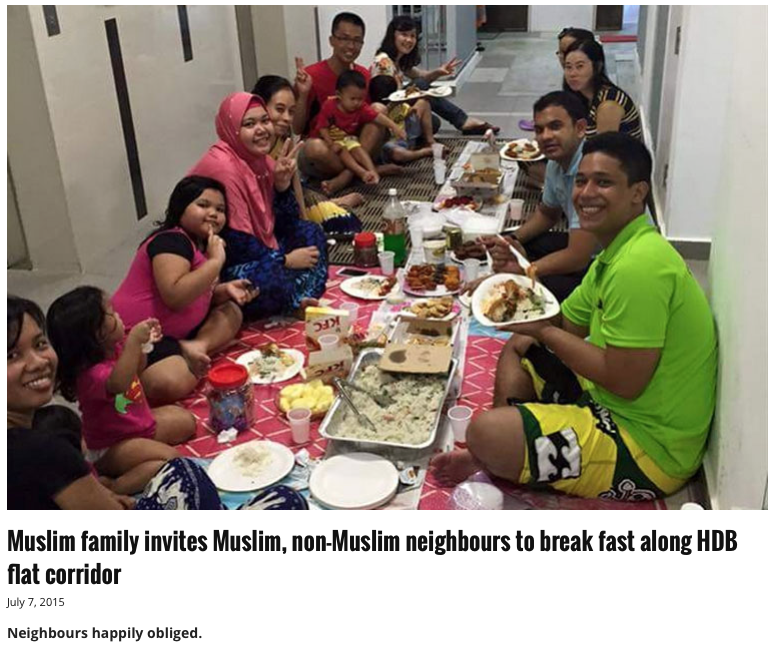
    The article on this actual overwhelmingly neighbourly behaviour of Singaporean Muslims can be found here.

    With regards to the Muslim population here being influenced by Middle Eastern influences – I must agree to this statement. Religion whether in the Middle East or any other part of the world – is still the same religion. The only difference is cultural influences. For example, there is a rising trend of believing what works in Saudi Arabia should work in Singapore. This idea is empirically false. The geo-politics, history and cultural nuances between the Middle East and South East Asia couldn’t be more apart from each other. On this respect – I find it amusing that Muslims in Singapore are increasingly seen to ditch their own culture, even their cultural dress in order to dress themselves like Middle Easterners so as to be more religious. The idea that your cultural dress influences your piety is a laughable construct. For this – the Muslims in Singapore are wrong.

    The article, only after pointing out the Muslims as examples of growing intolerance, goes on to say that the current model for Muslims in Singapore is a successful one and that we should cherish it. In media, we understand what is referred to as attention span. The average reader doesn’t read beyond the fourth paragraph. In this respect anything positive about our Muslim population only appeared after 5th paragraph.

    Why are the above points on how the article was written a great disservice to Singapore? The immediate impact was the Muslims taking a defensive posture, demanding data and statistics to back up the statements in the article. This puts the Minister who is in charge into a difficult position because it doesn’t clearly portray his stand on the issue. It also pits non-Muslims and Muslims at odds into a game of finger-pointing. It makes talking more difficult and accusing far easier.

    Ultimately it points out the the Today newspaper is more interested in sensationalising news than taking into consideration what impacts how and what they publish might have on the social fabric of our country.

    To Muslims I say this – stop being the victim. You are not. Stand up and be counted amongst those who value life and peace. To the non-Muslims I say this – before easily drawing the lines in the sand consider that there is more to be had without doing so.


    Source: http://zayedtalib.tumblr.com/

  • A True Malay Love Story – My Family Finally Accepted My Ex-Convict Boyfriend I Met Through Tagged

    A True Malay Love Story – My Family Finally Accepted My Ex-Convict Boyfriend I Met Through Tagged

    Nurul Ain’s family did not approve of her relationship with her then-boyfriend Hermanto, but they showed them that their love can conquer it all.

    She shared the story of how they met and got married for Stomp’s love story contest:

    “It all started when I just had a bad day at work, posting all the unnecessary shoutout on Tagged

    “Yes!! Tagged… a website where most of us have it and always think that girls/guys in Tagged are useless… but nevertheless, ‘HE’ private messaged me and tried to cool me down, he gave me words full of encouragement, and he melted me!!:)

    “We talked all day and night, and when it was time, we arranged a day to meet up.

    “It all went well and he told me everything! yes… everything!! From ex-convict to divorce and his family background,so did I.

    “I was scared he might not want to contact me after all that we have shared, but I was wrong:)

    “We got closer and closer! 🙂 We went through so many ups and downs.

    “Financial was the worse situation. He had no shelter at that point of time (due to some miscommunication and family hatred).

    “To cut the story short, on Dec 2014 he was sentenced to 8 months in prison, and I had to go through HELL!!

    “Because we weren’t married yet but we already have a rental house and I’m unemployed, I have to struggle to look for financial assistance. But at last I managed,and also found a job!!

    “I visited him on my every day off @ AWP, until one day I was admitted due to too much stress and dehydration.

    “Yet I pulled through… Well,my family still disapproves my marriage with him cause of his background.

    “But after all, people make mistakes and they still deserve a second chance to stand up and be happy! YES I waited for him until the day when he was released.

    “I made up my mind that I wanted to stay with him and ignore all those nagging and negative responses.

    “We were so happy until my parent want to see us. YES we did, and ALLAH listened to my prayer, WE WERE GETTING MARRIED!

    “It’s not easy though, we have been through a lot (some are not stated).

    “130615 is the day we were legally husband and wife, and thank god, with all those guidance, my family has accepted him and we are happy now!!:)”


    Source: http://singaporeseen.stomp.com.sg

  • I Don’t Wish My Hindu Neighbour Happy Deepavali But We Get Along Very Well

    I Don’t Wish My Hindu Neighbour Happy Deepavali But We Get Along Very Well

    Saya berjiran dengan keluarga berbangsa india berugama hindu untuk hampir 15 tahun. Kami saling menghormati dan menyayangi walaupun saya tidak pernah mengucapkan happy deepavali kepada mereka.

    Malahan semasa memakai kain ihram untuk berangkat menunaikan haji beberapa tahun lalu, jiran hindu ini menawarkan untuk hantar saya ke airport. dia sempat kata, kain ihram yang saya pakai seumpama kain yang dia pakai untuk upacara keugamaan hariannya.

    I am neighbours with an Indian-Hindu family for about 15 years. We respect and appreciate each other even though I never wish them Happy Deepavali.

    In fact when I was wearing the ihram before heading for the haj a few months ago, this Hindu neighbour offered to send me to the airport. He even said that the ihram that i was wearing is similar to the cloth he uses for during his Hindu events.


    Source:  Abdullah Othman

  • Mizi Wahid: Respect And Tolerance Is Important Whichever Mazhab You Follow

    Mizi Wahid: Respect And Tolerance Is Important Whichever Mazhab You Follow

    I majored in Islamic Law for my degree. And one of the things we learned about was on Mazhabs (which essentially refers to Schools of Thought). My biggest takeaway from it was not of obsession towards one particular school of thought, or even the rejection of all.

    Instead, the most profound lesson I gained, was from appreciating the beautiful character of the scholars who were the “founders” of their Mazhab.

    Their individual opinions differed. Their reasonings weren’t the same. And the criteria used for the process of deriving rulings and arriving to conclusions were varied.

    But some things stood out amidst the differences. Respect. Tolerance. Mercy. Objectiveness. And humility.

    Were there disagreements? Yes. But there were also compliments. Were there conflicting ideologies? Yes. But there were no expectations to appease.

    For those who know me well enough will tell you, that I’m not the kind of person who likes to keep lessons confined to one discipline (and you may be too). First, I’ll try to see where else in the world am I seeing something similar taking place. And secondly, how these lessons can be applied in other parts of my life.

    What I’ve discovered is that in every area of our work and relationships, there are Mazhabs.

    When young parents believe in raising their own children a certain way, while their parents or in-laws believe in doing it differently. After all, “You ended up OK today.”

    When nursing mothers who believe in doing things 100% natural, disagree with those who are a bit more flexible – things can get pretty nasty. My wife has shown me some of the “discussions” in some group pages. Imposing views – is an understatement.

    When you find it uncomfortable seeing others posting photos or updates about personal religious practices, but you are fine posting updates about your new bag, new car, new house, your voluntary work, or an unplanned good deed that you did today. Mazhabs.

    When certain entrepreneurs believe strongly in working long hours and over the weekends, while others believe in the chill-by-the-beach concept – again, just different Mazhabs. Those who hustle feel alive when they do. While the other group simply believes that their businesses should be giving them more life, instead of draining it all away.

    So, in politics you see Mazhabs. In leadership you see Mazhabs. In school you see Mazhabs. In healing and medication you see Mazhabs. The list goes on and on.

    I must add that scholars of Mazhabs respect and acknowledge their peers because they know that the opinions are based on sound research, a trusted process, and the integrity of the individuals. I just hope that respect, mercy, tolerance, and humility will prevail in the end.

    ps/ for those who don’t subscribe to a particular school of thought, Lo and Behold! That is also a Mazhab

    ‪#‎whatsyourmazhab‬


    Source: Mizi Wahid

  • Zulfikar Shariff: Remember The Malay Regiment?

    Zulfikar Shariff: Remember The Malay Regiment?

    The Malay Regiment was established in 1933 as “a body of Malay
    troops who would share the responsibility of military defence and protection of their homeland”.

    The British were initially hesitant to train the Malays since they were known to be warlike and were fighters.

    They felt the problem was “not to get the Malays to fight (at which they had shown themselves only too ready) but to prevent them from fighting.”

    Johor established a Malay Regiment in 1885 and its success was used as proof of the efficacy of the project.

    The first batch of 25 soldiers from Malaya were selected from 1,000 applicants. This ensured a very high standard of recruits.

    During the Japanese invasion of Singapura, the Malay Regiment fought with their heart and their blood to defend the island.

    In the words of General Percival, the Malay Regiment “acquitted themselves in a way which bore comparison with the very best troops in Malaya.

    In particular, by their stubborn defence of the Pasir Panjang Ridge at the height of the Battle of Singapore, they set an example of steadfastness and endurance which will become a great tradition in the Regiment and an inspiration for future generations.”

    On “the morning of the 14th again saw enemy shells falling steadily on the Malay Regiment area and casualties mounted.”

    After heavy fighting, including some hand to hand combat, the Japanese army tried to trick the Malay Regiment by dressing like Punjabi soldiers.

    But the Malays quickly realised the trick and gunned down the enemy “at close range (which) left about 22 (Japanese) lying on the ground dead or wounded.

    The ruse having failed, the Japanese staged a determined attack about two hours later in overwhelming strength. Although the defenders fought bitterly with grenades and automatic weapons they were unable to hold the hill.”

    “Lt. Adnan, commander of Platoon No. 7,… encouraged his men. Mortally wounded he ordered his men to fight on to the last man.”

    Many of the men and all the officers (except Second-Lieutenant Abbas) died in the close and at times hand-to-hand fighting which developed. A number of the captured survivors were massacred by the Japanese.

    Lt. Adnan who, along with his brother officers, fought gallantly in this action was shot down and bayoneted by the enemy.

    His body was then hung upside down from a nearby tree; no one was allowed to cut it down for burial.”

    British “surrender did not mean the end of casualties to the Regiment.

    Within a fortnight five Malay officer-internees of the Regiment were summarily executed for refusing to serve under the Japanese or, alternatively, to put on civilian clothes and accept release.

    Most officers and men who escaped internment at Singapore were arrested on their return home during the year and imprisoned for a while.

    A number of the other ranks were pressed into forced labour gangs and sent to work as far afield as Siam and Indonesia.

    The majority were released from prison camps in Singapore at different dates in March when all up-country evacuees in Singapore were ordered to return home.

    Several of them in a party of 98 Malay personnel serving with the Imperial forces were removed by the Japanese military police and machine-gunned near the Gap.”

    Reference:

    Ramli, Dol. “History of the Malay Regiment 1933-1942.” Journal of the Malaysian Branch of the Royal Asiatic Society (1965): 199-243.

    Picture: NCOs and Men of The Malay Regiment 27th May 1941.


    Source: Zulfikar Shariff

deneme bonusu