Tag: Islam

  • Aaron Aziz Bidas Erwin Shah Dawson

    Aaron Aziz Bidas Erwin Shah Dawson

    KUALA LUMPUR : Pelakon dan pengarah dari Singapura, Aaron Aziz, membidas pelakon baharu senegaranya, Erwin Dawson, 26, berikutan kenyatan beliau mengenai Islam.

    Erwin menerusi sebuah portal tempatan menyatakan beliau boleh mengamalkan ajaran Islam secara bebas di Malaysia berbanding di negara asalnya.

    Tegas Aaron, kenyataan yang dibuat oleh Erwin itu kurang matang dan boleh mendatangkan pelbagai persepsi negatif terhadap umat Islam di Singapura.

    “Sebagai seorang yang lebih ‘senior’ saya menasihatkan kepada awak supaya lebih berhati-hati sebelum mengeluarkan sebarang kenyataan kepada pihak media.

    “Kenyataan yang dibuat boleh membuatkan orang ramai lebih menyampah dengan artis Singapura, sekali gus membuatkan orang ramai bergaduh, mencaci dan mengutuk sesama sendiri di laman sosial,” tulis Aaron menerusi status Instagramnya.

    Selang beberapa minit kemudian, Erwin pula memuat naik kenyataan balas, yang menganggap cara Aaron menegurnya sebagai kurang sesuai. “Anda lebih ‘senior’ dan seharusnya lebih tahu cara baik untuk menegur saya.

    Bukan dengan cara memuat naik di laman sosial yang boleh mendatangkan banyak masalah.

    “Namun, jika saya salah, maafkan saya kerana sebagai pendatang baharu. Lebih banyak yang perlu saya belajar,” tulis Erwin.

    Erwin atau nama sebenarnya Erwin Shah Dawson mula membina nama di Malaysia menerusi drama bersiri Dunia Generasi Baru dan Bencinta.

    Source: www.bharian.com.my

  • Bishan-Toa Payoh Town Council Wanted To Disrupt Water Supple On Eve Of Hari Raya

    Bishan-Toa Payoh Town Council Wanted To Disrupt Water Supple On Eve Of Hari Raya

    A reader Siti Saad residing in Block 136 Bishan Street 12 got a rude shock when she received a mailer from Bishan-Toa Payoh Town Council that informed residents there will be disruption of water supply on 16 July 2015 between 9 am to 5.30 PM for works to replace water pipes.

    Ms Siti Saad believe this is insensitive of Bishan Toa Payoh Town Council as the date of disruption falls on the eve of Hari Raya when Muslims Singaporeans will be making preparations for the festive season.

    She urged the town council to reconsider the choice or date and remarked if this will happen during “Chinese New Year” or Christmas and ended her comment with hashtags #marginalizedmalays #sg50.

    Fortunately, the MP in her area Mr Wong Kang Seng was informed of the incident and promptly took remedy actions. He subsequently notified her that the replacement works will be carried out at a later date.

    Prior to the reply from Mr Wong, unhappy Singaporeans gave their opinions and assumptions of the incident.

    Do you think Bishan Toa Payoh town council could have done better?

    Source: www.allsingaporestuff.com

  • Mohd Khair: Pinkdot Agendas Undermine Familial And Social Fabric Of Singapore

    Mohd Khair: Pinkdot Agendas Undermine Familial And Social Fabric Of Singapore

    Talking about intolerance, we Singaporeans have been a very tolerant society.

    When a Muslim goes to a non-halal eatery and ask for halal food but none could be served by the eatery, we don’t see Muslims in Singapore suing the owner of the eatery for any form of distress caused by the rejection of the request. In fact, there’s no distress whatsoever.

    Likewise, when a non-Muslim goes to a halal eatery and ask for pork or liquor to be served, we don’t see non-Muslims in Singapore suing the Muslim owner of the eatery for any form of distress caused by the rejection of the request. And really there’s no distress at all.

    Why?

    Because we respect each other’s beliefs and value systems.

    Alcohol drinkers don’t go around suing Muslims just because the latter believe and say that drinking alcohol is wrong based on their religious belief.

    Likewise, we don’t find Muslims in Singapore suing others who say that polygamy is wrong. We don’t. We simply don’t find that in Singapore.

    Why?

    Because this is Singapore, and we are Singaporeans who are very tolerant to different beliefs so long as they do not tear down our basic familial and social fabric. But the moment anyone or any activism is going all out to undermine that familial and social fabric, we Singaporeans will stand up and unite together to defend it at all costs. Defending that familial and social fabric that have been the bedrock of Singapore’s development and progress all these years cannot be deemed as intolerance, cannot be defined as bigotry and cannot be accused of propagating hate speech.

    Instead, those labels should be directed at those who undermine that familial and social fabric that we Singaporeans cherish and protect.

    Why?

    Because they are the ones that are intolerant. Any form of disagreement will be immediately labelled as bigotry and accused of propagating hate. And that is happening now even with the 377A still around. It is not hard to imagine the kind of absolute intolerance we can face if 377A is abolished from the Penal Code.

    How come?

    Well, just look at what is happening right now in the US. Refusing to bake a wedding cake for a gay marriage results in a legal suit. Refusing to solemnise gay marriages is now a crime. And yet lgbt activists here claim that legalising same-sex marriages will not affect anyone at all. It is instead absolutely clear from that legalising same-sex marriage will result in the absolute intolerance on the part of the lgbt activists. The slightest disagreement with them will result in lawsuits or even being charged in court for alleged crimes.

    So, to those lgbt activists and sympathisers, don’t go round saying that we are intolerant as a society in Singapore. Singaporeans have been and will continue to be tolerant so long as the familial and social fabric are not threatened. Once threatened, we will defend it. PERIOD.

    And Singaporeans are neither stupid nor illiterate. We know what the lgbt activism has done to other parts of the world once same-sex marriage is legalised.

    Same-sex marriage has become the demon that is out to destroy the institution of marriage and family in those countries. If ever 377A is abolished and same-sex marriage is legalised in Singapore, the same level of intolerance or more will also set foot. SSM will then be used to knock out anyone, any organisation, any religion and any law (including AMLA – Administration of Muslim Law Act) that is against same-sex marriage.

    So, don’t ever say that pinkdot is an innocent movement just for a group of lgbts and their supporters to celebrate diversity and the freedom to love. Pinkdot is a political movement that is intolerant of the familial and social values so dearly upheld by Singaporeans all these while. These are the very familial and social values that have seen us through the ups and downs of Singapore’s development and progress. Pinkdot wants us to abolish Section 377A and legalise same-sex marriage. And should that be allowed to happen, the pinkdot will transform itself into a demon that will be so intolerant to any form of disagreement to same-sex marriages and to its lifestyle choice of freedom to love anyone and anything at all.

    And by the way, Singaporeans have long been tolerant of lgbts living in our midst. They live, work and play together with all of us for as long as we can remember. The Government also acknowledges that they are in almost every sector of the economy, including the public sector and public service. And for the record too, no lgbts have been persecuted in Singapore by the Courts just because of them being lgbts. But the lgbt activism at the level we are seeing right now, especially in the form of pinkdot, is a recent phenomenon fuelled by external parties, and has now become brazen and emboldened with the recent US Supreme Court ruling. We Singaporeans have been a tolerant society all these while. The very existence of pinkdot now in our midst is testimony to that. But that does not negate our right to say that it is wrong and that we are against pinkdot in Singapore.

    And why are we against pinkdot in Singapore?

    Because pinkdot is pushing for the repeal of Section 377A and the legalisation of same-sex marriage. These two pinkdot agendas will undermine the very familial and social fabric that Singapore has been based on in its years of development and progress. And if we can sum up what PM Lee Hsien Loong has said in recent weeks, it would be this: The society in Singapore is deeply religious. The social sphere has developed taking into account the religious and ethnic beliefs of the multireligious and multiracial societies found in Singapore. So don’t push it.


    Mohd Khair

    Source: We Are Against Pink Dot

  • HPB Steps Up Effort To Promote Healthy Lifestyle Among Malay Community

    HPB Steps Up Effort To Promote Healthy Lifestyle Among Malay Community

    When the National Disease Registry (NDR) reported in December last year stating that Malays are the unhealthiest in Singapore, it drew a backlash from some people in the community.

    “If a certain issue is indeed worrying and needs immediate attention/solution, why would identifying a certain enthic/community make any difference?” said  Facebook user Zulkifli Yusof.

    According to the NDR report, Malays are more likely to suffer from a stroke, undergo kidney transplants or go through dialysis.

    On Thursday, the Health Promotion Board announced nation-wide efforts stepped up to promote healthy lifestyle, with tailored programmes for the Malay community.

    These programmes consist of establishing health-promoted madrasahs, running the Ramadan “I Quit” smoking cessation campaign, distributing health calendars – consisting of healthy recipes and tips – to Malay families and organising healthy living programmes at mosques.

    During a visit to Al-Ma’arif Al-Islamiyah, one of the participating madrasahs, on Thursday, Associate Professor Muhammad Faishal Ibrahim and parliamentary secretary for the Ministry of Health responded to the reactions.

    He said he has seen positive response on the programmes from madrasah teachers, students and people who go to mosques.

    “The fact that they feel for it means that they are quite committed to their healthy habits and lifestyle.”

    “I feel that those among the (Malay) community who have embraced it (healthy living) are doing their best to eat healthily.”

    There are currently three madrasahs actively promoting healthy living in Singapore: Al Ma’arif Al-Islamiyah, Irsyad Zuhri Al-Islamiyah and Wak Tanjung Al-Islamiyah. HPB plans to extend the initiative to three more.

    These madrasahs now have health programmes permanently fitted into their school curriculum; some of these include health workshops and a student health ambassador-training programme. There are a total of 107 student health ambassadors across the three madrasahs, and their roles include leading health workshops.

    These health workshops are designed to educate students on being mentally and physically healthy. Student ambassadors will hold talks sharing tips on maintaining a balanced diet, healthy stress levels and good self-esteem.

    Faishal said that he is happy with the progress of the programmes, noting that at least 1,800 madrasah students have benefited from them.

    The principal of Al-Ma’arif Al-Islamiyah, Sukarti Asmoin, 61, welcomes the new initiatives as part of the school curriculum. Speaking in Malay, she says she feels that it is important to keep the students healthy so that they will not fall sick.

    It is also encouraged in the religion to maintain good health, which is linked to having a healthy mind, she added.

    The school has also changed the food served in the school. For example, the canteen vendors are only allowed to sell fried foods on Tuesdays and Thursdays.

    Other plans

    For the wider Malay community, HPB aims to recruit 2,000 smokers for the 2015 edition of Ramadan “I Quit” 28-day programme. There were 1,500 sign-ups in 2014.

    They also plan to increase health-screening sessions and venues — from six to 10 mosques.

    The school has also changed the food served in the school. For example, the canteen vendors are only allowed to sell fried foods on Tuesdays and Thursdays.


    Source: https://sg.news.yahoo.com

  • The Remarkable Structure Of The Quran

    The Remarkable Structure Of The Quran

    The Qur’an is a very unique book in terms of its composition. Its 114 chapters (or ‘Surahs’ in Arabic) are not arranged chronologically or thematically. Even within the individual chapters, numerous topics can be covered with sudden switches from one topic to another and then back again.

    This unique structure at face value may appear to be disjointed. However, modern research has discovered a sophisticated structural coherence in the Qur’an known as ring composition.

    THEORY OF RING COMPOSITION

    Ring composition has been explained by Mary Douglas in her book “Thinking in Circles: An Essay on Ring Composition”. In ring compositions there must be a correspondence between the beginning and the end. It is structured as a sort of circle, or mirror image. The central meaning of the text is placed at its centre. The second half mirrors the first half, in reverse order — e.g., A, B, C, D, C’, B’, A’.

    The correspondence usually involves the repetition of a striking or evident word or phrase, and there must be a clear thematic connection between the two sections. The correspondence serves to complete the circle and provide closure. Also, the internal sections – within the ring – must correspond to each other.

    To put it in simple terms; ring composition is the equivalent of putting a mirror in the middle – what is mentioned in the first half will be reflected in the second half.

    THE CIRCUMSTANCES OF THE QUR’AN’S REVELATION

    Before getting into the ring composition of the Qur’an, it’s worth discussing the background and circumstances of the Qur’an’s revelation:

    Prophet Muhammad, peace be upon him, could not read or write. The Qur’an itself confirms this:

    “Those who follow the Messenger, the unlettered prophet, whom they find written in what they have of the Torah and the Gospel…” [Chapter 7, verse 157]

    Throughout his life, prior to Prophethood, Muhammad did not have a reputation for poetry. In fact we know from history that at a personal level he disliked it and wasn’t a skilled poet. There are instances where he attempted to relate some poetry and would jumble the words up [1]:

    Qatadah narrated, Aisha was asked: Did the Prophet, may the peace and blessings of Allah be upon him, use to relate anything from poetry?” She said: It was most detestable thing to him except that (at times) he used to relate a verse from the person of Banu Qays and he jumbled it up. Abu Bakr told him it was not like that. So the Prophet of Allah said, “By Allah I am not a poet and neither is it appropriate for me.”

    The Qur’an was originally delivered to its first audience in the form of speech through recitation. Remarkably the Qur’an did not have the opportunity for an editorial process, as many verses were revealed on the spot as a response to unexpected questions and challenges that were brought forward to Prophet Muhammad from both believers and non-believers.

    The 6,236 verses that make up the Qur’an were revealed gradually over a period of 23 years. It did not go through multiple revisions as it was revealed:

    And those who disbelieve say, “Why was the Qur’an not revealed to him all at once?” Thus [it is] that We may strengthen thereby your heart. And We have spaced it distinctly. [Chapter 25, verse 32]

    In light of these circumstances, one would expect the structure of the Qur’an to be incoherent. What we find however, is that it exhibits the sophisticated structure of ring composition.

    THE RING COMPOSITION OF THE QUR’AN

    Surah al-Baqarah, which we are going to use as a case study in this article, happens to be the longest chapter of the Qur’an and was revealed over a span of many years. Surah Al-Baqarah consists of 286 verses and can be divided into nine main sections based on theme/topic (verse numbers in parenthesis):

    1. Faith vs. unbelief (1 – 20).
    2. Allah’s creation and knowledge (21 – 39).
    3. Deliverance of Law to Children of Israel (40 – 103).
    4. Abraham was tested (104 – 141).
    5. Ka’ba is the new qibla (142 – 152).
    6. Muslims will be tested (153 – 177).
    7. Deliverance of Law to Muslims (178 – 253).
    8. Allah’s creation and knowledge (254 – 284).
    9. Faith vs. unbelief (285 – 286).

    Re-arranging this list to fit into a ring composition:

    A Faith vs. unbelief (1 – 20).
    ——–B Allah’s creation and knowledge (21 – 39).
    —————-C Deliverance of Law to Children of Israel (40 – 103).
    ————————D Abraham was tested (104 – 141).
    ——————————–E Ka’ba is the new qibla (142 – 152).
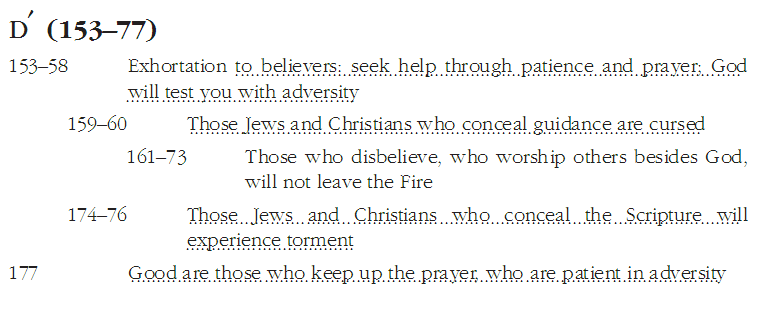
    ————————D’ Muslims will be tested (153 – 177).
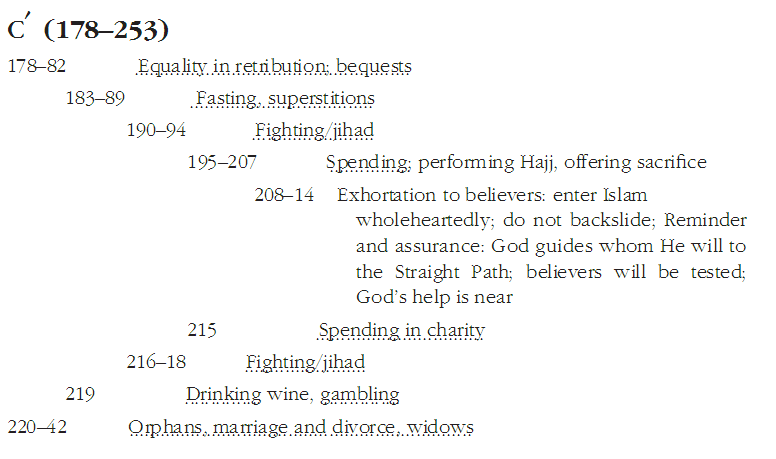
    —————-C’ Deliverance of Law to Muslims (178 – 253).
    ——–B’ Allah’s creation and knowledge (254 – 284).
    A’ Faith vs. unbelief (285 – 286).

    The coherence in the form of a ring composition is best illustrated in the diagram below (please click on picture to enlarge) [2]:

    Baqarah ring diagram

    If we examine the 9 sections we find that they contain sub-ring compositions. So what we have is rings within rings (please click on pictures to enlarge) [3]:


    Baqarah ring A


    Baqarah ring B


    Baqarah ring C


    Baqarah ring D


    Baqarah ring E


    Baqarah ring D'


    Baqarah ring C'


    Baqarah ring B'


    Baqarah ring A'

    Here is a table showing parallels between the corresponding sections (the correspondences here are indicated horizontally):

    Baqarah ring summary

    Finally, it’s worth paying special attention to a particular verse of Surah al-Baqarah, the 255th verse known as ‘Ayat al-Kursi’. This verse is considered the most excellent verse of the Qur’an, according to Prophet Muhammad. Its memorisation is highly encouraged, and it just so happens that it too exhibits a ring composition:

    ayat kursi

    Raymond K Farrin, author of “Surat al-Baqarah – A Structural Analysis”, concludes on Surah al-Baqarah’s ring composition:

    “Indeed this sura exhibits marvellous justness of design. It is precisely and tightly arranged, as we have seen, according to the principles of ring composition; even the section lengths fit perfectly in the overall scheme. Moreover, the precise structure serves as a guide, pointing to key themes in the sura. These occur, according to the logic of the pattern, at the centers of individual rings and, particularly, at the center of the whole sura. At the center of the sura, again, one finds instructions to face Mecca — this being a test of faith; identification of the Muslims as a new, middle community; and the message that all people, regardless of their qibla or spiritual orientation, should race to do good and God will bring them together.”

    BENEFITS OF RING COMPOSITION

    Ring composition has great exegetical application. For a ring structure not only holds the text together, but also gives focus to the important words and themes. By means of concentric patterning, ring composition calls attention to the centre – we are drawn to look here for the essential message. As Mary Douglas notes concisely, “The meaning is in the middle.” [4]

    It also serves as an aid in memorisation, especially useful given the length of Surah al-Baqarah. In his study of ancient poetry, Cedric Whitman found that ring composition simultaneously performed both aesthetic and mnemonic functions. It aids memorisation by permitting the oral poet to easily recall the basic formulae of the composition during performances [5].

    CONCLUSION

    Given the difficult and protracted circumstances of the Qur’an’s revelation, one would expect it to be in disorder. However as this article has demonstrated, any such understanding reveals a lack of insight into the Qur’an’s sophisticated structure. Upon deep analysis of the Qur’an’s composition we see that it exhibits a remarkable structure. It is simply impossible for Prophet Muhammad, given that he could neither read nor write and had no reputation as a poet or literary expert, to have engineered such a structure himself. This represents compelling evidence that his inspiration for the Qur’an was God Almighty, as the Qur’an itself states:

    “Your Companion is neither astray nor being misled. Nor does he say (aught) of (his own) desire. It is no less than inspiration sent down to him. He was taught by one mighty in Power.” [Chapter 53, verses 2-5]

    References

    1 – Tafsir at-Tabari, also see Tafsir Abdul Razzaq 3/86 Narration No. 2496 under Qur’an 36:69.

    2 – Original diagram taken from article at Islam21c, “The Coherence of al-Baqarah”.

    3 – Surat al-Baqarah – A Structural Analysis, Raymond Farrin, 2010.

    4 – Mary Douglas, Thinking in Circles 16, 35.

    5 – Cedric M. Whitman. Homer and the Heroic Tradition. Cambridge: Harvard UP, 1958.


    Source: http://manyprophetsonemessage.com

deneme bonusu