Tag: Islam

  • Singaporean Woman And Four Children Stuck In Aden, Yemen

    Singaporean Woman And Four Children Stuck In Aden, Yemen

    A Singaporean woman and her four children are stuck in Aden, Yemen, as rebel troops close in on the Middle Eastern port city.

    Madam Sherin Fathima Syed Abdul Ravoof, in her 30s, and her four children aged between four and 13, have no way out of the country, which is on the brink of civil war.

    Countries such as China and India have been evacuating their citizens on naval frigates.

    “My kids are terrified because nothing like this ever happens in Singapore,” Madam Sherin told The New Paper.

    A Ministry of Foreign Affairs (MFA) spokesman said it is in close contact with Singaporeans in Yemen, especially those who want to leave the country.

    But since Singapore has no diplomatic representation in Yemen, MFA is working with the Malaysian and Indonesian embassies to help evacuate Singaporeans.


    Source: www.tnp.sg

  • Dzar Ismail: Syukur Dilahir Seorang Muslim Di Singapura

    Dzar Ismail: Syukur Dilahir Seorang Muslim Di Singapura

    Kalau di China, orang Islam dilarang berpuasa, sampai ada yg sembunyi sembunyi bershaum. Disini, kita bebas berpuasa, itu pun ada orang tak puasa.

    Kalau di Perancis, keselamatan seseorang yg berhijab itu sering terancam. Siap ada undang-undang lagi melarang orang berhijab. Tidak disini. Sapa nak berhijab silakan, siapa tak nak, takder paksaan. Sendiri jawab.

    Kalau di England, sembahyang kat stadium, orang amek gambar, upload internet, label ‘disgrace’. Tidak disini, ada yg siap berjemaah satu sudut di stadium, sebelum game bermula. Sholat Hari Raya dalam stadium lagi ada.

    Kalau di Jerman, peh susah nak cari makanan halal. Ada bila melancong, siap tarpao biskut dengan Meggi, was was punya pasal. Tidak disini. Senang nak cari makanan halal. Bacon pun halal. Turkey baconlah.

    Kalau di Korea Selatan, peh susah nak cari masjid, Korea Utara jgn cakap lah. Disini, hampir satu masjid di setiap estet perumahan. Sampai belia masjid boleh buat acara touring naik basikal dari masjid ke masjid.

    Aku tinggal di Singapura. Pemerintah sekular, bukan pemerintah Islam. Tapi kadang kadang sifat mereka lebih Islam dari yg sekian ada di merata dunia.

    Penjualan arak diharamkan dibeberapa tempat dan waktu tertentu. Untuk menjaga keamanan dan keselamatan.

    Aktiviti menghisap rokok diharamkan dikebanyakkan tempat. Sampai bawah blok, corridor rumah pun tak boleh.

    Aktiviti hubungan sejenis diharamkan menurut undang-undang.

    Kita bebas berdakwah, nak buat ceramah, forum perdana, kelas agama, maulid, ibadah korban, silakan, asalkan dgn yg bertauliah dan mengikut garis panduan yg disarankan.

    Aku bersyukur dilahirkan seorang Muslim di Singapura. Bebas. Tiada halangan ketara. Hujan emas di negeri orang, hutan batu di negeri sendiri, lebih baik di negeri sini.


    Source: Dzar Ismail

  • Cherian George: Lee Kuan Yew Was Bulwark For Singapore Minorities

    Cherian George: Lee Kuan Yew Was Bulwark For Singapore Minorities

    Unlike-Lee admirers around the world may be missing significant details.

    In an amusing case of mistaken identity, a banner honouring Lee Kuan Yew has appeared in India, bearing a photo of another Singaporean elder statesman, President Tony Tan. Both are white-haired ethnic Chinese males, but Tan, as you have may noted from Channel NewsAsia’s coverage of Lee’s funeral today, is rather more alive.

    The picture has been making the rounds on social media in Singapore, bringing smiles to an otherwise sombre day. It serves as a useful reality check for Singaporeans, that although Lee has been lauded by world leaders as a 20th century giant, not everyone can recognise him from Tom, Dick or Tony.

    Some other cases of mistaken identity are less trivial. It’s nothing new. For at least a couple of decades, he has been all things to all men who aspire to a certain kind of leadership. They see in him a model, a kind of proof-of-concept that they can point to when defending their own missions and methods. Leader X is Country A’s Lee Kuan Yew. How often have you heard that line.

    As a Singaporean born in the year of the republic’s independence, I’ve benefited from Lee’s global brand, most tangibly in the fact that my red passport travels extremely well. But the way that brand is sometimes used is cringeworthy.

    Most of the parallels that foreign politicians and their acolytes draw with Lee Kuan Yew are selective and self-serving. His name is evoked by anyone who wants to apply less-than-democratic means in the name of strong, decisive leadership in order to achieve high economic growth. But there was a lot more to the man and his formula for success.
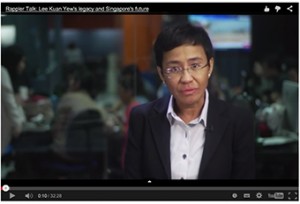
    My interview with Maria Ressa of Rappler.com.

    The most obvious was the zero tolerance of corruption that he embodied and instituted in the Singapore system. That is probably a chapter in his bestselling memoirs that admirers like former Thai prime minister Thaksin Shinawatra skipped. Similarly, fans of Indonesia’s late president Suharto who cite his friendship with Lee conveniently ignore the fact that Suharto topped the world league table of corrupt leaders, according to the same organisation that routinely names Singapore as the cleanest in Asia.

    Less noticed is the fact that Lee, while loudly dismissive of the liberal brand of democracy, never deviated from electoral authoritarianism – the belief that regular multi-party elections are ultimately the only way for a government to win legitimacy, and are not bad at keeping a dominant party on its toes. Of course, he did his best to insulate his government from distractions like short-term public opinion, an adversarial press and protest movements; he also treated the opposition unfairly, to put it mildly.

    But, to this day, elections in Singapore remain competitive enough and credible enough to make democracy “the only game in town”, as political scientists would put it. As a result, opponents of the regime plot election strategy, not extra-parliamentary struggle; and Singaporeans accept the government’s authority as legitimate, even if they disagree with its policies. The thousands of Chinese officials who pass through Singapore to learn the Lee model may think this lesson can’t apply to the People’s Republic, but shouldn’t overlook how important it has been to Singapore’s success.

    Back to India. When its government decided to fly the tricolour at half-mast today, I wonder which Lee they were honouring. I hope – but I doubt – that it was the leader who stood resolutely against sectarian politics and majority domination. Among all his core principles, this is the one least talked about abroad. Yet, to minorities like me – and, thankfully, most members of the majority race as well – this may be the single most precious aspect of the legacy.

    Not that he got everything right. Older Indian Singaporeans still bristle at the way he labelled us as “fractious and contentious”. The stereotype might not have been off the mark (note Amartya Sen’s Argumentative Indian thesis), but if only he had seen it as a positive contribution to Singapore’s national culture rather than a weakness. Similarly, his open suspicion of Muslim Singaporeans’ growing religiosity was hurtful. Some of such straight-talking about race and religion could come back to haunt Singapore, should future bigots exploit his words to justify their prejudices.

    But minorities never needed to doubt this: Lee was an unshakeable bulwark against majoritarian tendencies that could have easily overwhelmed Singapore. Malay/Muslims make up only 15% and Indians 7% of the population. For decades, the risk of a Chinese chauvinist party playing the race/language card posed the single biggest threat to PAP dominance. This fact is lost on most of the Western press, who self-aggrandisingly like to believe that they were Lee’s bête noire. They were more like sparring partners, compared with champions of the Chinese-speaking ground, who were the main victims of both detentions without trial as well as flagrant censorship.

    Lee went to the extent of amending the republic’s Constitution to stop any party from sweeping into power without minority support. For most Parliamentary seats, candidates are forced to contest as small teams that must include minorities. Thus, no Chinese party could do in Singapore what the BJP did in India last year – come to power without a single MP from the country’s largest minority group.

    Thankfully, Lee and his comrades were influenced by an older Indian tradition, the Nehruvian secular ideal that accommodated minorities – the same tradition that the BJP and the larger Hindutva movement is bent on dismantling.

    Singapore should not presume that it can serve as a model for any other country, least of all India. The world’s largest democracy is 200 times larger than the city state that Lee ran, and its challenges are profoundly more complex.

    But if foreigners do choose to honour Lee Kuan Yew, they shouldn’t fall into the mistaken-identity trap. Yes, he was a firm leader who stretched the limits of democratic government to breaking point in order to get things done.

    But a leader who makes minorities feel unwanted, insecure and fearful?

    That’s not a face that Singaporeans recognise.


    Source: www.airconditionednation.com

  • Zulfikar Shariff: Rethingking Lee Kuan Yew’s Legacy – Islam Beyond Rituals

    Zulfikar Shariff: Rethingking Lee Kuan Yew’s Legacy – Islam Beyond Rituals

    Quite a few Tipah and Tiped (tak tahu nama Tipah lelaki) tried to justify discrimination with “Aku boleh pergi masjid sembahyang…aku boleh puasa”….mana ada diskriminasi.

    As if that is all that is in Islam. Dapat sembahyang dapat puasa…dah cukup. Baik LKY…tengok kita boleh puasa…dia tak paksa kita makan.

    Another group of Tipah pula argue when discussing Kuan Yew… “Our mission is to cleanse our heart”…

    tu pasal lah nothing changes….bukan Kuan Yew je yang tipu Tipah…Tipah tipukan diri sendiri.

    Rasulullah bawa risalah selama 23 tahun….just untuk ajar solat dan puasa? Tu je? Punya lama nak ajar solat dan puasa?

    And our mission in life is just cleanse our heart? Tak kisah lah Kuan Yew buat apa..tak kisah he discriminate our brothers and sisters….tak kisah lah dia kutuk Islam..

    Kita bersihkan hati je cukup…

    Tu pasal lah Rasulullah hari hari cuma duduk….bersihkan hati…puasa dan solat..tu je? He didnt do anything else for Islam?

    A Muslim is not simply someone who prays, fasts and cleanse his heart. The three are parts of the behaviour of the Muslim. But does not encapsulate what being a Muslim means.

    A Muslim is someone who submits fully, totally…with no reservations to Allah’s wills and commands.

    He not only prays, fast and cleanse his heart…he lives in full accordance with what Allah has decreed. And if there are any commands that he is prohibited from applying..he strives to remove the prohibition.

    He speaks and stands against oppression. He applies Islam totally in his life or he strives within himself to apply it.

    Islam is a full, comprehensive way of life, worldview, understanding.

    Let us not reduce Islam to just a couple of rituals.


    Source: Zulfikar Shariff

  • Female Malay: Disagree With Lee Kuan Yew’s Policies, Do Not Belittle Or Disrespect The Sacrifices He Made For Singapore

    Female Malay: Disagree With Lee Kuan Yew’s Policies, Do Not Belittle Or Disrespect The Sacrifices He Made For Singapore

    Yesterday I quoted MISS INI’s conversation with me, expressing her frank views from her heart & mind on LEE KUAN YEW. THE MALAYS & SINGAPORE. [https://www.facebook.com/notes/maidin-packer/lee-kuan-yew-the-malays-singapore-a-note-from-the-heart-of-a-young-professional-/860914697303713?pnref=story].

    She inspired yet another young Malay woman, 30, to share her thoughts with me. She also requested to remain anonymous. So I will refer to her as MISS ITU.

    MISS ITU: Dear En Maidin, Thank you for sharing the thoughts of Ms INI on your Facebook. It heartens me to know that there are others out there, like me, who view the current situation in the same way.

    Let me apologise for this rather lengthy note – or rant as you may see it. These are words that I have never spoken out loud to anyone outside my family, and I do not wish for my identity to be known.

    It alarms me to note that over the last few days, my own Facebook feeds have been filled with narrow-minded perspectives of how [some] Malays view the actions of the late LKY. I agree that while one may not agree on actions taken in the past, one should never belittle or disrespect the sacrifices and actions he carried out for the sake of the country.

    Often, I read comments that were made based on little knowledge – if not total lack of knowledge – of the background and reason for decisions and policies. Often, these policies are viewed in the perspective of ‘with intent to marginalize Malay/Muslim communities further’.

    Often, I’d expect these comments to be made by the older generation, who are often less educated. Ironically, these comments are usually made by peers who have had decent levels of education, if not tertiary and further.

    I fail to understand the reason for the discontent. I’ve seen Malay/Muslim individuals rise up and take their place among the top of the cohorts in schools and workplaces. I’ve seen Malay/Muslims succeed in businesses, locally and overseas. I’ve seen success that was borne out of sheer determination and hard work. – LEE KUAN YEW

    I often feel that the grumbles on the ground by people in my own community stem from the mentality that they should be on the receiving end of things without having to work too hard for it. They often have the ‘Malays were here first, so should have more rights over others’ – a very Bumiputera-ish attitude. 

    But Malays are often content with what they have, and instead of aspiring to be better than the other races, or even those if the same race, belittle the achievements to the extent of insinuating that these successes can be attributed to knowing the right people and having the right kind of money. Never sheer hard work. It’s the constant putting down of others that is holding us all back as a community.

    While many are quick to quote what the late LKY said about integrating the Muslims as ‘evidence of marginalizing and attempting to eradicate the entire race’, I wonder why the same quote cannot be used to spur the community on to prove that we can integrate into the society without sacrificing our beliefs. We can hold on fast to our faith while still being Singaporeans first.

    Same can be said when I read a certain post on my FB feed about the reasons why the Malay schools were abolished. We Malays should be ashamed of ourselves. Majority of us cannot even speak in our own mother tongue fluently, much less in comparison to the late LKY who can converse in Malay without needing a translator. And his diction is at times better than a native Malay speaker.

    We are blind to the contributions the country led by the late LKY have made to our community. Our mosques are huge examples of such contributions. Should we have relied on the ‘Malays will depend on itself to build its community’ mentality, we would not have gotten far. [Some] People grumble over the compulsory mosque development fund that we contribute to every month. Such complaints over a petty amount of cash that is often so insignificant that we fail to notice it.

    And we should be honest and upfront with ourselves. How many of us can actually save enough money every month to be able to afford the house we live in if not for our CPF? We Malays are easily contented and quick to keep up with the Joneses. We are quick to display acts of keeping up appearances while piling on mounts of debts. We are quick to fall for get-rich quick schemes instead of getting down to the grind of things.

    I am a child of the 80s. I did not go through what my parents and grandparents went through in the early years of our nation. But it never fails to amaze me that we have come far as a nation in terms of development and infrastructure.

    Yet, I am afraid. I am afraid thinking of the situation my children will have to face growing up, based on the current mentality of the people. People are holding on so tightly to the past, to the misconceptions, that they are getting left behind without them realizing it.

    I may be seen as too ‘intergrated’ into the society. I may be seen as naive. I have served in the civil service, and left it to spend close to a decade in the private sector working for expats.

    I have more non-Malay friends than Malay friends, but they all celebrate my festivities and take time to understand my racial customs and traditions as well as religious beliefs and rituals. If not for the fact that I live in a multi-cultural society which the late LKY insisted on, this would not have happened. And just for that, I am thankful.


    MY REPLY: TQ for sharing your views. Would be nicer if it could be shared with others. Yes many of our people need to be re-educated. Your views could help. I would be happy if you are to share it or allow me to use it, with or without your name. Pls advice.

    MISS ITU: Salam Sir. Thank you for reading my note. Do feel free to share and use it. However I would appreciate if my name was not revealed. I believe there are others who feel the same, and like me, are finding it difficult to voice out our thoughts without being hacked down. Ironically, by our own community.

    If you want to be popular, do not try to be popular all the time. Popular government does not mean that you do popular things all the time. We do not want to be unpopular or to do unpopular things. But when they are necessary, they will be done. Popular representative government means that within each five-year period, your policies have demonstrably worked and won popular support. That is what it means. And if we flinch from the unpopular, we are in deep trouble. – LEE KUAN YEW


    Source: Maidin Packer

deneme bonusu