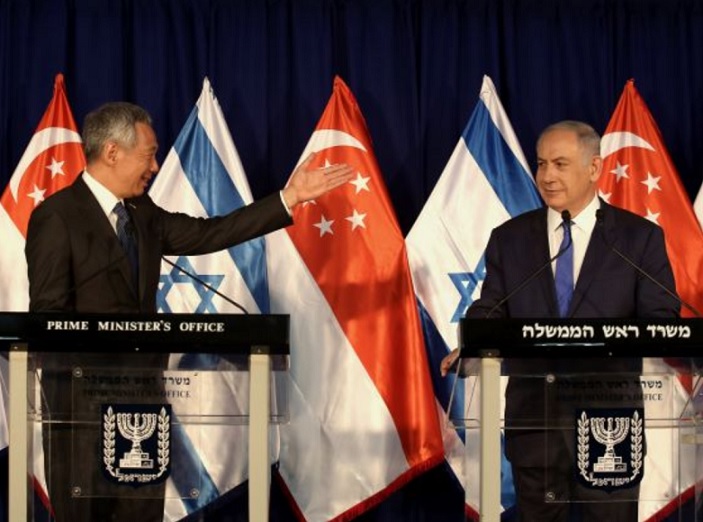
Tag: Israel

  • Israel’s Settlement Law: Consolidating Apartheid

    Israel’s Settlement Law: Consolidating Apartheid

    “Israel has just opened the ‘floodgates’, and crossed a ‘very, very thick red line’.” These were the words of Nickolay Mladenov, United Nations’ Coordinator for the Middle East Peace Process, in response to the passing of a bill at the Israeli Knesset on February 7 that retroactively legalises thousands of illegal settler homes, built on stolen Palestinian land.

    Mladenov’s job title has grown so irrelevant in recent years that it merely delineates a reference to a bygone era: a “peace process” that has ensured the further destruction of whatever remained of the Palestinian homeland.

    Israeli politicians’ approval of the bill is indeed an end of an era.

    We have reached the point where we can openly declare that the so-called peace process was an illusion from the start, for Israel had no intentions of ever conceding the occupied West Bank and East Jerusalem to the Palestinians.

    In response to the passing of the bill, many news reports alluded to the fact that the arrival of Donald Trump in the White House, riding a wave of right-wing populism, was the inspiration needed by equally right-wing Israeli politicians to cross that “very, very thick red line”.

    There is truth to that, of course. But it is hardly the whole story.

    The political map of the world is vastly changing.

    Just weeks before Trump made his way to the Oval Office, the international community strongly condemned Israel’s illegal settlements on Palestinian land occupied since 1967, including East Jerusalem.

    UN Security Council Resolution 2334 stated that these settlements have no legal validity and constitute a flagrant violation of international law. Fourteen UNSC members voted in approval, while the US abstained, a revolutionary act by the US’ brazenly pro-Israel standards.

    The US, when still in the final days of the Barack Obama administration, followed that act by even more stunning language, as Secretary of State John Kerry described the Israeli government as the “most right-wing in history”.

    A chasm immediately emerged.

    Capitalising on the US-Israel rift, Trump railed against Obama and Kerry for treating pompous Israeli Prime Minister Benjamin Netanyahu with “total disdain and disrespect”. Trump asked Israel to “stay strong”, for January 20 was not too far away.

    That date, Trump’s inauguration was the holy grail for Israel’s right-wing politicians, who mobilised immediately after Trump’s rise to power. Israel’s intentions received additional impetus from Britain’s Conservative Prime Minister, Theresa May. Despite her government vote to condemn Israeli settlements at the UN, she too ranted against the US for its censure of Israel.

    Kerry’s attack on a “democratically elected Israeli government” was not appropriate, May charged. “We do not … believe that the way to negotiate peace is by focusing on only one issue, in this case, the construction of settlements,” she added.

    Not only did May’s words define the very hypocrisy of the British government (which committed the original sin 100 years ago of handing historic Palestine to Zionist groups), but it was all that Israel needed to push forward with the new bill.

    It is quite telling that the vote on the bill took place while Netanyahu was on an official visit to the UK. In a country greatly influenced by ‘Friends of Israel’ cliques in both dominant parties, he was among friends.

    With the UK duly pacified, and the US in full support of Israel, moving forward with annexing Palestinian land became an obvious choice for Israeli politicians. Bezalel Smotrich, a Knesset member of the extremist Jewish Home party, put it best. “We thank the American people for voting Trump into office, which was what gave us the opportunity for the bill to pass,” he said shortly after the vote.

    The so-called “Regulation Bill” will retroactively validate 4,000 illegal structures built on private Palestinian land. In the occupied Palestinian territories, all Jewish settlementsare considered illegal under international law, as further indicated in UNSC Resolution 2334.

    There are also 97 illegal Jewish settlement outposts – a modest estimation – that are now set to be legalised and, naturally, expanded at the expense of Palestine. The price of these settlements has been paid mostly by US taxpayers’ money, but also the blood and tears of Palestinians, generation after generation.

    It is important, though, that we realise that Israel’s latest push to legalise illegal outposts and annex large swaths of the West Bank is the norm, not the exception.

    Indeed, the entire Zionist vision for Israel was achieved based on the illegal appropriation of Palestinian land. Wasn’t so-called “Israel proper” – as in land obtained by force from 1948 to 1967 – originally Palestinian land?

    Soon after Israel occupied the West Bank, Gaza and East Jerusalem in 1967, it moved quickly to fortify its military occupation by unleashing settlement construction throughout the occupied territories.

    The early settlements had a strategic military purpose, for the intent was to create enough facts on the ground that would alter the nature of any future peace settlement; thus, the Allon Plan. It was named after Yigal Allon, a former general and minister in the Israeli government who took on the task of drawing an Israeli vision for the newly conquered Palestinian territories.

    The plan sought to annex more than 30 percent of the West Bank and all of Gaza for security purposes. It stipulated the establishment of a “security corridor” along the Jordan River, as well as outside the “Green Line”, a one-sided Israeli demarcation of its borders with the West Bank.

    While the religious component of the Israeli colonisation scheme currently defines the entire undertaking, it was not always this way. The Allon Plan was the brainchild of Israel’s Labor government, as the Israeli Right then was a negligible political force.

    To capitalise on the government’s alluring settlement policies in the West Bank, a group of religious Jews rented a hotel in the Palestinian town of Al-Khalil (Hebron) to spend Passover at the Cave of the Patriarchs, and simply refused to leave.

    Their action sparked biblical passion of religious orthodox Israelis across the country, who referred to the West Bank by its supposed biblical name, Judea and Samaria. In 1970, to “diffuse” the situation, the Israeli government constructed the Kiryat Arba settlement on the outskirts of the Arab city, which invited more orthodox Jews to join the growing movement.

    Over the years, the strategic settlement growth was complemented by the religiously motivated expansion, championed by a vibrant movement, epitomised in the finding of Gush Emunim (Bloc of the Faithful) in 1974. The movement was on a mission to settle the West Bank with legions of fundamentalists.

    Presently, by incorporating the illegal outposts (the work of religious zealots) into the strategically located, government-sanctioned larger illegal settlement blocs, Israeli politics and religion converged like never before.

    And between the unfortunate past and the troubling present, Palestinians continue to be driven out of their ancestral land and homes.

    But what is the Palestinian leadership doing about it? “I can’t deny that the (bill) helps us to better explain our position. We couldn’t have asked for anything more,” a Palestinian Authority official told Al-Monitor on condition of anonymity, as quoted by Shlomi Elder.

    Elder writes: “The bill, whether it goes through or is blocked by the Supreme Court, already proves that Israel is not interested in a diplomatic resolution of the conflict.”

    Be as it may, this is hardly enough. It is absurd to argue that it was Palestinians’ purported inability to articulate their position that emboldened Israel to this extent. It is rather the international community’s failure to translate its laws into action that bolstered Israel’s militancy.

    The greatest mistake that the Palestinian leadership has committed (aside from its disgraceful disunity) was entrusting the US, Israel’s main enabler, with managing a “peace process” that has allowed Israel time and resources to finish its colonial projects, while devastating Palestinian rights and political aspirations.

    Returning to the same old channels, using the same language, seeking salvation at the altar of the same old “two-state solution” will achieve nothing, but to waste further time and energy. It is Israel’s obstinacy that is now leaving Palestinians (and Israelis) with one option, and only one option: equal citizenship in one single state or a horrific apartheid. No other “solution” suffices.

    In fact, the Regulation Bill is further proof that the Israeli government has already made its decision: consolidating apartheid in Palestine. If Trump and May find the logic of Netanyahu’s apartheid acceptable, the rest of the world shouldn’t.

    In the words of former President Jimmy Carter, “Israel will never find peace until it … permit(s) the Palestinians to exercise their basic human and political rights.” That Israeli “permission” is yet to arrive, leaving the international community with the moral responsibility to exact it.

    Dr Ramzy Baroud has been writing about the Middle East for more than 20 years. He is an internationally syndicated columnist, a media consultant, an author of several books and the founder of PalestineChronicle.com. His books include Searching Jenin and The Second Palestinian Intifada, and his latest, My Father Was a Freedom Fighter: Gaza’s Untold Story. His website is www.ramzybaroud.net .


    Source: www.aljazeera.com
  • Warning To Any Malay-Muslim Or Muslims From Other Races Attempting To Create Unrest

    Warning To Any Malay-Muslim Or Muslims From Other Races Attempting To Create Unrest

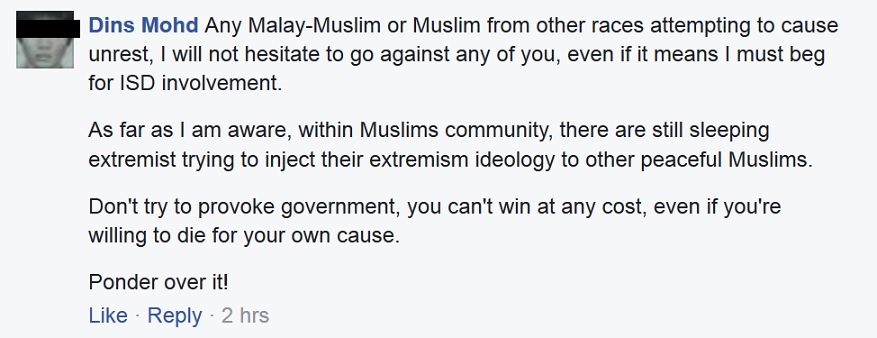
    Someone post a warning to all the malays/muslims in sg about jangan buat kecoh or his words “unrest” when the Israel Pm comes to sg soon. The screenshot of the post said:

    “Any Malay-Muslim or Muslim from other races attempting to cause unrest, I will not hesitate to go against any of you, even if it means I must beg for ISD involvement.

    As far as I am aware, within Muslims community, there are still sleeping extremist trying to inject their extremism ideology to other peaceful Muslims.

    Don’t try to provoke government, you can’t win at any cost, even if you’re willing to die for your own cause.

    Ponder over it!”

    Tapi bukan itu saje!! He even accused that there is sleeping extremist in the muslims community?

    Jangan sembarang tuduh sesama orang Islam dan sangka buruk niat orang. Tak paham lah orang mcm ni.

    He even dare to tag Singapore Police ForceMr Lee Hsien Loong & Mr K Shanmugam Sc to scareus.


    Cahaya

    Reader’s Contribution

  • Israel PM Netanyahu Still Plans To Visit Singapore On Feb 19 And 20

    Israel PM Netanyahu Still Plans To Visit Singapore On Feb 19 And 20

    Despite ongoing police investigations, Prime Minister Benjamin Netanyahu’s planned visit to Singapore and Australia is “very much still on,” an Australian official said on Wednesday.

    Planning for the late February visit is proceeding apace, according to the official.

    Netanyahu will be the first sitting Israeli prime minister to visit Australia – which has given the Jewish state strong diplomatic support for years – as well as to Singapore, with whom Israel has a very robust military relationship.

    However, the planned third leg of the trip – a visit to Fiji and participation in a summit of leaders of Pacific island states there – has been canceled, with diplomatic officials saying that adding the Fiji leg would be “too long and too complicated” from a security point of view.

    It is well understood in Jerusalem that a cancellation of Netanyahu’s visit to Australia would not be looked upon kindly in Canberra given that three high level visits to the country have been canceled over the last three years.

    Netanyahu canceled a planned trip there in 2014 because of Operation Protective Edge; foreign minister Avigdor Liberman then canceled a visit there that same year; and President Reuven Rivlin scratched a trip there last year, opting instead to go to Russia.

    It has been made clear to Israel that while there would be some understanding for the cancellation of the trip for a genuine reason, tolerance for these cancellations is eroding. The trip is important for the Australians because it is an acknowledgment and recognition by Israel of the strong political and diplomatic support Australia gives Israel in international forums.

    The trip is also deemed as very significant to the Jewish community in the country which wants to feel that its strong support for Israel is not taken for granted.

    The current government of Malcolm Turnbull is extremely supportive of Israel and would like the visit to take place on its watch to reap domestic political support from the Jewish community and other pro-Israel supporters in the country.

    Australia’s diplomatic support was on display this week when not only did it only send a low-level delegation to the Paris Mideast conference, but it also distanced itself from the conclusions afterward.

    A representative of Foreign Minister Julie Bishop said the Australian presence at the conference “does not mean we agree with every element of the final statement.

    “The most important priority must be a resumption of direct negotiations between the Israelis and the Palestinians for a two-state solution as soon as possible.”

    Turnbull was the only world leader, with the exception of Netanyahu, to publicly speak out against UN Security Council Resolution 2334, which was adopted in December, saying it was “one sided” and “deeply unsettling.”

    Netanyahu is scheduled to leave Saturday night, February 18, and fly to Singapore, arriving Sunday evening.

    He is then slated to spend Monday in Singapore, a reciprocal visit to that made by Prime Minister Lee Hsien Loong last year, before flying the next day to Sydney.

    Netanyahu is scheduled to fly back to Israel on Saturday night, February 25.

    During those five days, he also will travel to Melbourne, but not stay there overnight. The bulk of his meetings with government officials will be held in Sydney.


    Source: JPost

  • Benjamin Netanyahu Slams John Kerry’s Speech, Thanks Donald Trump For Friendship

    Benjamin Netanyahu Slams John Kerry’s Speech, Thanks Donald Trump For Friendship

    Israeli Prime Minister Benjamin Netanyahu took parting swipes Wednesday at the Obama administration, calling John Kerry’s earlier speech “unbalanced” but saying he had “no doubt” the alliance between the countries would endure despite disagreements.

    Earlier Wednesday, Secretary of State John Kerry defended the Obama administration’s decision to abstain from voting on a U.N. resolution condemning Israeli settlement activity in areas Palestinians seek for a state. Allowing it to pass was seen by some as a slap to Israel. He questioned Netanyahu’s commitment to Palestinian statehood, which has been the basis for serious peace talks.

    “If the choice is one state, Israel can either be Jewish or democratic, it cannot be both, and it won’t ever really be at peace,” Kerry said.

    Kerry’s speech came amid the final days of an administration that has had tense relations with Israel. President-elect Donald Trump has vowed to repair the relationship. Trump has condemned Obama for allowing the resolution to pass and said Wednesday that the current president has put up “roadblocks” for Trump’s transition.

    Trump’s comments on U.S.-Israeli relations clash with past precedent in which presidents-elect did not comment on foreign policy until they took office.

    Netanyahu on Wednesday thanked Trump on Twitter for his “warm friendship” and “clear-cut support for Israel” after the president-elect tweeted that Israel should “stay strong” as his administration approaches.

    Netanyahu said Kerry’s speech was “almost as unbalanced” as the U.N. resolution, which he harshly criticized. He said that peace will not be achieved through speeches or U.N. resolutions but through direct talks.

    “Israel remains committed to resolving the outstanding difference between us and the Palestinians with direct negotiations,” Netanyahu said.

    He also contended that Kerry spent “most of his speech blaming Israel for the lack of peace.”

    In his speech, Kerry stressed that Obama’s commitment to Israel has been as strong as previous presidents, giving assurances that the Obama administration is not planning any other parting shots at Israel and saying it would not recognize Palestinian statehood. He did not focus only on Israel’s failings in the peace process, criticizing Palestinian leaders’ “incitement” of violence.

    Obama has expressed frustration about the growth of Israeli settlements, and Israel’s government has argued that curbing them should not be a precondition to peace talks.


    Source: www.cnbc.com

  • Benjamin Netanyahu ‘Told New Zealand Backing UN Vote Would Be Declaration Of War’

    Benjamin Netanyahu ‘Told New Zealand Backing UN Vote Would Be Declaration Of War’

    Benjamin Netanyahu reportedly told New Zealand’s foreign minister that support for a UN resolution condemning Israeli settlement-building in the occupied territories would be viewed as a “declaration of war”.

    According to reports in Israeli media, the Israeli PM called Murray McCully, the foreign minister of New Zealand, before Friday’s resolution, which was co-sponsored by Wellington. Netanyahu told him: “This is a scandalous decision. I’m asking that you not support it and not promote it.

    “If you continue to promote this resolution, from our point of view it will be a declaration of war. It will rupture the relations and there will be consequences. We’ll recall our ambassador [from New Zealand] to Jerusalem.”

    McCully, however, refused to back down, telling Netanyahu: “This resolution conforms to our policy and we will move it forward.”

    A western diplomat confirmed that the call took place and described the conversation as “harsh”.

    The details of the call – disclosed in Haaretz – suggest a mounting sense of panic on the part of Netanyahu in the run-up to the UN security council resolution that passed on Friday demanding an end to settlement building.

    As well as the Netanyahu call, a senior official in Israel’s foreign ministry called New Zealand’s ambassador to Israel, Jonathan Curr, and warned that if the resolution came to a vote, Israel might close its embassy in Wellington in protest.

    Israel responded furiously to the vote, threatening diplomatic reprisals against the countries that voted in favour. Diplomatic ties with New Zealand were temporarily severed and ambassador Itzhak Gerberg was recalled.

    But in a sign that the international pressure may be being felt by the Netanyahu administration, scheduled plans to consider for approval 600 new settlement houses in occupied east Jerusalem were abruptly removed from the agenda of the city’s municipality on Wednesday.

    Netanyahu’s language and behaviour – which has resulted in ambassadors being reprimanded and consultations with foreign leaders, including the UK’s Theresa May, cancelled – has raised eyebrows among foreign diplomats, who point out that the UN resolution does no more than confirm the longstanding view of the international community on Jewish settlements.

    Later on Wednesday the US secretary of state, John Kerry, will make a speech outlining the parameters for how the Obama administration sees a settlement of the Middle East peace process.

    Kerry’s speech, less than a month before Barack Obama leaves office, is expected to be the current administration’s last word on a decades-old dispute that Kerry had hoped to resolve during his four years as America’s top diplomat.

    It could also be seen in Israel as another parting shot at Netanyahu, who has had an acrimonious relationship with Obama since they both took office in 2009. Israel’s public security minister, Gilad Erdan, told Israel Army Radio that the planned speech was a “pathetic move” and “anti-democratic”.

    The US on Friday broke with a longstanding approach of diplomatically shielding Israel and abstained on a United Nations security council resolution that passed with 14 countries in favour and none against.

    An Egyptian paper supportive of the country’s president, Abdel Fatah al-Sisi, reported what it said was a leaked memo allegedly confirming Israel’s allegations that the Obama administration and Palestinian officials had coordinated positions over the wording of the resolution to allow the US to abstain in the vote. The state department denied the report.


    Source: www.theguardian.com