Tag: Mandarin

  • Malay Woman Teach Thousands Of Non-Chinese Students Mandarin

    Malay Woman Teach Thousands Of Non-Chinese Students Mandarin

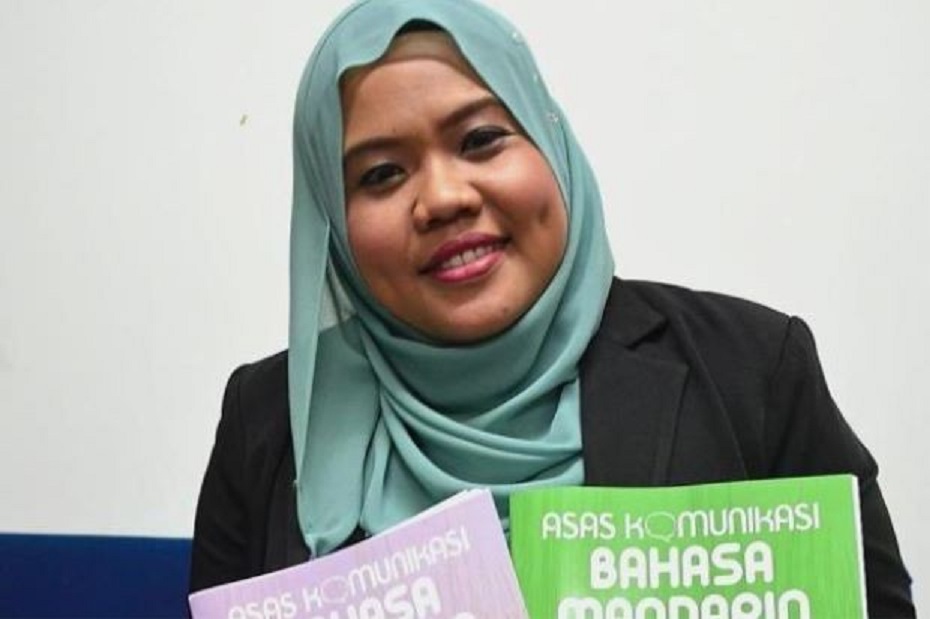
    From teaching Mandarin to her non-Chinese colleagues and neighbours a decade ago at her house in Taman Scientex, Pasir Gudang, Azlen Sugito now has five centres in Johor, Melaka and Selangor.

    The 33-year-old has introduced her own teaching modules and guide books to teach non-Chinese students Mandarin at her centres in Taman Bukit Dahlia, Pasir Gudang; Bandar Baru Utama in Johor Baru; Taman Saleng, Kulai; Cheng, Melaka; and Taman Puchong Utama, Selangor.

    Azlen said she has helped thousands of students, mainly Malays, Indians and people from Sabah and Sarawak, converse in Mandarin.

    From teaching Mandarin to her non-Chinese colleagues and neighbours a decade ago at her house in Taman Scientex, Pasir Gudang, Azlen Sugito now has five centres in Johor, Melaka and Selangor.

    The 33-year-old has introduced her own teaching modules and guide books to teach non-Chinese students Mandarin at her centres in Taman Bukit Dahlia, Pasir Gudang; Bandar Baru Utama in Johor Baru; Taman Saleng, Kulai; Cheng, Melaka; and Taman Puchong Utama, Selangor.

    Azlen said she has helped thousands of students, mainly Malays, Indians and people from Sabah and Sarawak, converse in Mandarin.


    Source: The Star

  • The Voice SG & MY: Participants Can Be Of Any Race Or Nationality, But Have To Be Fluent In Mandarin

    The Voice SG & MY: Participants Can Be Of Any Race Or Nationality, But Have To Be Fluent In Mandarin

    Popular international reality TV show The Voice has now made its mark in Southeast Asia, with a new show aimed at Singaporean and Malaysian audiences.

    The singing competition will now be adapted for the countries under one program, co-produced by mm2 entertainment along with cable providers StarHub (Singapore) and Astro (Malaysia).

    They’ve now opened entries to aspiring singers from these two countries, and they assure that they’re “on the search for true talents with good voices regardless of their appearances.” But there is one curious catch: you must be able to sing in Mandarin.

    “There is no restriction on race as long as you have a good voice, are fluent in Mandarin, and are able to perform Mandarin songs,” they state on the FAQ page on their official website.

    It appears that this version of The Voice is primarily targeted towards Mandarin-speaking audiences. This differs from the Singaporean adaptation of American Idol, where contestants sang in English.

    Social media users are understandably angry over this rule, raising questions over the show’s language exclusivity.

    It’s likely that this show is aiming to reach the level of success of Sing! China, which was formally known as The Voice of China and mainly featured singers, which included finalist Nathan Hartono last year, performing in Mandarin. mm2 will not be allowing entrants to sing in Hokkien or Cantonese.

    While some are crying foul over the show’s discrimination against non-Mandarin speakers, B-Quartet frontman Bani Haykal threw in a slightly different perspective on the matter on Twitter: speculating that the rule is likely a strategic move for the show to appeal to audiences in China, the same way Sing! China became popular with audiences in Southeast Asia.

    He explains more in an entire Twitter thread, and it is an interesting argument: Sing! China‘s finals broke viewership records in China, and the country remains an extremely attractive prospect for foreign media to target (*cough* The Great Wall).

    The Voice for Singapore and Malaysia could simply be an attempt at replicating the success of Sing! China, but with the emphasis on multi-racial growth in both countries, could this be simply a tone-deaf strategic move by mm2?

    Registration

    StarHub announced on Friday (May 5) that those aged 16 and up can begin to apply for a spot on the show as of 6pm.

    Again, although participants can be of any race or nationality, “talents have to be fluent in Mandarin and able to perform songs in Mandarin”, according to a press release from StarHub.

    They must also submit a clip of themselves singing. Clips must be no longer than 90 seconds, and dialect songs such as those in Cantonese or Hokkien are not allowed. Other than that, there is no restriction to the language or genre of the song selected, and applicants may choose between singing a cappella or with an instrument, said the press release. Singing with accompanying music tracks is not allowed.

    The auditions close on May 31. Visit www.thevoicesgmy.com


    Rilek1Corner

    Source: https://www.bandwagon.asia and http://www.todayonline.com

  • More Diversity In Voices Need To Be Heard On Racism In Singapore

    More Diversity In Voices Need To Be Heard On Racism In Singapore

    This article, “Racism in Singapore: Stop telling us minorities how to react to it“. has been shared widely, and I definitely think it is an important voice. I see a growing number of articles/conversations about racism, and a wider range of people speaking up, which I think are encouraging signs that there is more awareness and willingness to talk about race in Singapore.

    I hope the conversation doesn’t fixate on or stagnate at individualised, interpersonal instances of microaggressions, exclusion or privilege. Of course, these experiences aren’t separate from systemic racism, and are in fact deeply linked to them, but the connection often isn’t made as strongly as it could be.

    People switching to Chinese in conversations, friends telling racist jokes, etc are definitely significant and we should keep talking about these things and how they affect us, as well as how we can respond to them. We’ve all had these experiences and can feel solidarity around them.

    But I’m also interested in conversations that I don’t hear as much – about how Malay and Tamil people are overrepresented in prisons, whether they’re more likely to be profiled/picked up for certain crimes than Chinese people are, how Malay students are grossly underrepresented in universities, and what the barriers racial minorities face in accessing education, housing and jobs are.

    I’m interested in critiquing more closely, how our cultures and people are portrayed as backward, lazy, violent, uncivilised and parasitic in national narratives, and whether we can organise to push for anti-discrimination laws, for greater political representation and more in-depth analysis on how the media perpetuates harmful stereotypes about race.

    How many of the 1 in 10 families that live in poverty in Singapore are Malay or Tamil, and how much harder is it for racial minorities to experience intergenerational social mobility? The narrative continues to be that minorities need to work harder to catch up, and some minority groups are held up as “model minorities” and pitted against others. The recent study on Singaporeans’ receptivity to a president of a different race showed that both Indian and Malay respondents would prefer a Chinese candidate over each other. Is this what the success of a divide and rule approach looks like? Solidarity amongst racial minorities is low, and there’s plenty of racism to be explored there too.

    Social problems like unplanned teenage pregnancy, drug abuse and gang culture are ghettoised, stigmatised and pinned to the cultural deficit of minority communities rather than to structural discrimination, alienation and poverty. They’re also not given the same centrality in social policy as problems like gambling, that are more common in Chinese communities, are (as Alfian Sa’at’s play ‘GRC’ points out so well).

    Race needs to be a lens we apply to every social phenomenon we study, and we need more race disaggregated data about everything. The government, certain think tanks and the media are quick to look at race when it is to pin an issue as an “Indian problem” or “Malay problem”, but not to pinpoint racial discrimination.

    To take one example, there’s been a lot of discussion about bullying in Singapore schools – if studies on this also looked at whether racial minorities face more abuse/different types of abuse in school (I’m sure it’s true), anecdotes of interpersonal racism that appear in articles like this would have more context and meaning, and we would be able to offer deeper analysis and make stronger arguments for change. It doesn’t just stop at “my friends needs to be more sensitive” but allows us to demand that MOE, schools and educators take a proactive stance in addressing racial discrimination on a nationwide, school-wide or at least classroom-wide level.

    But maybe there is a different point to be made here too. While there is more interest in discussing race, while there are more voices addressing this now than before, are they diverse enough? Many of these voices, including mine, are middle-class voices. And I believe there are more important voices to listen to, when it comes to racism. The same way that middle-class feminism can silence working class women’s struggles, race consciousness that is not informed by class struggle can be a hazard. I am excited to explore possibilities for organising, for collective action, and to not allow individualised identity politics (or the “cult of individualism”) to become self-limiting or deteriorate into navel gazing.


    Source: www.theonlinecitizen.com
     

  • Frozen Yogurt Chain Llaollao To Be Investigated By Tripartite Aliance For Fair And Progressive Employment Practice

    Frozen Yogurt Chain Llaollao To Be Investigated By Tripartite Aliance For Fair And Progressive Employment Practice

    Frozen yogurt chain Llaollao has apologised to a local Punjabi woman who was reportedly turned away from a part-time position at an outlet because she could not speak Mandarin.

    The Tripartite Alliance for Fair and Progressive Employment Practices (TAFEP) is also investigating the incident for possibly violating employment guidelines, reported TODAY.

    Karish Kaur related the experience via her Facebook page on 7 January, explaining how she was turned away during a walk-in interview at West Mall’s outlet after telling a manager she did not speak Mandarin.

    “Why is it that the onus is now on me to learn a whole new language just so I am able to attain a part-time job at an F&B outlet?” she wrote. “Are we not taking into account the fact that this is a multiracial country and that (surprise surprise) there are people who do not speak Chinese?”

    Llaollao posted an apology on its Facebook page on January 13, saying it was “deeply sorry for the insensitivity shown”.

    Llaollao’s country manager Edwin Ferroa also personally apologised to Karish in an email on 11 January, adding that the West Mall franchisee will stop walk-in interviews for the time being in order to give staff more adequate training “to treat potential employees better”.

    After conducting its own investigations, Llaollao told TODAY that the person who turned Karish away was not an employee, but a wife of one of the franchise owners. Llaollao’s management has since warned all franchisees not to allow unauthorised people into their kitchens.


    Source: https://sg.news.yahoo.com

  • Pre-schoolers Speak Mixing of English and Mandarin Have Better Grasps of Languages

    Pre-schoolers Speak Mixing of English and Mandarin Have Better Grasps of Languages

    SINGAPORE: Parents and teachers tend to frown upon children speaking a mix of English and Mandarin, but a study done on pre-schoolers here has found that such a habit does not necessarily reflect a weaker command of either language.

    On the contrary, the study — which saw the participation of 51 pre-schoolers aged between five-and-a-half and six-and-a-half years old — found that children switch between these languages because they have the linguistic capacity to do so. In fact, those who switch between English and Mandarin more frequently were found to have a better command of the latter language.

    Assistant Professor Yow Wei Quin from the Faculty of Humanities, Arts and Social Sciences at the Singapore University of Technology and Design (SUTD), who conducted the study, said many parents and teachers discouraged children from switching between these languages, which she called “code-switching”.

    “Code-switching is a pretty common thing that Singaporeans do and there are people, parents and those whom I have worked with — teachers and pre-school principals — who say that code-switching, code-mixing seems pretty bad,” said Asst Prof Yow, who will present her findings at the Ministry of Education’s Mother Tongue Languages Symposium this Saturday.

    However, upon noting that there was a dearth of research to prove that code-switching is bad, she set out to discover more, within the context of Singapore. Over the course of nine months, Asst Prof Yow and her research team studied the way the children spoke during free play, language lessons, meals and group project time at two pre-schools. These children shared similar family profiles, with parents whose average highest education was a university degree and who spoke more English than Mandarin at home.

    To test their English receptive vocabulary, Asst Prof Yow and her team used the internationally-recognised Peabody Picture Vocabulary Test, where children were required to identify the picture that depicts the word being read to them. To measure their competencies in both spontaneous English and Mandarin speech, they considered the number of unique word types used, the mean length and complexity, some aspects of grammar and complexity of their sentences.

    The team found that the children “code-switched” 14 per cent of the time, but this did not affect their English language skills. Those who switched between English and Mandarin more frequently displayed better Mandarin vocabulary and expressed themselves better in the language.

    The findings suggest that code-switching gives children the opportunity to speak Mandarin. “The children are not pressured to think that they must speak in a full Mandarin sentence. Whatever they know, they will just use (it),” she said.

    Asst Prof Yow hopes that with the findings, parents would not discourage their children from code-switching. However, she said it is important that parents continue to use full sentences in one language. Acknowledging the limitations of her study, she said she was considering an expansion of her research to include a study into the impact of switching between other mother tongue languages and measuring language competencies through the analysis of syntax, for example.

    Source: http://www.channelnewsasia.com/news/singapore/using-two-languages-in/1322760.html

    letters R1C

    YOUTUBE: youtube.com/user/rilek1corner

    FACEBOOK: facebook.com/rilek1corner

    TWITTER: twitter.com/Rilek1Corner

    WEBSITE: rilek1corner.com

    EMAIL: [email protected]

    FEEDBACK: CONTACT RILEK1CORNER