Tag: minorities

  • PM Lee: Why Didn’t Malay Candidates Come Up In PE2011? Cause They Knew Non-Chinese Have No Chance

    PM Lee: Why Didn’t Malay Candidates Come Up In PE2011? Cause They Knew Non-Chinese Have No Chance

    Prime Minister Lee Hsien Loong made it plain that he knew the reserved presidential election would be unpopular and would cause the ruling party to lose votes, but said it had to be done because it was the right thing to do.

    Addressing the unhappiness over the election for the first time at a dialogue last Saturday (Sept 23), he said: “Did I know that this subject would be a difficult one? That it would be unpopular and would cost us votes? Yes, I knew. If I do not know that these are sensitive matters, I cannot be in politics.”

    “But I did it, because I strongly believe, and still do, that this is the right thing to do,” he added.

    The candid remarks were the first by the Prime Minister, since Madam Halimah Yacob was declared President in a walkover at the election reserved for Malay candidates.

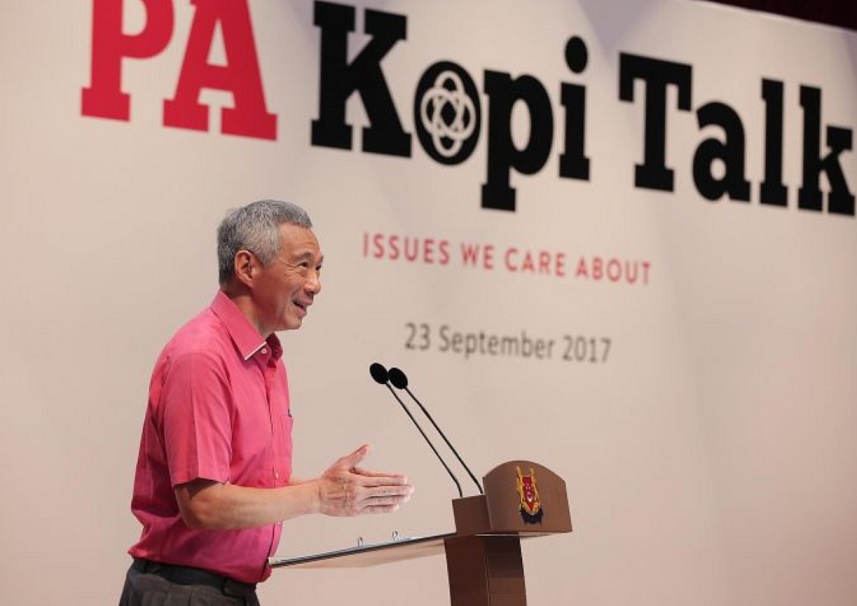
    PM Lee was speaking at a People’s Association Kopi Talk dialogue with about 500 grassroots leaders last Saturday, and the Prime Minister’s Office released an edited transcript on Friday (Sept 29).

    During the dialogue, he spoke about race, multiracialism, terrorism and the elected presidency, and gave a stout defence of why constitutional changes were made to reserve elections for groups that have not held the presidency for some time.

    Acknowledging that there was “some unhappiness” over the election, PM Lee said: “I can feel that; you don’t have to tell me.”

    He noted that the Government had spent nearly two years preparing to make changes to the Constitution, and had discussed and debated the issue continually since he first raised the subject in January 2016 during the opening of Parliament.

    “But it is only now that people are seized with it, after a reserved election in which only one candidate qualified,” he said.

    PM Lee added that while some people think “we may be going backwards towards racial politics”, the reality “is the opposite”.

    In fact, he said, ensuring that minorities are elected president from time to time will strengthen Singapore’s multiracial system.

    The current state of affairs, where Singaporeans of different races and religions live in harmony, is not a given, he said.

    “There is nothing natural about where we are – multiracial, multi-religious, tolerant and progressive. We made it happen, and we have got to protect it, nurture it, preserve it, and never break it.”

    Referring to the recently-concluded reserved election, Mr Lee said that three Malay candidates had put themselves up for the presidency, of whom two did not qualify.

    “But they came forward,” he added.

    In the 2011 presidential election, there was not one Malay candidate, he noted.

    “Was there a Malay candidate? Where were the Farid Khans and the Salleh Maricans? Why didn’t they come? It did not cross their minds? No. So why didn’t they come? Because they knew that in an open election – all things being equal – a non-Chinese candidate would have no chance,” he said.

    Citing President Halimah, who said when she was sworn in that she looked forward to the day when reserved elections are no longer needed, Mr Lee said: “I too hope that we will eventually not need such a mechanism to ensure minority representation.”

    But he said it would take time to work towards this ideal state.

    “In climbing towards that ideal state, we need guide-ropes and guard-rails to help us get there and to prevent us from falling off along the way. The reserved election for the President is one such guard-rail,” he added.


    Source: http://www.straitstimes.com

  • Najib Razak: Although My Father Or Grandfather Isn’t From Kerala, I Am Known As The Father Of Indian Development

    Najib Razak: Although My Father Or Grandfather Isn’t From Kerala, I Am Known As The Father Of Indian Development

    In what may be another attempt to court ethnic minority voters, Malaysian Prime Minister Najib Razak has declared himself a champion of development for the Indian community. He highlighted that he insisted on appointing a senior civil servant to head the Customs Department, despite objections to the candidate’s ethnicity.

    Addressing the Malaysian Indian Congress (MIC) general assembly yesterday, the Prime Minister said: “Although my father or grandfather isn’t from Kerala, I am known as the father of Indian development.”

    It was a sarcastic broadside against his mentor turned critic Dr Mahathir Mohamad, who is now chairman of the opposition Pakatan Harapan coalition. The former premier’s lineage includes ancestors from the southern Indian state.

    Mr Najib told the 2,000 MIC delegates that the opposition is merely trying to confuse people by labelling Malaysia a failed state.

    “The question is, what have they (the opposition) done for the Indians compared with what BN (Barisan Nasional) has done, more so after I took over the leadership of the country from Abdullah Badawi,” he said.

    “With his (Mr Abdullah’s) permission, I initiated (a) Cabinet committee on Indian affairs to further develop the Indian community because I realised that without intervention and political will, Indians would be neglected, marginalised and left behind.” The MIC is a component party of the ruling BN coalition.

    Mr Najib said he also prioritised Indians in the selection of the new director-general of Customs. “I do not mind telling you, even the appointment of the new director-general of Customs was difficult. I received petitions not to pick an Indian for the post,” he recounted.

    “I said no, he (Mr T Subromaniam) deserves the post because he is the most senior. I stood my ground.”

    In March, Mr Subromaniam was appointed to head the department. His appointment came despite grassroots efforts to petition for the post to go to a Malay candidate.

    However, some Indian community leaders were sceptical about Mr Najib’s comments. “When he held many important posts in the government prior to becoming the prime minister, what has he done for the Indians? Basically nothing,” said Mr A Rajaretinam, president of Malaysian Indian group Rapat.

    The Premier is believed to have been wooing the Chinese and Indian minorities, fuelling speculation that the general election could be held later this year.

    In July, Mr Najib said the government will study a request from the Indian-Muslim community to be recognised as Bumiputera. Earlier this month, he said he wanted to see a “stronger Chinese representation in the BN government”.


    Source: http://www.todayonline.com

  • Commentary: Singapore Malay President Dilemma; Everybody Want To Count Themselves Malay For PE

    Commentary: Singapore Malay President Dilemma; Everybody Want To Count Themselves Malay For PE

    🇸🇬SINGAPORE MALAY PRESIDENT DILEMMA

    In Malaysia it was very clear that most Indian Muslims and all others Muslims minority wanted to blend with the Malay masses and to be recognized as Malay so as to benefit the bumiputra status.

    It was encouraged by the Malaysian government as it has benefited both parties but it cannot be the same with Singapore after the separation with Malaysia.

    Singapore government has always wanted to segregate other Muslims minorities and ethnicities from being grouped and counted as Malays.

    Since Malays in Singapore were weak economically, politically and position so it’s is not an issue for them and in fact they themselves wanted to be distinct and separated and they were always proud of their own heritage, language and culture.

    Now that Elected President is reserved for Malays, they suddenly wanted to count themselves as Malays which made most Singaporean Malays felt amused and reserved.

    I think that’s the perception that has to be corrected and Singapore government must have clear definitions what constitute to be a Malay in multi racial Singapore.

    They just cannot become a Malay selectively.

    🖊 Ismail L. A.


    Source: Mohamed Ismail Ismail

  • Shanmugam Stresses Need To Uphold Racial Equality

    Shanmugam Stresses Need To Uphold Racial Equality

    The need for Singapore to remain committed to protecting its minorities was stressed by Home Affairs and Law Minister K. Shanmugam yesterday, as anti-Islamic and anti- immigrant sentiments jolt the world and the region grapples with growing polarisation along religious lines.

    “In the face of all this, the Government has to convey a clear message: We are all Singaporeans. We guarantee the safety, security and freedom of religion to all, including the Muslim community,” he said. “And as a community, we must covenant to ourselves to never allow xenophobia and majoritarianism to override the protection and guarantee of equality, particularly to minorities.”

    With 74 per cent of the population being Chinese, “our system of elections means majoritarianism could have easily taken hold and can, in future, easily take hold”.

    He credits Singapore’s founding leaders for laying the foundation that includes ensuring equal opportunities for the minorities.

    Mr Shanmugam’s robust statement on Singapore’s core principle of equality for those of all races and religions follows the upheavals of the past week after US President Donald Trump’s order suspending refugee intake and temporarily keeping the citizens of seven Muslim-majority countries out of the US.

    At a seminar on religion, conflict and peacebuilding, he said the US changes, made suddenly, present a serious risk to Singapore. The travel curbs, he noted, reflect anti-Islamic feelings gaining ground in the United States and Europe. “It is a groundswell fuelled by fear and a substantial element of racism. Many otherwise reasonable people are also supporting such movements,” he said.

    Singapore, with a 15 per cent Muslim population, could easily slide into a similar situation, he added. Hence, it is imperative that the Government steer clear of engaging in racial politics, Mr Shanmugam said.

    But it can do this only with the community’s support, he added.

    While the majority must back these efforts, the minorities must play their part, and not grow increasingly exclusive. Both sides need to “work together to increase common space, and work with the Government that is determined to hold the common space together”, he said.

    “That is the only way we can resist the tide of populism that is sweeping the rest of the world. We keep to our way of life,” he added.

    The two-day symposium is organised by the S. Rajaratnam School of International Studies under its Studies in Inter-Religious Relations in Plural Societies Programme.

    In his address, Mr Shanmugam sketched his view on what has led to the anti-Islamic wave in the West, Singapore’s approach in avoiding the backlash elsewhere against minorities, and regional trends that could agitate Singapore’s minorities.

    Pointing to the Chinese majority, he noted that Singapore has avoided majoritarianism by ensuring equal opportunities regardless of race or religion, guaranteeing religious freedom and clamping down strongly on hate speech.

    “The result is, regardless of all else, you can walk with a sense of being yourself, comfortable in your own skin, as an equal citizen… That is the lived reality of a Singaporean,” Mr Shanmugam said.

    But this takes work, he said, noting that the Government has not taken a laissez faire approach. Without active state intervention, he said, “you will get segregated communities, segregated schools, the lessening of common space and a reduction of opportunities for minorities”.

    Urging racial and religious leaders to champion integration and interaction, he said: “This is critical… to preserve what we have in Singapore.”


    Source: ST

  • US Special Rep To Muslim Communities: Important To Give Singapore Minorities Equal Entrepreneur Opportunities

    US Special Rep To Muslim Communities: Important To Give Singapore Minorities Equal Entrepreneur Opportunities

    PALO ALTO, CALIFORNIA – For Singapore’s entrepreneurship landscape to reflect the diversity of its society, business owners and youths from minority groups must have equal access to funding and opportunities, a United States official said.

    This is important because entrepreneurship can act as a powerful counter to violent extremism, while also exposing young people to new ideas and opportunities, noted Mr Shaarik Zafar, the US Department of State’s Special Representative to Muslim Communities.

    Mr Shaarik was speaking to journalists on the sidelines of the Global Entrepreneurship Summit, which is being held over three days on the Stanford University campus in California.

    More than 700 entrepreneurs and 300 investors from around the world are taking part in the summit, including at least seven representatives from Singapore.

    Mr Shaarik has made three visits to Singapore, most recently in May this year when he met with Singapore’s Minister for Environment and Water Resources Masagos Zulkifli.

    “Singapore’s diversity, just like diversity in other countries, is its strength,” he said in response to questions from The Straits Times at the Summit.

    “Singapore has strong rule of law, and access to capital. But the challenge is, as in many parts of the world, sometimes minority youth don’t have access to this,” he noted.

    “I think the key is mentorship, and often that means people mentoring young people outside their community.”

    Mr Shaarik added that Singapore can be an “important role model” when it comes to helping minorities access entrepreneurship opportunities.

    “The next step is engaging Muslim youth, and other minority youth, and making sure they have access to the same training, the same mentorship, and the same capital…It’s important that all aspects of Singaporean society are able to access (these).”

    Mr Shaarik also said promoting entrepreneurship is a “fundamental part”of US President Barack Obama’s foreign policy, “because we recognise entrepreneurship is directly linked to stability, economic growth and connectivity with the world”.

    His comments echoed remarks made by US Secretary of State John Kerry earlier the same day, during the official opening of the Summit.

    Entrepreneurship can create jobs and opportunities for young people all over the world who might otherwise be vulnerable to violent extremist ideas, Mr Kerry told the audience.

    “Think of the peril if we leave those minds, which have the same desires that many of you do here, if we leave them to the pickings of extremists and exploiters and demagogues,” he added.

    “(Entrepreneurs) provide a highly visible and very effective rebuttal to the propaganda of violent extremist groups. Because your optimism provides an alternative to their nihilism. Because you’re trying to build the brighter future that in fact these folks are determined to prevent.”


    Source: www.straitstimes.com