Tag: minorities

  • Suliyati Sufian Maryam: Lack Of Alternative Voices In Parliament, Fair Representation Of Minorities Unlikely

    Suliyati Sufian Maryam: Lack Of Alternative Voices In Parliament, Fair Representation Of Minorities Unlikely

    <suli>After the results of last night’s GE, I came back from my best friend’s wedding to witness the area around my block littered with hell notes, smoke and ashes flying into my eyes and my Chinese neighbours fervently lighting up joss sticks along almost every inch space of the grassy patches around the area. No, I wasn’t annoyed or frustrated; I thought “oh it must be the last day of the hungry ghost, that’s why they are going all out.” I didn’t feel like I should be telling anyone that they should be more considerate in their burning or that they should pick up the stray notes after they are done because I accept it as a way of living in singapore and I actually enjoy seeing this experience although it gets hot (I mean on top of the haze!) and sometimes ashes do get blown into my flat. It is part of living here and I accept it as it is.

    But then I started thinking about how I had to perform my acts of worship when I was in school or when I was still working and I felt sad. I felt sad because I always had to do it in secret, as though what I was doing was a crime. My friends and I would look for corners along dusty staircases, back alleys, helping each other keep a look out for teachers or other students who might pass by. And when I began teaching at a secondary school, I had to pray in secrecy at an area where broken chairs are kept and even then, I was warned not to let anyone see me enter that place to pray. When the boss eventually found out about the prayer place though, it was forbidden to us and all of us who have been using that dirty abandoned place to pray had to look for staircases to perform our daily obligation. Yes, for those of you who dont know, Muslims HAVE to pray five times a day abd for most of us, we&apos;ve been doing it like how I describe it above, like we are criminals.

    And then I think of the ban on music during Thaipusam and I also felt sad for my Hindu friends and I started to think what is the rationale behind the ban? If it’s the music that’s too loud, then we should also ban music during Malay weddings and Chinese funerals cos these can get very loud too. If the govt is afraid of ppl getting too carried away by the music during thaipusam, I am sure there are 1001 ways to work around that issue because they’ve been doing for years without much incident.

    When I was deciding what faculty to enrol in as I was about to enter NUS, I ruled out Nursing after Medicine (and I didnt get into Medicine) because I know nurses in Singapore cannot wear hijab but I accepted it as it is. So even though I wanted to go into healthcare, I ended up taking a basic Life Science degree instead because one option was already out for me because of what I wear on my head.

    My dear friends who are part of the majority, I want you to know that I have nothing against you and am indeed happy for you that you have every opportunity to pursue your dreams or climb that social ladder as long as you work hard for it. Or that as you are burning hell notes for youtlr ancestors, you dont have to do it like a thief and make sure no one sees you doing it. But pls pls don;t let your experience of life here be your only measurement of life for others who are not part of that majority. Don’t say “where got unfair? If you work hard sure can get it what. Govt doesnt discriminate against religion also, so what are you talking about?” because you don’t experience life here as a minority, and with an obligation that makes you stand out (im talking about the hijab). Only those of us who have been dealing with it on a daily basis know how difficult it can get at times and even then, we;ve been very tolerant about our situation for years and years and how can we know this? Despite having our basic right to practise our religion without being discrimated against violated, you dont hear of riots by Muslims do you? Instead we have been engaging the govt in diplomatic ways thru petitions and dialogue sessions. So pls dont tell us things like we need to do more to assimilate – we have been assimilating for as long as we can remember despite the restrictions placed on us.

    So back to the GE story, I was predicting PAP to win and I am happy that they have won because I do think they are strong and capable of leading singaporeans. But when you think of this country declaring itself as a democratic country and you see 83 out of 89 seats in govt occupied by one party, you must think to uourself, where is the democracy in that? Where is the chance for alternative views to be heard? 6 voices out of 89 will be drowned out, so how can issues that the incumbent party have for years dodged get addressed properly without being shot down as asking for more privileges?

    So i hope you can understand our frustrations when we see our hopes for alternative voices get voted against by ppl spreading fears of “freak elections”, or that the GE was held immediately after the ruling party has pampered its citizens with money and SG50 celebrations. It’s not that we want to see the PAP toppled; it’s that they are only going to have their policies checked against by 6 voices outof 89. There is no way that there will be fair representation for us minorities with that kind of statistics.


    Source: Suliyati Sufian Maryam

  • Cherian George: Lee Kuan Yew Was Bulwark For Singapore Minorities

    Cherian George: Lee Kuan Yew Was Bulwark For Singapore Minorities

    Unlike-Lee admirers around the world may be missing significant details.

    In an amusing case of mistaken identity, a banner honouring Lee Kuan Yew has appeared in India, bearing a photo of another Singaporean elder statesman, President Tony Tan. Both are white-haired ethnic Chinese males, but Tan, as you have may noted from Channel NewsAsia’s coverage of Lee’s funeral today, is rather more alive.

    The picture has been making the rounds on social media in Singapore, bringing smiles to an otherwise sombre day. It serves as a useful reality check for Singaporeans, that although Lee has been lauded by world leaders as a 20th century giant, not everyone can recognise him from Tom, Dick or Tony.

    Some other cases of mistaken identity are less trivial. It’s nothing new. For at least a couple of decades, he has been all things to all men who aspire to a certain kind of leadership. They see in him a model, a kind of proof-of-concept that they can point to when defending their own missions and methods. Leader X is Country A’s Lee Kuan Yew. How often have you heard that line.

    As a Singaporean born in the year of the republic’s independence, I’ve benefited from Lee’s global brand, most tangibly in the fact that my red passport travels extremely well. But the way that brand is sometimes used is cringeworthy.

    Most of the parallels that foreign politicians and their acolytes draw with Lee Kuan Yew are selective and self-serving. His name is evoked by anyone who wants to apply less-than-democratic means in the name of strong, decisive leadership in order to achieve high economic growth. But there was a lot more to the man and his formula for success.

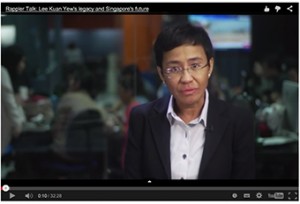
    My interview with Maria Ressa of Rappler.com.

    The most obvious was the zero tolerance of corruption that he embodied and instituted in the Singapore system. That is probably a chapter in his bestselling memoirs that admirers like former Thai prime minister Thaksin Shinawatra skipped. Similarly, fans of Indonesia’s late president Suharto who cite his friendship with Lee conveniently ignore the fact that Suharto topped the world league table of corrupt leaders, according to the same organisation that routinely names Singapore as the cleanest in Asia.

    Less noticed is the fact that Lee, while loudly dismissive of the liberal brand of democracy, never deviated from electoral authoritarianism – the belief that regular multi-party elections are ultimately the only way for a government to win legitimacy, and are not bad at keeping a dominant party on its toes. Of course, he did his best to insulate his government from distractions like short-term public opinion, an adversarial press and protest movements; he also treated the opposition unfairly, to put it mildly.

    But, to this day, elections in Singapore remain competitive enough and credible enough to make democracy “the only game in town”, as political scientists would put it. As a result, opponents of the regime plot election strategy, not extra-parliamentary struggle; and Singaporeans accept the government’s authority as legitimate, even if they disagree with its policies. The thousands of Chinese officials who pass through Singapore to learn the Lee model may think this lesson can’t apply to the People’s Republic, but shouldn’t overlook how important it has been to Singapore’s success.

    Back to India. When its government decided to fly the tricolour at half-mast today, I wonder which Lee they were honouring. I hope – but I doubt – that it was the leader who stood resolutely against sectarian politics and majority domination. Among all his core principles, this is the one least talked about abroad. Yet, to minorities like me – and, thankfully, most members of the majority race as well – this may be the single most precious aspect of the legacy.

    Not that he got everything right. Older Indian Singaporeans still bristle at the way he labelled us as “fractious and contentious”. The stereotype might not have been off the mark (note Amartya Sen’s Argumentative Indian thesis), but if only he had seen it as a positive contribution to Singapore’s national culture rather than a weakness. Similarly, his open suspicion of Muslim Singaporeans’ growing religiosity was hurtful. Some of such straight-talking about race and religion could come back to haunt Singapore, should future bigots exploit his words to justify their prejudices.

    But minorities never needed to doubt this: Lee was an unshakeable bulwark against majoritarian tendencies that could have easily overwhelmed Singapore. Malay/Muslims make up only 15% and Indians 7% of the population. For decades, the risk of a Chinese chauvinist party playing the race/language card posed the single biggest threat to PAP dominance. This fact is lost on most of the Western press, who self-aggrandisingly like to believe that they were Lee’s bête noire. They were more like sparring partners, compared with champions of the Chinese-speaking ground, who were the main victims of both detentions without trial as well as flagrant censorship.

    Lee went to the extent of amending the republic’s Constitution to stop any party from sweeping into power without minority support. For most Parliamentary seats, candidates are forced to contest as small teams that must include minorities. Thus, no Chinese party could do in Singapore what the BJP did in India last year – come to power without a single MP from the country’s largest minority group.

    Thankfully, Lee and his comrades were influenced by an older Indian tradition, the Nehruvian secular ideal that accommodated minorities – the same tradition that the BJP and the larger Hindutva movement is bent on dismantling.

    Singapore should not presume that it can serve as a model for any other country, least of all India. The world’s largest democracy is 200 times larger than the city state that Lee ran, and its challenges are profoundly more complex.

    But if foreigners do choose to honour Lee Kuan Yew, they shouldn’t fall into the mistaken-identity trap. Yes, he was a firm leader who stretched the limits of democratic government to breaking point in order to get things done.

    But a leader who makes minorities feel unwanted, insecure and fearful?

    That’s not a face that Singaporeans recognise.


    Source: www.airconditionednation.com

  • IS Militants Targeting Minorities, Women And Children

    IS Militants Targeting Minorities, Women And Children

    LONDON (Thomson Reuters Foundation) – Islamic State militants have abducted, injured and killed thousands of civilians across northern Iraq and uprooted millions from their homes in a bid to eradicate the country’s ethnic and religious minorities, rights groups said on Friday.

    Several minority communities, including Christians, Yazidis and Turkmen, have been subjected to killings, rape and sexual enslavement, and women and children have been targeted in particular, a report by four human rights organizations said.

    Islamic State seized the Iraqi city of Mosul in June last year while sweeping through the north towards Baghdad, meeting virtually no resistance from the army and declaring a caliphate in parts of Iraq and Syria under its control.

    Around 8,000 civilians were killed and more than 12,000 wounded between June and December 2014, the United Nations said.

    Alison Smith, legal counsel of No Peace Without Justice, said Islamic State had committed war crimes, crimes against humanity and possibly even genocide against minorities in northern Iraq.

    Iraq’s U.N. ambassador told the U.N. Security Council last week that Islamic State had committed genocide.

    Sectarian violence across Iraq has worsened since June last year according to Mark Lattimer, executive director at Minority Rights Group, who said the abduction of thousands of women by Islamic State was “particularly concerning”.

    “Islamic State have sold Yazidi slaves to families in Mosul, which wasn’t hidden or kept secret,” Lattimer told the Thomson Reuters Foundation. “Enslavement has become an accepted fact of life in areas under (Islamic State) control.”

    The report said that thousands of women and girls had been raped, tortured and forced into conversion and marriage, while a pregnant teenager who escaped Islamic State said captives were forced to donate blood to keep wounded fighters alive.

    The bodies of women raped and killed by Islamic State in the Turkmen majority town of Beshir in June last year were stripped naked and hung from lamp posts around the city, the report said.

    Children as young as 13 have been used to carry weapons and act as human shields for the militants during combat, it said.

    “HUMANITARIAN CRISIS”

    More than two million people in Iraq have been displaced, primarily in the north, according to the latest figures from the International Organisation for Migration.

    The majority are living under bridges or squatting in abandoned buildings, while those in refugee camps face a lack of food, water and healthcare because of government failings and limited aid from international agencies, the report said.

    International donors have so far provided 37 percent of the $2.23 billion requested for humanitarian aid for Iraq, according to the United Nations.

    “The sheer number of displaced people means the country continues to face a humanitarian crisis… many of them are in a difficult and precarious situation,” Lattimer said.

    Many minority groups are now trying to leave the country, fearing that the government will be unable to support any return to their communities, locate missing people and ensure the recovery of possessions looted by Islamic State.

    “It’s a feeling that we are no longer welcome in our own home,” one Christian leader told the writers of the report.

    The report said the Iraqi government lacked a legal framework to address the rights and entitlements of those displaced, and should clarify its role and responsibilities.

    It also called on Iraq to investigate and prosecute corruption in the delivery and acquisition of humanitarian aid, provide urgent assistance to the humanitarian effort, and resettle minorities who have been displaced.

    The report was co-authored by the Institute of International Law and Human Rights, Minority Rights Group International, No Peace Without Justice and The Unrepresented Nations and Peoples Organization.


    Source: www.todayonline.com