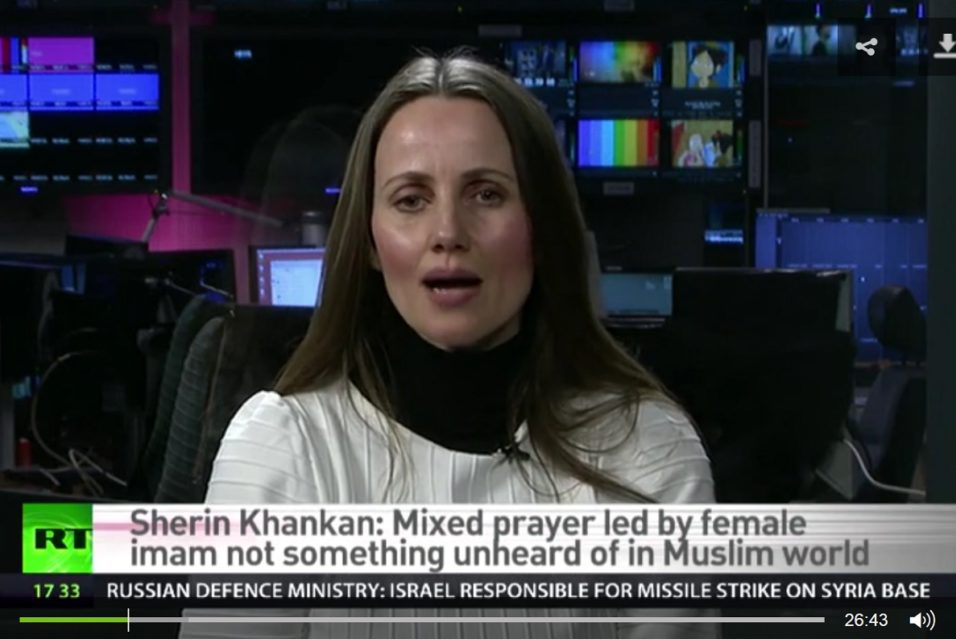
Islam in Europe has long been viewed with suspicion by the majority, accused of not representing European values. Is that really true and can it be changed? We asked Sherin Khankan, Denmark’s first female imam.
Follow @SophieCo_RT
Sophie Shevardnadze:Sherin Khankan, Denmark’s first female imam, welcome. It’s really great to have you with us, I am really excited to ask you all the questions that I want. Now, you call yourself an Islamic feminist being Denmark’s first female imam. Do you think a woman could ever lead a mixed mosque in prayer in Islam, not just female-only? And would you like that to happen?
Sherin Khankan: Actually, I had the vision of a mosque with female imams many years ago back in 1999. I was inspired when I did my thesis in Syria in Sufism and Islamic activism and back then I visioned a mosque with female imams leading the prayer actually for both men and women because I’ve always prayed together with men and women. So it is very natural to me, I was always working against the segregation within different spheres. So when I started the mosque we recruited other people for our team for the theme imam group and, like any group, like any community, you have to vote as it is a democracy and the majority of the community voted for a women’s mosque only. So I had to accept that and I think now, when I look back, I am really happy about the decision because I realised that having a mosque where women or female imams lead the prayer for only women is not controversial at all. So we are actually able to do other revolutions that I consider more important because when you pray it is about….
SS:But do you feel like your vision of having a mixed mosque could ever come true? Is this something you would want to see in the future?
SK: It is already happening because we are the first mosque in Scandinavia with female imams, but there are mosques all over the world – in China since the 1820s, in the U.S. and Canada, in Germany. And especially in Germany and Canada and the U.S. there are mosques with mixed prayers, so it is already happening in many places in the world. I do hope that in the future we could have a mosque with both male and female imams and I hope that in the future we could have mixed prayer also, because we have so many young men who tell us: “We would also like to come to the Mariam Mosque and to pray with you, we would like to come as a family with our children”. So I think it will happen maybe in the future. But right now I am quite happy about a women’s mosque.
SS: So Islamic State’s extreme take on Islam still attracted a lot of women to go and volunteer and join its cause. You, as a female spiritual leader, how do you explain that? Why would people, why would women volunteer to be so horribly oppressed? By ISIS, I mean.
SK: I think that people tend to become radicalized or attracted to radicalized communities because they don’t feel a part of the existing communities that they live in. Often if you don’t feel a part of the existing community, you have nothing to lose and you try to seek other communities where you feel at home and where you feel that you are validated. So, unfortunately, these communities that are very extreme, they focus on all these political issues of today and they use all these political tensions in order to recruit very vulnerable young people, who maybe do not feel at home in the existing European communities or where they might live. That is why it is so crucial that we try to include our minorities in the existing countries in order for everybody to feel at home and to feel a part of the community.
SS:You believe that the Koran at its basics considers men and women equal. So all the patriarchal oppressive parts of the traditional Islamic societies – where do they come from, if not religion?
SK: In the Koran there are 114 chapters and more than 6600 verses. There are six verses that could be interpreted as discriminatory against women, but they could also be interpreted or re-read differently with a focus on women’s rights and gender equality. That is actually what we are trying to do in the Mariam Mosque. We try to re-read these verses in order to create gender equality. This is actually happening all over the world, we have male and female scholars who try to re-read the Koran in our times and our societies. Within Islam, we have a patriarchal structure within religious institutions and that patriarchal structure, of course, has affected the interpretation of the Koran. So this is also what we would like to challenge – this patriarchal structure, these patriarchal readings of the Koran – and I think that female imams have something to contribute in that context because we have a specific focus on gender equality and we are in need of that.
SS:So you are not wearing a hijab. Should a head or face cover be a choice? Is it a sign of oppression? What do you think?
SK: Of course, I mean, we are born free, so all humans should choose for themselves how they want to live their life. Muslim women have different interpretation of what it means to be a modest woman. This is my interpretation of modesty: to me the scarf is a metaphor for sincerity towards God and sincerity in the relationships that you find yourself in – it could be a friendship or a marriage or whatever. But I also respect women who choose to wear the hijab and see it as a part of their Islamic identity. We have to accept and respect that women have these different interpretations of what it means to be a modest woman. In the Koran there are two verses concerning the scarf and concerning the covering. One of the verses is specifically related to the wives of the Prophet and the other verse is more universal.
SS:So, like you said, hijab to burka, it is all based in the requirement to be modest for a woman in Islam. Don’t you see that as another vestige of the patriarchy that you are resisting, like and woman has to think about how a man sees her and worry whether she is judged modest or not by a man?
SK: That is not my interpretation of modesty, I use the term more in a sense that you choose how you want to present yourself in a sense of a more spiritual sincerity. So I have the same respect for a woman who is wearing a miniskirt and a woman who is fully covered. I mean it is up to any woman to choose how she wants to dress and how she feels comfortable. It is stated clearly in the Declaration of Human Rights that any human being has the right to practise his or her religion in the private sphere and in the public sphere, so we cannot decide that women should not wear the hijab. It is a human right, it is a freedom of religion, and freedom of religion is just as important as freedom of speech. Of course, what happens in Iran where women are forced to wear the scarf – I condemn that and I fight against that and I would fight for any woman’s right…
SS:But do you also condemn whatever is going on in Europe right now where countries are trying to ban full hijabs on women in the streets?
SK: Of course, if a woman chooses to wear the hijab or the burka it is her own individual decision and we should not fight against that. We have to support any person’s right to practise his or her religion. I mean, we signed the contract, we signed the Declaration of Human Rights, so it is actually stated there very clearly that this is a possibility. So I will fight for any woman’s right to wear the hijab and not to wear the hijab. It’s a matter of personal decision.
SS:You are quite an interesting mix of an absolute European democrat and a spiritual leader in Islam. When you try to fight Islamophobia and open up your religion, open up Islam from a different angle, how do your fellow believers see you? Do you think you are a true Muslim in their eyes, in the eyes of clerics from Egypt and Iraq? Or maybe you don’t even care what they think?
SK: Actually, I do not seek the recognition of other people; I seek the recognition of God. But, of course, it means something to me what people think. Actually, we had a visitor – it was the grand imam from the third largest mosque in Indonesia, Jakarta. It is called the Istiqlal Mosque. The grand imam has 200,000 Muslim visitors every Friday for his Friday prayer. He came to the Mariam Mosque in Copenhagen, he prayed in our mosque and he blessed our mosque and he blessed the concept of female imams. He even quoted one of my favorite inspirational sources which is Ibn Arabi – he lived from 1165 till 1240 – and he said: “The perfect man is a woman”. So we have great Muslim spiritual leaders who support the mosque, but we are also met by the opposition, because when you change a patriarchal structure you change the power balance, and people will become upset. It is natural and it is expected.
SS:What is harder in your everyday reality? Dealing with the nationalist Islamophobic right-wingers or religious Islamic fanatics?
SK: I think both. I mean, they are very similar on both sides. Both sides tend to generalize, they are manipulating dichotomies between them and us, between being a Muslim and being a secularist, between Muslims and Jews, Muslims and Christians. All these manipulated dichotomies – you will find them on both sides. And this is actually what I try to fight against, what we try to fight against or challenge. We try to deconstruct all of these manipulated dichotomies showing the world that Islam is a religion and it is a peaceful religion. It is possible to be a practising Muslim to believe that the Koran is the word of God and at the same time to be a member of secular societies. It is possible.
SS:Sherin, in Morocco the council of Islamic scholars is allowing women to officiate interfaith marriages, in Saudi Arabia women have been allowed to drive. There are steps forward in more traditional Islamic countries, but do you understand that from a Western point of view this is not really impressive? These are very basic things that should not have been banned in the first place.
SK: Yes, I agree with you totally. In the Mariam Mosque we have constructed a new Islamic marriage contract that gives Muslim women a right to divorce. Actually, today in the world Muslim women do not have the basic right to divorce, it’s the right of the husband. But actually it is an Islamic principle – a right to divorce. We have constructed a new marriage contract giving women the basic Islamic right to divorce. If polygamy is forbidden in our contract, if mental or physical violence occur then marriage is annulled, and the woman has the right over the children in case of a divorce. We also conduct inter-religious marriages in the Mariam Mosque as the first ones in Scandinavia. We believe that any person has the right to choose her partner for life and it should be a very basic thing. But unfortunately, today one of the biggest dilemmas, not only in the Muslim world, but also in Europe, is interfaith marriages and the concept of the interfaith marriages.
SS:Yes, I am going to come to that. But before we speak about that, I’ve met Arab Spring activists, women from Yemen and Libya. They work on women’s rights while looking at theological foundations, ways of interpreting the Koran, finding the right hadith, etc. Can women’s rights ever work outside religion in Islamic communities? What I mean is that, for instance, feminism in the West is not tied to religion, feminists don’t go to St. Luke or St. Paul, they don’t turn to the Bible and ask if women have rights too. So I am asking if secular feminism is even possible in Muslim culture?
SK: Of course, it is possible. It is happening all the time. In many Muslim countries you have a population that is secularist and they are not even occupied with religion. But I am occupied with reform within the religion; I am occupied about how can we re-read the Koran with a focus on gender equality. But the secular feminism is present all over the world and also in the Muslim world.
SS:So when you say “down with polygamy, down with oppression of women, you could be a good Muslim and not wear a veil”, but I’d imagine your religious opponents would say: ‘Wait, well, this is not Islam at all’. Is Islam really an all-you-can-eat cafeteria where you can pick and choose what you like and discard what you don’t like?
SK: Actually, I believe that, as a Muslim spiritual leader, we should not judge people, we should listen to people. In the Mariam Mosque we have female imams with and without the scarf and in that sense we are reflecting reality as it is. I am very confident and happy about that.
SS:Now interfaith marriages – you conduct them in your Mosque, and people come from all over Europe to get married by you saying that it is possible to find imams elsewhere who’d do it. But if other imams don’t do it that means that your religion is against that. So is this technically cheating?
SK: Actually, Tunisia is the first Muslim country in the world that has changed the law in December 2017. Now they made it possible for Muslim women to marry non-Muslims. I think that that could create a domino effect in the rest of the Muslim world, not now, but maybe in the future because someone has to take the first step. We are actually not the only mosque that conducts interfaith marriages; it is happening in different places in the world. Officially it is not stated that it’s happening, but I know that it is happening in different places.
SS:I don’t mean to offend, but I need to get down to the core of things and ask you whether there are double standards in everything that we are talking about here. Maybe someone would even tell you that clinging to the religion in such a way is really paying a lip service for it. What I mean is that if Islam doesn’t accept hypothetically interfaith marriages, and if I want to marry a Hindu and I am a Muslim, then maybe Islam is just not for me if it calls me to be a sinner for it, right? And if I am gay and the Catholic Church doesn’t want me at prayer, then maybe Catholicism is not for me? What is the point, if you simply do not fit?
SK: I do believe that interfaith marriage is legitimate also according to Islam as a religion. In the Koran it is stated clearly that a Muslim man can marry a Jew or a Christian, but it is not stated clearly that a woman can marry a Jew or a Muslim. And it is not stated that she cannot. But in the Koran it is stated clearly that both men and women should seek devoted secrets of the One God. We find the legitimacy in the Koran and we do believe that the right to choose your partner is a basic human right. If you believe that the Koran contains an essence on gender equality – ‘what goes to a man, goes to a woman’ – this is actually what we come from and what we believe in.
SS: I wonder if you have any ties with woman clerics of other religions like female rabbis or female Christian priests, is there any kind of gender solidarity that is crossing religious lines?
SK: In the Mariam Mosque we corporate with other communities, we are very inspired by the Jewish, the progressive Jews in Denmark. I’ve also recently met Delphine Horvilleur in France; I’ve met the French President recently in the company of Delphine. We are really inspired by what they do because female rabbis are doing the same thing as we are doing within Islam. I think, we have a lot to learn from each other.
SS:You know we hear many top political figures in Europe saying that Islam does not belong to Europe. You live in a country where the government is strongly against Islam. Does it make it hard for you to get your message across? Or the rhetoric on the politicians’ level doesn’t really reflect what ordinary people think and how they treat you?
SK: I think, it is a myth to state that the government in Denmark is against Islam. That is not the case. We have a growing Islamophobia, a growing anti-Islamic rhetoric and propaganda in Denmark, but it is in the right-wing parties. The government, in general, they do accept Islam as a religion like any other religion, so at the state level it is accepted and I do not experience any kind of anti-Islamic rhetoric at the state level. But, of course, at the right-wing parties on a daily basis you experience an anti-Islamic rhetoric and propaganda. And we try to challenge that.
SS:There is a push from Muslims in countries like England, Canada and France to create a separate Shariat legality for them, since those laws are the way of the faith. Do you think that Muslims in non-Islamic societies should have a separate legal system for themselves?
SK: No, I do not think so. I think that Muslims all over the world and in European countries should accept and be a part of the constitution that is existing in those countries. It is also stated clearly in the Koran that Muslims have to submit themselves to the existing constitutions in the countries that they live in, so it is actually very basic. And I do believe that the Western educational system is quite good. We also spoke about what would it be like to have female imam education in Denmark, and I think that Western educational system is quite good and it lays quite a good foundation for being a female imam.
SS:So the cultural clash in secular societies gets violent sometimes if we remember the Danish cartoon of the Prophet, Charlie Hebdo or the American Muhammad movie, and how many people died as a result of all of that. What should come first here – the right of Europeans to draw any cartoon they wish, or the religious sensibility of Muslims?
SK: I think that, of course, freedom of speech is a universal and fundamental value, and it is not a Christian or Western value. It is a universal value, which is shared by people all over the world. To me as a Muslim, freedom of speech is an essential value. At the same time I have another essential value, which is the belief that the Koran is the word of God. I do believe that it is important for us as human beings to have this freedom of speech, but it is not a freedom to discriminate other people. Always with freedom of speech there comes responsibility, and everybody is responsible for how we talk and how we meet people. We have to ask ourselves: “What is the purpose of the dialogue, what do we want to use our freedom of speech for?” If we want to have a dialogue with people who think differently, it is not a very good strategy to speak really badly about these people. We have to ask ourselves what do we want to use the freedom of speech for and what is the purpose of freedom of speech. On both sides, everybody has to be aware and responsible when we have the power to express ourselves. With that power comes responsibility. As a spiritual Muslim leader I know that I have a certain responsibility, and when you have a power you have responsibility too. I think we should reflect on that theme when discussing freedom of speech because it is really very important.
SS: Sherin, thank you very much for this wonderful interview. We wish you all the best of luck. We were talking to Sherin Khankan, Denmark’s first female imam discussing whether Islam and European values can co-exist. That’s it for this edition of SophieCo. I will see you next time.
SK: Thank you.
Source: RT


