Tag: PAP

  • Tan Jee Say: Lee Hsien Loong Should Stop Fear-Mongering Over Calls For More Welfare Benefits

    Tan Jee Say: Lee Hsien Loong Should Stop Fear-Mongering Over Calls For More Welfare Benefits

    Two days ago, PM told a large audience at SMU that Singapore has to raise the GST from 7 to 20% if we want Scandinavian style benefits to raise the fertility rate. He is wrong. His speech is here

    In SingFirst’s social safety net announced in February this year, we have provided for Scandinavian style welfare benefits to encourage childbirth such as 90% subsidies on childcare centre fee and child allowances of $300 per month for children up to age 12. In addition, we also proposed a range of other benefits for families by lowering the cost of living such as waiver of all fees from primary one to university, 30% reduction in public transport fares and old age pension of $300 per month for all senior citizens aged 60 and above. The total package costs only $6 billion a year and it can be financed from the investment return of around $8 billion that the government is allowed to use for annual budget spending. There is absolutely no need to raise the GST at all, much less to up it to 20%. Here’s a summary table of SingFirst’s safety net package


    Details of our package are in this posting  SingFirst’s social safety net

    It is highly irresponsible for a prime minister to simply pluck a figure from the air and use it to scare the people from putting forward their legitimate demands.  Stop your PAP-style scare-mongering to mislead the people. And lay out the facts and figures in full so that Singaporeans can know the truth and engage in a meaningful debate about what the government can do to help them lower their cost of living, raise children, look after the elderly and develop strong families.


    Source: Tan Jee Say

  • Has Lee Hsien Loong Been Damaged In His Personal Capacity?

    Has Lee Hsien Loong Been Damaged In His Personal Capacity?

    Lee Hsien Loong and his lawyers were in court today at the beginning of the hearing to determine what damages Roy Ngerng had to pay him (see the report from the State media here).

    The lawyers said that:

    “It is therefore an extremely serious matter for the defendant to accuse the plaintiff of criminally misappropriating the monies paid by Singaporeans to the CPF.”

    “Such an allegation undermines the plaintiff’s ability to lead the country, sustain the confidence of the electorate and to discharge his functions as Prime Minister and chairman of GIC.”

    They concluded:

    “The case for a very high award of damages, including aggravated damages, is compelling”

    However, is it?

    It is a well-established principle in English defamation law that in order to win substantial damages you have to show that you suffered financial loss from the defamation. Thus if you were a politician and you lost an election or had to resign as a minister because of  defamatory statements made about you then you would be entitled to the loss of earnings from losing your seat or your position in the Cabinet. If you lost your job then you would be entitled to damages representing your lost earnings and your reduced earning capacity as a result of the libel.

    After the 1997 election Goh Chok Tong sued my father, JBJ, for holding up a police report at an election rally and saying that Tang Liang Hong had just handed it to him. The police report was made against Goh Chok Tong and several other PAP ministers including Lee Kuan Yew and his son, Lee Hsien Loong.

    However at the hearing, George Carman, my father’s QC, cross-examined Goh Chok Tong and got him to admit that his earnings had not suffered as a result of the election rally statement. To quote from a report that appeared in the Hong Kong Standard at the time,

    Mr Goh testified 1997 had been a good year saying his standing in the world had not been injured. Yet in an affidavit Mr Goh had said his “reputation, moral authority and leadership standing had been gravely damaged both locally and internationally”.

    Because Goh Chok Tong could not prove that he had suffered any damage and also because Carman showed that the plaintiffs (Goh Chok Tong  and the other ten ministers) had authorised the release of the police reports to the press themselves, the district judge Rajendran only awarded Goh $20,000 in damages initially. Later, as always happens in Singapore, Prime Minister Goh was able to find a more sympathetic ear from the judges in the Court of Appeal, and the damages were raised to $100,000 plus costs.

    Similarly in Lee Hsien Loong’s case what damage can he prove he has suffered as a result of Roy’s admitted defamation?

    He is still Prime Minister of Singapore praised by international leaders, including President Obama, and likely to continue in office after the next general election. Has his salary of $2.2 million been cut either by reducing his monthly salary or his Individual Performance Bonus of three months pay been cut?

    Lee Hsien Loong continues to be an MP so in addition to his Ministerial salary he continues to draw his MP’s salary of $192,500 per annum.

    The PM also remains Chairman of GIC which is a serious conflict of interest, and which I have criticised frequently ( most recently in “The Problem with Husbands and Wives in the WP, in the Ruling Family, in Our Reserves”).

    Although GIC’s annual report is silent on the subject of remuneration, it seems likely that Lee Hsien Loong would be paid, just as the other directors presumably receive directors’ fees and expenses.  The Ministerial Salaries Committee said in its 2011 report that Ministers would continue to only receive one salary per Ministerial appointment held but was silent on the subject of Ministers who serve on the boards of Schedule 5 companies like GIC and Temasek.

    Lee Hsien Loong’s wife, Ho Ching, continues as CEO of Temasek, despite the conflict of interest when her husband is the Prime Minister and has the ultimate authority over her appointment. Roy’s comments did not lead to her being sacked and she undoubtedly continues to be paid a multi-million dollar compensation package. Since her subordinates, most notably Ms Chua at SingTel who is earning over $12 million a year (see “Singaporeans Would Be Much Angrier If They Knew How Much SingTel’s CEO Was Really Getting” ), are earning total compensation packages running into many millions of dollars, Ho Ching can hardly be getting less. It is likely her total pay dwarfs that of her husband’s.

    Lee Hsien Loong appears not to have suffered any financial loss. Neither has he become a pariah or outcast on the international stage. Despite his lawyers arguing that Roy’s allegations had undermined his ability to lead the country, sustain the confidence of the electorate and to discharge his functions as Prime Minister and Chairman of GIC, there is no evidence of that.

    In fact, if there is any damage to the PM’s reputation, that damage is self-inflicted by his absurd decision to sue Roy, an unemployed health service worker from a lower income background, and to press for a ridiculous level of damages that he knows will force Roy into bankruptcy.

    At the same time Roy has been dismissed from his job with a Government hospital, suffered a public attack on his integrity by the Ministry of Health which has to all intents and purposes made him unemployable and also been charged with illegal assembly for exercising his rights to free speech in the only area allotted to Singaporeans for this purpose. If this is not a vendetta by the Prime Minister it certainly appears as such.

    It is also difficult to argue that Lee Hsien Loong has shown “an unflinching fidelity to integrity” as his lawyers said. If he did would he have permitted a system of governance with such an egregious conflict of interest where he is Chairman of GIC and his wife is CEO of Temasek? Between them they control over $800 billion of the nation’s assets including all the monies invested by the CPF Board in Government securities.

    It is a pity that Roy admitted defamation in the crude sense that the PM was directly  misappropriating CPF monies, which is how the Prime Minister’s lawyer, Davinder Singh, insisted on interpreting what Roy said.

    While there is no evidence of such gross impropriety, if the Prime Minister receives any remuneration as Chairman of GIC that is related to its performance then he indirectly benefits from GIC being able to borrow from the Government as cheaply as possible, which is again dependent on the interest rates paid to CPF holders. The lower those interest rates, the lower GIC’s cost of funds and, presumably, the higher its returns.

    While Temasek may not be directly dependent on CPF for funding, it receives subventions from the surpluses the Government generates. If cheap CPF funding enables GIC to make a higher rate of return and thus higher contributions to the Budget, the higher surplus may enable the Government to provide more money to Temasek for investment. According to Temasek’s annual report the bonuses of senior management are linked to the excess returns over a hurdle rate. If the hurdle rate is tied to the rates paid to CPF holders then Ho Ching’s compensation would be higher  the lower the rates paid to CPF holders.

    Roy would have been on safer ground if he had been clear that that is all he meant and that the PM should clarify whether he received any compensation from GIC and how Ho Ching’s compensation was determined.

    Going back further into the past, there is the HPL saga in the 1990s to remind us that Lee Hsien Loong has not always shown an unflinching fidelity to integrity. He, together with his father and siblings, received large discounts for the purchase of properties from a developer over whom his government held the power to withhold planning permission or to compulsorily acquire its land. That is the only instance that we know about but the fact that Lee father and son paid back the discounts they received is an acknowledgement that they had done wrong.

    In the UK ministers initiating defamation actions are normally required to resign from their posts for the duration of the case to avoid any conflict of interest that could arise. This is doubly the case with the all-powerful Prime Minister’s ridiculous action against a humble blogger who has admitted defamation. Instead of resigning for the duration of the case, LHL has gone the other way and even used the services of his Press Secretary in his private action, in a flagrant misuse of taxpayer resources that breaches the Ministerial Code of Conduct.

    Combined with the cruel and inhumane treatment meted out to sixteen-year old Amos Yee for criticising  LHL’s dead father, it appears that the Lee family want to silence any criticism of their godlike status. What will be next, I wonder, a six-year old expelled from kindergarten for saying bad things about Lee senior?

    It is clear that any reasonable judge or jury would either dismiss LHL’s suit, on the grounds that he had suffered no damage, or else award him derisory damages of, say, $1,000-$5,000. It used to be the case in the UK that juries would award damages of just a penny if they decided that the plaintiff had been technically defamed, but had not suffered any financial loss or else was guilty of similar transgressions just not the exact one of which he was accused by the offending publication. If we had a jury in Singapore that would be likely to be the outcome here.


    Source: http://sonofadud.com

  • Lee Hsien Loong: Roy Ngerng Not Remorseful

    Lee Hsien Loong: Roy Ngerng Not Remorseful

    The hearing on the assessment of damages that blogger Roy Ngerng has to pay to Prime Minister Lee Hsien Loong — after he was found guilty of defaming the Prime Minister — began today (July 1), in front of a packed courtroom with queues forming outside the courtroom hours before the session started.

    However, there were few fireworks during the six-hour hearing, with the judge repeatedly interjecting Mr Ngerng’s cross-examination of Mr Lee as a witness and bringing him back on track, despite giving the blogger — who was representing himself in court — more leeway in his questioning.

    On several occasions, Mr Ngerng tried to argue that his blog posts have no malicious intent, despite the fact that he was already found guilty of defamation. This prompted Mr Lee to remark that “we are not here to play games”, while his lawyer Davinder Singh objected to Ngerng’s comments and questions as being irrelevant.

    Both sides also crossed swords on whether there was malice in Mr Ngerng’s conduct, whether he was sincere in his apologies and whether his subsequent actions aggravated the injury to Mr Lee’s reputation.

    While Mr Ngerng started his cross-examination by apologising to Mr Lee at least three times, and pointing out that he had posted an apology on his blog for 405 days as of yesterday, his other actions suggested there was no remorse, Mr Lee pointed out. For instance, he posted a YouTube video repeating defamatory allegations against Mr Lee after he was served a letter of demand to remove the offending blog posting, and later set the access to the clip to private instead of removing it.

    That was not the end of it, added Mr Lee, who noted that Ngerng also went on to email the media on how to access offending posts on another website, among other things.

    “The issue is your motive and your purpose, having committed to take down the video, having committed not to repeat the libel, you have gone instead to make maximum effort to distribute as widely as you can to all editors in Singapore and overseas, and tell them where they can find it after you have taken it down,” said Mr Lee, who had offered not to claim aggravated damages if Ngerng removed the clip.

    Mr Ngerng argued that he meant no malice, adding that since Mr Lee had not met him before yesterday’s hearing, he had no basis to come to that conclusion. “If need be, you can put me on a lie detector and I can prove to you that there is no malice on my part,” he told Justice Lee Seiu Kin.

    He also questioned why Mr Lee had decided on suing instead of trying other means of recourse. To which, Mr Lee said he consulted his lawyers and saw the need to defend himself in this instance, after having observed Mr Ngerng’s blog for some time, which had previous postings on the Central Provident Fund (CPF) system.

    “You have been skirting closer and closer to defaming me for a long period, I have been watching this. I have not responded … eventually it was unambiguous (and) I decided that I have no choice but to act,” added Mr Lee.

    When Mr Ngerng sought to show that parts of his article contained factual statements, even pressing Mr Lee on issues pertaining to the workings of the CPF, Mr Singh objected, calling it a “thinly-disguised attempt to try to introduce issues not relevant to this hearing”.

    Both Mr Lee and his lawyer also pointed out that Mr Ngerng was straying into challenging the issue of defamation that had already been settled by the court. Mr Lee added: “We are not here to play games, the meaning of these offending words have already been settled … there is no point going through again other than to aggravate damages”.

    On Mr Ngerng’s question of why his initial offer of S$5,000 in damages was rejected even though it was an amount higher than his monthly salary then as a healthcare worker at Tan Tock Seng Hospital, Mr Lee responded that it was “not a sincere offer” because Mr Ngerng had aggravated the matter through his conduct.

    “He was not serious or worried of how much he was earning … He wanted to make as big a dent in my reputation as he could,” added Mr Lee.

    The hearing continues tomorrow (July 2), with Mr Singh expected to cross-examine Mr Ngerng.


    Source: www.todayonline.com

  • Don’t Hope Of Getting Back All Your CPF Money At 55 As Long As PAP Has Parliamentary Majority

    Don’t Hope Of Getting Back All Your CPF Money At 55 As Long As PAP Has Parliamentary Majority

    Dear CPF members

    With PAP in power, you should not hope for a miracle to happen and somehow you will be able to spend any/much of your hard-earned CPF before you meet your maker. Do not continue to rely on sacrifices from fellow citizens like Roy to help you get back YOUR money. It’s about time you help yourself.

    Do read up on CPF issues and question/discuss all that you have read, including this post. It is likely that you will be convinced PAP has abused the CPF scheme for its own benefit. There will be more delaying tactics to prevent full CPF withdrawal. Learn to read the ‘right’ things instead of propaganda fed to you by PAP’s mainstream media.

    What I have written is based on information from various government websites. If I were merely speculating, PAP could have provided counter arguments and put all ‘speculators’ to shame. (Not necessary to resort to legal threats) The fact that PAP has not been able to do so confirms most of what I have written to be factually accurate.

    1 You need to realise that:

    – CPF is YOUR hard-earned retirement savings and no political party can have more say than you. You should not allow PAP total control over YOUR CPF through frequent policy tweaks.
    – Many of you NEED your CPF at 55 but somehow keep supporting PAP, a political party whoseobjective is to retain increasing amounts of our CPF. Perhaps you have bought into PAP’s propaganda but it’s not too late to realise this and stop victimising yourself.

    Ignorance is not bliss.

    2 CPF was used by the PAP to fund the construction of HDB flats, infrastructures and the set up of profitable government companies which were subsequently transferred to Temasek Holdings below market value. After tasting their ‘success’, PAP had proposed to delay the CPF withdrawal age from 55 to 60 in the Howe Yoon Chong report 31 years ago. The clear rejection of this proposal is evidenced by theunprecedented 12.9 % vote swing at the 1984 GE.

    Without parliamentary checks, PAP has become more brazen and progressively increased the withdrawal age to 65 by 2018. The MS of almost $200,000, including Medisave, is senseless because the majority of CPF members do not even have this amount.

    CPF members were unhappy with PAP in 1984 for attempting to retain our CPF and we are unhappier now because the withdrawal age has been increased by 10 years instead of 5 years.

    3 CPF appears to be the mother of all Ponzi schemes. A Ponzi scheme entices ‘investors’ with the promise of high short-term returns; CPF scheme promises low long-term returns.

    The “guarantee” of low CPF interest rate by the PAP government is a joke at our expense. CPF members are also taxpayers and when the “guarantee” comes from taxpayers (government), we are effectively guaranteeing ourselves. PAP has fooled many in the past and it’s about time you reject the role of being a fool by reading the ‘right’ things in order to break free from PAP’s BS.

    4 PAP has effectively hijacked public monies into a private company called GIC. Once our CPF is privately managed, PAP owes no one any explanation as to how or where our CPF is invested.

    Since GIC was formed in 1981, it has never disclosed any absolute figures such as it profits,losses, dividends, etc. Without a proper set of accounts, GIC’s real performance is concealed from CPF members. It does not even disclose the tens of million$ paid to its directors or hundreds of million$ to fund managers. All the percentage figures disclosed are meaningless to its stakeholders.

    GIC has been concealing relevant information from its stakeholders for 34 years. A functioning government needs trust from the people but citizens are not stupid to trust a government which insists on concealing information for decades.

    If you are a scholar with stellar academic results from Harvard, would you conceal the information? So if GIC has indeed been a fund manager par excellence, why has it chosen to conceal information for 34 years?

    One can only logically assume such information could embarrass the PAP if disclosed. Many have alsospeculated GIC has made huge losses which necessitates the retention of larger amounts of CPF.

    We have now been forced into a pay-until-you-die CPF installment scheme by the PAP because the government lacks the funds to return a lump sum payment to CPF members at 55.

    PAP has the propensity to cook up ridiculous justifications and you should not rule out PAP increasing the withdrawal age to 80 or even 90 from 65.

    5 Like you, I used to be impressed by the GIC reported in the mainstream media. But after some research the last couple of years, I believe Singaporeans have been fooled.

    Investment losses are inevitable but massive losses could have been avoided if only GIC had a game plan. Holding on to bad investments after fundamentals have changed confirms GIC has no discipline.

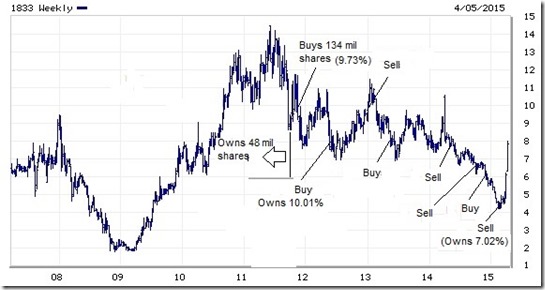
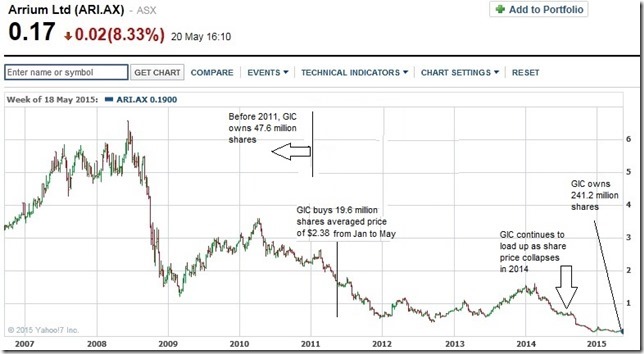
    By becoming a substantial shareholder in many companies with no track record, GIC is merely speculating on capital gains. GIC has no margin for error in its judgement as any mistake will wipe out the investment. And GIC has lots of these wipeout investments. Here are a few:


    Link


    More details on GIC’s China Coal Energy here.

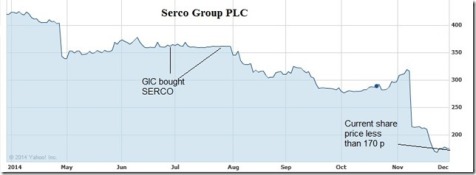
    Less than a year ago, GIC invested in Serco Group PLC in what appears to be ‘bottom picking’. But the bottom has since fell out and Serco’s shares are now worth one third of GIC’s original price.

    intime5.jpg?w=1000&h=

    More details on GIC’s investments at this link.

    There are of course many more such investments.

    6 GIC will never learn from its mistakes because there has been no accountability. Not even after Citigroup or UBS. There are simply too many bad investments which confirm GIC has not conducted due diligence.

    Since a steady stream of about $20 billion CPF is being channeled into GIC every year, it can sit on every underwater investment. It is like our local punters who ‘cold storage’ a collapsed penny stock and then hope for the best in the next bull cycle.

    GIC’s investment ‘strategy’ does not provide for a lump sum withdrawal by CPF members.

    7 Last year, DPM Tharman revealed in Parliament that “In eight out of 20 years, GIC’s returns were lower than the rate promised to CPF members, but the Government absorbed the losses”. GIC claims to have made annual real return of 4.1% over a 20 year period.

    Although Tharman’s statement appears to have revealed little, it has actually confirmed GIC’s mediocre performance.

    It would be fine if GIC’s return was lower than CPF rate for a couple of years but it did so 40% of the time.

    “Lower than the rate promised to CPF members” could also mean GIC had made losses in a number of years. And when PAP is unable to state factually its underachievements, rest assured it must be an embarrassing number.

    It could also be due to GIC’s mediocre performance that it is unable to return a lump sum CPF to members at 55.

    8 GIC has disclosed its 20-year rate of return in Singapore dollar since 2001. It was only after the financial crisis in 2007/2008 that GIC suddenly reported this in US dollar.

    GIC’s 20-year rate of return in Singapore dollar
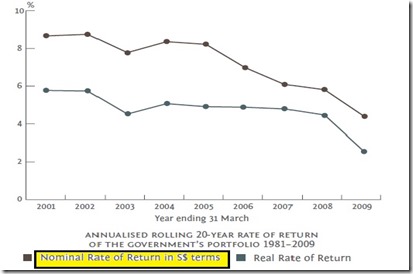
    If GIC had reported in Singapore dollar, its real rate of return would have been much lower – between 2% and 3%.

    GIC’s profits were impacted by forex losses due to the appreciation of our currency
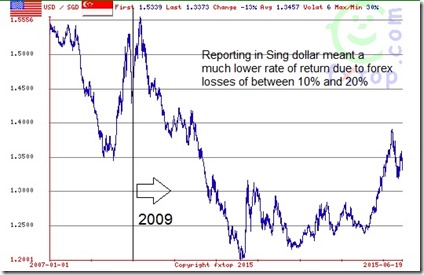
    (Sing dollar strengthened against every major currency except the Swiss Franc during the last decade)

    Reporting in Sing dollar after 2009 would have meant a disastrous performance for GIC. The sub par performance was masked by the change from reporting in Sing dollar to US dollar. Should Sing dollar depreciate, rest assured the reporting currency will be reverted to Sing dollar.

    There have been too many attempts to project GIC’s ‘superior’ performance. If GIC’s client and board of directors isn’t the Singapore government, it would have folded years ago.

    Do you think GIC has the funds to pay every CPF member a lump sum at 55?

    9 By admitting that “the Government absorbed the losses”, Tharman must have meant our reserves were used to pay CPF members for 8 years. If so,why was this not highlighted in Parliament?

    Since GIC had to resort to using our reserves to pay CPF interest on 8 occasions during a 20-year period, does this not confirm it did not have the funds to make lump sum payments to CPF members?

    10 CPF is not invested in foreign companies with strong earnings which are able to pay regular dividends. GIC has taken excessive risks by speculating for capital gains. If this is factually inaccurate, GIC could quell speculation by simply producing a complete list of its investments.

    GIC could have been as transparent as Norway’s GPFG and easily provided FULL disclosure. (2014 GPFG annual report)

    PAP has no reason to invite unnecessary speculation on GIC but why does it continue to conceal basic information of CPF investments?

    11 It is obvious GIC does not have sufficient funds to return all CPF monies to CPF members at 55 or 65. Perhaps it’s time you query your MPs but don’t get your hopes too high – chances are they know only as much as you do.

    redwire-singapore-janil-sleep.png
    Image credit: Redwire Times

    Conclusion

    Your CPF belongs to you, it is YOUR money but how you spend your hard-earned savings is nowdictated by PAP.

    The CPF scheme the mother of all Ponzi schemes. A Ponzi scheme promises high returns to attract investors whereas CPF legislates low returns.

    GIC does not seem to be managing our investments, appears to be speculating and does not have an exit plan when market fundamentals have changed. If due diligence has been conducted, there is no reason for investments to lose half their market value in a year, wiped out within 2 years.

    PAP should not expect CPF members to trust an organisation managing more than $1/4 trillion of our retirement savings when it has not produced a proper set of accounts for 34 years.

    There are obvious question marks all over our CPF scheme but PAP has repeatedly refused to provide relevant answers.

    The original contract for the government to return our CPF at 55 was amended by PAP because Singaporeans voted for a PAP majority in Parliament. The only way to undo this self-created problem is to deny PAP its 2/3 parliamentary majority. There is no alternative.

    Without any checks on the PAP, all your hard-earned CPF will never be returned to you at 55.


    Source: https://likedatosocanmeh.wordpress.com

  • PAP’s Potential Malay/Muslim Candidates For Upcoming Elections Identified

    PAP’s Potential Malay/Muslim Candidates For Upcoming Elections Identified

    A few Malay-Muslim candidates, including women mostly in their early 30s, have been identified for the next General Election, said Second Minister for Home Affairs and Foreign Affairs Masagos Zulkifli.

    “I do not know who will finally … become candidates, but … they are committed, they are also single-minded about helping out, contributing to the party as well as to become part of the party,” said Mr Masagos, referring to the People’s Action Party.

    He said the potential candidates hail from various sectors, adding that most of them are young. “Therefore, they will have a very good long runway to learn about leadership and be moulded into credible and reliable leadership.”

    When asked whether they are ready for a leadership role in the community and on the national stage, Mr Masagos said, “I don’t know anyone who is ready … Even for myself, after I have been elected, the kind of work I’m exposed to is something I couldn’t imagine.”

    He added that the potential candidates need mentors. “They are not merely (serving) their constituency, they are also the vanguard of the Muslim community,” said Mr Masagos.

    “Therefore, we have to guide them and teach them. We have to embrace them to teach them to become reliable and respectable (not just for the community).”


    Source: www.channelnewsasia.com

deneme bonusu