Tag: parliament

  • Australian Senator Pauline Hanson Wears Burqa To Parliament In Bid To Ban Them

    Australian Senator Pauline Hanson Wears Burqa To Parliament In Bid To Ban Them

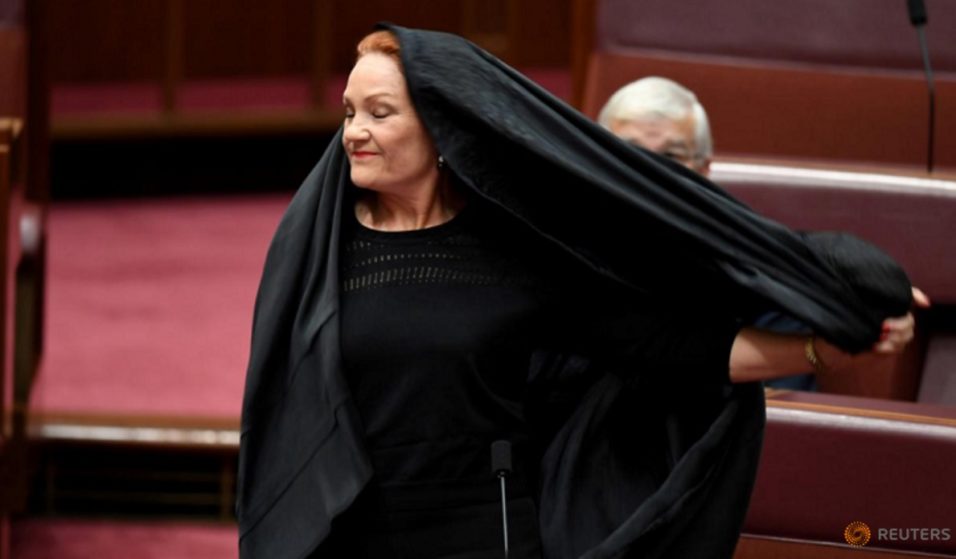
    Australian far-right senator Pauline Hanson wore a burqa to parliament on Thursday (Aug 17) as part of her campaign to ban the all-enveloping garment worn by some Muslim women, drawing a quick rebuke from the government and Muslims.

    Hanson sat in her seat in the assembly for about 20 minutes covered by the black burqa before removing it to call for them to be banned in public for national security reasons.

    “I’m quite happy to remove this because this is not what should belong in this parliament,” Hanson, who leads the far-right One Nation party, told the Senate.

    “If a person who wears a balaclava or a helmet in to a bank or any other building, or even on the floor of the court, they must be removed. Why is it not the same case for someone who is covering up their face and cannot be identified?”

    Hanson, who first rose to prominence in the 1990s because of her strident opposition to immigration from Asia and to asylum seekers, has in recent years campaigned against Islamic clothing and the building of mosques.

    Her party has four senators, which gives it influence in parliament when closely contested legislation is being voted on.

    Attorney-General George Brandis rebuked Hanson.

    “I am not going to pretend to ignore the stunt that you have tried to pull today by arriving in the chamber dressed in a burqa,” he said, drawing applause from members of the Senate.

    “We all know that you are not adherent of the Islamic faith. I would caution and counsel you with respect to be very, very careful of the offence you may do to the religious sensibilities of other Australians.”

    Adel Salman, vice president of the Islamic Council of Victoria state, said Hanson’s action was “a mockery of her position”.

    “It is very disappointing, but not surprising as she has sought to mock the Islamic faith time and time again.”


    Source: http://www.channelnewsasia.com
  • Gilbert Goh: PAP’s Main Motive For Suing WP’s Three MPs Probably To Stop Them From Standing For Next General Election

    Gilbert Goh: PAP’s Main Motive For Suing WP’s Three MPs Probably To Stop Them From Standing For Next General Election

    Let’s support the Workers’ Party as the PAP seeks to destroy and bring down the opposition party here. They can’t unfortunately ownself clear ownself like our PM did three weeks ago in Parliament.

    The PM’s own ward Ang Mo Kio Town Council also faced similar alleged corruption but the case was easily settled out of the public scrutiny when the town council general manager was relieved of his duties last year and dismissed without implicating the MPs.

    Its also a important distraction tactic as the government faces a host of its own problems involving the PM’s own abuse of power allegation by his two siblings which he has cleared himself in Parliament and the Malay-only Presidential Election.

    The PE which will take place in September has hurt the feelings of alot of our Singaporean Malays and put the government on a back-foot for the past few weeks as it struggles to properly address the racial legality of their preferred Indian-Muslim candidate Halimah.

    As for the lawsuit against the three WP main figures, if it involves corruption, the goverment should bring in the CPIB to investigate WP but it has instead threw the legal law book at the opposition party which will give the issue wider smear publicity.

    By appointing Philip Jeyeretnam son of WP’s founder father JB Jeyeretnam to preside over the case, it has also stir up much sentiments against the former founder’s son who now works for the government.

    Its vintage PAP’s distraction technique at its best to sue the WP now when the government has also faced many Accounting-General Office’s official complaints for the past 3 years into financial irregularities for many of its own statutory boards and civil services.

    Nothing is believed to have being done to properly investigate and clear the irregularities as the same financial problem is being re-flagged the next year. Should we not also sue the government for improper handling of our millions of taxpayer money?

    If the WP’s three MPs are found guilty by our court system, they are likely to be heavily fined and may not be able to stand for the next general election – probably the PAP’s main motive for suing them now.

    Let us support WP for the sake of our opposition cause!


    Source: Gilbert Goh

  • Flashback 1988: Definition of Malay Was Debated In Parliament (In The Context Of GRC System)

    Flashback 1988: Definition of Malay Was Debated In Parliament (In The Context Of GRC System)

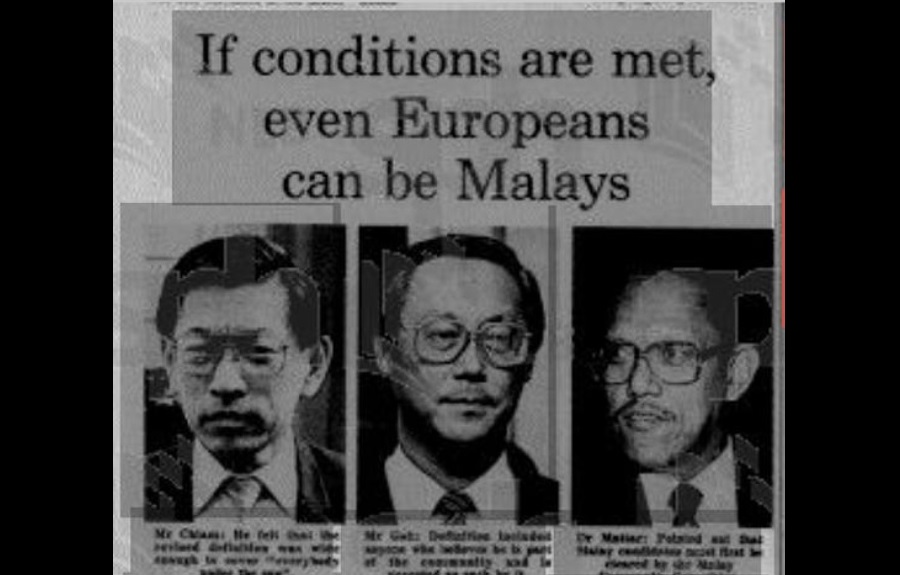
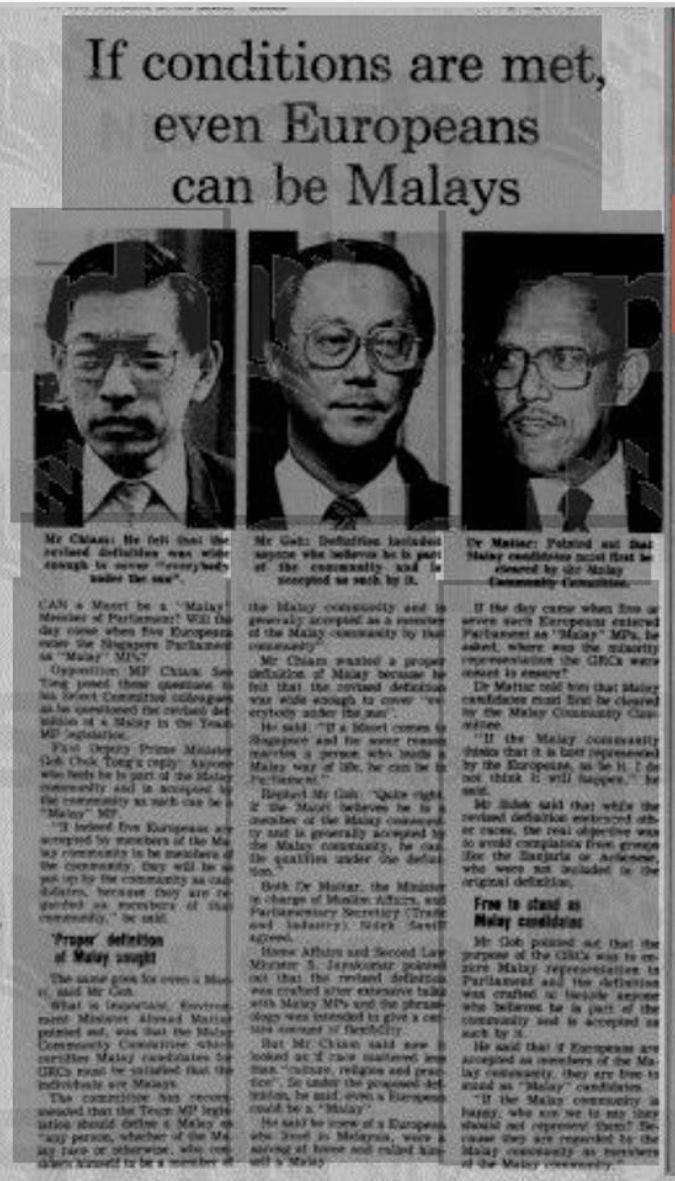
    The issue on the definition of Malay was debated earlier in Parliament (in the context of the GRC system) back in 1988.

    It was an exchange involving Goh Chok Tong, Chiam See Tong and Ahmad Mattar.


    Part of the excerpt read;

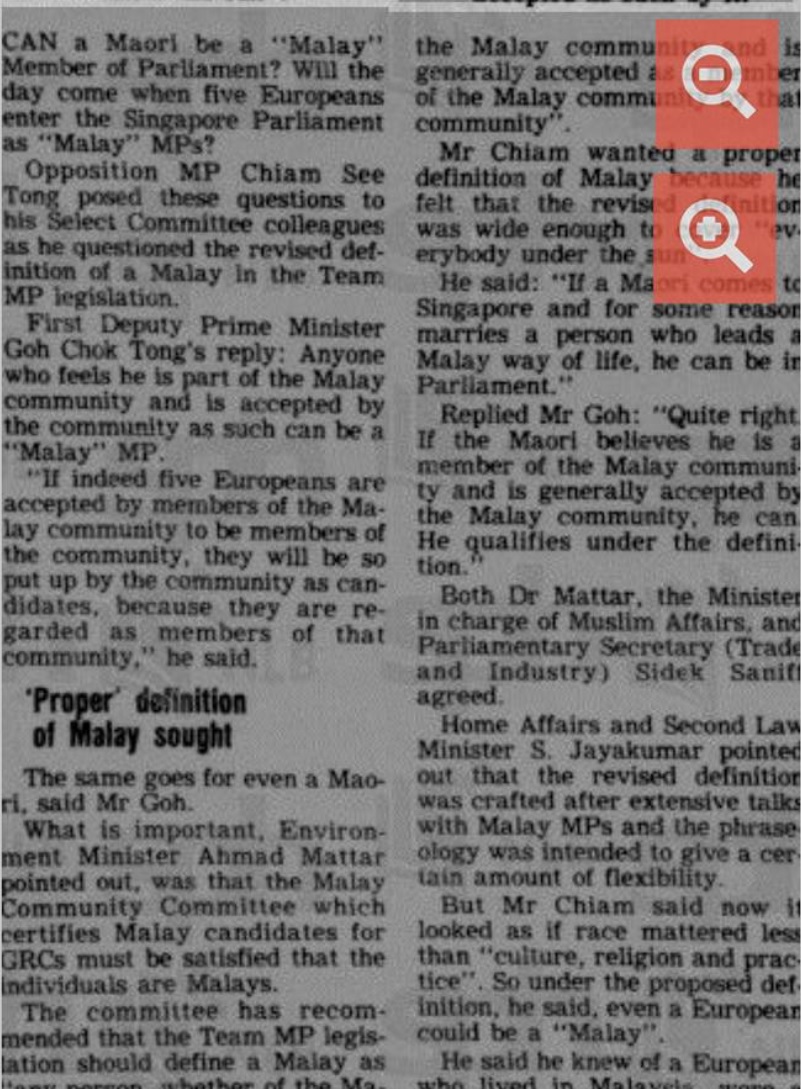
    Can a Maori be a “Malay” Member of Parliament? Will the day come when five Europeans enter the Singapore Parliament as “Malay” MPs?

    Opposition MP Chiam See Tong posed these questions to his Select Committee colleagues as he questioned the revised definition of a Malay in the Team MP legislation.

    First Deputy Prime Minister Goh Chok Tong’s reply: Anyone who feels he is part of the Malay community and is accepted by the community as such can be a “Malay” MP.

    “If indeed five Europeans are accepted by members of the Malay community to be members of the community, they will be so put up by the community as candidates, because they are regarded as members of that community,” he said.

    The same goes for even a Maori, said Mr Goh.


    In another part;

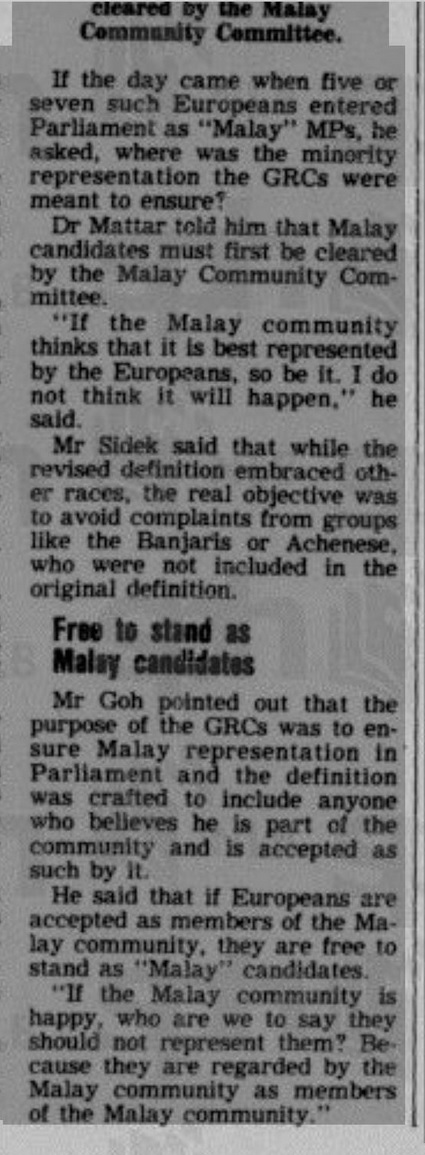
    If the day came when five or seven such Europeans entered Parliament as “Malay” MPs, he asked, where was the minority representation the GRCs were meant to ensure?

    Dr Mattar told him that Malay candidates must first be cleared by the Malay Community Committee.

    “If the Malay community thinks that it is best represented by the Europeans, so be it. I do not think it will happen,” he said.

    Mr Sidek said that while the revised definition embraced other races, the real objectives was to avoid complaints from groups like the Banjaris or Achenese, who were not included in the original definition.


    Also;

    Mr Goh pointed out that the purpose of the GRCs was to ensure Malay representation in Parliament and the definition was crafted to include anyone who believes he is part of the community and is accepted as such by it.

    He said that if Europeans are accepted as members of the Malay community, they are free to stand as “Malay” candidates.

    “If the Malay community is happy, who are we to say they should not represent them? Because they are regarded by the Malay community as members of the Malay community.”


    Source: Abdul Rohim Sarip

  • Commentary: 38 Oxley Is Not The Address Of Singapore

    Commentary: 38 Oxley Is Not The Address Of Singapore

    38 Oxley is Not the Address of Singapore

    After a noisy 2 days in Parliament the matter of Singapore’s Founding Prime Minister’s Mr Lee Kuan Yew’s home at 38 Oxley Road will now be settled through private channels among his three children. This is arguably how it should have been done all along. As the dust settles it is pertinent to make some observations on what this all means.

    First, Singapore works. Our economy continued to hum, people got up and went to work and spent time with their families, the water still ran and the lights still came on. Our institutions and systems have held firm.

    This is the most reassuring and reaffirming observation to make. In fact, it is the only one that really matters. If this had not held true nothing else would be material.

    Second, ending the fiction of a ‘natural aristocracy’. Many of our leaders overinvest in the concept of meritocracy to conclude that we have a ‘natural aristocracy’ that deserves its rights and privileges because they are very intelligent.

    Singapore has special people – they are Singaporeans, and not just Singaporean ‘leaders’. It is Singaporeans who define, embody and refresh the spirit that is Singapore.

    Let us cease the practice of making demi-gods of political leaders. They are only human and in recognising them to be so we are paying them the respect they deserve for coping with life just as we all have to and yet rising (or trying to) above its travails to focus on the bigger picture and the longer term.

    For their part political leaders should not forget that they serve at the pleasure of the people. Leaving aside the matter of the quality of the debate, there was no better affirmation of this than the debate in Parliament. It was a political display to retain the confidence of the people and a necessary one to underscore that we have a democratic system that must not just work but be seen to work.

    Third, 38 Oxley Road is an address in Singapore. It is not the address of Singapore. It is time for Singaporeans and for politicians, current and aspiring, to grasp that Singapore is neither about land or Lee.

    That is a very good thing. It shows that Singaporeans have matured, can keep perspective and know how to separate past from present and also know the difference between myth, however attractive, and practical matters.

    While the personalities involved in this family fracas come out of this politically scarred, Singapore emerges from this stronger and better.

    The Merlion may have been spitting in disgust recently but it is not drowning in despair. Its eyes look out at the horizon not at its navel or its tail. Our future lies out there and with it, dangers to deal with and opportunities to seize. Nothing has changed that and nothing will.


    Source: Devadas Krishnadas

  • Pritam Singh: In The Interest Of Fairness, Let Lee Wei Ling And Lee Hsien Yang Speak In Parliament Too

    Pritam Singh: In The Interest Of Fairness, Let Lee Wei Ling And Lee Hsien Yang Speak In Parliament Too

    Some Singaporeans have asked about Parliamentary Select Committees. What are they?

    Parliament hosts powers to appoint Select Committees of MPs to look at issues in depth, including calling for evidence and summoning witnesses if necessary. My WP colleagues and I have filed a number of parliamentary questions that relate to allegations of the Prime Minister abusing his powers in the matter of 38, Oxley Road. The Prime Minister has announced he will make a statement in Parliament and welcomes vigourous debate. There is one problem though. Unlike the Prime Minister, Mr Lee Hsien Yang and those who support him will have no opportunity to clear the air on 3 July 2017.

    In the interests of fairness, Mr Lee should be allowed to tell his story to Parliament too. A Select Committee would allow MPs the opportunity to call up any witness, including the Prime Minister or anyone else to get to the truth of the matter behind the allegations of abuse of power.

    By way of a parliamentary question, I have asked the Prime Minister to support the setting up of a Select Committee to look into the serious allegations made against him. The use of Select Committees for such a purpose is nothing new. The PAP have used Select Committees to look into allegations made against the Government in the past.

    On 21 Mar 1996, Parliament resolved to appoint a select committee to verify the Government’s healthcare expenditure, amongst other reasons, to verify statements made in the Singapore Democratic Party publication, The New Democrat and in a speech made by SDP MP Ling How Doong in Parliament where he said, “healthcare costs are not subsidised at all.”

    One submission to this Select Committee defined the role of Select Committees perfectly:

    “The public has every right to know the facts and to receive from the Government the fullest possible information….The Select Committee serves a useful and informative field of public education and members of the Select Committee would seek to produce agreed reports in the best interest of the public.”

    In a voluminous report (hyperlinked below), the Select Committee on Healthcare Subsidies published all the questions MPs put to various witnesses who were asked to give evidence to the committee. But things did not stop there. In view of the replies given to the Select Committee by Mr Chee Soon Juan and other witnesses, then Minister of Health George Yeo filed a complaint of contempt of Parliament to the Committee of Privileges against several witnesses arising out of the Select Committee hearings. I remember watching clips of the Select Committee hearing on TV, with PAP MPs relentlessly questioning Chee Soon Juan.

    Like many Singaporeans, no one knows how long the current episode is going to drag on for with new information and allegations coming out almost on a daily basis, and perhaps even after 3 July 2017.

    The allegations of abuse of power by the Prime Minister need to be looked into. A Parliamentary session as a forum to hear only one side of the story will just not do. After all, it was the late Lee Kuan Yew who said:

    “No government in this part of the world will open willingly when it need not open a problem like this and take it out, whether a Commission of Inquiry, debate in Parliament, Select Committee, or even a prosecution if a case could be made out.”

    Useful links:

    30 Sep 1996 – Report of the Select Committee on Verification of Healthcare Subsidy of Government Polyclinics and Public Hospitals: goo.gl/zgk6ie

    22 Nov 1996 – Report of the Committee of Privileges: Complaint against Representors from the Singapore Democratic Party: goo.gl/xG6ER3


    Source: Pritam Singh