Tag: politician

  • Dollah Kassim’s Grave Among Those Slated For Exhumation

    Dollah Kassim’s Grave Among Those Slated For Exhumation

    The graves of a local football icon and a former politician known for his anti-drug advocacy work are among those slated for exhumation at Choa Chu Kang cemetery to make way for the expansion of Tengah Air Base.

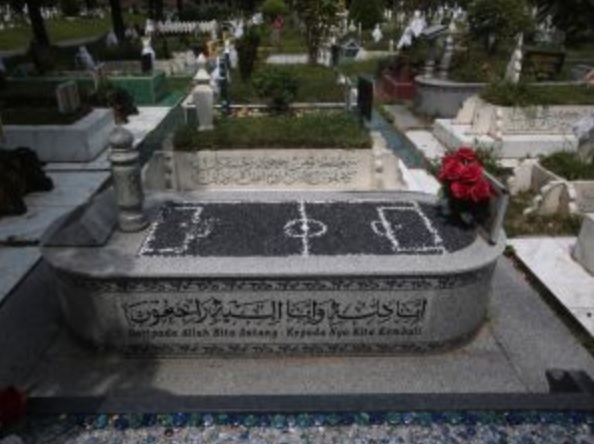
    Abdullah Mohamed Kassim, who died in October 2010, rests in a tomb adorned with a bunch of red flowers and a miniature football pitch formed out of grey and white stones on top of the structure.

    Better known as Dollah Kassim, he represented Singapore between 1968 and 1981, playing centre-forward, and was nicknamed “gelek king” for his graceful and deceptive dribbling.

    Dollah, a respected legend in the region and one of the Republic’s star strikers in the 1970s, suffered a heart attack in October 2009, while playing in a veterans’ exhibition match. He died at 61, after spending a year in a coma.

    Like Dollah, Harun A. Ghani, a former Member of Parliament and political secretary to the Home Affairs Ministry, was laid to rest at one of the 30,000 Muslim graves that will be exhumed at a later date, after they reach the 15-year burial limit.

    Harun, who died aged 66 in August 2005, was known for leading the charge in the war against drugs in the Malay community.

    He pioneered “meet-the-family” sessions, which have become a key component in rehabilitating former drug addicts and other ex-offenders.

    He was often spotted at coffee shops counselling former abusers and their family members.

    In 2005, an education fund dedicated to assisting families struggling with consequences of drug addiction was set up in Harun’s memory.

    A total of 80,500 Chinese and Muslim graves, dated between 1955 and 2000, will be exhumed progressively to make way for the air base’s expansion. The first to go will be 5,000 Muslim graves across two blocks in the fourth quarter of next year.

    TODAY understands that some families have already sought clarifications from the National Environment Agency and Islamic Religious Council of Singapore regarding the exhumation of their ancestors’ graves.

    Heritage enthusiast Raymond Goh said many of the Republic’s founding fathers who died between 1946 and 1978 would have had their graves exhumed in earlier phases.

    Mr Goh — who has embarked on an extensive documentation of graves at the Bukit Brown cemetery with his brother Charles — urged the authorities to work with the claimants to document the graves before they are exhumed.

    “There is a lot you can uncover about the person’s genealogy and ancestry from the inscriptions on the graves,” said the 53-year-old pharmacist.

    Prior to exhumation of graves at the Bukit Brown cemetery to make way for road developments, the Government worked with key stakeholders.

    These included Singapore Hokkien Huay Kuan, The Peranakan Association of Singapore, Singapore Heritage Society, academics and grave experts, to document the graves, as well as memories and rituals associated with the cemetery.


    Source: http://m.todayonline.com

  • Damanhuri Abas: The Malay Reserved President Is A Done Deal

    Damanhuri Abas: The Malay Reserved President Is A Done Deal

    The Malay Reserved President is a done deal no matter how much Dr Tan Cheng Bock try to argue for an Open Election. He will be admired for his tenacity and resolve to truly serve the people he love. So what can Singaporean hope for after Dr Tan Cheng Bock?

    Looking at the rank and file in Government, they are still mostly dominated by career civil servants from the uniformed or non-uniformed services. This reality undermines the Government’s claim that pegging Ministers salary to that of top private sector senior management will lead to more coming forward to join politics and becoming Ministers.

    In fact since the Government calibrated the salary of Ministers to be on par to that of private sector senior management, we have not seen any ground-breaking move that is worth mentioning. The truth is, if one has attained senior management position in business it is most unlikely that a political career is anywhere in his or her radar. Instead it is those who don’t see financial prospect in the private sector that will grab a chance of making big bucks as politician. It is definitely rare and extremely far between to expect anyone who is earning a handsome annual pay comfortably in the private sector to be so driven by a calling to serve the people.

    Singaporean yearns for that truly fresh face to rejuvenate their hopes and dreams amidst the gloom of a Machiavellian driven politically sterile landscape dominated by the powerful elite and their avarice. For now, such a one is imperceptible in both the near and far vista of our political horizon.


    Rilek1Corner

    Source: Damanhuri Bin Abas

  • Almakhazin: Chee Soon Juan As An Intellectual Statesman

    Almakhazin: Chee Soon Juan As An Intellectual Statesman

    There are very few politicians that I believe have impeccable integrity.

    Faisal Abdul Manap is one.

    Chee Soon Juan is another. Chee Soon Juan’s integrity I believe, come from his deep commitment to his Christian beliefs.

    It is this commitment and integrity that I am sure, helped him to weather the challenges of opposition politics in Singapura.

    Soon Juan has done a lot for Singapura’s political space. He has sacrificed and suffered. He gave all that he had to the cause.

    Like JBJ, he has fought the good fight.

    But fighters do not necessarily become leaders. And while the system remain, they may not necessarily be fully appreciated.

    Singapurans may not generally recognise his sacrifices. The system and instruments of the state have been successful in painting him as a rabble-rouser who may not be able to manage the state or a town council.

    And while there is optimism that Singapurans may be better informed and more receptive of his message, we should recognise that accepting his ideas do not necessarily mean they are willing to have him as their representative.

    The Bukit Batok By-Election

    The election was a watershed moment. After the optimism from opposition gains in 2011, there was a strong sense that the PAP may lose a few more wards in 2016. SG50 and Lee Kuan Yew’s deification clearly swung support to the PAP.

    While there is evidence of some remnants of the SG50/ Lee Kuan Yew effect, the by-election provided a strong yardstick, not only of where the PAP is with regard to the public, but whether Soon Juan is able to dismiss the public perception that has been created.

    There are indications that he has changed some minds. However, once again, the perception change relates to his ideals and person. Not necessarily as a statesman or political administrator.

    Soon Juan has helped to elevate how Singapurans view the political process. He has helped to expand political understanding.

    His ideas are making its way among Singapurans not because he was elected into office but because he transmits it outside of the defined political arenas.

    Redefine role

    He did not need to be in parliament to transmit his ideas and ideals.

    He has done a lot without needing political office.

    I truly hope that Soon Juan will consider a shift. And we can help him to achieve that shift.

    Not as a politician.

    Not as a future MP.

    But as a moral and public intellectual.

    The fighter in him will want to keep fighting for parliamentary access.

    But rather than focus on winning a seat, I hope he will redefine his role.

    Help civil society develop.

    And be an intellectual statesman.


    Source: Almakhazin SG

  • This Is The Change A Former Politically Apathetic Millenial Wants To See

    This Is The Change A Former Politically Apathetic Millenial Wants To See

    The mood changed after August 9.

    SG50 had culminated in a spectacular show of fireworks and nostalgia, but now the nation’s joyous jubilee celebration would make way for equally fervent political discourse.

    No one knew when Parliament would dissolve, but we all knew it would be a watershed year for local politics. After all, this is the first election since the passing of former Prime Minister Lee Kuan Yew and the air was pregnant with anticipation.

    It wasn’t long before the barrage of online posts about Singapore’s changing political landscape came fast and furious. From regaling personal stories about meeting their personable and humble MPs, to articulately listing the pros and cons of having a multi-party government, it seemed everyone was now a political pundit and had something to say about something or someone.

    For someone who has never been well-versed in, nor cared much for, politicking, covering the GE forMothership.sg helped me make sense of the online discourse I was seeing. There were two major camps: the conscientiously-researched commentaries, and the ones loosely strung together, just to jump onto the bandwagon and garner Facebook likes and shares. Still, I took them all in – besides, the more poorly structured debates there were, the more the genuinely intelligent ones stood out.

    Then, there were the vocal minority who, upon seeing netizens engage in political discourse, call it hypocrisy because such debate only happens during the GE. This reaction was apparently similar to the online sentiments when Lee Kuan Yew passed. Back then, my Facebook feed had been divided between those praising his deeds and those calling the former hypocrites when they hadn’t extolled him previously.

    And therein lies the main gripe I have with our political discourse, and ultimately, our system – it doesn’t allow for nuanced views.

    If we’re pro-PAP, we’re Yes Men who can’t think for ourselves; if we’re pro-Opposition, we’re unappreciative ingrates. Likewise, call ourselves politically apathetic and we’re irresponsible; have strong views and we’re getting caught in the hype.

    This clear dichotomy between differing views leaves no room for contradictions and grey areas, both essential parts of simply being human, to co-exist – therefore unnecessarily limiting discussion to extreme opinions. The truth is Singapore is a stable and comfortable society, but that incredible safety should not be an excuse to breed complacency and entitlement, whether with regards to opinions or material goods.

    No matter the news we wake up to on the morning of September 12, what I most want to see is significant progress towards cultivating creativity, open-mindedness and a sense of ruggedness in our youth. Provide room and reason for them to grapple with the various degrees of breadth and depth in the nation’s pertinent issues. Challenge our youth to question their own beliefs and ways of life, and in the process, develop more robust and individualistic points of view.

    And perhaps this starts with understanding the beauty of democracy. Knowing the power to change things can lie in a single vote, this heady responsibility can force even the most politically apathetic to keep themselves abreast with the latest happenings, and to remain discerning and well-informed. With an inevitable overload of information, it also means that we learn not to engage with every opinion that we see, but nonetheless appreciate the diversity for keeping our minds sharp and aware.

    There’s nothing hypocritical about deciding to educate oneself on the political scene, nor to want open and candid discussions about your future in this country. We are a highly educated workforce; let’s speak and behave as such – so that it no longer has to mean that if we’re pro-something, we’re automatically anti-something else.

    Because frankly speaking, it’s no longer cool to just care. It’s how we care that makes all the difference.


    Source: http://mothership.sg

  • Chiam See Tong Beat Mah Bow Tan at ‘O’ Levels and Other Revelations

    Chiam See Tong Beat Mah Bow Tan at ‘O’ Levels and Other Revelations

    Former Opposition MP Chiam See Tong’s reputation over the years has been recast to one of an elder statesman, well-respected by the ruling party and the opposition alike.

    One observed how Chiam is respectfully treated by the Prime Ministers this year.

    Chiam is indeed a politician of his time. As founding Prime Minister Lee Kuan Yew observed in his memoirs, Chiam took the “shrewder line than Jeyaretnam, was more in tune with the sentiments of the population, that the PAP was doing a fair job, but could do better and should listen more to criticism”.

    Now there is a book that will set his life on paper.

    Let The People Have Him, a book by academic Loke Hoe Yeong that traces Chiam’s birth to his winning of the Potong Pasir seat in 1984, is a reminder that Chiam’s rise as a national opposition is no easy feat.

    Below are ten revelations from Chiam’s biography that will interest every well-informed Singaporeans about 1970s/1980s politics.

    1. Then PM Lee Kuan Yew compared the ‘O’ Level results of the two candidates for Potong Pasir – Mah Bow Tan and Chiam.

    Lee said, “Mah Bow Tan, age 16, took his ‘O’ Levels – six distinctions, two credits.

    Mr Chiam, age 18 – six credits, one pass.”

    The residents of Potong Pasir chose Chiam. Chiam won 60.28% of the votes, compared to Mah’s 39.72% in the 1984 General Elections.

    2. Staffers from the Prime Minister’s Office (PMO) apologised to Chiam for an error Mr Lee Kuan Yew made in a 1984 GE rally speech.

    The PMO also conveyed an apology from Lee himself for the error. Chiam had gotten seven, not six credits in his ‘O’-Level results.

    3. Chiam sued then Foreign Minister S. Dhanabalan and Defence Minister Howe Yoon Chong for defamation.

    Then Workers’ Party Sec-Gen and MP JB Jeyaretnam represented Chiam in filing a writ in the High Court seeking damages for slander made in the election speeches by Dhanabalan and Howe.

    Dhanabalan called Chiam “a two-bit lawyer orchestrating a three-piece band whose members only appear once every four or five years”.

    Howe called Chiam “a twice unsuccessful lawyer” and “a lawyer who is not even very good at law”.

    4. Both Foreign Minister S. Dhanabalan and Defence Minister Howe Yoon Chong apologised to Chiam.

    Howe: “I, Howe Yoong Chong, hereby unreservedly withdraw all imputations against the professional capacity and competence of Mr Chiam See Tong made by me on December 21 1980 and published in the issue of this newspaper on December 22 1980.” Business Times, 13 Feb, 1981.

    Dhanabalan: “I acknowledge that there was no foundation for any of the imputations and I sincerely apologise to Mr Chiam for having made them”. Business Times, 28, 1981.

    Chiam accepted the apologies and withdrew his lawsuits against them.

    5. The origin of Chiam’s name.

    The name See Tong roughly translates from Teochew Chinese as “timely” or “punctual”, given to him by his paternal grandfather.

    6. You are never too old for public life.

    In December 1976, Chiam entered politics at the age of 41.

    7. The distant family relationship between Chiam and Lee Kuan Yew

    Chiam has never met Lee in person until he was sworn into Parliament in 1985.

    However, other members of Chiam’s extended family were on cordial terms with Lee’s extended family. This relationship stemmed from the marriage of Chiam’s maternal grandfather Lim Liang Quee’s daughter to a member of the Kwa family, from which Lee’s wife was.

    8. Chiam thought of giving up politics.

    After losing three elections, Chiam entertained the thought of giving up politics. His friends and relatives had been coaxing him that he would be able to live a contented life as a lawyer.

    9. Chiam successfully sued the mainstream media for damages.

    Chiam sued the now defunct Singapore Monitor for damages when it ran a headline on its frontpage: “Chiam See Tong charged with criminal trespass”.

    10. When Chiam first met Lee.

    Chiam (extending his hand): “Mr Prime Minister, may I congratulate the PAP on winning the elections”.

    Lee (firm handshake): “See you in Parliament”.

    “Let The People Have Him – Chiam See Tong: The Early Years” is available for purchase online at Epigram Books. Check out Mothership.sg’ interview with author Loke Hoe Yeong tomorrow.

    Source: http://mothership.sg/