Tag: radicalisation

  • ST Commentary: Of Minorities, Majorities And Sensitivities Across Race And Religion

    ST Commentary: Of Minorities, Majorities And Sensitivities Across Race And Religion

    Do individual Muslims have a special obligation to speak up when radicalised Muslims are in the news for attacks or arrests – such as by condemning the acts or clarifying that Islam is a religion of peace?

    Some non-Muslims in Singapore think so, and it can cause unease among their Muslim friends.

    This discomfort was given voice in Parliament this month, in speeches by two Muslim MPs, in the debate on a motion to strengthen multiracialism in the fight against terror.

    Ms Rahayu Mahzam (Jurong GRC) cited a conversation with a non-Muslim friend about terrorism. She was made to feel defensive and frustrated when he pressed her to say what “true Muslims” were doing to address the problem.

    “I told him, I do not know these people, I do not understand their psyche and it was unfair to put the burden on Muslims alone to resolve this issue,” she said.

    She found a similar situation playing out on social media, noting: “I saw many Facebook postings of Muslim friends condemning the terrorist attacks but also expressing similar frustrations of having to explain to non-Muslim friends that the terrorists’ actions were not aligned with Islamic teachings.”

    Dr Intan Azura Mokhtar (Ang Mo Kio GRC) also warned against “religious suspicion against the Muslims”, adding that “we cannot allow Muslims to feel apologetic for what these terrorist groups – which proclaim to carry out their heinous acts in the name of Islam – have done”.

    It is not that non-Muslims are not allowed to expect anyone from the Muslim community to come out firmly against terrorism or to detail what is being done about the problem within the community. The point here is that they should not expect each and everyone in the Muslim community to have to explain themselves to the satisfaction of any non-Muslim who happens to have doubts on where they stand.

    The fact is, each time someone in the Singaporean Muslim community is implicated in terrorist activity or detained for being radicalised, prominent representatives of the community do issue statements setting out in no uncertain terms the view of the community as a whole. These representatives may be from the Islamic Religious Council of Singapore or other groups, such as the Federation of Indian Muslims, or they may be political leaders who are Muslim. These statements should suffice.

    Non-Muslims should accept them in good faith as being representative of the views of Singaporean Muslims in general – which they are – and not require each individual Muslim they meet in the course of the day to have to prove his or her sincerity afresh.

    Pressing individual Muslims on the issue in person and on social media or requiring them to speak apologetically or to feel apologetic reflects an underlying distrust. It can feel like a slight. It is incumbent on non-Muslims here to be sensitive in their words and actions.

    The reality on the ground is that the Muslim community in Singapore is far more committed to multiculturalism and far less inclined towards the radical ideology of groups like the Islamic State in Iraq and Syria and Al-Qaeda than Muslims in most countries.

    The radicalised segment of Muslims here is very small by proportion. Furthermore, they receive virtually no support from the wider community. There is thus no basis for the kind of scepticism implied by the encounters Ms Rahayu spoke about. (If the radicals in fact receive a lot of latent warmth from ordinary Muslims, then it would be a different story. But that is not the case.)

    What non-Muslims should do, therefore, is: first, understand there is a majority who are distinct from a very small minority, and second, not let that minority colour the way they interact with the majority. But it is possible that the corollary is also true – that Muslims need to approach the issue in a similar way.

    Muslims can see things this way: There is a small minority of non-Muslims who lack prudence in the way they converse with Muslims on the issues of terrorism and radicalism. The broad majority of non-Muslims are not like that – they understand the subtleties or, if not, they are careful not to broach the topic. If this is true, then Muslims too should not allow the actions and words of a minority among non-Muslims to colour their interactions with the majority of non-Muslims.

    In other words, the majority of Muslims and the majority of non-Muslims – who together are the majority of Singapore – instinctively understand, believe in and show respect for multi-religious norms.

    But the two minorities complicate the picture – a Muslim minority who are radicalised, and a non-Muslim minority who are callous or ignorant in the way they speak or act.

    The worst outcome for Singapore is for the two minorities to be allowed to dominate the narrative, thereby dragging the whole of society into an insalubrious atmosphere of suspicion and counter-suspicion.

    The two majorities need to do two things. Each majority must draw a line of principle between itself and its minority, and it must then stand in solidarity with the other majority, so that society stays united.

    In the aftermath of terror attacks in the West, this majority-minority dynamic is often in play.

    In Britain, London and Manchester have reported sharp spikes in the number of anti-Muslim hate crimes after terrorist attacks in the two cities this year – that is, a minority of Muslims conducting attacks on society, and a minority of non-Muslims carrying out just as malignant reprisals on Muslims.

    But when the two majorities defend one another and show solidarity, they can prevail.

    An example of this was the #illridewithyou campaign, a social media campaign in Australia after the Sydney cafe hostage incident in 2014. Non-Muslim Australians offered to ride on public transport with Muslim Australians, to ensure the latter’s safety.

    When the two majorities stand as one, the two minorities are forced back into their dark corners on the fringe of society.

    In Singapore, no physical attack has happened yet, in one direction or the other. But if the country can guard against verbal unpleasantries, like those highlighted in Parliament this month, then there can be more confidence about preventing physical ones too.


    Source: http://www.straitstimes.com (Elgin Toh, Insight Editor)

  • RRG Counsellors Saved Two Secondary Schoolboys From Further Radicalisation

    RRG Counsellors Saved Two Secondary Schoolboys From Further Radicalisation

    One developed an interest in global affairs involving Muslims and became convinced of the need to migrate to an Islamic caliphate. Another penned pro-Islamic State (IS) slogans in his school books that were discovered by his father.

    In both cases, which involved secondary schoolboys, relatives and friends became concerned enough to alert the Religious Rehabilitation Group (RRG). The boys met with RRG counsellors, who explained religious concepts and the IS’ violent ideology to them.

    A third case was of a wife who noticed her husband becoming more vocal about a much stricter form of Islam, holding the exclusivist view that loyalty could only be given to God and Muslims. She confided in her relative, who approached RRG for advice. The wife spoke a few times over the phone with a counsellor on how she could advise her husband not to hold such extreme religious views.

    Sharing these cases on Friday (June 23) of people who had approached the RRG, the group’s vice-chairman Mohamed Ali urged the public to tap its helpline, mobile app and resource and counselling centre at Khadijah Mosque on Geylang Road, if they suspect their loved ones are close to being radicalised.

    The three cases are the only instances of voluntary reporting that RRG has encountered since 2014 – the year its resource centre opened – and that its counsellors “saved” from going further down the path of radicalisation, said Ustaz Mohamed.

    Because they were detected early, they did not need to be reported to the Ministry of Home Affairs or dealt with under the law, he said. “They are not those who were ready to use violence, but they believed that violence is justified.”

    Ustaz Mohamed declined to reveal when RRG was alerted to each case or the backgrounds of the individuals. The secondary schoolboys felt they benefited from the sessions with RRG counsellors and realised the danger of supporting IS, he said.

    In the third case, counsellors had no contact with the husband. But through speaking with the counsellors, the wife learnt more about how extremists promote their ideologies “under the cloak of religion”, said the RRG.

    Loved ones must be “first agents” and seek information such as what websites their children, relatives or friends have browsed, and for how long, said Ustaz Mohamed.

    Cases are not reported to the MHA unless individuals persist in the belief that violence is legitimate even after counselling. “RRG works with MHA, not for MHA,” he said.


    On whether the three individuals might have ended up detained under the Internal Security Act (ISA), were they not reported early to the RRG, Ustaz Mohamed said the answer was not straightforward.

    This is because there are other channels available, such as local mosques or the Islamic Religious Council of Singapore. “But logically we understand that when someone is radicalised and nothing is being done, that process of radicalisation can go further and it could lead to violence. It could lead to him wanting to use violence,” he said.

    The authorities have stepped up calls for family members and the community to report those who are potentially radicalised. They said the time between radicalisation and committing violence could be very short and that terror attacks would divide communities, playing into the hands of terrorist groups.


    Source: www.todayonline.com

  • Khan Osman Sulaiman: Rising Islamophobia, Are Muslims In Singapore Walking On A Tightrope?

    Khan Osman Sulaiman: Rising Islamophobia, Are Muslims In Singapore Walking On A Tightrope?

    Ahok got 2 years jail in Indonesia for blasphemy and the world cries foul. Yes its jail time. Not murder.

    When The Rohingyas were persecuted, not many were outrightly denouncing the Myanmar government for its crimes against humanity.

    Islam got slammed instead for bigotry. Clerics are ridiculed. Judges chastised. The press also solidifies the hatred/prejudice some people have for the religion by pushing out articles to make the religion look bad instead of correctly pointing the atrocities of humans, using religion to promote their political agendas.

    Shanmugam recently has called on the United States (and the world) to pay attention to the rise of “political Islam” and radicalism in Southeast.

    Instead, I say we should also pay close attention toward islamophobia.

    With rising islamophobia across the world and Singapore, the Muslims in Singapore are walking on a tightrope. We get scrutinized even for raising fundamental issues.

    The government’s distrust on the Malay/Muslim community dates back to LKY’s era. It has continued with the current administration led by his son Lee Hsien Loong but with a new dimension added to it. ‘Radicalization’

    With radicalization on the rise, and the effort to look into its emergence in Singapore, rightfully, the government may have fail to also give due consideration towards an emerging trend in Singapore. Islamophobia.

    I’d came across many postings on social media to kill the Muslim. To incarcerate anyone with the slightest differences of opinions. To remove citizenships of Singaporean Muslims and ship them ‘back’ to Saudi/Pakistan etc etc.

    It’s a growing trend if left unchecked, may rip apart the delicate social fabric currently maintained.

    Radicalization is a problem. So is Islamophobia. Deal with it concurrently without further aggravating the growing pressure my community faced from the gov and public.


    Source: Khan Osman Sulaiman

  • Najib Warns Uneven Growth Could Fuel Extremism, Instability

    Najib Warns Uneven Growth Could Fuel Extremism, Instability

    Prime Minister Najib Razak on Friday warned that Southeast Asian countries needed to ensure their economic growth was inclusive, or risk marginalised populations turning to violent extremism or even overturning political systems.

    Speaking at an event for entrepreneurs during the Association of South East Asian Nations (Asean) summit in Manila, Najib said the region was posting strong growth that could see Asean become the world’s fourth-largest economy, but that growth needed to be equitable.

    “We do not want our citizens to be marginalised in the age of extremism and radicalisation,” he said.

    “We know that those who see no hope in their own societies are more prone to the siren calls of terrorists who can and will exploit their vulnerability and fill them with their lies.”

    Islamist extremism is expected to be high on the agenda during this week’s meetings, with fears for Indonesia, Malaysia and the Philippines about piracy and the rising threat of Islamic State.

    Of particular concern is the ease in which militants can acquire weapons, seek refuge with existing rebel groups and move between the many islands between the three countries.

    Najib lauded the success of Asean, which is celebrating its 50th anniversary this year, in expanding its collective GDP to about US$2.7 trillion now, from US$87 billion four decades ago.

    Asean has 10 members: Thailand, Myanmar, Laos, Cambodia, Vietnam, Singapore, Brunei, Malaysia, Indonesia and the Philippines.

    He warned that economic disparity was dangerous at a political level too, fuelling anger and populism that was causing problem in Western Europe.

    “The neglected underclass of those who felt left behind by economic growth, prosperity and globalisation can overturn elections and political systems,” he said.

    Economists frequently point out huge income gaps among the 620 million people of Southeast Asia, a region that has one of the world’s largest concentrations of billionaires, according to Forbes Magazine.

    Najib said awareness of Asean needed to be better promoted among its citizens to “make it feel real, relevant and tangible”. Trade integration was lagging, he said, with too many trade tariffs still in existence.

    Their removal, and harmonised customs standards, needed to be “vigorously pursued”, he said.

    Philippines Vice-President Leni Robredo echoed Najib’s call for leaders to pay more attention to their poor.

    “For many years, many thought income inequality was alright. But the voiceless and the powerless are now raring to be heard, and with technology and social media, their frustrations are being felt on a global scale,” she said in a speech.

    “They are rejecting globalisation, democracy, traditional media.”


    Rilek1Corner

    Source: http://www.freemalaysiatoday.com

  • Tricky, but necessary, to build resilience against security threats

    Tricky, but necessary, to build resilience against security threats

    Terrorism and radicalisation will be an inescapable part of our lives from here on, and the main threats for 2017 and beyond should be divided into two parts.

    The first is the foreign fighter blowback. With the so-called Islamic State (IS) suffering reverses on the battlefield in Iraq and Syria, many South-east Asian fighters will return home to Indonesia and Malaysia. They may also seek new safe havens such as in the southern Philippines.

    In addition, they will seek to leverage issues which give them propaganda mileage that can reinvigorate their social media campaigns — such as the plight of the Rohingya.

    And we should not be so quick to assume that it is simply South-east Asian fighters we will need to reckon with. One cannot discount the possibility of a wider movement of battle-hardened Uighur veterans who, for various reasons, cannot return to their home countries elsewhere.

    For some sense of what is likely to happen with these returnees, we can look to Europe, where Western fighters have been trickling home for some time now.

    Many are embittered by their experiences and disillusioned by the depravity of the IS; but some have come back even more determined to wreak havoc, and even more radicalised.

    There is no reason to suppose that a similarly mixed scenario should not play out in South-east Asia.

    RADICALS OF ANY FAITH

    The second threat is radicalisation in general. We have to accept that this is not simply an issue of Islamist radicalisation. Religious revivalism is increasingly present in other major faiths.

    Radicals inhabit the fringes of all these. And the sobering fact is that we live in a future where all sorts of individuals are going to be “radicalised” in some form or other — even those without strong religious convictions.

    We should not forget that we have had an individual, a Singapore citizen, who has tried to join Kurdish militia to fight IS. Whatever his motivations — and there is some suggestion of alienation and wanting to do good — we need to understand that, in future, all sorts of people are going to want to fight for causes, or else take up some form of muscular activism.

    This will be a rising trend and these impulses, if not managed, will lead to schisms within societies.

    Terror networks can be interdicted and taken down. Security services are actually pretty good at this sort of thing. However, what all of us need to get our heads around is the rising tide of intolerance and, more precisely, tolerance for intolerance.

    This is the second big issue we need to face. It is a phenomenon that did not start in South-east Asia, but it is creeping in. Traditional forms of syncretistic religious practice that have existed here for centuries (if not longer) are being replaced by a more hardline, less inclusive type of observance.

    This type of feeling is fuelled by social media. As Foreign Affairs Minister Vivian Balakrishnan said last year: “We now live in a world of fragmented echo chambers — we hear what we want to hear, we ignore what we don’t want to hear, or inconvenient truths are not heard.

    “And in fact, from an academic point of view, this leads to a ‘shallowing’ of discourse, a world in which there is a dearth of deep thought and cogent discussion across diverse perspectives. You get a more monochromatic world and a narrowing of minds.”

    Singapore will have to maintain its values of multiculturalism and tolerance. These will be increasingly valued in an era where these are becoming rare commodities (and, indeed, in an era where these qualities are persecuted in some quarters).

    It is my view that Singapore will increasingly come to be seen as a beacon, not simply on account of good policymaking, which we have, but because parts of the world and our immediate environment are becoming increasingly insalubrious.

    A POST-TRUTH WORLD

    The echo chambers that Dr Balakrishnan and other leaders have talked about suggest a milieu in which people can choose simply to hear what they want to hear. This is especially problematic for a number of reasons.

    One is that state and non-state actors are increasingly taking advantage of various mechanisms to subvert the truth and to peddle their own information, which may actually be quite distant from the facts. These may all the more easily be lapped up by groups of people within society who, for some reason or the other, might be susceptible to this kind of subversion.

    Consider, for example, the masterful information-operations campaign that Russia has waged in Ukraine. There was a cyber takedown of the power grid, but more importantly was the media (including social media) manipulation and distortion of information which led many to believe the Russian point of view.

    Seen from that point of view, what Russia had done was an entirely legitimate protection of Russian minorities living under persecution. The real point is, of course, that information had been bent and twisted to a level where no one was sure where fact ended and fiction began.

    As commentators have increasingly observed, we live in a post-truth world. One could also argue that Russia did something very similar in the United States election. Why not? A state can nowadays accomplish aims allied to its self-interest that promise outcomes that are much more certain than diplomacy and much less costly than warfare.

    BEWARE THE SLOW-BURN ATTACK

    The people of Singapore, therefore, should not assume that the “attack”, when it does come, will be a mass-casualty terror incident. This is what our agencies routinely hold drills for.

    But the attack might equally be a cyber takedown — either a hacking attempt (and at least one government ministry, the Foreign Affairs Ministry, has suffered a major cyber hack) or some seemingly low-level but nonetheless persistent and insidious cyber effort to chip away at the resilience of our people.

    The basic point is that, while keeping a wary lookout for Black Swans, we need to be aware of slow-burn issues too — particularly the kind that amount to attempts to sap away at the will of a people until the nation is itself shrivelled from within.

    How do we counter this? Part of the answer lies in critical thinking — the ability to ruthlessly interrogate source material that comes before us. In this, the post-truth era, those digital natives who grow up knowing — either instinctively or through some form of instruction — the difference between the objective facts and fake news will have an intrinsic advantage over others.

    A great deal will also boil down to resilience. This could be divided into two kinds. The Government has succeeded in hardening the obvious targets in Singapore and, over the past 10 years or so, focusing some attention on the “bounce-backability” of society.

    The second part is more tricky but achievable. This has to do with how our society coheres and prevents fissures from forming after an event. This next leg is about a certain toughness and resolve that we need to develop more of.

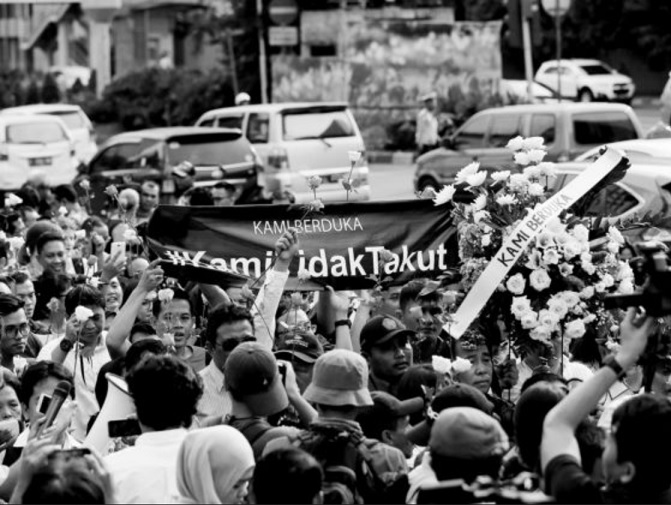
    Consider, for example, what happened after terror incidents and attacks worldwide. The Sydney hostage-taking in December 2014 was followed by a dignified viral campaign, “I’ll Ride with You”, to show solidarity with Australian Muslims. The Charlie Hebdo attacks in Paris in January 2015 saw the ground-up viral campaign “Je Suis Charlie”, while the Jakarta attacks in January 2016 saw the hashtag #KamiTidakTakut (Bahasa Indonesia for “We are not afraid”) go viral.

    Each of these was seen to be a grassroots event and response. Do the people of Singapore have the wherewithal and gumption to rise up, to come together with dignity, resilience and resolve, and with minimal government intervention? Whether and how we can we can do this will be a telling indicator of the shape or form in which we make it to SG100.

    ABOUT THE AUTHOR:

    Dr Shashi Jayakumar is a Senior Fellow and head of the Centre of Excellence for National Security at the S Rajaratnam School of International Studies, Nanyang Technological University.


    Source: Today

deneme bonusu