Tag: radicals

  • MUIS Dekati Ibu Bapa Demi Bantu Anak-Anak Tangani Radikalisme Di Media Sosial

    MUIS Dekati Ibu Bapa Demi Bantu Anak-Anak Tangani Radikalisme Di Media Sosial

    MAJLIS Ugama Islam Singapura (Muis) bakal mendekati ibu bapa untuk memberi panduan kepada mereka bagaimana membantu anak mereka dalam mengendali radikalisme di media sosial.

    Langkah terbaru Muis itu bakal diperkasa dengan menganjurkan sebuah seminar keibubapaan bagi menyediakan wadah kepada ibu bapa dalam menggunakan media sosial sebagai alat meningkatkan pembelajaran.

    Ibu bapa juga bakal dibekalkan sebuah buku panduan bertajuk ‘Resilient Families: Safeguarding Against Radicalisation’ (Keluarga Berdaya Tahan: Berlindung dari Radikalisme).

    Menurut jurucakap Muis, buku panduan ini julung kali diterbitkan Pejabat Mufti dalam usaha mempersiap dan memperkasa ibu bapa membimbing kanak-kanak menggunakan media sosial dengan selamat.

    Seminar keibubapaan yang akan dianjurkan Sabtu ini bertajuk Parenting IRL (In Real Life)*: Raising The Snapchat Generation atau Keibubapaan (Dalam Hidup Sebenar): Membesarkan Generasi Snapchat.

    Seminar dan buku panduan itu juga bertujuan menyedarkan ibu bapa tentang cabaran dalam percambahan media sosial dalam masyarakat hari ini.

    Menurut jurucakap Muis, peranti elektronik yang menghubungkan mereka ke Internet digunakan secara meluas hari ini. Sesetengah anak mula menggunakan peranti sedemikian pada usia yang terlalu muda.

    Bagi kanak-kanak dan remaja, media sosial menyediakan platform bagi mereka meneroka dunia maya melalui permainan dan interaksi. Ini mendedahkan mereka kepada pelbagai risiko.


    Source: www.beritaharian.sg

  • Jakarta Anti-Governor Protest: Cars Burnt, 1 Dead And Many Injured

    Jakarta Anti-Governor Protest: Cars Burnt, 1 Dead And Many Injured

    Indonesian police have used tear gas and water cannon to subdue protesters as thousands of hard-line Muslims marched against Jakarta’s governor.

    Basuki Tjahaja Purnama, a Christian, is the first ethnic Chinese to hold the governor’s post in the capital of majority Muslim Indonesia.

    The demonstrators accuse him of having insulted Islam’s holy book, the Koran, and want him to be prosecuted.

    Clashes broke out between police and protesters who refused to disperse.

    One elderly man died, the Associated Press reports, citing police. Several other people, including police officers, have been injured.

    Protesters had earlier marched upon the presidential palace.

    Police had been braced for the possibility of religious and racial tensions erupting at the rally, which an estimated 50,000 people attended.

    It had mostly been peaceful but groups of angry demonstrators clashed with police after nightfall and set vehicles alight.

    In 1998, a wave of anti-Chinese sentiment led to mobs looting and burning Chinese-owned shops and houses. Ethnic Chinese make up about 1% of Indonesia’s population of 250 million people.

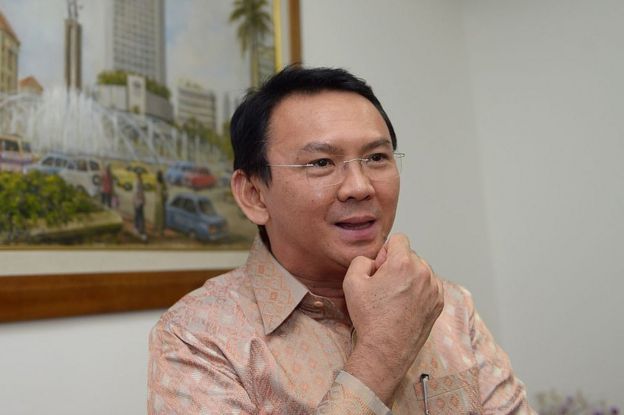
    Basuki Tjahaja Purnama, known by his nickname Ahok, speaks to journalists at his office in Jakarta in 2014
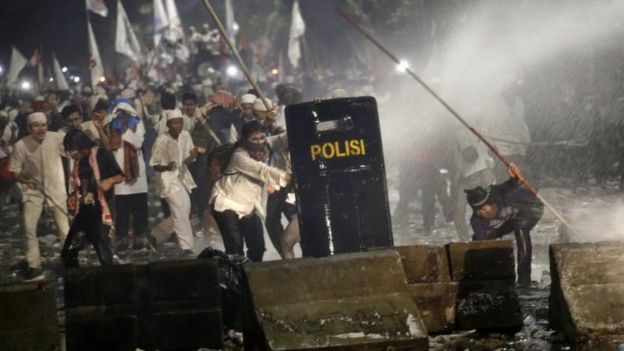
    Protesters are sprayed with water from a police water cannon truck during a clash outside the presidential palace in Jakarta, Indonesia, Friday, Nov. 4, 2016

    The protest was held to demand that Mr Purnama be prosecuted for blasphemy over comments he made in September that were seen as criticising a Koranic verse.

    He said that Islamic groups using a passage of the Koran to urge people not to support him were deceiving voters, who will go to the polls in February.

    The verse is interpreted by some as prohibiting Muslims from living under the leadership of a non-Muslim.

    Mr Purnama has since apologised but formal complaints were lodged against him by Islamic groups for defamation. He is now being investigated by police.

    Who is Governor Ahok?

    Some protesters at Friday’s rally carried signs calling for the governor’s death, the BBC’s Rebecca Henschke in Jakarta says.

    Representatives met with Vice-President Yusuf Kalla, who promised that the investigation into Mr Purnama would be completed within two weeks.

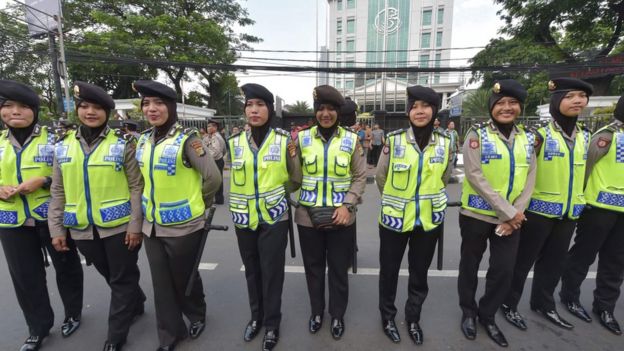
    Indonesian policewomen stand guard as Muslims march towards the presidential palace during a protest against Jakarta governor Basuki Tjahaja Purnama also known as Ahok over an alleged blasphemy in Jakarta on November 4, 2016

    There have long been tensions around Mr Purnama political role.

    In 2014, he was the deputy governor under Joko Widodo. When Mr Widodo was elected president the main group behind the current protest – Islamic Defenders Front (FPI) – did not want Mr Purnama to succeed him.

    They argued that a Christian should not govern a Muslim-majority city. The campaign against him has since taken on anti-Chinese overtones, though the FPI said the rally was not about the governor being from a minority group.

    Jakarta police said there were “provocative statements and images” on social media urging people to take violent action against Mr Purnama, including calls to kill him.

    Despite being seen as brash and outspoken, the governor is popular among many in the capital and has been praised for his effectiveness.

    Muslims in Indonesia are largely moderate and the country’s largest Islamic organisation, Nahdlatul Ulama, had advised its 40 million members not to take part in the protest.


    Source: www.bbc.com

  • Global Survey: Most Will Trade Freedom For Security

    Global Survey: Most Will Trade Freedom For Security

    Most people think that violent terrorism is a major challenge facing their societies and they support tough measures to counter the problem at the expense of some civil liberties, according to a global survey on public perceptions towards violent terrorism commissioned by the Center for Strategic and International Studies (CSIS), based in Washington.

    According to the findings released earlier this week — derived from 8,000 respondents in eight countries — one in two people feel that their governments have not taken adequate steps to address violent extremism.

    The survey was conducted in August this year and involved participants from China, Egypt, France, India, Indonesia, Turkey, the United Kingdom, and the United States.

    Around 25 per cent of the respondents from Turkey and France felt that violent terrorism is the most important issue facing their countries. Overall, around two-thirds of those polled see violent extremism as a major problem in their country.

    “In everywhere except China, at least 75 per cent of those surveyed expect a terrorist attack in the next year,” said CSIS in a report of the survey findings.

    “On a more alarming note, a majority in every country believes that it is likely that violent extremist groups will acquire and use weapons of mass destruction in their lifetime.”

    The majority of respondents in Turkey, France and the US feel their own governments have not taken adequate steps to contain and prevent violent extremism.

    In late June, a gun and bomb attack on Istanbul’s Ataturk airport killed more than 40 people and injured more than 230. Yesterday, a Turkish official said police in the capital had fatally shot a suspected Islamic State (IS) group militant who was planning a suicide bombing.

    France has also been hit hard by violent terrorism, with 230 deaths and about 700 injuries as a result of attacks said to be carried out by IS.

    Both France and Turkey are both sources of a relatively high number of foreign militants fighting in Iraq and Syria, with an estimated 700 French citizens and 500 Turks fighting under the IS flag.

    Just last month, an Afghan-born American sowed terror across Manhattan and New Jersey, wounding 29 people before he was arrested — the latest in a spate of lone-wolf attacks to rock the US.

    Despite widespread anxiety about the terrorist threat, 73 per cent of respondents in the CSIS survey believe that violent extremism can be eradicated.

    When asked about potential measures to counter violent extremism, 90 per cent were in favour of requiring all citizens and visitors to have identification cards.

    A similar percentage also supported asking Internet companies to do an even better job of shutting down all content from violent extremist groups, while 71 per cent favoured allowing government agencies to monitor all phone records, email and social media for contacts with terrorists.

    Close to 90 per cent of the sample was also supportive of asking Muslim leaders to declare definitively that Islam does not in any way condone violent extremism or the creation of a caliphate. More than 80 per cent of those surveyed also said that immigrants who have not passed rigorous screenings and background checks for connections to extremism should be barred from entering their countries.

    On Monday, Iraqi forces, supported by a US-led international coalition, launched a major offensive on the city of Mosul, the IS’ last major stronghold in Iraq.

    The US expects IS to use crude chemical weapons as it tries to repel the offensive, although experts say the group’s technical ability to develop such weapons is highly limited.


    Source: www.todayonline.com

  • Singaporean Asrul Alias Issued Restriction Order For Terrorism-Related

    Singaporean Asrul Alias Issued Restriction Order For Terrorism-Related

    A Singaporean, Asrul Alias, was issued with a two-year Restriction Order in August after he was found engaging in terrorism-related activities, the Ministry of Home Affairs said on Thursday (Oct 6).

    The 33-year-old was arrested in August under the Internal Security Act (ISA) for investigation into his involvement in terrorism-related activities. He is a supporter of the Islamic State in Iraq and Syria (ISIS), MHA said.

    Starting in 2014, Asrul watched online religious sermons by radical preachers, as well as videos that featured ISIS fighters in combat. MHA said he had actively looked up pro-ISIS materials and shared them on social media with the intention of spreading the group’s radical ideology.

    Asrul also showed his support for ISIS by countering criticisms of the group he came across online, the ministry added.

    However, after warnings from a family member and a close friend to stop posting pro-ISIS and pro-militant materials, the technician stopped doing so from late 2015/early 2016. He remained supportive of ISIS though, and continued to consume ISIS-related materials online.

    MHA said that while its investigation showed that he had become radicalised, he was given a Restriction Order instead of being detained as he was “not an imminent security threat”.

    He will undergo religious counselling while on the Restriction Order, the Ministry added.

    In August, MHA announced that four other Singaporeans had been dealt with under the ISA for supporting ISIS. Two were detained under the ISA after they made plans to travel to Syria to fight for the terrorist group, while the other two were issued Restriction Orders.

    In their comments to the media on Thursday, the authorities also stressed the role of the community in countering terrorism. “It is a challenge to detect self-radicalised individuals who have not previously attracted security attention and who are not part of a structured organisation, such as Asrul,” they said in the statement.

    “This is why it is those who are close to the individual – family, friends and colleagues – who are usually better placed to detect signs that the individual has become radicalised. It is critical that they alert the authorities early of such individuals to save them from getting involved in violent activities that could harm themselves and others.”

    SINGAPOREAN WHO FOUGHT IN YEMEN RELEASED FROM DETENTION

    MHA added that Singaporean Mohammad Razif Yahya, who was detained in August 2015 for voluntarily taking up arms in the sectarian conflict in Yemen, has been released from detention this month, and issued with a Suspension Direction (SD).

    Razif’s Order of Detention was suspended after it was assessed that he no longer posed a security threat that required him to be placed in preventive detention, MHA said. Among the conditions of the SD include being prohibited from associating with any militant or terrorist groups or individuals, and he is not allowed to leave the country without the prior written approval of the ISD Director.

    MHA also announced on Thursday that the eight Bangladeshi nationals who were detained for their involvement in the group called the Islamic State in Bangladesh have had their Orders of Detention cancelled.

    Six of them had contributed funds towards the purchase of firearms for the group’s plans in Bangladesh, and were convicted of terrorism financing. They have been sentenced to between two and five years’ jail, and as such, their Orders of Detention have been cancelled, the ministry said.

    The remaining two members, Sohag Ibrahim and Islam Shariful, were repatriated to Bangladesh last month after investigations were completed, it said, adding that Bangladeshi security authorities were apprised of their repatriation.

    MORE THAN 80 DETAINED FOR TERROR-RELATED ACTIVITIES SINCE 2002

    Since 2002, over 80 people have been detained for terrorism-related activities, with 17 currently placed on Orders of Detention, two on Suspension Directions and 25 on Restriction Orders under the ISA, said MHA.

    The Home Affairs Ministry said that it bases what action to take against individuals investigated by the Internal Security Department (ISD) on evidence obtained through investigations and an assessment of the level of the threat.

    “Detention is a last resort to be used only when the threat is imminent,” it said.

    Once an individual is detained, however, he or she will have to go through a “thorough and stringent” process before being released. This factors in progress in the rehabilitation programme as well as the assessments of psychologists, ISD case officers, detention centre wardens and religious counsellors from the Religious Rehabilitation Group, MHA said, adding that those who “no longer pose an imminent threat” will be released.

    “The Government takes a very serious view of any form of support for terrorism and will take firm and decisive action against any person who engages in any activity in support of terrorism,” it said in the statement.

    “Every member of the public has a responsibility not to engage in such activity, and not support others who do so.”


    Source: www.channelnewsasia.com

  • Nazem Suki: Pakar-Pakar Penyelidik Dan Golongan Terorisma Dari Golongan Sama Yang Sesat

    Nazem Suki: Pakar-Pakar Penyelidik Dan Golongan Terorisma Dari Golongan Sama Yang Sesat

    Pakar-pakar penyelidik dalam ideologi terorisma juga adalah golongan yang menyelewang dan sesat.

    Apabila golongan teroris memesong salah guna fatwa dan ajaran ulama muktabar untuk kepentingan ideologi terorisma mereka, golongan pakar selidik terorisma juga memesong salah guna fatwa dan ajaran ulama muktabar yang sama untuk melabel ulama tersebut adalah ‘ibu’ ideologi terorisma.

    Maka secara khusus nya, golongan terorisma dan penyelidik terorisma adalah sama dari golongan yang sesat yang parah.

    Mungkin tidak menjadi melampau sekira pakar selidik terorisma ini akan mengatakan Al Quran dan Sunnah adalah ‘ibu’ ideologi terorisma.

    Yang lebih parah ialah pakar ini dilahirkan seorang Muslim, atau hanya Muslim pada nama.


    Source: Mohamed Nazem Suki