Tag: RSIS

  • Shanmugam Stresses Need To Uphold Racial Equality

    Shanmugam Stresses Need To Uphold Racial Equality

    The need for Singapore to remain committed to protecting its minorities was stressed by Home Affairs and Law Minister K. Shanmugam yesterday, as anti-Islamic and anti- immigrant sentiments jolt the world and the region grapples with growing polarisation along religious lines.

    “In the face of all this, the Government has to convey a clear message: We are all Singaporeans. We guarantee the safety, security and freedom of religion to all, including the Muslim community,” he said. “And as a community, we must covenant to ourselves to never allow xenophobia and majoritarianism to override the protection and guarantee of equality, particularly to minorities.”

    With 74 per cent of the population being Chinese, “our system of elections means majoritarianism could have easily taken hold and can, in future, easily take hold”.

    He credits Singapore’s founding leaders for laying the foundation that includes ensuring equal opportunities for the minorities.

    Mr Shanmugam’s robust statement on Singapore’s core principle of equality for those of all races and religions follows the upheavals of the past week after US President Donald Trump’s order suspending refugee intake and temporarily keeping the citizens of seven Muslim-majority countries out of the US.

    At a seminar on religion, conflict and peacebuilding, he said the US changes, made suddenly, present a serious risk to Singapore. The travel curbs, he noted, reflect anti-Islamic feelings gaining ground in the United States and Europe. “It is a groundswell fuelled by fear and a substantial element of racism. Many otherwise reasonable people are also supporting such movements,” he said.

    Singapore, with a 15 per cent Muslim population, could easily slide into a similar situation, he added. Hence, it is imperative that the Government steer clear of engaging in racial politics, Mr Shanmugam said.

    But it can do this only with the community’s support, he added.

    While the majority must back these efforts, the minorities must play their part, and not grow increasingly exclusive. Both sides need to “work together to increase common space, and work with the Government that is determined to hold the common space together”, he said.

    “That is the only way we can resist the tide of populism that is sweeping the rest of the world. We keep to our way of life,” he added.

    The two-day symposium is organised by the S. Rajaratnam School of International Studies under its Studies in Inter-Religious Relations in Plural Societies Programme.

    In his address, Mr Shanmugam sketched his view on what has led to the anti-Islamic wave in the West, Singapore’s approach in avoiding the backlash elsewhere against minorities, and regional trends that could agitate Singapore’s minorities.

    Pointing to the Chinese majority, he noted that Singapore has avoided majoritarianism by ensuring equal opportunities regardless of race or religion, guaranteeing religious freedom and clamping down strongly on hate speech.

    “The result is, regardless of all else, you can walk with a sense of being yourself, comfortable in your own skin, as an equal citizen… That is the lived reality of a Singaporean,” Mr Shanmugam said.

    But this takes work, he said, noting that the Government has not taken a laissez faire approach. Without active state intervention, he said, “you will get segregated communities, segregated schools, the lessening of common space and a reduction of opportunities for minorities”.

    Urging racial and religious leaders to champion integration and interaction, he said: “This is critical… to preserve what we have in Singapore.”


    Source: ST

  • Singapore Must Guarantee Equality To Minorities: Shanmugam

    Singapore Must Guarantee Equality To Minorities: Shanmugam

    Faced with issues such as growing Islamophobia and religious extremism, Singapore must never allow xenophobia and majoritarianism to override the protection and guarantee of equality – particularly to minorities, said Singapore Home Affairs and Law Minister K Shanmugam on Wednesday (Feb 1).

    “We are all Singaporeans. We guarantee the safety, security and freedom of religion to all, including the Muslim community,” he told a roundtable discussion at a symposium organised by the S Rajaratnam School of International Studies (RSIS).

    Mr Shanmugam opened his speech by revealing he had initially not been slated to speak. “But events around the world give cause for pause, for reflection,” he said, referring to the likes of Brexit and the election of Donald Trump as US president.

    “Post-US election, there has been a scramble, to predict the policies of the new Administration and what it means for the world,” Mr Shanmugam said. “We now have had a preview of what might happen … The country whose actions possibly have the greatest importance on the world seeks to change course, and seeks to change course suddenly.”

    Pointing to the US exiting the Trans-Pacific Partnership (TPP) and banning citizens from seven Muslim-majority countries within a week of Mr Trump assuming office, he said: “When a superpower moves this fast, the rest of us have to avoid being caught in the slipstream.”

    He warned that events in the US could impact Singapore on a racial and religious front, specifically the “public disagreement” displayed by Mr Trump’s firing of the acting Attorney-General for opposing his travel ban, protests on the streets and deep splits within Congress.

    “There are many consequences to perceptions of the US, its leadership role in the world, and the role the Rule of Law plays and is valued in the US,” said Mr Shanmugam. “One of the consequences … is that it could lead some Muslims around the world to become anti-American, believing that the US has become more Islamophobic.”

    “This has serious risks for a lot of people including us.”


    Source: CNA

  • Tricky, but necessary, to build resilience against security threats

    Tricky, but necessary, to build resilience against security threats

    Terrorism and radicalisation will be an inescapable part of our lives from here on, and the main threats for 2017 and beyond should be divided into two parts.

    The first is the foreign fighter blowback. With the so-called Islamic State (IS) suffering reverses on the battlefield in Iraq and Syria, many South-east Asian fighters will return home to Indonesia and Malaysia. They may also seek new safe havens such as in the southern Philippines.

    In addition, they will seek to leverage issues which give them propaganda mileage that can reinvigorate their social media campaigns — such as the plight of the Rohingya.

    And we should not be so quick to assume that it is simply South-east Asian fighters we will need to reckon with. One cannot discount the possibility of a wider movement of battle-hardened Uighur veterans who, for various reasons, cannot return to their home countries elsewhere.

    For some sense of what is likely to happen with these returnees, we can look to Europe, where Western fighters have been trickling home for some time now.

    Many are embittered by their experiences and disillusioned by the depravity of the IS; but some have come back even more determined to wreak havoc, and even more radicalised.

    There is no reason to suppose that a similarly mixed scenario should not play out in South-east Asia.

    RADICALS OF ANY FAITH

    The second threat is radicalisation in general. We have to accept that this is not simply an issue of Islamist radicalisation. Religious revivalism is increasingly present in other major faiths.

    Radicals inhabit the fringes of all these. And the sobering fact is that we live in a future where all sorts of individuals are going to be “radicalised” in some form or other — even those without strong religious convictions.

    We should not forget that we have had an individual, a Singapore citizen, who has tried to join Kurdish militia to fight IS. Whatever his motivations — and there is some suggestion of alienation and wanting to do good — we need to understand that, in future, all sorts of people are going to want to fight for causes, or else take up some form of muscular activism.

    This will be a rising trend and these impulses, if not managed, will lead to schisms within societies.

    Terror networks can be interdicted and taken down. Security services are actually pretty good at this sort of thing. However, what all of us need to get our heads around is the rising tide of intolerance and, more precisely, tolerance for intolerance.

    This is the second big issue we need to face. It is a phenomenon that did not start in South-east Asia, but it is creeping in. Traditional forms of syncretistic religious practice that have existed here for centuries (if not longer) are being replaced by a more hardline, less inclusive type of observance.

    This type of feeling is fuelled by social media. As Foreign Affairs Minister Vivian Balakrishnan said last year: “We now live in a world of fragmented echo chambers — we hear what we want to hear, we ignore what we don’t want to hear, or inconvenient truths are not heard.

    “And in fact, from an academic point of view, this leads to a ‘shallowing’ of discourse, a world in which there is a dearth of deep thought and cogent discussion across diverse perspectives. You get a more monochromatic world and a narrowing of minds.”

    Singapore will have to maintain its values of multiculturalism and tolerance. These will be increasingly valued in an era where these are becoming rare commodities (and, indeed, in an era where these qualities are persecuted in some quarters).

    It is my view that Singapore will increasingly come to be seen as a beacon, not simply on account of good policymaking, which we have, but because parts of the world and our immediate environment are becoming increasingly insalubrious.

    A POST-TRUTH WORLD

    The echo chambers that Dr Balakrishnan and other leaders have talked about suggest a milieu in which people can choose simply to hear what they want to hear. This is especially problematic for a number of reasons.

    One is that state and non-state actors are increasingly taking advantage of various mechanisms to subvert the truth and to peddle their own information, which may actually be quite distant from the facts. These may all the more easily be lapped up by groups of people within society who, for some reason or the other, might be susceptible to this kind of subversion.

    Consider, for example, the masterful information-operations campaign that Russia has waged in Ukraine. There was a cyber takedown of the power grid, but more importantly was the media (including social media) manipulation and distortion of information which led many to believe the Russian point of view.

    Seen from that point of view, what Russia had done was an entirely legitimate protection of Russian minorities living under persecution. The real point is, of course, that information had been bent and twisted to a level where no one was sure where fact ended and fiction began.

    As commentators have increasingly observed, we live in a post-truth world. One could also argue that Russia did something very similar in the United States election. Why not? A state can nowadays accomplish aims allied to its self-interest that promise outcomes that are much more certain than diplomacy and much less costly than warfare.

    BEWARE THE SLOW-BURN ATTACK

    The people of Singapore, therefore, should not assume that the “attack”, when it does come, will be a mass-casualty terror incident. This is what our agencies routinely hold drills for.

    But the attack might equally be a cyber takedown — either a hacking attempt (and at least one government ministry, the Foreign Affairs Ministry, has suffered a major cyber hack) or some seemingly low-level but nonetheless persistent and insidious cyber effort to chip away at the resilience of our people.

    The basic point is that, while keeping a wary lookout for Black Swans, we need to be aware of slow-burn issues too — particularly the kind that amount to attempts to sap away at the will of a people until the nation is itself shrivelled from within.

    How do we counter this? Part of the answer lies in critical thinking — the ability to ruthlessly interrogate source material that comes before us. In this, the post-truth era, those digital natives who grow up knowing — either instinctively or through some form of instruction — the difference between the objective facts and fake news will have an intrinsic advantage over others.

    A great deal will also boil down to resilience. This could be divided into two kinds. The Government has succeeded in hardening the obvious targets in Singapore and, over the past 10 years or so, focusing some attention on the “bounce-backability” of society.

    The second part is more tricky but achievable. This has to do with how our society coheres and prevents fissures from forming after an event. This next leg is about a certain toughness and resolve that we need to develop more of.

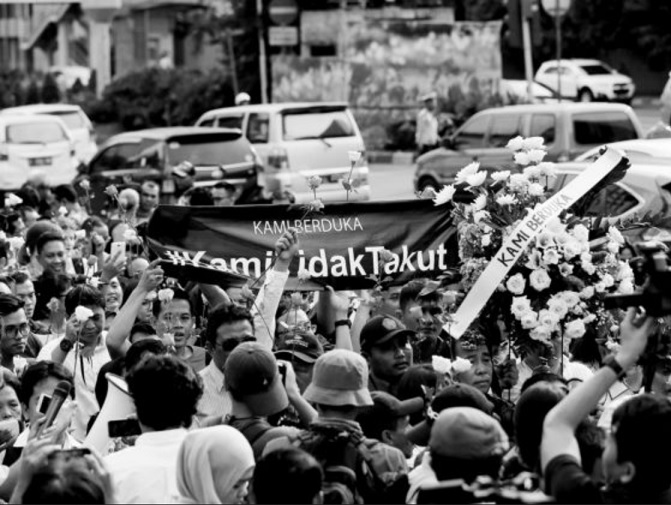
    Consider, for example, what happened after terror incidents and attacks worldwide. The Sydney hostage-taking in December 2014 was followed by a dignified viral campaign, “I’ll Ride with You”, to show solidarity with Australian Muslims. The Charlie Hebdo attacks in Paris in January 2015 saw the ground-up viral campaign “Je Suis Charlie”, while the Jakarta attacks in January 2016 saw the hashtag #KamiTidakTakut (Bahasa Indonesia for “We are not afraid”) go viral.

    Each of these was seen to be a grassroots event and response. Do the people of Singapore have the wherewithal and gumption to rise up, to come together with dignity, resilience and resolve, and with minimal government intervention? Whether and how we can we can do this will be a telling indicator of the shape or form in which we make it to SG100.

    ABOUT THE AUTHOR:

    Dr Shashi Jayakumar is a Senior Fellow and head of the Centre of Excellence for National Security at the S Rajaratnam School of International Studies, Nanyang Technological University.


    Source: Today

  • Ustaz Dr Mohamed Ali: Masyarakat Tidak Harus Keliru ISIS Berlandas Islam

    Ustaz Dr Mohamed Ali: Masyarakat Tidak Harus Keliru ISIS Berlandas Islam

    Masyarakat Islam tidak harus keliru dengan fakta bahawa ajaran pengganas ISIS walaupun atas nama Al-quran dan Sunah tetapi bukanlah satu ajaran Islam yang sebenar.

    Pengganas ISIS ialah golongan yang melampau yang menggunakan agama bagi membenarkan sesuatu fahaman atau ajaran mereka termasuk pengganasan diterima oleh umat Islam yang lain.

    Fahaman mereka itu hanya menuju ke arah radikalisme dan akan terus merosakkan Islam.

    Naib pengerusi Kumpulan Pemulihan Keagamaan (RRG), Ustaz Dr Mohamed Ali, yang juga Penolong Profesor Program Pengajian Perhubungan Antara Agama Dalam Masyarakat Majmuk (SRP), Sekolah Pengajian Antarabangsa S. Rajaratnam (RSIS) di Universiti Teknologi Nanyang (NTU) berkata: “Adakah umat Islam perlu menanggung masalah ISIS? Sebenarnya masalah yang dihadapi oleh ISIS bukanlah masalah umat Islam keseluruhannya. Tetapi ini masalah salah guna agama dan tiada kena-mengena dengan Islam.”

    Beliau berkata demikian ketika diminta mengulas mengenai tulisan Encik Sulaiman Daud di laman Facebook yang meminta umat Islam menanggung masalah militan ISIS.

    Menurut Dr Mohamed, umat Islam perlu membezakan antara keperluan sebenar umat Islam dengan kehendak pengganas.

    Beliau turut mengutarakan konsep ‘Al Wala Wal Bara’ iaitu di antara konsep Islam yang diputarbelitkan kumpulan pengganas bagi mengesahkan niat jahat mereka itu.

    Konsep itu membicarakan tentang hubungan antara orang Islam dan golongan bukan Islam, serta Islam ialah agama yang mementingkan perhubungan baik sesama manusia.

    Menyentuh tentang langkah mewujudkan negara Khalifah Islam, Dr Mohamed berkata tindakan mewujudkan negara khalifah bukan satu keperluan agama pada zaman hari ini.

    “Zaman ini terdapat kuasa negara ‘nation state’ dan zaman telah berubah kepada bentuk sekular atau sistem pemerintahan yang lain. Umat Islam sebenarnya sesuai pada setiap zaman pemerintahan. Kita boleh tinggal di mana sahaja di England atau di mana sahaja. Apa yang diperlukan oleh setiap orang Islam yang berpegang teguh kepada agama dan menyesuaikan diri dalam apa sahaja keadaan,” ujar Dr Mohamed.


    Source: http://beritaharian.sg

  • ISIS Targeting Indonesia

    ISIS Targeting Indonesia

    Indonesia may be declared the next Islamic State in Iraq and Syria (ISIS) province, said terrorism expert Professor Rohan Gunaratna.

    And when an area is declared a “province”, resources including foreign fighters move in and join local groups to impose ISIS’ will – this includes its vision of a caliphate.

    ISIS leader Abu Bakar Al-Baghdadi had earlier declared only areas in and around the Middle East such as Sinai, Libya, Iraq, Saudi Arabia and Yemen as “provinces”.

    Prof Gunaratna of the S. Rajaratnam School of International Studies (RSIS) said: “There is a misperception that the IS (another name for ISIS) threat is Syria- and Iraq-centric.

    “IS is going beyond its core area. It is sprinting while some governments are trying to play catch-up.”

    He said there are already several different groups affiliated to ISIS in South-east Asia. (See map on facing page.)

    And last year, Malaysian security authorities said four new terror groups were planning to create an Islamic caliphate to rule parts of South-east Asia, including Singapore.

    They planned to call it Daulah Islamiah Nusantara and it covers Singapore, Malaysia, Indonesia, southern Thailand and southern Philippines.

    All this makes it clear that ISIS’ aim is not just getting the self-radicalised – like M. Arifil Azim Putra Norja’i, the 19-year-old student who had planned to kill President Tony Tan Keng Yam and Prime Minister Lee Hsien Loong – to push its agenda.

    The big prize is Indonesia as a “province”, and exerting its influence in South-east Asia.

    WHAT PROOF IS THERE THAT ISIS IS REACHING INTO INDONESIA?

    Foreign fighters, including four Uighur men from Xinjiang province in China, were arrested in Indonesia last year.

    There are about 400 Uighurs in Syria fighting for ISIS.

    Then there is Santoso, an ambitious, if somewhat inexperienced Indonesian terrorist, as described in an April report by Indonesia-based Institute for Policy Analysis of Conflict (IPAC).

    In 2014, Santoso, head of East Indonesia Mujahedeen (MIT), pledged allegiance to ISIS leader Al-Baghdadi.

    He also gave himself the name Abu Musab Al-Zarqawi Al-Indunesi. Abu Musab Al-Zarqawi is the founding father of ISIS, who was killed by the US in 2006.

    Santoso had pushed for Poso in Sulawesi to be an IS “province”.

    Until recently, Al-Baghdadi ignored regions outside of the Middle East.

    But earlier this year, he declared South Asia as an IS “province”, a significant shift.

    Describing Santoso as “the greatest threat”, Prof Gunaratna said ISIS now has a global vision and is looking to link up with groups around the world.

    ISIS is reaching out to conflict zones in Indonesia and the Philippines and will hijack issues like the expulsion of the Rohingya people, he added,

    The four Uighur men had been trying to reach Santoso after a failed attempt to make it to Syria.

    HOW BIG A THREAT IS NETWORK IN POSO?

    A number of terrorists in Indonesia belonging to Jemaah Islamiah (JI) were killed and captured after the 2002 Bali bombing which claimed 202 lives.

    But in 2009, a group under Abu Bakar Bashir, the emir of JI, formed a branch in Poso. The group reached out to former fighters, said Ms Navhat Nuraniyah, an associate research fellow at RSIS.

    She told The New Paper the old network was revived and MIT was formed with Santoso as its leader. MIT’s military camp has been running in Poso since 2011.

    “Poso has a long history. It dates back to 1998 when a sectarian conflict broke out between Muslims and Christians,” said Ms Navhat.

    “JI and other jihadist groups first mobilised their fighters to defend Muslims there, and they subsequently used it as a training ground.”

    She added that MIT has carried out small-scale attacks in Poso including a botched suicide bombing and may not be a sophisticated group yet.

    “However, IS gave them a new purpose and the situation could change if their members or former students come back from Syria or Iraq,” she said.

    They already have the funds.

    In 2011, one of Santoso’s supporters, IT expert Rizki Gunawan, hacked a multi-level marketing company website and stole 6 billion rupiah (S$606,000).

    Part of the funds was said to have been used in a church bombing that year.

    WILL RETURNEES FROM SYRIA POSE THREAT?

    Official Indonesian sources say there are about 50 Indonesians fighting in Syria. Australian media has been reporting the figure as closer to 300.

    Prof Gunaratna said that like the experience in Afghanistan, returnees will have even greater resolve coupled with battlefield experience.

    In February, militants, believed to be returnees, were suspected to have been behind an attempted chlorine bomb attack at a shopping mall in south Jakarta.

    Indonesian police said it was the first such attack ever attempted in Indonesia and that it resembled tactics employed by ISIS in Syria and Iraq.

    Besides combat experience and deepened ideological commitment, IPAC’s director Sidney Jones reportedly said in March that returnees will also have international connections and legitimacy that could provide leadership for the terrorism network.


    Poso (in Sulawesi) has a long history. It dates back to 1998 when a sectarian conflict broke out between Muslims and Christians. JI and other jihadist groups first mobilised their fighters to defend Muslims there, and they subsequently used it as a training ground.

    – Ms Navhat Nuraniyah, an associate research fellow at RSIS


    There is a misperception that the IS (another name for ISIS) threat is Syria- 
and Iraq-centric. IS is going beyond its core area. It is sprinting while some governments are trying to play catch-up.

    – Professor Rohan Gunaratna of the S. Rajaratnam School of International Studies (RSIS)


    HOTLINE

    Anyone who knows or suspects that a person is radicalised should promptly call the ISD Counter-Terrorism

    Centre’s 24-hour helpline: 1800-2626-473 (1800-2626-ISD).

    Bali bombers’ connection

    Lamongan is a sleepy town about 50km from Surabaya, Indonesia’s second largest city. It was also the home of Bali bombers and brothers Amrozi, Mukhlas and Ali Imron.

    The tiny town’s connection to terrorism has been in the news recently.

    In March, two sisters-in-law from Lamongan were deported from Turkey with their children after trying to get to ISIS-controlled Syria.

    An April report published by the Indonesia-based Institute for Policy Analysis of Conflict (IPAC) said Lamongan’s extremist community was shaped by Jemaah Islamiah and its satellite school.

    Many of the attacks in Indonesia were planned or started in Lamongan, according to the IPAC report.

    The report said the Lamongan network also helped present Santoso’s MIT group as being a serious threat.

    MEDIA ARM

    The report added: “The key to this was providing Santoso with an effective media arm, and the Lamongan network did just this – connecting Santoso first with Al-Qaeda’s Global Islamic Media Front and then with ISIS.

    “The objective was to create the illusion, both internationally and at home, that the Indonesian effort was bigger and more significant than it really was.

    “The propagandists may have wanted international recognition for Indonesia’s home-grown jihad, but they wanted even more to persuade small-town recruits from other parts of Indonesia that Poso was a war worth fighting.”

    Over time, the Lamongan network has also provided recruiters, fighters and propagandists for ISIS.

    Following a series of crackdowns, many of the fighters ran to Poso and Santoso, making him Indonesia’s most wanted terrorist.


    Source: www.tnp.sg