Tag: Singaporeans

  • Ustaz Pasuni Maulan Antara 11 Penerima Anugerah SG50 MUIS

    Ustaz Pasuni Maulan Antara 11 Penerima Anugerah SG50 MUIS

    Buat pertama kalinya, Majlis Ugama Islam Singapura (MUIS) memberi anugerah khas SG50 kepada 11 individu bersempena sambutan Jubli Emas negara.

    Para penerima diiktiraf atas sumbangan mereka kepada pembangunan negara menerui penglibatan mereka dalam MUIS dan pertubuhan-pertubuhan masyarakat yang lain.

    Anugerah itu disampaikan Presiden Tony Tan Keng Yam di majlis anugerah MUIS di Istana petang tadi.

    PRESIDEN 4PM TERIMA ANUGERAH JASA CEMERLANG

    Penerima Anugerah Jasa Cemerlang pada tahun ini ialah Presiden Persatuan Persuratan Pemuda Pemudi Melayu (4PM), Encik Izzuddin Taherally, 62 tahun, yang sudah hampir 44 tahun terlibat dalam kerja-kerja kemasyarakatan.

    Penerima Anugerah Jasa Cemerlang MUIS, Presiden 4PM, Encik Izzuddin Taherally. (Gambar: Nurulkhasanah Agost)

    “Yang penting sekali bagi saya, kalau kita memberikan khidmat kita kepada sesiapa, menolong mereka, apabila kita melihat perasaan gembira yang terpapar di wajah mereka, ia memberikan satu dorongan kepada saya untuk meneruskan kerja-kerja ini,” ujar Encik Izzuddin.

    MANTAN PRESIDEN PPIS TERIMA ANUGERAH JASA BAKTI

    Lapan individu pula menerima Anugerah Jasa Bakti kerana membuat sumbangan dalam bidang-bidang seperti pendidikan, ekonomi, khidmat masyarakat atau pendidikan Islam yang telah membawa perubahan baik kepada masyarakat.

    Salah seorang daripada mereka ialah mantan presiden PPIS, Cik Sapiah Molla.

    “Sangat bererti bagi saya, saya bersyukur atas pengiktirafan ini, dan ini kerana dapatlah sedikit sumbangan kepada masyarakat, dan saya rasa beruntung dapat memberi sumbangan kepada masyarakat,” kata Cik Sapiah.

    USTAZ PASUNI MAULAN RAIH ANUGERAH SG50 MUIS

    Salah seorang penerima Anugerah SG50 MUIS, yang diberikan buat pertama kalinya, ialah Ustaz Pasuni Maulan, yang menyumbang secara aktif dalam Majlis Tertinggi MUIS.

    “Saya merasa puas kalau yang saya tolong atau segala usaha yang dilakukan itu berjaya. Jadi bukanlah mengharapkan anugerah atau apa jua penghargaan dari sesiapa,” kata Ustaz Pasuni.

    Di majlis tersebut juga, Presiden Tan menerima sumbangan cek berjumlah $100,000 berupa sumbangan masyarakat Islam Singapura kepada Cabaran Presiden.

    Source: http://berita.mediacorp.sg

  • Why Are Fewer Women Interested In Singapore Politics Than Men?

    Why Are Fewer Women Interested In Singapore Politics Than Men?

    In the month of August, I’ve been writing mainly about politics and reduced the frequency of my other type of content like personal development and travel significantly. This was due to our upcoming elections on 11 September 2015.

    Traditionally, I track my reader’s demographic by looking at the breakdown of the Facebook followers I have. Last month, I started using Google Analytics instead of the built-in analytics platform on blogger. This gave me a better insight into the type of readers I was getting.

    I checked my Google Analytics recently and found some unexpected results after focusing on politics primarily for a month.

    What disturbed me was that the proportion of female readers I had fell significantly. Previously the ratio was about 50:50 (based on my follower count on Facebook). Now, female readers only constitute 35.8 percent!

    I used to think that I had fewer female commenters because they were less vocal and didn’t like confrontation in general. However, numbers don’t lie I guess.

    Jeraldine-Blog-Stats-Gender


    I did some research about this phenomenon and realized that in general, women are less aware about political issues and active. This is the case even for rich and developed countries in the world.

    Professor James Curran, Director of the Goldsmiths Leverhulme Media Research Centre at University of London, carried out a research by interviewing 10,000 people across 10 countries – Australia, Canada, Colombia, Greece, Italy, Japan, South Korea, Norway, the UK and the US.

    The survey contained 8 questions and in every country, men scored better than women in their own country. British men scored an average of 5.8 correct answers out of eight on subjects such as the name of the United Nations secretary general, the national unemployment rate and what job Vladimir Putin did. Their female counterparts failed the test scoring 3.9/8 on average.

    Researchers report that besides having lesser knowledge, women are also more disconnected from the political process; inclined to say they are not interested in politics and more inclined to say politics are complicated and difficult to understand,” reported the researchers.

    Here is why:

    1) The lack of female representation

    First of all, men are more likely to be encouraged to take part in political activity than women. Ananalysis of primetime TV news coverage found it was “heavily weighted towards male sources”, with women interviewed and cited in fewer than a third (30%) of news stories.

    Instead, women were interviewed for topics such as “family, lifestyle and culture”.

    According to co-author of the research above, Kaori Hayashi, gaps in exposure to media are related to the gaps of knowledge between men and women.

    “Such under-representation and topical bias of women in news media may curb women’s motivation to acquire political knowledge actively, and discourage them from political participation, and even prevent women from engaging as citizens in a democratic society,” he said.

    Curran agreed with him saying that “Politics is projected as a man’s world and that encourages a sense of disconnection…It’s enormously off-putting for women to be looking at the news as always being about men,”

    This situation is worsened by the fact that women are always super underrepresented in governments across the world.

    Looking at the candidates for General Elections, I can’t help but notice there are so few women representatives when we constitute 50 percent of the population.

    For the Worker’s Party candidate list, I could only find four women out of 25 candidates. The Singapore Democratic Party has only three women out of 11 candidates. Reform party has 0 female candidates out of 6.  PAP’s numbers are no better as well though I’ve noticed they try to have one female representative in every GRC. Then again, they have more people and more resources.

    Singaporean female politicians have differing views. According to Sim Ann, “in politics, women get it a lot worse than men… Names heaped on women are nastier”. I definitely agree with her because of what poor Tin Peiling had to go through in 2011. =(

    SPP’s Jeannette Chong believes this is could also be due to “ruling party’s focus on co-opting military men and reliance on old boy’s networks is limiting the space in the front bench for equally capable women who do not come from those backgrounds.”

    Either way, I really hope to see more women contesting in the next elections!
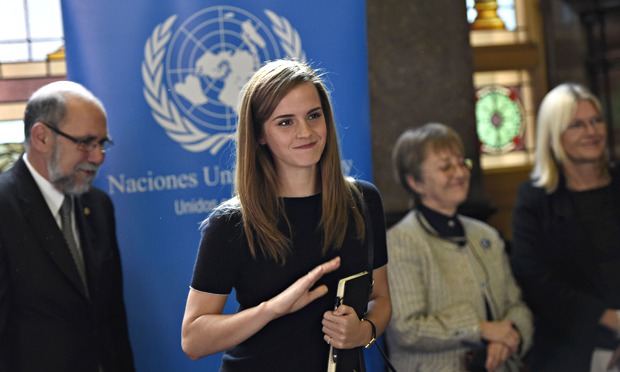
     

    Emma Watson a good role celebrity model who focuses on doing well at school and championing causes like environmental protection and women’s rights.


    2) Women lack confidence to discuss sociopolitical affairs

    A separate study also found that a mere 20% of op-eds are written by women. While women wrote more frequently than men about so-called “pink” topics (like family concerns and home life), they were almost mute on matters such as Occupy Wall Street and other protests or rallies (14% of commentaries), international politics (13%), and the economy (11%).

    According to Katherine Lanpher, an instructor for the Op-Ed Project, a group that works to increase the diversity of voices in the media, this is due to self-confidence.

    She observed that women will write in when they feel certain they have specialized knowledge of a subject, whereas men don’t feel they need much more than a strong opinion or an interesting idea.

    She explains:

    “A significant part of the problem appears to be that women just don’t have confidence that their opinions matter, or that they are informed enough. Therefore, they don’t bother aiming for the op-ed pages…they are usually the first people to say, ‘Oh, I’m not an expert in that, you could find someone better to talk to,’” “‘What if someone who knows more calls me on it?”


    3) Women’s interest are defined by society

    Life isn’t just about fashion and beauty

    In the magazine section, book shops or in online portals like elite daily, you often see a section titled “Women” or “Women’s interest”. The thing that falls under this category will be cooking; beauty; lifestyle; fashion; parenting; how to get boys to like you etc.  So perhaps from this type of social conditioning, many women begin to develop narrow interests in these areas.

    Furthermore, what I find disturbing in society is that women are mostly taught to focus on beauty alone.  Female characters on television rarely have much character development beyond their main role of being ‘pretty’ or the ‘object of male attention’. Of course this is gradually changing with the rise of movie characters like Katniss in Hunger Games and Tris Prior in Divergent.

    Similarly, in interviews with female actresses, they are often asked dumb and shallow question like their fitness regime or skincare secrets. This includes even smarter actresses like Angelina Jolie and Natalie Portman.


    4) Women care more about harmony

    Research has shown that women are, on average, more concerned with connecting to others and maintaining group harmony. They care more about what others think of them; how others feel and less likely to debate.

    Thus, while men are likely to hold their ground, act independently, and refuse to conform, women are more likely to conform to the opinions of others in order to prevent social disagreement.

    Perhaps due to these personality differences, women are less interested in politics where one has to make a stance about an issue or voicing it out.


    As we move closer to the General Elections period, I’d like to encourage more women to pay attention to current affairs and social issues.

    It is really important because ultimately who gets selected determines the path we will take over the next decade. Do you want more foreign talents in Singapore? Do you want more affordable housing? Would you like a less stressful education for your children next time? All these is determined by your vote and who you choose.

    Politics is not a ‘guy thing’. Neither is it too ‘cheem’ or difficult to understand. It is not a topic you need to be an expert in to discuss. What makes you think you know less than the coffee shop uncle anyway?

    I really hope to see more ladies coming forward to participate in the political process whether it is championing a cause they care about; expressing a political stance or even running as a candidate.


    Source: www.jeraldinephneah.me

  • Why 50K HDB Rentals Can’t Buy When Less Than 1K Can Afford?

    Why 50K HDB Rentals Can’t Buy When Less Than 1K Can Afford?

    1,800 earning less than $1,000 bought HDB

    According to the Straits Times news report GE2015: PM Lee’s assurance on cost of living” (Sep 3) – “With more subsidies, the net price for a two-room flat is now $30,000 and many families have been able to afford it, he said. In the last four years, 1,800 families earning less than $1,000 a month have bought two-room flats.

    “So when I say we have made housing more affordable to help people with the cost of living, I’m telling the truth.””

    50,000 HDB rental tenants can’t afford to buy HDB?

    If even most people earning less than $1,000 a month find buying a HDB flat affordable – then, arguably why do we have more than 50,000 HDB rental flats that are rented by Singaporeans?

    How many of the 1,800 families earning less than $1,000 who bought HDB flats in the last four years were HDB rental flat tenants?

    From the cheapest to the most expensive public housing in the world?

    Our public housing has arguably changed from being the cheapest public housing during our late former Prime Minister’s era, to the most expensive in the world – if measured by the price to wages ratio

    Supply of HDB flats to meet demand?

    The supply of HDB flats to meet demand was also an issue.

    For example, whilst the total number of HDB flats grew by 201,755 or 25,219 per year, in the eight years from 661,163 in 1994 to 862,918 in 2002 – it only grew by 21,438 or 3,063 per year, in the seven years from 868,774 in 2003 to 890,212 in 2010.

    In other words, the average increase in flats per annum declined by a whopping 88 per cent (3,063 divided by 25,219).

    Huge population increase 

    During this seven-year period when very few HDB flats were built – the huge influx of foreigners increased the population by a whopping 961,906 or 23 per cent, from 4.1 million to 5.1 million, from 2003 to 2010.

    HDB prices

    With this huge increase in the population – the HDB Resale Price Index increased a whopping 66 per cent or 7.5 per cent per annum during the same period from 75.1 in 2003 to 124.4 in 2010.

    Housing problems compounded by low CPF %, wages, population increase?

    Our public housing problems were perhaps compounded by the decrease from 6.5 per centCPF interest to 2.5 per cent (the lowest real return amongst national pension schemes in the world since 1999), huge influx of foreigners, hardly any real increase in wages, etc.

    We should relook the “great” policies like HDB and CPF implemented during the late former Prime Minister’s tenure – in the context of how they may have convoluted to become the key problems that Singaporeans have today?


    Leong Sze Hian

    A.S.S. Contributor

    Source: www.allsingaporestuff.com

  • Difficult To Get A Job With General Degree And No Work Experience

    Difficult To Get A Job With General Degree And No Work Experience

    Hi Mr. Tan,

    I came across your blog and would like to share my thoughts and experiences with you.

    I have a diploma in business (merit) from a local polytechnic. After NS, I was rejected by NUS for a place in Business School but was offered sociology instead. Because of my interests in business, I did a minor in management and realised to my shock that 30% of those in business school were foreigners – from Vietnam, China, Malaysia who don’t even understand business terms!

    After a year, I lost interest in my course and just breezed through and scraped by with a basic pass degree. Although I admit this is my fault for not working hard and securing a comfortable government job like a few of my peers, but the whole idea is that the private sector is a completely different ball game although.

    When I graduated, I sent in hundreds of resume but only got two interviews. The reality for fresh graduates is that unless you have a law, accountancy or medicine degree where you have secured a training contract of some sort then you are safe. Civil service aside, the private sector is very unwilling to take on someone with a general degree with no experience.

    In fact, I have been unemployed for 2 years after graduating and helping our my mother in her restaurant. This has made me feel very inferior towards the S-pass holders from third-world countries!

    Eventually, I decided to put my diploma as my highest educational level and secured a part-time job as an admin executive earning $1,200 a month with a local SME working about 20 hours a week.

    I can tell you for a fact that the graduate employment surveys are bullshit! It is done on a voluntarily basis and only those who have secured jobs would have sufficient information to fill such as basic salary and so on. The reality is that the unemployed like myself are too ashamed to fill up the survey.

    Even for those who do, what does 15% of FASS (faculty of arts and social science) graduates who are unemployed SIX months after graduation is no joke, considering the amount they spent on their education. I would personally estimate that around 30% of my peers are unemployed and another 30% are like me underemployed doing jobs like estate and insurance agents which do not even require degrees!

    In my free time, I am also studying for an ACCA to enhance my future prospects after seeing how general degrees have no value in the job market while there are so many foreigners competing with Singaporeans who have served NS.

    I have really really lost faith in our PAP.


    Source: http://tankinlian.blogspot.sg

  • Walid. J Abdullah: On Freak Election Results And Voting For The Sake Of It

    Walid. J Abdullah: On Freak Election Results And Voting For The Sake Of It

    On freak election results and voting opposition for the sake of it:

    It is that time of the year when you hear people warning about a ‘freak election result’ and voters who ‘do not know what they are angry about’ and ‘want to vote opposition for the sake of it’. To be fair to the PAP candidates, i have not heard them use this card too much during hustings, so that is commendable. Unfortunately, some of their overzealous supporters choose to propagate this rhetoric. To which, I say:

    1) There is no such thing as a freak election result. If people have voted, they have voted. If on september 12, for instance, there are 89 PAP MPs, it is not a freak election result: people have made their choice. Likewise, there is no reason to state that it is a freakish result if PAP does not do well.

    2) The PAP WILL remain as the government: you can be sure about that. In fact, in all likelihood, they will retain their two-thirds majority. Quite comfortably, i believe. I shall justify this claim by detailing the different electoral contests in a later post.

    3) Do people realize how condescending they sound when they say this? It is as though any vote for the opposition is irrational, and the only non-freakish or right outcome is a PAP victory.

    4) Let us just look the logic of the claim. Let’s say John tells people that ‘we must be careful not to have a freak result.’ When you ask him why, he will say ‘because the people still wants PAP as the government.’ So when you ask him what is the evidence, he will say: ‘they have been voting for the PAP all this while’.

    So…

    Assertion: People want PAP as government.
    Evidence: Their voting patterns.

    Then you say, hang on a minute: let us say the PAP does not become the government. Why is that a freak result? If the evidence for people wanting PAP as their government is the voting pattern, then when the pattern changes, why don’t you trust the pattern and accept that the people do not want PAP as the government anymore?

    John would then go ‘errr, almost all the people i know want PAP as government and those who support the opposition, have no idea why they are doing so’.

    Then you would tell him: ‘the people you know, are not representative of the population. The voting results, are.’

    He would then go: ‘err, this is just what i feel.’

    Then you would say: ‘Well John, i feel like slapping you right now too, but that doesn’t mean my feeling is rational or justified.’

    5) If you believe that voters cannot be trusted to make the right choice, have voters been wrong all this while then?

    Singaporeans have voted for the PAP as our government 11 times since independence. For each of those 11 times, was their judgment sound or suspect?
    You can’t have your cake and eat it.

    6) Ultimately, claims like these only serve to obfuscate matters and distract us from what really matters: discussions on policies.

    Let us get back to those constructive discussions.


    Source: Walid J. Abdullah

deneme bonusu