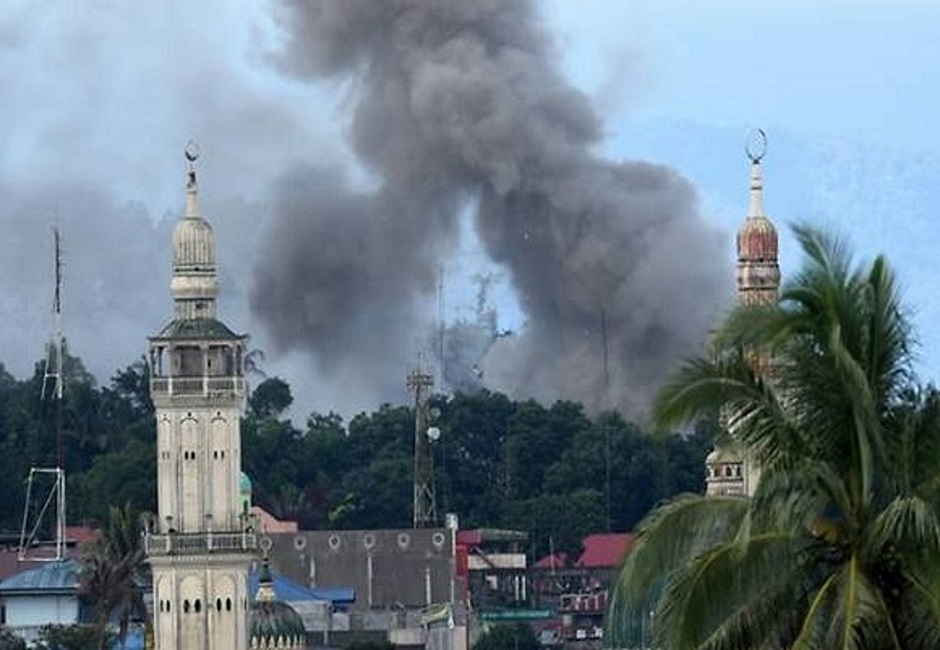
MANILA: The Philippine military has recovered what they believe to be the body of a Singaporean fighter in the besieged city of Marawi.
According to the Marawi joint task force on Tuesday (Jul 4), the Singaporean is believed to be among 11 suspected foreign fighters who have been killed so far as Philippine troops battle to regain control of militant-held areas of the city.
Fighters from Malaysian, Indonesia, Yemen and India were among the bodies recovered, said the joint task force, adding that it has not yet completed the identification process.
“A cadaver of a foreign-looking individual was also recovered by troops. It is believed that it is one of the reported foreign fighters from Singapore,” the military was quoted saying in local media reports.
Singapore’s Ministry of Home Affairs had in May confirmed that a Singaporean man has been implicated in terrorism-related activities in the southern Philippines, but said it has no information about whether he is involved in the armed insurgency in Marawi city on Mindanao island.
The southern region of Mindanao has been under martial law since May 23, after hundreds of gunmen waving black Islamic State flags occupied parts of Marawi city and triggered deadly clashes that have yet to end.
More than 400 people, including 337 militants and 85 members of the security forces, have been killed in the fighting in Marawi. Forty-four civilians have also been killed, either in crossfire or executed by the militants, the military said.
A leader of a militant group who was directly involved in the kidnap and execution of Canadian and German nationals was among those killed by Philippine troops in a clash on a resort island this week, the military said on Wednesday.
Troops killed at least six members of the Islamic State-linked Abu Sayyaf during the firefight on the popular tourist island of Bohol on Tuesday, but suffered four casualties.
The military has recovered the body of Muamar Askali, also known as Abu Rami, a former spokesman for Abu Sayyaf, a group well known for extortion, piracy and kidnaps for ransom.
Armed Forces chief of Staff General Eduardo Ano described Abu Rami as “a very notorious Abu Sayyaf leader” responsible for several atrocities.
The group last year beheaded Canadians John Ridsdel and Robert Hall. Elderly German Jurgen Kantner suffered the same fate in February when a US$600,000 ransom demand was not paid.
Ano said Abu Rami was “trying to make a name of his own” and had risen to become one of Abu Sayyaf’s top leaders. He was involved in what the army said was a thwarted attempt to kidnap tourists in Bohol during Holy Week in the mainly Roman Catholic nation.
Ano said the situation in Bohol, far from Abu Sayyaf’s island strongholds in the South, was now “back to normal” even as security forces chased down other fighters involved in the gun battle.
The clash happened after the United States, Canadian, Australian and British embassies warned citizens about kidnappings during the holiday and advised against travel to Central Visayas, which includes Cebu and Bohol.
The military has declared all-out war with Abu Sayyaf on the islands of Jolo and Basilan, but is hamstrung by its presence among large civilian communities.
Abu Sayyaf has its roots in separatism but its activities are mostly banditry and piracy and it has invested the profits of its business in modern weapons and fast boats.
The military has struggled to curb the piracy, with the group’s boats difficult to detect when they target slow-moving trawlers. Indonesian, Malaysian and Vietnamese vessels are frequently targeted and their crew abducted, and the government has sought international help to patrol the Sulu Sea.
The government also says it has credible intelligence that some Abu Sayyaf leaders are in contact with Islamic State with a view to establishing a presence in the mainly Muslim southern Philippines.
President Rodrigo Duterte has warned of a potential Islamic State “contamination”.
KUALA LUMPUR: LESS than a decade after local militant groups were thought to have been neutralised, security agencies are warning of the emergence of four new terror organisations.
Intelligence sources told the New Straits Times that these four groups, permutations of earlier terror cells, such as Jemaah Islamiah and Kumpulan Mujahidin Malaysia, are embarking on an aggressive recruitment drive and pushing their agenda ahead. They are believed to be operating from, among others, Perak and Selangor.
Under an understanding with intelligence sources, the NST will only refer to these organisations by their acronyms: BKAW, BAJ, DIMzia and ADI.
Their endgame is the establishment of a “super” Islamic caliphate, called Daulah Islamiah Nusantara, comprising Malaysia, Indonesia, Singapore, southern Thailand and southern Philippines.
This was, more than a decade ago, the ultimate goals of several regional terror groups which was forced to be shelved after many of their leaders were picked up in a global terror clampdown.
Although the four groups currently operate independently of one another, sources revealed that they subscribe to the same salafi Jihadi ideology, which mirror that of terror group al-Qaeda and the Islamic State of Iraq and the Levant (Isil).
The cornerstone of the ideology is to fight and reject the democratic system applied by Muslim nations, including Malaysia.
Leaders and senior members of these terror groups, according to sources, had established solid links with similar groups in the region, active in places such as southern Thailand, Indonesia, Myanmar, as well as Philippines-based Abu Sayyaf and Isil, which has a strong presence in the Middle East.
Police are also monitoring a terror organisation based in Sabah, called Darul Islam Sabah, whose members were the last to be released from detention under the Internal Security Act.
United by a common agenda, it is believed these groups may eventually cooperate with other far-flung terror groups such as Isil, to achieve their ultimate aim.
Authorities, who have their pulse on the groups’ communications and movements, said intelligence revealed that the members of these groups, which are slowly gaining strength, had gone through training to perfect their battlefield knowledge and tradecraft, including producing their own weapons and explosives.
Experience gleaned by Malaysian militants from their Syrian and Afghan campaigns, sources believe, could also be tapped and put to use, eventually, by groups here.
They have strong local financial backers, including businessmen and professionals, as well as those whose employment status had not been ascertained.
One of the more high-profile Malaysian militants was a former drummer of a local rock outfit.
These terror groups go though great lengths to ensure that their set-up and agenda are not disrupted. In their meetings, members are constantly warned that death is the punishment for betrayal.
Authorities revealed that these groups were also behind the sending of Malaysians to be embedded in jihadist groups in Syria.
Prior to them being deployed to Syria, recruits would be sent for basic training in southern Thailand and with the Abu Sayyaf group.
The main Abu Sayyaf training camp was called Camp Hudaibiyah. It was here that recruits were taught, among others, the art of combat, urban warfare, hand-to-hand techniques, how to set up booby traps and construct improvised explosive devices (IEDs) and how to field strip weapons.
It is understood that the BKAW group, in building its strength, had been recruiting members through Facebook as well as through a series of ceramah. Their primary targets are youth and students from local institutions of higher learning.
Its members had pledged to procreate to give birth to a fresh supply of fighters.
It is understood that Ahmad Tarmimi Maliki, 26, the Malaysian linked to Isil and credited with blowing up 25 elite Iraqi soldiers at Iraq’s SWAT headquarters on May 26 in a suicide attack, was part of BKAW. He, and several others, had undergone training in Port Dickson late last year.
The NST learnt that the DIMzia, established earlier this year, was a splinter group of the BAJ. The split happened when two BAJ leaders had a falling out over the misappropriation of funds.
The sources said while the leader of DIMzia had been picked up by authorities, their members had been keeping the group active.
DIMzia had, in early April, held an orientation programme in Ijok, Perak, where members were put through rigorous physical training, which included scaling up the seventh level of a waterfall. Members were also made to soak in cold water as a test of their mental strength.
There, they were also supposed to get lessons on how to detonate a bomb using a handphone as the trigger mechanism. However, the local man who was supposed to teach them did not turn up.
It was also revealed that these groups refer heavily to “manuals” penned by militants, including Indonesian Abu Bakar Bashir, leader of Jemaah Islamiah, who in 2011 was sentenced to 15 years in prison for supporting a training camp.
Although barely a year old, ADI, which is allegedly headed by a respectable academic figure, was believed to have strong links with foreign militant groups, including Indonesia’s Jemaah Ansharut Tauhid (JAT).
Abu Bakar had, in 2008, reportedly announced his intention to create JAT, which also meant “partisans of the oneness of God”, when the Indonesian government was preparing to execute the three convicted Bali bombers. JAT is on the United States’ terror list.
Malaysian authorities share the concerns of their counterparts in the region that locals who join their militant brethren in Syria and Iraq would then return to their country of origin to “export” their knowledge and ideology.
“We are also looking at Syria and Iraq as a petri dish for local militants to establish international contacts and propagate their goals, not only in their respective countries, but in the region as a whole.
“Those countries (Syria, Iraq and Afghanistan) are real battlegrounds, unlike the basic training they went for in the southern Philippines or in other training camps.
“When they return, their insurgency tactics and battlefield knowledge would have been highly honed.
“To their supporters here, they will be seen as high-profile jihadists and it would be easier for them to pull in more young members,” a high-ranking intelligence officer said.
Police are seeking an Islamic studies lecturer with Universiti Malaya (UM) and a staffer with the Selayang Municipal Council (MPS) among five Malaysians suspected of recruiting members for militant Islamic groups in conflict-riddled Syria and the Philippines. – See more at: http://www.themalaymailonline.com/malaysia/article/wanted-for-islamic-militancy-um-lecturer-selayang-council-staffer#sthash.Y8dgMsTQ.dpufProfiles of the five men, complete with their pictures, were released in a wanted poster by Bukit Aman’s counter-terrorism unit.
Inspector-general of Police Tan Sri Khalid Abu Bakar said three of the suspects are believed to be serving the Islamic State of Iraq and The Levant (ISIL) while the other two are members of Darul Islam Sabah, a group now affiliated with the Abu Sayyaf terrorist sect based in South Philippines.
Among those identified as ISIL recruiters is Dr Mahmud Ahmad, otherwise known as Abu Hanadzalah, a lecturer attached with Universiti Malaya’s (UM) Academy of Islamic Studies faculty.
Also linked to ISIL is Mohd Najib Husen – who also goes by the name of Abraham – the operator of a photocopy and stationaries shop in UM, and Muhammad Joraimee Awang Raimee or Abu Nur, a secretariat staff with the Selayang city council.
Linked to the Darul Islam Sabah group, meanwhile, were Mohd Amin Baco and Jeknal Adil, both from Tawau, Sabah.
Polis Diraja Malaysia (Royal Malaysia Police)Polis Diraja Malaysia (Royal Malaysia Police)Polis Diraja Malaysia (Royal Malaysia Police)Polis Diraja Malaysia (Royal Malaysia Police)Polis Diraja Malaysia (Royal Malaysia Police)Polis Diraja Malaysia (Royal Malaysia Police)Polis Diraja Malaysia (Royal Malaysia Police)