Tag: Syria

  • IS Millitants Asked For Ransom Before Executing American Journalist

    IS Millitants Asked For Ransom Before Executing American Journalist

    Kneeling in the dirt in a desert somewhere in the Middle East, James Foley lost his life this week at the hands of the Islamic State in Iraq and Syria. Before pulling out the knife used to decapitate him, his masked executioner explained that he was killing the 40-year-old American journalist in retaliation for the recent United States’ airstrikes against the terror group in Iraq.

    In fact, until recently, ISIS had a very different list of demands for Mr. Foley: The group pressed the United States to provide a multimillion-dollar ransom for his release, according to a representative of his family and a former hostage held alongside him. The United States — unlike several European countries that have funneled millions to the terror group to spare the lives of their citizens — refused to pay.

    Sensitive to growing criticism that it had not done enough, the White House on Wednesday revealed that a United States Special Operations team tried and failed to rescue Mr. Foley — a New Hampshire native who disappeared in Syria on Nov. 22, 2012 — as well as the other American hostages during a secret mission this summer. Mr. Obama said the United States would not retreat until it had eliminated the “cancer” of ISIS from the Middle East.

    ISIS also appears determined to increase the pressure on Washington. It has now threatened to kill a second of its hostages, Steven J. Sotloff, a freelance journalist for Time magazine who was being held alongside Mr. Foley.

    james foley_2

    In the video uploaded to YouTube on Tuesday, the screen goes dark after Mr. Foley is decapitated. Then the ISIS fighter is seen holding Mr. Sotloff in the same landscape of barren dunes, wearing an orange jumpsuit and his hands cuffed behind his back. “The life of this American citizen, Obama, depends on your next decision.”

    Along with the three Americans, ISIS is holding citizens of Britain, which like the United States has declined to pay ransoms, former hostages confirmed. The terror group has sent a laundry list of demands for the release of the foreigners, starting with money but also prisoner swaps, including the liberation of Aafia Siddiqui, an M.I.T.-trained Pakistani neuroscientist with ties to Al Qaeda currently incarcerated in a prison in Texas. The policy of not making concessions to terrorists and not paying ransoms has put the United States and Britain at odds with other European allies, who have routinely paid significant sums to win the release of their nationals — including four French and three Spanish hostages who were released this year after money was delivered through an intermediary, according to two of the victims and their colleagues.

    Kidnapping Europeans has become the main source of revenue for Al Qaeda and its affiliates, which have earned at least $125 million in ransom payments in the past five years alone, according to an investigation by The Times. Although ISIS was recently expelled from Al Qaeda and abides by different rules, recently freed prisoners said that their captors were well aware of what ransoms had been paid on behalf of European nationals held by Qaeda affiliates as far afield as Africa, indicating that they were hoping to abide by the same business plan.

    While government and counterterrorism officials insist that paying ransoms only perpetuates the problem, the policy has meant that captured Americans have little chance of being released. A handful succeeded in running away, and even fewer were rescued in special operations. The rest are either held indefinitely — or else killed.

    In an opinion article for Reuters, David Rohde, a columnist for the news service and a former foreign correspondent for The Times who was kidnapped by the Taliban, said that the uneven approach to ransoms may have cost Mr. Foley his life.

    james-foley-fbi-570x341

    “The payment of ransoms and abduction of foreigners must emerge from the shadows. It must be publicly debated,” wrote Mr. Rohde, who escaped his yearlong custody of the Taliban only when he climbed out a window and freed himself. “American and European policy makers should be forced to answer for their actions.”

    Mr. Foley, a freelance videographer and reporter for GlobalPost and Agence France-Presse, went missing 21 months ago in a town 25 miles south of the Turkish border. According to Nicole Tung, a close friend and fellow photojournalist, who gave an account of Mr. Foley’s activities before his capture, he had spent weeks in Syria documenting the country’s spiral into civil war, narrowly avoiding a falling tank shell. The normally calm reporter — who had come under fire in Afghanistan and had been kidnapped a year earlier in Libya — was rattled.

    As the Thanksgiving holiday approached in 2012, he contacted Ms. Tung, and they made plans to meet for a few days across the border in Turkey. When Mr. Foley did not show up at the hotel at 5 p.m. as planned, Ms. Tung began calling his cellphone, finally reaching his translator.

    The man explained that Mr. Foley had stopped at an Internet cafe to file his last images in Binesh, Syria. Soon after, armed men sped up behind his car and forced Mr. Foley out at gunpoint.

    “I was sitting on the bed, in this depressing, dark hotel; the fact that the fixer answered the phone — when Jim was not answering his — was the cue that something had gone terribly wrong,” said Ms. Tung, who immediately contacted Mr. Foley’s family and editors.

    Across the ocean at his home in Cambridge, Mass., the chief executive and co-founder of GlobalPost, Philip Balboni, reached for his Blackberry and had a terrible sense of foreboding: The email informing him of Mr. Foley’s abduction was almost an exact replay of the horror his staff had endured a year earlier, when Mr. Foley was kidnapped with three others by Col. Muammar el-Qaddafi’s forces in Libya.

  • Malaysians With ISIS Links Raised Funds to Attack Putrajaya

    Malaysians With ISIS Links Raised Funds to Attack Putrajaya

    ISIS T shirt

    Malaysian militants linked to the Islamic State in Iraq and Syria (ISIS) were planning to overthrow the government in Putrajaya and attack several pubs, discos and even the Carlsberg brewery in Shah Alam, Selangor, according to the police.

    Federal Special Branch principal assistant director Ayob Khan Pitchay Mydin told The Sunday Times yesterday that out of 19 suspects arrested in a clampdown earlier this year, seven are set to face trial in October for security offences.

    “They have the same ideology as groups like Al-Qaeda, where the main objective is to topple the government and install an Islamic state,” said Datuk Ayob, who heads the force’s counter-terrorism efforts.

    The suspects had raised several thousand ringgit for their efforts which were nipped in the bud when the police dismantled the group between April and June.

    “Their plans were not that advanced. They were only discussing (how) to attack but had not obtained material to make bombs,” he said, adding that the police had seized homemade rifles, shotguns and ammunition.

    Mr Ayob said the group had dispersed after their leader and second-in-command were arrested between April and May. The police are searching for the remaining members.

    “Their plan is to go to Syria for training. More than 20 are already there but we have identified them and will nab them if they return,” he said.

    ISIS is a splinter group of Al-Qaeda that wants to set up an Islamic caliphate encompassing both Iraq and Syria.

    Malaysian factory worker Ahmad Tarmimi Maliki died as an ISIS suicide bomber in May, sparking alarm over renewed Islamic extremism in Malaysia.

    Muslim-majority Malaysia practises moderate Islam and has not been the target of any notable terror attacks in recent years.

    But it has been home to several key figures in militant Islamic groups, such as the Al-Qaeda-linked Jemaah Islamiah, blamed for the deadly 2002 Bali bombings.

    Home Minister Ahmad Zahid Hamidi has said that a regional ring he dubbed the “Nusantara network” might be recruiting citizens of Malaysia, Indonesia, southern Thailand and the Philippines to join militant activities abroad.

    In June, the police arrested three alleged militants in Sandakan, Sabah. One of them had allegedly received training from Islamic militant group Abu Sayyaf in the southern Philippines, while another was a Royal Malaysian Navy personnel. The latter was released last month and has since returned to full service.

    In late June, the United Nations revealed that 15 Malaysians were allegedly killed in Syria after joining terrorist and jihadist activities with ISIS.

    ISIS fighters have engaged in a bloody war across Iraq, overrunning large areas of the country and conquering a substantial part of the north.

    Iraq’s Prime Minister-designate Haider al-Abadi said last week that Iraqis must unite to face terrorism, promising that his government will fight to “salvage the country from security, political and economic problems”.

    Source: http://www.straitstimes.com/the-big-story/asia-report/malaysia/story/malaysian-govt-brewery-pubs-militants-target-list-20140817

    letters R1C

    YOUTUBE: youtube.com/user/rilek1corner

    FACEBOOK: facebook.com/rilek1corner

    TWITTER: twitter.com/Rilek1Corner

    WEBSITE: rilek1corner.com

    EMAIL: [email protected]

    FEEDBACK: CONTACT RILEK1CORNER

  • Could ISIS Launch Attacks on Malaysia and Indonesia?

    Could ISIS Launch Attacks on Malaysia and Indonesia?

    ISIS_2

    ISIS, which now refers to itself as the Islamic State and has claimed the title of Caliphate, has already made it clear that it wants to claim rule over the Muslim world. Now, security officials in both Malaysia and Indonesia claim that ISIS is attracting followers in said countries. How serious is the threat? And could ISIS actually launch global strikes?

    Hundreds of years ago caliphates did rule over most of the Islamic world, though they were often more well-known for their moderation, rather than extremism. ISIS is trying to revive the wide sweeping power of the Caliphate, though they are bastardizing it with extremism and increasing attacks against non-Muslims.

    Security Threat Real Even If Challenge To Power Isn’t

    Whatever ISIS might dream of, the organization simply isn’t in the position to build a global empire. The organization is still small, and its scope is largely limited to Syria and Iraq. Its followers are radicalized and ready to die for their cause. This does allow ISIS to exert a lot of power locally, but expanding that power internationally will be difficult.

    That doesn’t mean, however, that ISIS won’t find supporters abroad. Radical groups tend to attract alienated individuals, and every society has its alienated individuals. Authorities in Malaysia and Indonesia now fear that ISIS will be able to use these individuals to launch attacks within South East Asia.

    Terrorist attacks, by their very nature, focus on creating fear, rather than high casualties. While ISIS might not be able to ever sieze control of territory in Malaysia or Indonesia, that doesn’t mean the organization can strike fear into the hearts of citizens. Indeed, it only takes a single radical to launch an attack.

    Malaysia Is A Prime Targeting

    Malaysia is recognized across the world for being a moderate Muslim country. The rights of other religions and minorities are generally respected, even if tensions do exist. The brand of Islam practiced in the country tends to be more moderate, and individual choices are usually left to individuals.

    Terrorist activities, however, appear to be on the rise. Over the last several months Malaysia has managed to arrest 19 different suspects for being involved in terrorist activities. There are fears, however, that this may just be scratching at the surface.

    Malaysian security officials claim that the government is among the prime targets of the terrorists. As a moderate Islamic government that offers a clear alternative to the extremism espoused by ISIS, the Malaysian government would indeed be a prime target.

    At least 20 Malaysians have gone to fight for ISIS.

    Indonesia ISIS

    Indonesia Also Worried About ISIS

    Indonesia is the world’s largest Muslim majority country, home to nearly 250 million people. Over 87 percent of Indonesians are Muslim, so the country is a prime target for radical groups like ISIS. Indonesian authorities have already had to deal with radical threats in the past, though usually they’ve been domestic groups.

    Perhaps the most famous domestic terrorist, Abu Bakar Bashir, the now jailed leader of Jemaah Islamiyah, an Al Queda-linked terrorist group, has expressed support for ISIS. Jemaah Islamiya carried out the 2002 Bali bombings that claimed the lives of more than 200 people.

    Indonesia is undergoing a rapid period of modernization, which is likely creating a clash of cultures. With rampant poverty and a growing gap between the rich and the poor, the country is also a fertile recruiting ground for radicals looking for new recruits. It should come as no surprise then that at least 56 Indonesians have joined the ranks of ISIS.

    Indeed, ISIS is reportedly able to pay each of its fighters up to $250 dollars a month. While this wage might not seem like much, for people from poorer countries, like Indonesia, this can be quite substantial.

    Source: http://www.valuewalk.com/2014/08/malaysia-and-indonesia-in-cross-hairs-of-isis-terrorists/

    letters R1C

    YOUTUBE: youtube.com/user/rilek1corner

    FACEBOOK: facebook.com/rilek1corner

    TWITTER: twitter.com/Rilek1Corner

    WEBSITE: rilek1corner.com

    EMAIL: [email protected]

    FEEDBACK: CONTACT RILEK1CORNER

  • From Gaza to Syria: Managing Spirituality Amidst Tribulation

    From Gaza to Syria: Managing Spirituality Amidst Tribulation

    Shaykh Ahmad Muhammad Saad Ash-Shafi’ie Al-Azhari Al-Hasani
    Shaykh Ahmad Muhammad Saad Ash-Shafi’ie Al-Azhari Al-Hasani
    Ustaz Muhammad Zahid Mohd Zin
    Ustaz Muhammad Zahid Mohd Zin

    Public Lecture & Discussion From Gaza to Syria: Managing Spirituality Amidst Tribulations A Special Fundraiser for Gaza Emergency Relief
    Speakers (1) Shaykh Ahmad Saad Al-Azhari (2) Ustaz Muhammad Zahid Mohd Zin
    Date: Friday 22 August 2014Time: 7.45 pmVenue: UE Convention Centre [map]2 Changi Business Park Ave 1Singapore 486015(Next to Expo MRT & Changi City Point)  SynopsisThis lecture & discussion program aims to address the spiritual issues faced by Muslims, especially in the current tide of tribulations faced by Muslims in Gaza, Syria, and so on. The program will discuss spiritual approaches for Muslims when faced with tribulations. It aims to address the following questions:

    • How can we reconcile the oppression and tribulation of the Muslim Ummah with the Divine Mercy and Divine Decree?
    • What can Muslims do to help the people of Gaza or Syria and other oppressed communities?
    • Allah instructed believers who are facing tribulations to be firm and remember Allah frequently and strengthen the internal tapestry of the community. How can we maintain this steadfastness in the midst of manifest trouble as can be seen in places like Iraq, Syria and Gaza?
    • How should Muslims react when faced with calls of jihad, confrontation and adversity?
    • How can spiritual empowerment be the way forward?

    from gaza to singapore About the Speakers

    Shaykh Ahmad Muhammad Saad Ash-Shafi’ie Al-Azhari Al-Hasani was born into a family of scholars whose lineage goes back to the Prophet Muhammad (salla Allahu alayh wa sallam) in the northern Egyptian governorate of Monofiyyah. He completed the memorisation of the Holy Qur’an at the age of ten and studied basic Arabic and Islamic sciences before enrolling into Al-Azhar system of schools where he spent almost 17 years of his life graduating with a B.A. Honours in Islamic Studies in English. Alongside with his academic studies, he studied traditional Islamic sciences at the hands of senior scholars and specialists in Egypt, the most notable of whom is his late father Shaykh Muhammad Saad and the Grand Mufti of Egypt Sheikh Ali Gom’ah. He completed the memorisation of the Holy Qur’an at the age of ten, and went to memorise Riyad As-Salihin of Imam An-Nawawi at the age of 15 and Al-alfiyyah of Ibn Malik at the age of 13 and committed to memory thousands of lines of poetry and prose. He has also memorised texts on logic, tajwid, aqidah, morphology, rhetoric and many other sciences. He has toured the world as an Imam, speaker and lecturer; he visited Canada, USA, Germany, Malaysia, Singapore, Sweden and currently lives in London, United Kingdom. He is the Founder and Director of the Ihsan Institute for Arabic & Islamic Studies (UK) [website], and was the former Imam of North London Central Mosque. [more]

    Ustaz Muhd Zahid Zin completed his early Islamic studies at Madrasah Aljunied Al-Islamiah Singapore. He then went to further his studies at the famous Abou Nour Institute in Damascus, Syria. He was the Imam Executive at Masjid Muhajirin for 2 years. He is currently the Head of Programmes For Muslim With Disabilities at Badan Agama Dan Pelajaran Radin Mas or Radin Mas Association of Religious Education (BAPA). Beyond teaching, he also serves as the Naib Kadi and an active motivational speaker, having been invited by various local Muslim organizations, including SimplyIslam, PERGAS, PPIS, Darul Arqam and Jamiyah. Ustaz Zahid is also member of a local Qasidah group, Madeehul Mustafa.

    Source: http://singapore.eventful.com/events/gaza-syria-managing-spirituality-amidst-tribu-/E0-001-073194112-5

    letters R1C

    YOUTUBE: youtube.com/user/rilek1corner

    FACEBOOK: facebook.com/rilek1corner

    TWITTER: twitter.com/Rilek1Corner

    WEBSITE: rilek1corner.com

    EMAIL: [email protected]

    FEEDBACK: CONTACT RILEK1CORNER

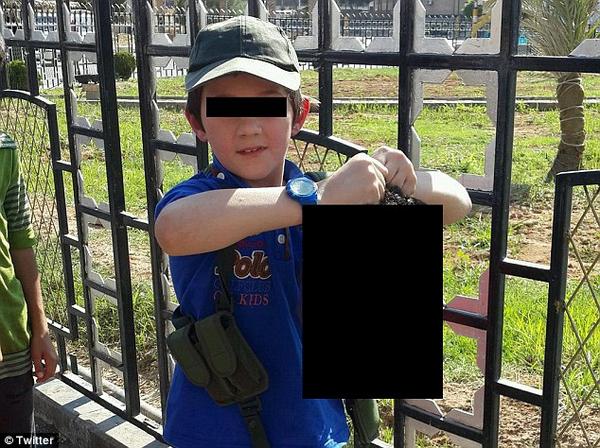
  • Jihadist Khaled Sharrouf tweets photo of son holding soldier’s severed head

    Jihadist Khaled Sharrouf tweets photo of son holding soldier’s severed head

    An Australian newspaper on Monday published a photograph of a child it said was the son of an Australian convicted terrorist holding aloft the severed head of a Syrian soldier.

    Prime Minister Tony Abbott told Australian Broadcasting Corp. radio that the photograph was further evidence of “just how barbaric” the Islamic State group is.

    The Australian newspaper reported that the photograph of terrorist Khaled Sharrouf’s son, who was raised in Sydney, was posted on Twitter by his proud father.

    “That’s my boy!” Sharrouf apparently posted beneath the image that was taken in the northern Syrian city of Raqqa, the capital of what has been declared that an Islamic Caliphate by the Islamic State, the newspaper reported.

    The child, who is not named, appears to be younger than 10 years old.

    Sharrouf used his brother’s passport to leave Australia last year with his wife and three sons to fight in Syria and Iraq. The Australian government had banned him from leaving the country because of the terrorism threat he posed.

    He was among nine Muslim men accused in 2007 of stockpiling bomb-making materials and plotting terrorist attacks in Australia’s largest cities, Sydney and Melbourne.

    He pleaded guilty to terrorism offences and was sentenced in 2009 to four years in prison.

    Australian police announced last month that they had arrest warrants for Sharrouf and his companion Mohamed Elomar, another former Sydney resident, for “terrorism-related activity.”

    They will be arrested if they return to Australia.

    Posing with massacred bodies

    The warrants followed photographs being posted on Sharrouf’s Twitter account showing Elomar smiling and holding the severed heads of two Syrian soldiers.

    In June, The Australian newspaper published a photograph of Sharrouf posing among the bodies of massacred Iraqis.

    Abbott, who on Monday was in the Netherlands, said he expected Australian C-130 Hercules and C-17 Globemaster military transport planes would join multinational humanitarian efforts this week on Iraq’s Sinjar Mountain.

    British officials estimated Saturday that 50,000 to 150,000 people could be trapped on the mountain, where they fled to escape the Islamic extremists, only to become stranded there with few supplies.

    “Australia will gladly join the humanitarian airlifts to the people stranded on Mount Sinjar,” Abbott told ABC. “This is a potential humanitarian catastrophe.”

    He said Islam State’s quest for a terrorist nation posed “extraordinary problems” for the Middle East and the wider world.

    “We see more and more evidence of just how barbaric this particular entity is,” Abbott said.

    Source: http://www.cbc.ca/news/world/jihadist-khaled-sharrouf-tweets-photo-of-son-holding-soldier-s-severed-head-1.2732838

    letters R1C

    YOUTUBE: youtube.com/user/rilek1corner

    FACEBOOK: facebook.com/rilek1corner

    TWITTER: twitter.com/Rilek1Corner

    WEBSITE: rilek1corner.com

    EMAIL: [email protected]

    FEEDBACK: CONTACT RILEK1CORNER