Tag: UMNO

  • China Wants This Malaysian Port To Rival Singapore

    China Wants This Malaysian Port To Rival Singapore

    The Straits of Malacca have been a gateway for China for centuries in its quest for power.

    A story blended from Malaysian history and folklore says an emperor sent a princess called Hang Li Poto marry the Sultan of Malacca in the Ming Dynasty, offering a ship filled with gold needles. He also sent a blunt message. “For every gold needle, there is a subject. If you can count the number of needles, you will learn the true extent of my power”, the emperor reportedly said in a letter.

    Hundreds of years later, China is again seeking influence in Malaysia as it spreads its economic and military clout through South-east Asia. It is investing billions in a US$7.2 billion (S$9.8 billion) redevelopment that will see Malacca, long the haunt of Chinese traders, become a new deep sea port.

    It is also providing funds for infrastructure projects down the eastern seaboard of Malaysia, key heartland areas for Prime Minister Najib Razak ahead of an election that could be held this year. New roads and bridges may help him woo ethnic Malays, but the money could come at a long-term cost.

    “The closeness with China is an Achilles heel for Najib,” said Dr Mustafa Izzuddin, a fellow at the ISEAS-Yusof Ishak Institute in Singapore. “While investment coming in will balloon government coffers and boost the economy, the opposition is using the China card to criticise the government for becoming too close to China and accusing it of selling Malaysia’s sovereignty.”

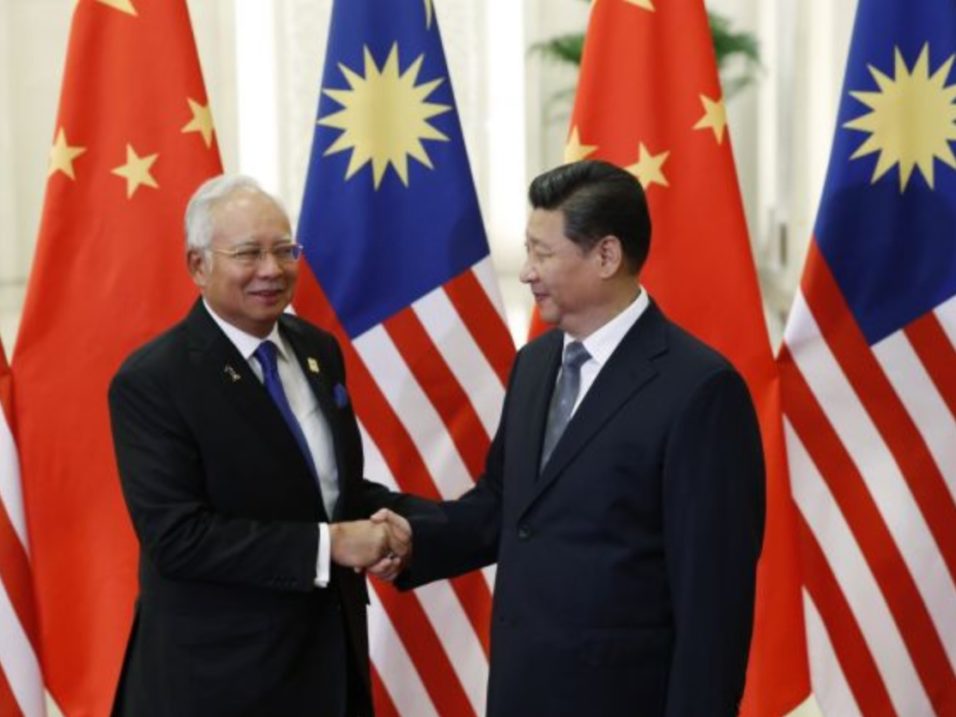
    China’s investment in Malaysia has risen since Mr Xi Jinping took power in 2012, with the president describing ties with Mr Najib as the “best ever”. Beijing is readying a state visit by Mr Xi to Malaysia in the coming months, according to three people with knowledge of the plans who asked not to be identified given the sensitivity of the discussions.

    China has committed to import goods worth US$2 trillion from Malaysia over the next five years (a nearly eight-fold jump from 2016 imports over that period), invest up to US$150 billion in the country and offer 10,000 places for training in China.

    Mr Najib brought home US$33.6 billion in deals when he visited China in November — the biggest haul yet between the countries — plus an agreement to buy four patrol boats from China.

    China has been Malaysia’s largest trading partner since 2009, displacing Singapore, with two-way trade last year valued at US$83.4 billion. China is Malaysia’s biggest export market.

    Malaysia, like Singapore, has strong historical links to China. About a quarter of its population is ethnically Chinese, and traders for centuries stopped at ports in Malacca and Penang to sell silk, tea and porcelain while buying cinnamon and nutmeg. There is even a fusion cuisine based on Chinese and Malay ingredients, called Peranakan or Nyonya.

    Chinese companies accounted for 8 billion yuan (S$1.6 billion) in construction projects in Malaysia in 2015, DBS analyst Chong Tjen-San said in an April report — nearly half the total value of projects clinched by foreign contractors.

    “We are going to be drawn into the economic gravity of China,” said Mr Steven CM Wong, deputy chief executive of the Institute of Strategic and International Studies Malaysia, at a conference on Mr Xi’s Belt-and-Road trade project in Kuala Lumpur last month. “Just as if you are in North America, you are drawn into the economic gravity of the United States,” he said. “This is not what we want or we don’t want. It’s just the way things are.”

    Still, the money risks being caught up in domestic politics. Mr Najib’s critics, including former premier-turned-opposition leader Mahathir Mohamad, say the country will need to cede influence to China in exchange for its money, and that local businesses will lose out.

    “Much of the most valuable land will now be owned and occupied by foreigners,” Dr Mahathir wrote on his blog in January. “In effect they will become foreign land.”

    Mr Najib, in an article published in May in the South China Morning Post before a visit to China, said that he made “no apologies for wanting to build world-class infrastructure for Malaysia that will, with local ownership being preserved, open up huge swathes of our country”. His office did not respond to requests for comment.

    Some analysts said Najib risks being painted as too close to China. While the countries both claim parts of the disputed South China Sea, for example, Malaysia has been mostly quiet on China’s military build up in the region.

    “There are perceptions that Najib is being bought by the Chinese,” said Professor Bridget Welsh, a political scientist at John Cabot University in Rome and author of The End of UMNO? Essays on Malaysia’s Dominant Party.

    “Within Malaysia, China’s interventions have the potential to bring about greater ethnic tensions and political instability, as well as affect Malaysia’s relationships with its neighbours,” she said.

    The Malacca Strait already has sufficient port facilities, according to opposition Selangor state legislator Teng Chang Khim. “Why can’t you make use of the present ports?” Mr Teng said at the Belt-and-Road conference.

    Deputy Secretary General for Trade Isham Ishak said the government would seek to balance its relationship with China.

    “We want to make sure that there’s fair value in terms of investments from China into Malaysia,” he said at the same conference. “It’s not only about Chinese products coming in, Chinese money coming in, and Chinese foreign workers coming in.”

    Investment in infrastructure is good for Malaysia whether it comes from China or the US, according to Mr Xu Bu, China’s ambassador to the Association of South-east Asian Nations.

    “Whoever comes to power that really doesn’t matter,” he said in a July interview. “Whoever comes to power in Malaysia, the leaders or the people in Malaysia they need investment.”

    Mr Harrison Cheng, a senior analyst with Control Risks in Singapore, said there were signs of unease in some quarters of Mr Najib’s United Malays National Organisation about Chinese investments.

    Still, UMNO’s core voters are more interested in bread-and-butter issues, he said. “There has yet to be any strong signs of a serious backlash within UMNO and the public.”


    Source: http://www.todayonline.com

  • Dr Mahathir: I Have Not And Will Not Apologise To Anwar Ibrahim

    Dr Mahathir: I Have Not And Will Not Apologise To Anwar Ibrahim

    KUALA LUMPUR — Former Malaysian premier Dr Mahathir Mohamad has revealed that he has not and will not apologise to his former protege-turned-enemy and now ally, incarcerated opposition leader, Anwar Ibrahim.

    In an interview with Australian broadcast agency SBS World News, Dr Mahathir said this is because he has never asked his detractors to apologise for criticising him.

    “We have all said nasty things about each other. I don’t ask people to apologise for calling me all kinds of names and accusing me of all kinds of wrongdoings.

    “What happened is in the past and we can’t be apologising for something that happened in the past,” he was quoted as saying.

    Anwar was Dr Mahathir’s deputy until they had a falling out in 1998, an event which sparked protests by Anwar supporters calling for political reform in the country.

    He was imprisoned on charges of corruption and sodomy shortly after, though Anwar claimed he was innocent and that the charges were politically-motivated.

    The former Umno man was released from prison in 2004 and went on to lead the opposition coalition, but was jailed again in 2015 on separate sodomy charges and is currently behind bars serving a five-year sentence.

    Last September, the two nemeses met face-to-face, under friendly circumstances, for the first time in 18 years — but the reunion has been described as a political ploy which “demonstrates the depth of their political opportunism and desperation”.

    Aside from Anwar, Dr Mahathir has also showed support for the DAP and its advisor, Mr Lim Kit Siang, who has been one of the former premier’s harshest critics for decades.

    When asked who will be named prime minister should Pakatan Harapan win the upcoming 14th general election, Dr Mahathir responded by saying “party infighting” has prevented the opposition pact from uniting and discussing the issue.

    “It is divisive. The moment you name a (candidate for) prime minister, there is going to be a lot of unsatisfied people who may sabotage the new opposition coalition,” Dr Mahathir said.

    “So it is better for us to name a prime minister (once) we win. It becomes irrelevant to name a prime minister now and then we lose,” he added.

    It is believed that Dr Mahathir was referring to Anwar’s party, PKR, which recently lost an ally, Pas, which ended its “tahaluf siyasi”, or political cooperation.

    Pas’ Syura Council decided that the move was necessary in order to defend the party’s Islamic agenda, aside from accusing PKR of breaking many terms of its conditional cooperation, including failing to support Pas in its Islamic agenda, and working against it in two by-elections last year.


    Source: www.todayonline.com

  • Kumpulan 25 Melayu Terkemuka – Pendapat Dr Zakir Naik Tiada Tempat Dalam Dunia Sekarang

    Kumpulan 25 Melayu Terkemuka – Pendapat Dr Zakir Naik Tiada Tempat Dalam Dunia Sekarang

    KUALA LUMPUR: Komen-komen negatif pendakwah yang penuh kontroversi, Dr Zakir Naik, terhadap agama lain boleh mencetuskan bahaya ke atas negara berbilang kaum dan sekular seperti Malaysia.

    Demikian menurut kumpulan bekas penjawat awam Melayu di Malaysia, dipanggil Kumpulan 25 Melayu Terkemuka (G25).

    Menerusi kenyataan media yang dikeluarkan minggu ini, G25 menambah pihaknya bimbang tentang sikap tolak ansur pihak berkuasa Malaysia terhadap sikap Dr Zakir Naik serta mempersoalkan status penduduk tetap yang diberikan kepadanya. Berikut ini kenyataan G25:

    G25 bimbang dengan sikap tolak ansur pihak berkuasa Malaysia terhadap komen-komen ekstrim yang dibuat oleh Dr Zakir Naik menerusi dakwahnya.

    Kami percaya dengan hak kebebasan bersuara namun apabila ia dibenarkan bagi orang-orang tertentu sementara pihak yang berlainan pendapat pula tidak diberikan kebebasan bersuara, itu bukanlah bentuk kebebasan bersuara untuk masyarakat kita yang berbilang budaya.

    Meskipun kami menghormati hak demokratik Dr Zakir Naik untuk menyuarakan pandangan beliau tentang Islam dan membandingkannya dengan agama lain dengan menukil beberapa kitab agama untuk memberikan gambaran pendapat beliau, Dr Zakir Naik seringkali mencetuskan kemarahan di kalangan masyarakat Muslim dan bukan Muslim disebabkan kebiasaannya memperolok-olokkan doktrin dan amalan agama lain.

    Beliau juga dikait rapat dengan pandangan ekstrim dan sikap tidak bertolak ansur terhadap hak kebebasan beragama. Oleh sebab itu beliau dilarang berdakwah di Britain, Kanada, Singapura, India dan Pakistan.

    Dr Zakir Naik gemar berbahas namun hanya dengan orang-orang beliau dan yayasan privetnya luluskan.

    Terdapat juga dakwaan yang menyatakan beliau tidak akan berbahas dengan para cendekiawan dari agama lain. Beliau mengelak perdebatan serius dengan para cendekiawan yang termuka di peringkat antarabangsa dengan meletakkan syaratnya sendiri.

    Dengan meletakkan syarat berbahas hanya dalam sekitaran yang menjadi pilihan beliau, Dr Zakir Naik jelas menunjukkan sikap pendakwah yang mahu diberikan sorakan gemuruh oleh hadirin supaya dapat menutup mulut lawannya.

    Kami juga bimbang komen-komen negatif Dr Zakir Naik terhadap agama lain akan membuat para ulama kita di Malaysia semakin berani mencontohi sikap tidak bertolak ansur beliau.

    Respons yang kami pantau dari kumpulan-kumpulan perbicangan menunjukkan golongan bukan Muslim berasa cemas dengan trend baru di mana para cendekiawan agama seolah-olah kebal dan boleh menyuarakan pendapat sesuka hati tanpa menimbangkan perasaan mereka yang dari agama lain.

    Sikap Dr Zakir Naik terhadap agama tiada tempat dalam dunia sekarang dan boleh mencetuskan bahaya sosial yang serius di negara yang berbilang kaum dan sekular seperti Malaysia.

    Ia juga membimbangkan apabila kami mendapat tahu Dr Zakir Naik dapat memperolehi status sebagai Penduduk Tetap dari Kementerian Ehwal Dalam Negeri tanpa diketahui oleh orang ramai sama ada beliau sudah memenuhi kriteria dan kelayakan ketat seperti yang dikenakan ke atas pemohon lain.

    Tentunya ratusan ribu kanak-kanak di Malaysia yang tidak mempunyai kerakyatan perlu mengetahuinya.

    Selain itu, jika pengecualian diberikan ke atas Dr Zakir Naik, maka penjelasannya perlu didedahkan.

    Akhirnya, pihak berkuasa Malaysia tidak sepatutnya dilihat sebagai memperjuangkan hak seseorang individu yang mempunyai reputasi sedemikian dan kami menggesa mereka supaya mengambil langkah berjaga-jaga.

    Sekiranya Malaysia digesa untuk bekerjasama dalam menangani pelampau agama yang berbahaya, kami menggalak supaya kerajaan melakukannya.

    Source: http://berita.mediacorp.sg

  • Malaysia’s Islamic Battle Takes A Heavenly Path

    Malaysia’s Islamic Battle Takes A Heavenly Path

    In the Islamists version of hell, that is the one in Malaysia, voting against the PAS is a vote to hell.

    This is part of the campaign to promote a united PAS-UMNO front in Malaysia, and the elite of the Islamist party are going national in their attacks against Muslims who are resistant to the idea.

    “It is important to unite PAS and UMNO in order to eliminate the DAP,” says a WhatsApp group message.

    The group – unknown since the name is not published on the posting in a pro-opposition Facebook page – changed its Icon to that of a PAS-UMNO hand shake.

    The message continue: “If you want to enter hell, you can vote DAP.”

    But if you wan to enter paradise.”Vote PAS”

    The message does not end there.

    It goes further into declaring – similar to an Islamic edict or Fatwa – that people who does not vote the PAS will be made ‘kafir harbi.”

    The threats are not new in Malaysia.

    On 23 June 2016, the Mufti of Pahang shocked Malaysians by stating that it is a sin for Muslims to support the Democratic Action Party (DAP), which he labelled as Kafir Harbi (infidels against whom war can be waged).

    The statement received mixed reactions from the Muslims: some voiced their support while many opposed it. For non-Muslims, it became a source of fear, given recent threats announced by the Malaysian Islamic State (IS) based in Syria, and the first bombing incident by IS in Malaysia.

    Following the overall rejection of the labeling by Muslim scholars and intellectuals who claimed that the label was invalid and unsuitable under contemporary circumstances, the Prime Minister’s Office announced that no Malaysians should be placed under the Kafir Harbi category.

    There is in Malaysia an unfortunate practice of using the term Kafir Harbi for political reasons, and for demonising certain opposition political parties and certain non-Muslim groups.


    Source: www.theindependent.sg


  • Malaysia Youth & Sports Minister: Bumiputra University Quotas Insult Malays

    Malaysia Youth & Sports Minister: Bumiputra University Quotas Insult Malays

    KUALA LUMPUR: Youth and Sports Minister Khairy Jamaluddin said Malays should view the quota system for entry into local universities as “insulting”.

    “These quotas and all that, some of it is in Article 153 in the constitution. I have been telling my Malay community, I said, ‘You know, one day, you should actually aspire, even before 2050, aspire to be in the university without quota’,” the Umno Youth leader told a dialogue on the National Transformation Plan 2050 with Indian youths at the Putra World Trade Center here today.

    “We should start seeing this quota (system) as something that is a bit insulting, that we need quota to get somewhere.”

    His comments came after a participant said he hoped that the quota system for Bumiputeras in the country would one day be removed.

    “Just as there is a perception of discrimination amongst other communities, we also feel that maybe we are not that good, because other communities are saying that, ‘Hey you are here only because of the quota’.

    “I want the Malay community to complete on a level playing field. That’s my aspiration,” said Khairy.

    The dialogue session was organised by MIC Youth as well as several Indian youth NGOs.


    Source: www.freemalaysiatoday.com