Category: Agama

  • Are Megachurches A Concern For Singaporean Society?

    Are Megachurches A Concern For Singaporean Society?

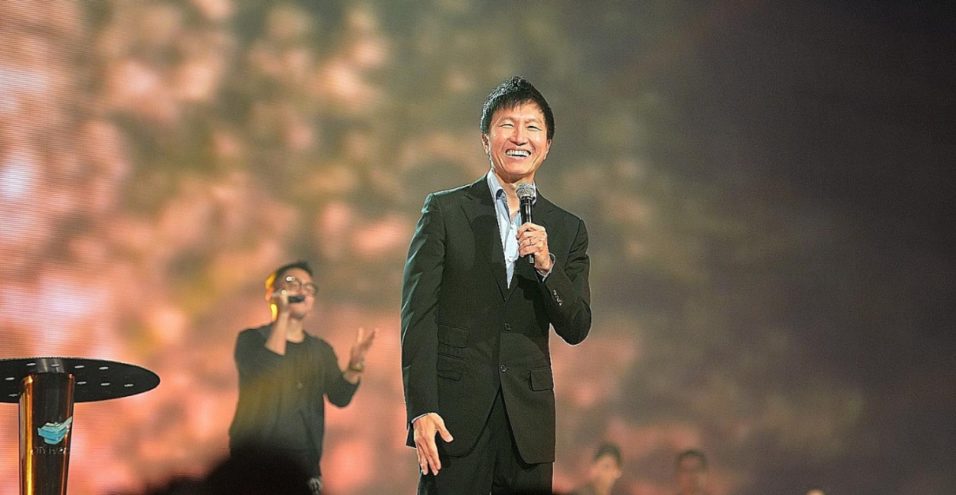
    The news that Kong Hee won his recent court case should not come as a shock. While it is still too early to judge our society’s reaction over CHC, suffice to say, CHC supporters are satisfied.

    Kong Hee’s verdict is a concern for Singaporeans. The growth of megachurches (which scholars define as churches which have a following of more than 10,000 people and are not aligned to any particular branch of Christianity) in Singapore has led to the development of networks of power and influence with little checks and balances (not even democratic elections), and which could be potentially exploited in the future for problematic purposes. [1]

    Why have megachurches in Singapore been so successful? As Terence Cheong [2] notes, it is because of the “market logic” that these megachurches ascribe to. This includes charismatic leadership culture and the mass-appeal of a Pastor who, instead of wearing archaic dresses, acts as a friendly, cool fatherly figure. This mixture of American evangelicalism with Singaporean capitalism taps on the emotional and spiritual needs of the emerging middle class. It is these factors which have allowed megachurches in Singapore to prosper.

    In comparison, other religions either comply with Singapore’s ethos of social harmony (e.g. Buddhism and Taoism) or are clearly aware of the OB markers for religion here. This applies to mainstream Christian branches and Islam – with the experience of Operation Spectrum, the Silat arrests, and the recent spat over the Islamic cruise in South East Asia ostensibly being a show of force by the government to prevent religious institutions from propagating alternative ideas that may destabilise Singaporean society.

    Therein lies the genius and the success of the megachurches in Singapore – their beliefs are totally in harmony with the State and are popular with the “emerging” middle class. The provision of KPI(s) to followers, recruiting of additional members, the creation of networks, and the amount of megachurch merchandise are consistent with Singapore’s capitalist system. These attributes are familiar to the emerging middle class, not fancily-dressed pastors swinging around incense, and through this, membership in the megachurches are surging.

    Perhaps then, the government found itself in a dilemma – even if it found Kong Hee’s actions problematic, to persecute him as a Marxist provocateur or whatever gobbledygook would have been disastrous for the government. There is no compelling narrative to shatter his reputation in order to dissuade his followers. The government cannot frame him as a Marxist, terrorist, or fundamentalist because Kong Hee is none of that. He is ostensibly a pastor ordained by God who happens to make a few million dollars – if anything, he is a very successful CEO.

    However, I argue when it comes to these megachurches, its CEO is never just a CEO.

    The megachurch is still a church at the end of the day. Its form of charismatic leadership allows a pastor to differ from a CEO. A pastor commands and claims to be ordained by God himself, unlike the CEO of Uber or Microsoft who is ordained by a Board of Directors. This connection to God gives the pastor a level of conviction and influence, and the ability to command his followers in the name of God. This has the potential to provide the Pastor considerable (and perhaps disproportionate) weight in Singapore’s socio-political-economic agora.

    Therein lies the problem, the size of these networks and power structures in these institutions can potentially allow a Pastor to wield considerable influence in business or politics. The system of developing large numbers of followers could see these churches reach the higher echelons of Singapore’s power structure.

    In mainstream churches and mosques, the pastor, minister, or imam has superiors. In the case of the Catholic Church, there is the Archdiocese and the Pope. For the imams, all doctrines come under the auspices of MUIS.

    What about the megachurches? How do we prevent their teachings becoming radicalised or their followers exploited? If all their teachings go through one man/woman, behind closed doors and beyond the regulatory reach of the government, what prevents this message from potentially being corrupted?

    Furthermore, the megachurch system differs from the ways businesses operate. While businesses may networks or connections – they rarely can directly inspire or mobilise the masses for political purposes, and in Singapore’s case there is also no reason to do so. Sembcorp or Keppel cannot, for example, compel their staff to all vote for a particular political party in an election; but what is stopping a leader of a megachurch from doing so in the name of God?

    However, something needs to be made explicit – I do not think that any of these megachurches will, in the near future, undermine security, stability or even the rights of religious and racial minorities in Singapore. Terrence Cheong has highlighted that many megachurches in Singapore have liberal views and are primarily obedient to the overused bible quote regarding Christ and Caesar. The lack of an ideological antithesis to the Singaporean capitalistic model and the ability to mobilise the masses is a concern for society, but not an immediate one.

    Viewing megachurches as cults would not be productive either. Instead, we should consider whether there needs to be checks and balances in play concerning their institutional structure, and the relationship between them and society.

    We need a frank discussion with members of these churches. How do we prevent these networks from being exploited by a power-hungry individual? Kong Hee and other megachurches have only God above them – what if one day someone attempts to exploit this power – not just for monetary gain, but, to disrupt Singapore’s society?

    Source: consensusg


    Rilek1Corner
  • One Lady Spoke Out About Being Sexually Harassed During Hajj, And Many Other Women Started Sharing

    One Lady Spoke Out About Being Sexually Harassed During Hajj, And Many Other Women Started Sharing

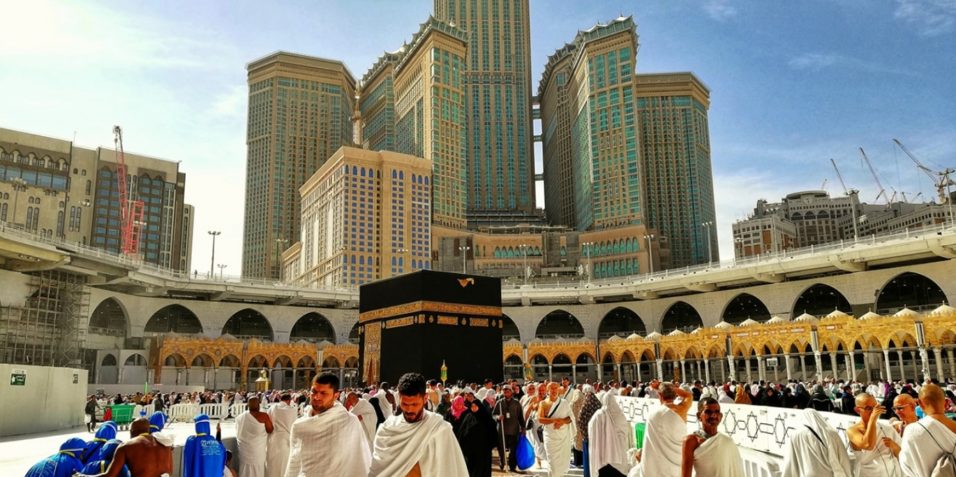
    While one might think that men would tame their vile urges while performing their religious Islamic duties in the holy city of Mecca, the reality is quite disturbing.

    Women have recently been speaking out about their experiences with sexual harassment while carrying out tawaf around the Kaaba during their pilgrimage to Mecca.

    It all started when Pakistani Sabica Khan shared a heartfelt Facebook post in which she detailed being harassed while performing tawaf, after which women began sharing their own encounters with sexual harassment in Mecca.

    On Facebook, she wrote:

    “*I was afraid to share this because it might hurt your religious sentiments*.

    While performing my tawaaf around the Kaaba after isha prayer, something really weird happened. It was my 3rd tawaf, and I felt a hand on my waist. I thought it was just an innocent mistake. I completely ignored. Then… I felt it again. It made me feel very uncomfortable. I kept moving. During my 6th tawaf I suddenly felt something aggressively poking my butt, I froze, unsure of whether it was intentional. I ignored and just kept moving slowly because the crowd was huge. I even tried to turn around but woefully couldn’t. When I reached the Yemeni corner, someone tried to grab and pinch my butt. I decided to stop there. Grabbed his hand and threw it off me *couldn’t move or turn around* I was literally petrified. Couldn’t even escape, so I stood, and turned around as much as I could, to see what’s happening, I turned around but… couldn’t see who it was.
    I felt so violated. I felt unable to speak out. Stayed quiet because I knew no one would trust me, or nobody would take it seriously, except my mum. So I told her everything when I returned to the hotel room. She was incredibly confused and devastated. After this incident, she never allowed me to go there again alone.

    It’s sad to say that you are not even safe at holy places. I’ve been harrased, not once, not twice , but thrice. My entire experience at the holy city is overshadowed by this horrible incident.

    I believe it’s totally okay and important to be open about harassment.
    Don’t know how many of you had similar experience there but this incident has unfortunately left me feeling upset.”

    Encouraged by Khan’s words, several women commented on the post with their own experiences.

    One woman, who chose to remain anonymous, said she has been sexually harassed multiple times during her many visits to Mecca for Umrah, the non-mandatory Islamic pilgrimage.

    She said harassment is most common in the queue leading to the Black Stone, a rock set into the eastern corner of the Kaaba.

    She explained that she has encountered “pinches and inappropriately being touched by male organs at the butt” on multiple occasions.

    As a result, during her recent visits to Mecca, she has been avoiding the Black Stone and performing tawaf in the outermost perimeter, which is less crowded.

    Others expressed their thoughts and experiences as they leave their comments on the issue.

    “Women aren’t safe anywhere, I experienced more or less same during tawaf at Huj 2010”

    “I had a similar experienced when a random guy with dare looks tired to put his hand over mine when i was leaning on one of Kabba’s walls…..Another one harassed me verbally…in both times i felt unsafe ans threatened even at Allah’s home…the holiest place on Earth but disgraces by human beasts.”

    “I am so, so sorry. Something along the lines of what you experienced happened to me as well. Do not let this overshadow your entire experience of performing your religious duty. You are so courageous to share this, and you are definitely not alone. That doesn’t make the situation any better, unfortunately. You did the right thing and did what you could to escape it. Im very sorry and making duas for you.”

    “You are not alone. I believe you. It happened to me as well. No hand on the wrist but definite poking on the butt. Twice. This ws when i was trying to touch the black stone. I also ignored it the first time around thinking while there was so much bumping going on, it must have happened by mistake. But the second time i was sure it was no mistake. I turned around but could only do a 90 degree turn which left me against the pushing crowd in a very wrong position and i started drowning in the crowd losing my breath. God knows how i was ale to get out but i do remember completing the last 2 tawafs and sitting to pray nafal prayers, thats when i realised i was still trembling.”

    “One of my friend had similar experience. You are so brave to open up.”

    “It doesn’t mean that those who are going to holy places have holy hearts. Majority of them are corrupt and sinful people. they perform their haj to deceive themselves and God but after they start doing more worst things.”

    “Places don’t matter, it’s the heart that needs to have God in it. You’re not the only one to have gone through this, Sabica. It certainly ruins the whole experience. Incidents of groping, harassing and pickpocketing in Harems are innumerable.”

    Source: stepfeed


    Rilek1Corner

  • Students Took Issue With UCF Muslim Group’s ‘Try A Hijab On’ Booth And Ignites Twitter Fight

    Students Took Issue With UCF Muslim Group’s ‘Try A Hijab On’ Booth And Ignites Twitter Fight

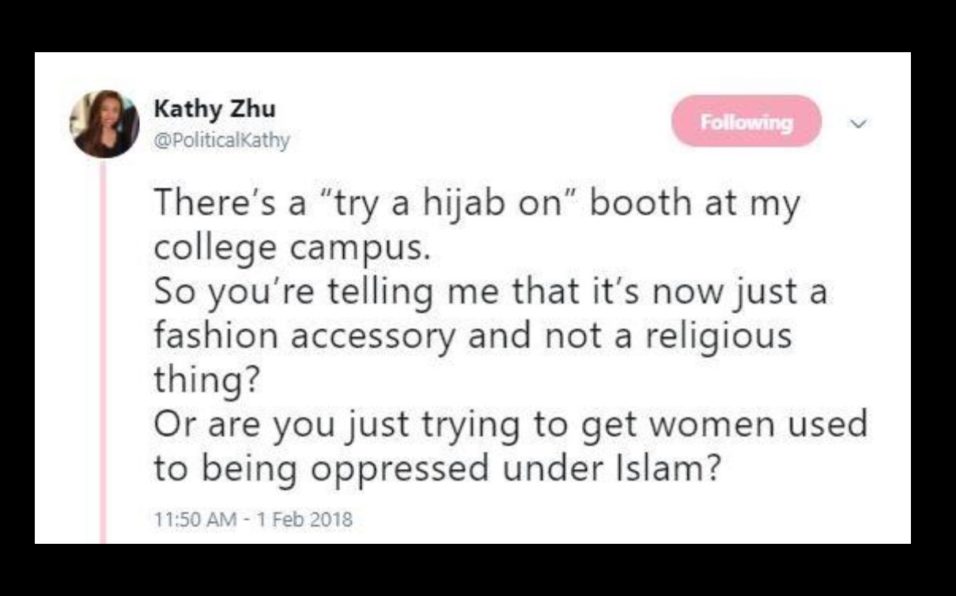
    A University of Central Florida freshman drew national attention this week after she posted on Twitter about a Muslim group at her school offering students the opportunity to try on a hijab.

    Kathy Zhu, 19, said she was walking between classes about noon Thursday, which was annual World Hijab Day, when she passed a Muslim Student Association tent near the Student Union.

    She posted three photos and wrote “there’s a ‘try a hijab on’ booth at my college campus. So you’re telling me that it’s now just a fashion accessory and not a religious thing? Or are you just trying to get women used to being oppressed under Islam?”

    Zhu’s post garnered a quick response, with thousands of Twitter users chiming in, including someone who said she was in one of the photos.

    “I invited you to try one on and you said ‘no thank you,’” the woman wrote. “You didn’t take the time to even ask questions or try to understand what Hijab is. That’s ignorant of you. You literally sprinted after taking the photos. That’s pathetic.”

    In a separate post, the woman urged people to contact the university’s Office of Student Conduct.

    “Let’s get this girl expelled,” she wrote.

    UCF issued a brief statement on Twitter about the matter Friday, saying no action would be taken.

    “The University of Central Florida has received a number of emailed complaints suggesting that disciplinary action be taken against students involved in a disagreement being played out via social media,” the post on the official UCF Twitter account read. “Upon review, neither student’s actions as reported to the university violate our Rules of Conduct.”

    Members of the Muslim Student Association did not respond to requests for comment Friday. The group posted photos on its Facebook page of several people, including at least one man, trying on the head coverings.

    Thursday’s dust-up is one of several social media incidents at UCF during the past year. In July, a student said he was suspended from the school after he posted a marked-up note from his ex-girlfriend on Twitter. The school quickly rescinded his suspension.

    And last March, a post on a private Facebook page inviting members to an event where they would learn how to find and report undocumented immigrants online received national attention. UCF officials said the event did not reflect the school’s values but would not trigger university discipline. The creator of the Facebook post later said the event was a hoax.

    Zhu, who is studying political science at UCF, was born in China and grew up in Kissimmee. She said Friday in an interview that her messages weren’t directed toward a specific student. The woman in the photo calling for her to be expelled, she said, “was way more out of line than what I did.”

    She said she took issue with the idea that students should try on hijabs at UCF, pointing to videos online of women removing or burning the head coverings in protest of a culture or religion they think is oppressive to women.

    One of the photos Zhu posted to Twitter show signs under the Muslim group’s tent saying “My hijab empowers me,” and “My hijab is a symbol of understanding.”

    “The hypocrisy of this is kind of disgusting,” she said.

    Source: orlandosentinel


    Rilek1Corner

  • Fair To Blame The MUSLIM Community For Subway Singapore’s Going ‘Halal = Not Tasty’?

    Fair To Blame The MUSLIM Community For Subway Singapore’s Going ‘Halal = Not Tasty’?

    Why would Subway Singapore want to turn halal?

    A few possible reasons. In recent years, there has been an increasing awareness of halal cuisine (New York’s famous Halal Guys food trucks for example), while Muslim tourism has seen a paradigm shift, with young Muslims worldwide driving a $300 billion boom. You can see that trend here as well, with the advent of popular halal food and travel blogs.

    So it makes sense to jump on the bandwagon — provide Muslim-friendly services to get in on the big, formerly disregarded chunk of pie that is the Muslim market.

    Or it could also be that Subway is losing customers with its mediocre sandwiches (we’ll get to that later) and wants to freshen things up a little.

    So, why are folks angry?

    ‘Halal = Not tasty’

    The general (and admittedly completely subjective) perception here, is that once a non-halal food establishment turns into an official halal-certified one, the nosh just won’t taste as good as before. South Korean fried chicken joint Nene Chicken and Pastamania suffered that fate, with complaints about how their offerings seemed to have reduced in quality. There may actually be some truth to that, given that halal restaurants have to abide by a strict list of ingredients and suppliers put out by MUIS, and sometimes, the results just aren’t as satisfying as before.

    Of course, there are rare cases like Maki-san and 4Fingers Crispy Chicken — both of which went halal and are still loved by all patrons from all backgrounds. It remains to be seen for Subway, though.

    ‘No more Subway classics’

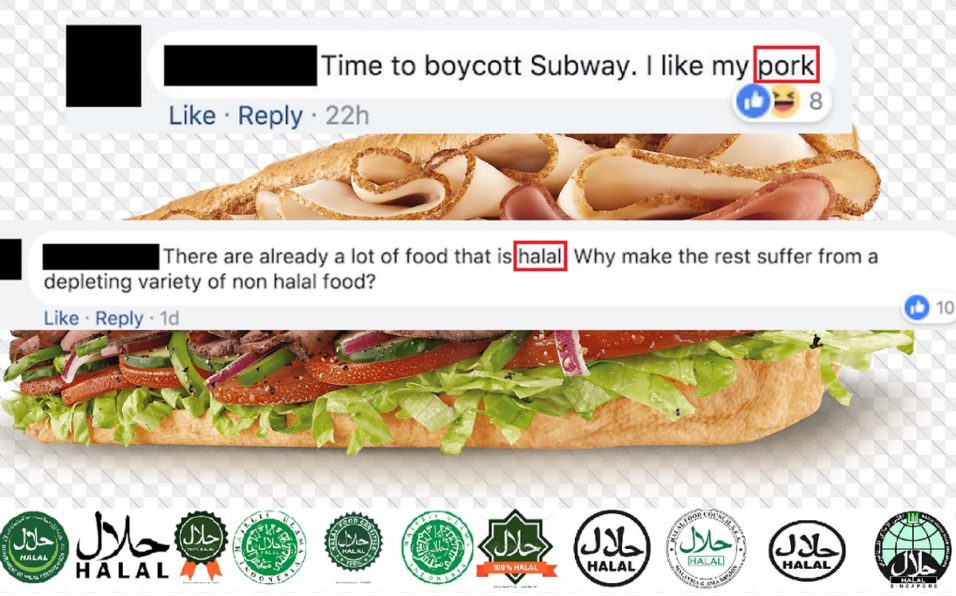
    The most obvious change once Subway goes halal is that the chain will no longer have longtime favorites such as their BLT and Italian BMT. Perhaps they’ll still include those sandwiches, but with halal ingredients instead. But as all pork-loving eaters would proclaim — fuck turkey bacon.

    ‘Muslims are forcing non-practitioners to conform to their standards’

    To be fair, religion is not to blame here — Muslims are not forcing Subway to get a halal certificate to accommodate them. Though the chain did entertain feedback from interested Muslim customers in 2010, it couldn’t find a way to do so back then.

    There are actually already a couple of local halal options for lovers of subs, including Toasties, Watsub Sandwich Bar, and Yellow Submarine Cheesesteaks. They even have the option of hopping the border to Johor if they really want some Subway, where it’s already halal.

    Subway Singapore clearly has reasons of their own to change up their business operations, but regulars are making the argument that the chain should have some outlets be halal-certified, while others stick to the status quo. But there’s the rub. Under the MUIS’ strict policy — if a franchise wants to officially go halal, all of their branches have to be halal, no exceptions.

    Of course, others have argued that Subway should have gone the way of Fatboys and Astons, both of which launched separate halal iterations of their brand in the form of Fatpapas and Andes, respectively.

    ‘Subway is ignoring loyal customers’

    No doubt about it, Subway will lose a significant portion of customers if it does go halal. There’s a reason why some are calling for a boycott — they feel like they didn’t ask for this at all. Mostly because they didn’t.

    On the flip side, what Subway loses in old regulars, they gain in new ones who didn’t have access to their subs here for the past 22 years. Furthermore, the chain still welcomes non-Muslim folks to patronage their outlets, the difference being that now they can dine in with the company of their Muslim friends, albeit without salami.

    But is Subway actually good?

    Ah, the obvious question. Why are people mad that Subway’s no longer selling non-halal food? Their sandwiches are mediocre at best, and no amount of MUIS-approved ingredients will fix shitty fast food. On the list of top sub sandwich restaurant chains in the Unites States, Subway doesn’t even crack the top 10. Hell, there are probably other sub sandwich makers here that do a far better job with halal subs.

    But the Muslim population here isn’t going to care really — they’ll happily flock to whichever spot hangs up a halal certificate, no matter the food quality, and that’s just sad. Because of the strict adherence to that green MUIS sign, they’ve never tasted cuisine from the other side of the fence and will be happy with whatever’s served. They’re the type who’ll say that Le Steak and its overdone beef cuts are the best steaks ever, without knowing how good actual steaks are in actual steakhouses.

    Then again, if Subway Singapore wants to be inclusive for the Muslim population, who’s to deny them that right? It might even be better than their old iteration. MIGHT.

    Source: coconuts


    Rilek1Corner

  • What Lessons Can Be Learned From Singapore’s Religious Regulatory Framework?

    What Lessons Can Be Learned From Singapore’s Religious Regulatory Framework?

    The city-state has developed an interesting model, but one that cannot be lifted wholesale into other environments, writes HA Hellyer.

    In the last year, several cases of abuse perpetrated by Muslim religious figures have been widely discussed in Western Muslim communities. It is not relevant to comment too deeply on those cases in terms of specifics, that requires investigations that others are carrying out, but these examples brought up an interesting question. What do Muslim communities, particularly in the West, do when religious leaders are accused of carrying out ethical violations, which are not necessarily against the law, but are contrary to their commitments as religious leaders?

    As part of a broader project around the engagement of the Islamic tradition with issues of fundamental rights, I was interested in looking at different models that sought to address how ethical violations were being dealt with in Muslim communities. To that end, a very interesting model – if very particular to its own context – is being developed in Singapore.

    The inspiration for Singapore’s religious regulatory framework came from neighbouring Malaysia, where religious activity for Muslim preachers and teachers has been regulated for much longer. Indeed, the initial regulatory instrument of Singapore for Muslim religious activity – the AMLA – was inspired to a very large degree by a similar law in one of Malaysia’s federal states.

    That regulatory instrument brought the Majlis Ugama Islam Singafora (the Islamic Religious Council of Singapore) into life in 1968. Generally, that body did not really regulate religious leaders: it managed items such as zakat, mosques, the existence of a mufti and other administrative functions. That began to change in the late 1990s, when Pergas, an association for religious teachers, sought the establishment of a religious teachers recognition board. There was no particular appetite at the time, and thus it was left by the way side until the 9/11 attacks in the United States.

    It’s unfortunate indeed that it was the threat of extremism that led to this renewed concern in what is essentially a far wider and less negative concern. But nothing induces political will more than threats and in 2005, the Asatizah Recognition Board was formed to oversee the Asatizah Recognition Scheme. It remained a voluntary association for much of its existence and only became a legally established body last year.

    It’s an interesting model. It engages in the training of imams and religious teachers for different skills; it provides for a recognition of religious qualifications that may not come from widely recognised university establishments; indeed, the religious teachers themselves stand to gain a great deal from the model. But the ARB is also a disciplinary institution. It is a place where religious teachers who have been accused of ethical violations may be questioned. It is made up of religious teachers who are widely respected in the Muslim community.

    In that regard, the scheme operates much like a professional syndicate and officials engaged within it openly admit that they took a lot of inspiration from other professional syndicates in terms of what services the ARB ought to provide its membership. Regular skills training is provided and is a condition of membership. The skills are meant to ensure the religious training of the teachers in question are also contextualised to Singapore’s realities – much like how, for example, the Cambridge Muslim College in the UK, or the Zaytuna College in the US, are aimed at ensuring imams and religious teachers are fully aware of the social realities in which they live.

    But here is the catch – membership of the ARS is mandatory for any religious teacher. Without it, they cannot teach. More than that, the ARB can impose penalties on teachers who have run afoul of ethical prescriptions – penalties that can include fines or even imprisonment. There exists no other such regime for other religious communities in Singapore.

    I spoke to several officials and civil society activists engaged in the wider administration of Muslim religious life on a recent trip to Singapore – who, like me, seemed suspicious of any state power being utilised in the regulation of religious life in this manner. Some confided in me that to begin with they had opposed the compulsory nature of the scheme and weren’t entirely happy about certain aspects of how it was being imposed. And yet, at the same time, for those who were particularly engaged, they admitted there were problems with a few religious teachers, whom they thought required a certain heavy-handed approach. It’s clear there are teething problems, but almost no one I met in Singapore considered the existence of a compulsory syndicate for religious teachers to be a bad idea.

    It’s an interesting model and one that cannot be lifted wholesale to other environments. In the UK, for example, a legally imposed syndicate for religious teachers would raise genuine concerns around religious freedom. But the idea of a religious teachers’ syndicate is not so unusual. The main question is how to ensure it gains social credibility among the community it ministers to, and those who are to be its members, because legal compulsion of any kind may not be the answer in many contexts. How that is all to be done, particularly with such variety among Muslim Western communities, is yet to be seen and at the same time, given the clear problems that exist without regulation at all, it is probably only a matter of time before Muslim Western communities themselves create their own mechanisms. As they seek to do so, they might learn certain lessons from their Singaporean co-religionists.

    Source: thenational


    Rilek1Corner