Blog

  • Doctor Fails To Escape Jail For Molesting Patient

    Doctor Fails To Escape Jail For Molesting Patient

    Medical doctor Winston Lee Siew Boon, 71, failed to escape jail for molesting a patient on two occasions after the High Court yesterday dismissed his appeal against his conviction and a 10-month prison sentence.

    Justice Chan Seng Onn found the woman’s testimony was “completely consistent internally” and that she had no motive to accuse Lee falsely of touching her breast.

    On the other hand, Lee’s testimony was “beset with inconsistencies” and far less logical than that of the woman, said Justice Chan as he upheld the conviction.

    In rejecting Lee’s appeal against the sentence, Justice Chan noted that the general practitioner – who is also known as a motoring writer – had abused his position of trust as a medical practitioner.

    Lee was “particularly cunning” in disguising his act of molestation as part of his explanation of a potential medical problem while examining the patient, said the judge.

    The woman trusted Lee and even gave him the benefit of the doubt after the first incident, he noted. “It is loathsome that he did not relent and tried it again by molesting her twice on the second occasion.”

    Lee, a doctor for 40 years, was allowed to start serving his jail term on Aug 17 and was released on bail of $15,000.

    He had asked for time to transfer his 70,000 patients to other doctors, make caregiving arrangements for his stroke-afflicted wife and undergo a medical check-up.

    Lee was 67 in June 2011 when the woman, 34, a medical products sales representative, went to his Bukit Batok clinic to do an HIV blood test. After her blood was drawn, she complained of nausea and flatulence and Lee told her to lie down on the bed.

    She then told him she had chest pains and asked if she could continue to exercise.

    Lee put his hand under her bra and squeezed her breast as he told her she could exercise as long as she did not feel pain there.

    She brushed it off as part of the check-up, thinking it was the doctor’s way of showing the location of her heart.

    Four months later, when she saw him for a sore throat and to discuss weight management, he groped her breast twice. She was confused but made a police report after checking with her boss and a female doctor on whether Lee’s actions were appropriate.

    Lee’s version was that he had placed a clenched fist over her breastbone to show where she would feel chest pains.


    Source: www.straitstimes.com

  • Female Driver Threatens Suicide After Parking Dispute In Woodlands

    Female Driver Threatens Suicide After Parking Dispute In Woodlands

    A female driver flew into a rage, gestured violently and called the other driver names after getting into a parking dispute in Woodlands yesterday (July 20).

    Stomper Sha sent in footage of the incident.

    The Stomper said:

    “Please help.

    “This Nissan Latio driver was tailgating at a carpark in Woodlands at 3.30pm yesterday (July 20).

    “According to her, we were driving very slowly, but it was in the carpark.

    “Driver claimed to have lots of problems and even said she wants to kill herself.

    “She cursed, accused us of being handicapped while she’s the one who parked at the handicapped lot. #AFriendlyNeighbourhoodStomped”


    Source: http://singaporeseen.stomp.com.sg

  • Erwin Dawson Nak PR Malaysia Kerana Tertarik Dengan Kebebasan Mempraktik Islam

    Erwin Dawson Nak PR Malaysia Kerana Tertarik Dengan Kebebasan Mempraktik Islam

    PETALING JAYA: Pelakon baru yang berasal dari Singapura, Erwin Dawson berhasrat untuk berhijrah ke Malaysia selain mahu mendapatkan taraf Pemastautin Tetap (PR) di negara ini apabila layak kelak.

    Pemilik nama sebenar Mohamed Erwin Shah Evan Dawson, 26, itu berkata, dia tertarik untuk menetap di Malaysia kerana berasa lebih bebas untuk mengamalkan ajaran Islam berbanding di negara asalnya.

    “Sejak beberapa bulan tinggal di negara ini saya tertarik dengan komuniti Islam di Malaysia yang berbeza daripada negara asal saya.

    “Sebagai seorang Muslim saya ingin berada dalam komuniti yang membolehkan saya mengamalkan agama saya tanpa sebarang sekatan dan itu adalah faktor utama mengapa saya ingin memohon menjadi rakyat negara ini,” katanya kepada mStar Online.

    Bagaimanapun kata Erwin dia sedar bukan mudah untuk mendapatkan PR dan perlu tinggal di negara ini sekurang-kurangnya lima tahun sebelum membuat permohonan tersebut.

    Erwin memberitahu dia tinggal di negara ini sejak November tahun lalu.

    Erwin semakin selesa bergelar pelakon di Malaysia.

    Dalam pada itu, jejaka kacukan Melayu Singapura dan New Zealand ini berkata, keluarganya juga tidak menghalang dengan keputusannya itu memandangkan jarak kedua-dua buah negara tidak jauh.

    “Jika diikutkan sejarah bapa kepada ibu saya berasal dari Perak tetapi saya tidak pernah ke sana kerana semua ahli keluarga telah berpindah ke Singapura jadi bukan sesuatu yang pelik apabila saya ingin berhijrah ke Malaysia.

    “Mungkin ada saudara-mara jauh yang masih tinggal di sini tetapi tidak pernah mengenali atau berjumpa dengan mereka,” katanya.

    Sementara itu, Erwin berkata, dia ingin meneruskan karier lakonannya di Malaysia selepas melihat peluang untuknya mengembangkan kerjayanya sangat besar.

    “Alhamdulillah setakat ini saya gembira dengan perkembangan kerjaya saya di Malaysia dan kepercayaan pihak produksi memberikan tawaran juga cukup baik.

    Bagaimanapun kata Erwin, dia berharap dapat membeli sebuah kereta dalam masa terdekat bagi memudahkan dia berulang-alik ke lokasi penggambaran memandangkan ketika ini terpaksa berharap kepada krew produksi.


    Source: www.mstar.com.my

  • Aaron Aziz Bidas Erwin Shah Dawson

    Aaron Aziz Bidas Erwin Shah Dawson

    KUALA LUMPUR : Pelakon dan pengarah dari Singapura, Aaron Aziz, membidas pelakon baharu senegaranya, Erwin Dawson, 26, berikutan kenyatan beliau mengenai Islam.

    Erwin menerusi sebuah portal tempatan menyatakan beliau boleh mengamalkan ajaran Islam secara bebas di Malaysia berbanding di negara asalnya.

    Tegas Aaron, kenyataan yang dibuat oleh Erwin itu kurang matang dan boleh mendatangkan pelbagai persepsi negatif terhadap umat Islam di Singapura.

    “Sebagai seorang yang lebih ‘senior’ saya menasihatkan kepada awak supaya lebih berhati-hati sebelum mengeluarkan sebarang kenyataan kepada pihak media.

    “Kenyataan yang dibuat boleh membuatkan orang ramai lebih menyampah dengan artis Singapura, sekali gus membuatkan orang ramai bergaduh, mencaci dan mengutuk sesama sendiri di laman sosial,” tulis Aaron menerusi status Instagramnya.

    Selang beberapa minit kemudian, Erwin pula memuat naik kenyataan balas, yang menganggap cara Aaron menegurnya sebagai kurang sesuai. “Anda lebih ‘senior’ dan seharusnya lebih tahu cara baik untuk menegur saya.

    Bukan dengan cara memuat naik di laman sosial yang boleh mendatangkan banyak masalah.

    “Namun, jika saya salah, maafkan saya kerana sebagai pendatang baharu. Lebih banyak yang perlu saya belajar,” tulis Erwin.

    Erwin atau nama sebenarnya Erwin Shah Dawson mula membina nama di Malaysia menerusi drama bersiri Dunia Generasi Baru dan Bencinta.

    Source: www.bharian.com.my

  • The Singapore Exception

    The Singapore Exception

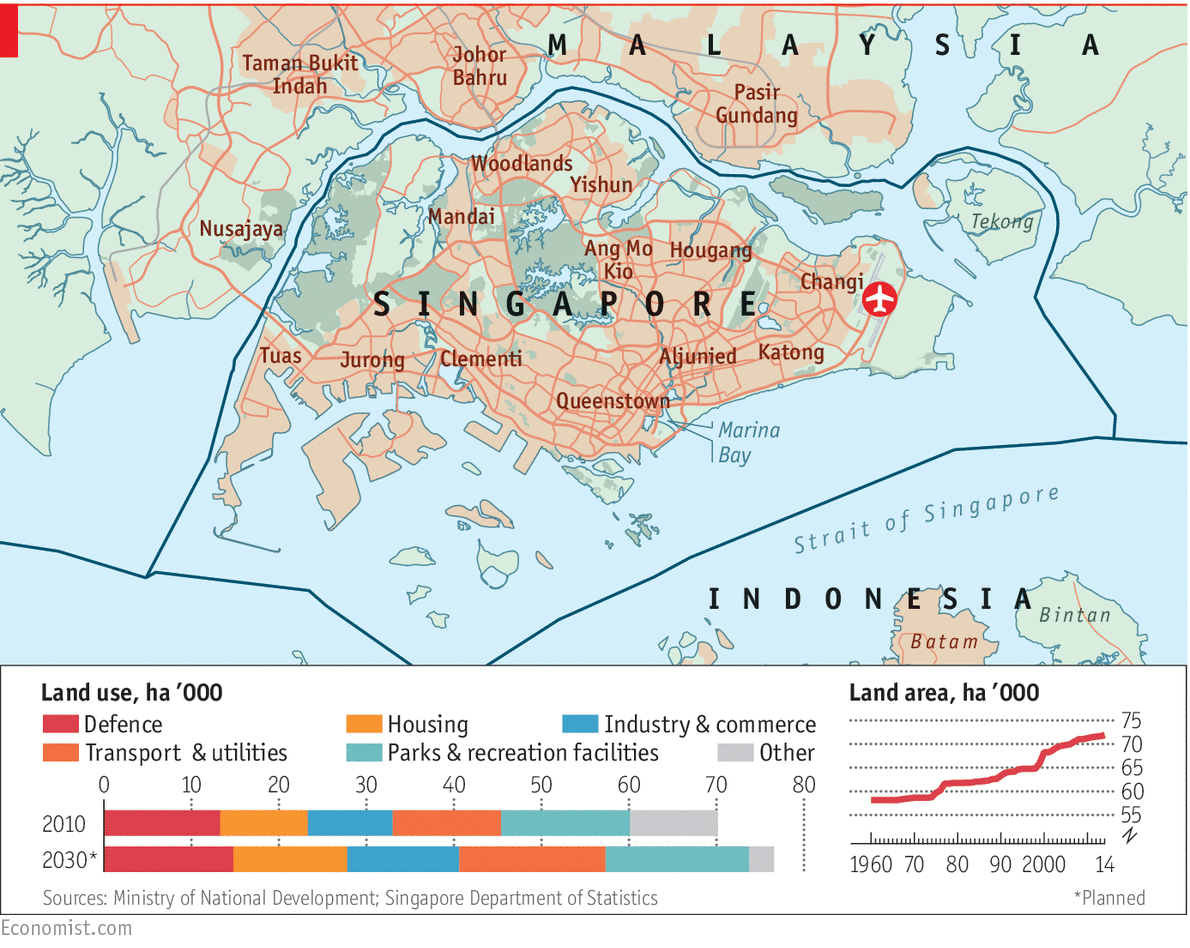
    AT 50, ACCORDING to George Orwell, everyone has the face he deserves. Singapore, which on August 9th marks its 50th anniversary as an independent country, can be proud of its youthful vigour. The view from the infinity pool on the roof of Marina Bay Sands, a three-towered hotel, casino and convention centre, is futuristic. A forest of skyscrapers glints in the sunlight, temples to globalisation bearing the names of some of its prophets—HSBC, UBS, Allianz, Citi. They tower over busy streets where, mostly, traffic flows smoothly. Below is the Marina Barrage, keeping the sea out of a reservoir built at the end of the Singapore River, which winds its way through what is left of the old colonial city centre. Into the distance stretch clusters of high-rise blocks, where most Singaporeans live. The sea teems with tankers, ferries and container ships. To the west is one of Asia’s busiest container ports and a huge refinery and petrochemical complex; on Singapore’s eastern tip, perhaps the world’s most efficient airport. But the vista remains surprisingly green. The government’s boast of making this “a city in a garden” does not seem so fanciful.

    Singapore is, to use a word its leaders favour, an “exceptional” place: the world’s only fully functioning city-state; a truly global hub for commerce, finance, shipping and travel; and the only one among the world’s richest countries never to have changed its ruling party. At a May Day rally this year, its prime minister, Lee Hsien Loong, asserted that “to survive you have to be exceptional.” This special report will examine different aspects of Singaporean exceptionalism and ask whether its survival really is under threat. It will argue that Singapore is well placed to thrive, but that in its second half-century it will face threats very different from those it confronted at its unplanned, accidental birth 50 years ago. They will require very different responses. The biggest danger Singapore faces may be complacency—the belief that policies that have proved so successful for so long can help it negotiate a new world.
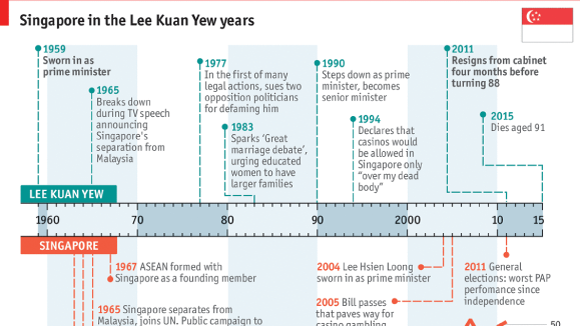
    In 1965 Singapore was forced to leave a short-lived federation with Malaysia, the country to its north, to which it is joined by a causeway and a bridge. Lee Kuan Yew, Lee Hsien Loong’s father, who became Singapore’s prime minister on its winning self-government from Britain in 1959, had always seen its future as part of Malaysia, leading his country into a federation with its neighbour in 1963. He had to lead it out again when Singapore was expelled in 1965. By then he had become convinced that Chinese-majority Singapore would always be at a disadvantage in a Malay-dominated polity.

    Mr Lee’s death in March this year, aged 91, drew tributes from around the world. But Mr Lee would have been prouder of the reaction in Singapore itself. Tens of thousands queued for hours in sultry heat or pouring rain to file past his casket in tribute. The turnout hinted at another miracle: that Singapore, a country that was never meant to be, made up of racially diverse immigrants—a Chinese majority (about 74%) with substantial minorities of Malays (13%) and Indians (9%)—had acquired a national identity. The crowds were not just mourning Mr Lee; they were celebrating an improbable patriotism.

    Lee Kuan Yew himself defined the Singapore exception. As prime minister until 1990, he built a political system in his image. In line with his maxim that “poetry is a luxury we cannot afford,” it was ruthlessly pragmatic, enabling him to rule almost as a (mostly) benevolent dictator. The colonial-era Internal Security Act helped crush opposition from the 1960s on. Parliament has been more of an echo-chamber than a check on executive power. No opposition candidate won a seat until 1981. The domestic press toes the government line; defamation suits have intimidated and sometimes bankrupted opposition politicians and hit the bottom line of the foreign press (including The Economist).
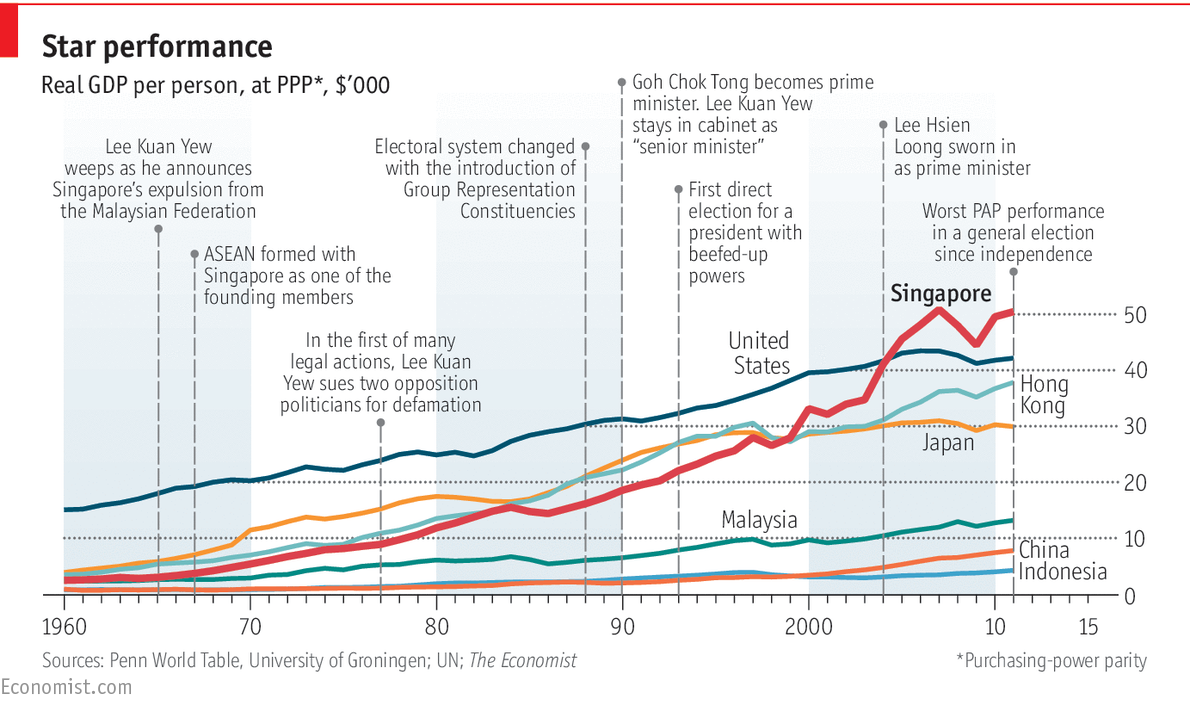
    Singapore, it is sometimes joked, is “Asia-lite”, at the geographical heart of the continent but without the chaos, the dirt, the undrinkable tap water and the gridlocked traffic. It has also been a “democracy-lite”, with all the forms of democratic competition but shorn of the unruly hubbub—and without the substance. Part of the “Singapore exception” is a system of one-party rule legitimised at the polls and, 56 years after Mr Lee’s People’s Action Party (PAP) took power, facing little immediate threat of losing it. The system has many defenders at home and abroad. Singapore has very little crime and virtually no official corruption. It ranks towards the top on most “human-development” indicators such as life expectancy, infant mortality and income per person. Its leaders hold themselves to high standards. But it is debatable whether the system Mr Lee built can survive in its present form.

    It faces two separate challenges. One is the lack of checks and balances in the shape of a strong political opposition. Under the influence of the incorruptible Lees and their colleagues, government remains clean, efficient and imaginative; but to ensure it stays that way, substantive democracy may be the best hope. Second, confidence in the PAP, as the most recent election in 2011 showed, has waned somewhat. The party has been damaged by two of its own successes. One is in education, where its much-admired schools, colleges and universities have produced a generation of highly educated, comfortably off global citizens who do not have much tolerance for the PAP’s mother-knows-best style of governance. In a jubilant annual rally to campaign for lesbian, gay, bisexual and transgender (LGBT) rights on June 13th, a crowd estimated at 28,000 showed its amused contempt for the illiberal social conservatism the PAP has enforced. Younger Singaporeans also chafe at censorship and are no longer so scared of the consequences of opposing the PAP.

    The PAP’s second success that has turned against it is a big rise in life expectancy, now among the world’s longest. This has swelled the numbers of the elderly, some of whom now feel that the PAP has broken a central promise it had made to them: that in return for being obliged to save a large part of their earnings, they would enjoy a carefree retirement. And it is not just old people who have begun to question PAP policies. Many Singaporeans are uncomfortable with a rapid influx of immigrants. These worries point to Singapore’s two biggest, and linked, problems: a shortage of space and a rapidly ageing population.


    Source: www.economist.com

deneme bonusu