Blog

  • Commentary: I Am Happy For Halimah Yacob, But Ask Me If I Am Proud..

    Commentary: I Am Happy For Halimah Yacob, But Ask Me If I Am Proud..

    I honestly happy for her win lah but if you ask if I feel proud then the answer is obviously no.

    People of Singapore need to see what she can do for our nation, our pure citizens, and ALSO for the Malay/Muslim community. Can she bring about visible change in policies especially towards our Malay/Muslim community since she is ‘Malay’ and Muslim right?

    So after she has become Singapore’s Malay female president

    Let’s see if the Singapore Navy will enlist Malay/Muslim sailors on board the frigates, vessels and warships. Even having a couple of Malay/Muslim woman sailors will be a welcoming sight. Christian Malays are not Malay or Muslim.

    Lets see if Singapore can have a Malay/Muslim Chief of Staff (we had an Indian before).

    Lets see if Singapore finally can allow Muslims to don hijab as part of the uniform, any uniform. After getting a Muslim president, this issue should be given proper consideration and followed by appropriate actions.

    Lets see if there will be improvements in bodies like Mendaki and MUIS that will benefit the Malay/Muslim community.

    Lets see if she can do good as president of Singapore like her slogan says

    Lets see…

    If she can make us sincerely proud.


    Reader’s Contribution

    Jai

  • The Road To Presidency: Who Is ‘Madam President’ Halimah Yacob?

    The Road To Presidency: Who Is ‘Madam President’ Halimah Yacob?

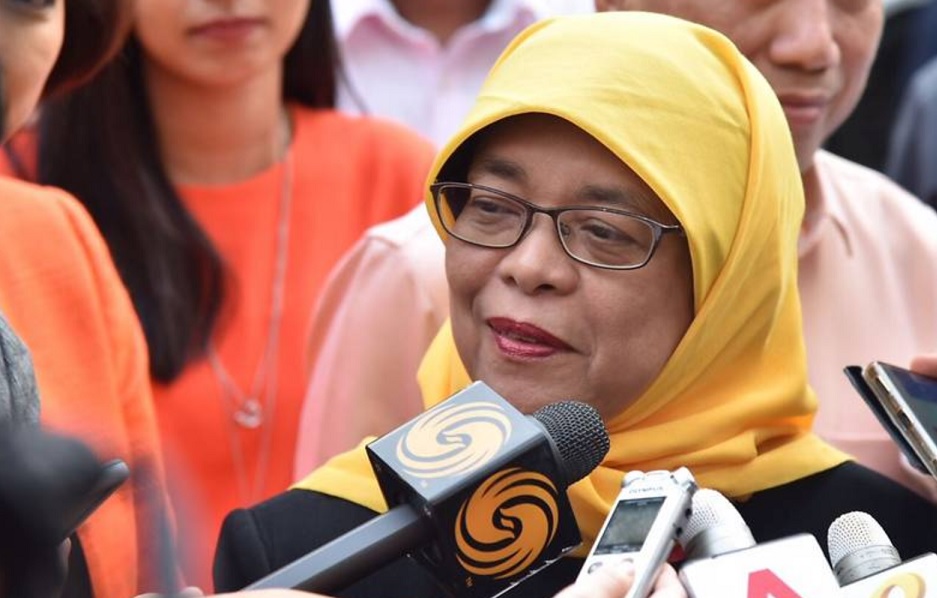
    Madam Halimah Yacob is set to become Singapore’s first female President after she submits her nomination papers on Wednesday (Sep 13).

    She is the only one of three prospective candidates to receive a certificate of eligibility for this year’s Presidential Election, which is reserved for the Malay community. Two other presidential hopefuls, Mr Mohamed Salleh Marican and Mr Farid Khan, had their applications to stand for the election turned down on Monday as both did not meet a requirement for private-sector candidates to helm companies with at least S$500 million in shareholders’ equity.

    The 63-year-old will be Singapore’s first female President and the first Malay head of state in more than 47 years, breaking barriers yet again after being elected as the first female Speaker of Parliament in 2013.

    The youngest of five children, Mdm Halimah was just eight years old when her father, a watchman, died. Her mother became the sole breadwinner, helping out at a food stall before dawn till late at night.

    “From the age of 10, my hours outside of school were spent being my mother’s assistant: cleaning, washing, clearing tables and serving customers, and I am a better person for it,” Mdm Halimah wrote in her bio on her website. “I have experienced poverty firsthand and know how debilitating it can be as you struggle to survive, to put food on the table and also grapple with the uncertainty of the future on a daily basis. It limits your choices but also tempers your determination to succeed.”

    In Secondary 2, she was nearly kicked out of Singapore Chinese Girls’ School for missing too many classes.

    “That was one of the worst moments of my life. But I told myself, ‘Stop wallowing in self-pity, pick yourself up and move on,’” Mdm Halimah told Channel NewsAsia in an interview last month.

    She later went on to attend Tanjong Katong Girls’ School and graduated from the University of Singapore with a law degree, subsequently obtaining her Master of Laws at the National University of Singapore.

    Her career began in 1978 with the National Trades Union Congress, where she served in various roles for the next three decades, eventually rising to become the labour movement’s deputy secretary-general.

    She entered politics at the urging of then-Prime Minister Goh Chok Tong in 2001, and was elected Member of Parliament (MP) for the Jurong Group Representation Constituency (GRC). Ten years later, she was given the portfolio of Minister of State for the then-Ministry of Community Development, Youth and Sports.

    Prior to announcing her intention to run as President last month, Mdm Halimah was serving as both Speaker of Parliament and MP for Marsiling-Yew Tee GRC – both roles she has since relinquished.

    Over the years, she has advocated for women’s rights, spoke up on senior citizens and mental health issues, and served as patron to associations such as Club HEAL and PPIS (Singapore Muslim Women’s Association).

    The decision to run for the highest office of the land did not come easy: The mother of five told Channel NewsAsia her children initially had reservations about being in the public eye.

    However, they and her husband – her university sweetheart Mohamed Abdullah – gave their support after some discussion.

    Since her bid for presidency was made known, Mdm Halimah has repeatedly denied allegations that she may lack independence due to her close ties to the People’s Action Party.

    “It is a gross disservice … even (among) those who continue to hold party colours, if they put the interest of people behind party colours,” she said at a press conference last month, citing times when she disagreed with the Government both as a trade unionist and as an MP.

    She also said on Monday that her commitment to serve Singaporeans was not affected by the fact that there is no election. “I promise to do the best that I can to serve the people of Singapore and that doesn’t change whether there is an election or no election … My passion and commitment to serve the people of Singapore remains the same.”

    Mdm Halimah has said that as President, she hopes Singaporeans will work together with her to build a stronger Singapore. One of the President’s roles is to act as a unifying force, she said.

    “The process may be a reserved election but the President is for everyone, for all communities – regardless of race and religion.”


    Source: http://www.channelnewsasia.com

  • Do Indians Regard Newly Elected President As A Traitor For Disowning Her Indian Race?

    Do Indians Regard Newly Elected President As A Traitor For Disowning Her Indian Race?

    Some people still don’t get it as to why Singapore’s 2017 Presidential Election is a discrimination to the Malay community. Some questioned where got anymore pure breed Malays in Singapore?

    Actually, to measure how Malay you are, it is tightly linked to how Islamic you are. If you notice, in our mainstream media, usually news bulletins or articles will feature Malays as “Malay/Muslim” or “Melayu/Islam” without fail. So, somehow, if you want to argue that there are Malays who have denounced Islam, yes, that can be true, but bottomline is, perhaps, majority of Malays are still Muslims, whether or not they are practicing Muslims.

    However, there are some people who may want to argue that the race group you belong to depends on your father. If your father is a Malay, then the child will be Malay. And this has been the government’s stand for the longest time. That is the reason why previously, Malay children do not have to pay for their school fees (however, this privilege has been withdrawn). The new President, Halimah Yacob, was born to an Indian father, hence, why is the government still flipping prata?

    Another issue is that the government has always been pressing on the meritocracy. Whoever has the ability will be accepted into any job, especially those high-ranking jobs. The meritocratic aspect does not give privilege to any individual from whatever race or religion. This was what the government has been proud of and that from here, we can see that those who have the ability will be successful in securing the high-ranking job without accounting the individual’s race or religion.

    However, for the Singapore’s 2017 Presidential Election, the government has bypass the meritocratic principle because other races were not allowed to contest for Presidency. This caused the other races, especially the Chinese to be very angry because it is true that the Presidential Election is an unfair one. And this also shame the Malay community because it is obvious that the newly “elected” President got her high-ranking job not based on meritocracy.

    And the Indians are also angry because the “elected” President is an Indian and dear Mdm President Halimah Yacob is seen as someone who disown her own race to become Malay and hence, be eligible for Presidency. If there is a Malay who declares him/herself as Chinese just to be eligible for a career in the political office, for sure, the Malay community will regard the individual as a traitor and a disgrace to the Malay community.

    It is obvious that the new “elected” President has caused so much unhappiness and problems to Singapore even before her term started.


    Rilek1Corner

  • Commentary: We Didn’t Like #PE2017, But We Didn’t Resist, Either

    Commentary: We Didn’t Like #PE2017, But We Didn’t Resist, Either

    Finally, Singapore has a female president. A woman as our head of state. Her photo will hang in every government building, not as the benevolently smiling wife, but as the boss.

    I would have expected myself to be bloody ecstatic.

    Instead, I’m feeling a range of emotions that run the gamut from a simmering anger to an exasperated eye-roll. The pride I should have felt over what would otherwise be significant progress in the political landscape of my country has been usurped by an overwhelming sense of having been taken for a ride.

    It’s been over a year since the People’s Action Party (PAP) government said that they would make changes to the Elected Presidency to include this “hiatus-triggered model”. Over a year of parliamentary speeches, of think pieces, of forums, of Facebook posts, of challenges in court, of “oops I called her Madam President” slips, of will-Halimah-run-or-not faux-suspense. Of wayang, wayang, wayang.

    I know that Singapore’s democracy flawed, an illusion in many respects. I know about the gerrymandering of electoral boundaries, of the obstacles deliberately erected to trip up opponents, of the calculated coercive actions that extract costs from opposition politicians and dissidents alike.

    Yet this presidential “election” has been its own sickening reveal—a demonstration of a ruling party so up itself that it would prioritise its own power and self-interest over what’s good for the country and its democratic processes. Or, and this is almost worse, a ruling party who has conflated itself with the country so much that it believes its self-interest is the country’s interest.

    The implications are terrifying; if the PAP’s #1 goal is to consolidate its own power, what will (or won’t) it do?

    After the optimistic-sounding “new normal” post-2011, civil and political space has been shrinking once again in Singapore. Key members of the opposition Workers’ Party are now facing lawsuits for huge amounts of money. We’ve been promised laws that will further restrict free speech and press freedom, all in the name of maintaining religious harmony and combating “fake news”. Academics, artists and activists have been pushed out of the country, either through the denial of visas and permits or of employment. The police have opened an investigation into activists, reporters and supporters—myself included—for attending a candlelight vigil for a death row inmate who was about to be hanged at Changi Prison.

    But it’s not enough to just look at the PAP. We need to look at ourselves too. Despite the presidential election triggering widespread scepticism and unhappiness, there was no organised grassroots resistance. There were plenty of frustrated, cynical social media posts; it was clear that there was no shortage of intellectual discussion or criticism. Yet there was little to no on-the-ground action, no mobilisation or organising to mount greater opposition to this farce.

    There are, of course, reasons for this: years of oppression, restriction and restraint, of an education purged of awareness of civil and political rights. But we can’t wait for the government to loosen the reins before we shake ourselves out of this inaction, because, as we’ve just seen, they have no intention of doing anything of the sort.

    It’s going to get tough; action will not be without risks. But silence and paralysis can’t be the answer. The more we resign ourselves to our fate, the more we tell ourselves that “this is just how Singapore is”, the more we wait for that magic election where the scales will suddenly tip in the opposition’s favour, the more inevitable results like this joke election will be.

    To resist further erosions of our democracy, we need to build: build awareness, build networks, build solidarity. We need to be activists for our own cause, and democracy is our own cause.

    This is not to say that we should all take to the streets right now (although, if that’s what you want to do, it should be your right). But we should find ways to push ourselves and the people around us a little more—to normalise (intelligent) political discussion, to be more critical about the assumptions we make on a daily basis, to refuse to simply sit down and accept. We need to find our comfort levels, then push ourselves a little further. If you’ve been a casual observer, educate yourself more. If you’ve been passively attending events, find ways to volunteer and contribute more actively. If you’re already a member of civil society, start working on how to organise more effectively and reach more people. There is no step too small, as long as we keep taking more steps.

    We can’t turn back the clock on this farcical election now. But we can do something about future erosions of our democracy—as long as we’re willing to work for it.


    Source: https://spuddings.net

  • People’s Power Party (PPP): We Should Deny PAP 2/3 Majority In The Next GE, After Their Blatant Political Ploy In Reserved PE

    People’s Power Party (PPP): We Should Deny PAP 2/3 Majority In The Next GE, After Their Blatant Political Ploy In Reserved PE

    Date: 12 Sep 2017
    For Immediate Release:

    People’s Power Party (PPP) Statement on Singapore Presidential Elections 2017

    The Elections Department announced on 11th of September 2017 that Madam Halimah Yacob is set to be the 8th President of the Republic Singapore, having been the only potential candidate to have been issued both the Malay Community Certificate and the Certificate of Eligibility.

    This means that the other two presidential hopefuls, Mr Mohamed Salleh Marican and Mr Farid Khan were not successful in their application to stand although both gentlemen had also been issued the Malay Community Certificate each. Both had failed to satisfy the ridiculously stringent criteria imposed upon private sector applicants.

    The People’s Power Party (PPP), first of all, would like to express gratitude to both gentlemen who had bravely stepped forward to provide an opportunity for Singapore citizens to choose their next Elected President reserved for the Malay community. Mr Salleh and Mr Farid had subjected themselves to be scrutinised by the public with regard to their “Malayness” since they are of Indian and Pakistani by descent respectively. Madam Halimah, though technically an Indian by descent, have had her “Malayness” certified four times over in general elections previously.

    PPP views this latest development of PE2107 as opportunity denied to both private sector candidates since the Presidential Elections Committee (PEC) has discretionary powers. We also note the administrative manipulation of what could have been a participatory democracy.

    First and foremost, the virtue of Reserved Presidential Elections had been eclipsed by the notion that the Malays are not capable of winning in an open contest. The Malays of Singapore are actually sick of such tokenism. To add salt to injury, the “Malayness” of Presidential hopefuls are being questioned by the general public and subjected to a special committee to certify that they are Malays.

    Mr Salleh and Mr Farid should be lauded as successful self-made men who are truly non-partisan and independent. That cannot be said of Madam Halimah, who, despite of her claim to not be serving any political party after stepping down as Speaker of Parliament just about a month ago, would always be seen to be beholden to her supposedly erstwhile political masters. This indebtedness would forever be etched in the memory of Singapore for generations to come should she submit her nomination forms this Wednesday, 23rd of September 2017.

    When victory is declared on a battle not fought, there is no glory nor dignity.

    While we could grudgingly accept that this may be a Reserved Presidential Elections for the Malay but we definitely could not agree with the blatant political ploy to turn it into Reserved President for PAP’s Halimah!

    While Dr Tony Tan was not the President of 64.8% of Singaporeans who voted against him in PE2011, at the very least he fought a battle and won by 0.35% margin against his closest contender, Dr Tan Cheng Bock.

    PPP is disappointed without reservation that the office of the Elected Presidency is once again tweaked in forms and eventually, it denies robust electoral challenge that is the essence of our Democratic guarantee. In our view, Mr Salleh and Mr Farid who are prominent individuals of the Malay community with the exceptional capabilities to perform the role of the Elected President with full competency. The denial of their candidacy is really regrettable.

    PPP shares the sentiments of Singapore Malays who feel insulted that they been taken for a ride. The community sees themselves, yet again, as a scapegoat for the political agenda of the Powers That Be. They are the ones paying the ultimate political price. They rightly feel used, betrayed, played out and stupefied now that they bear witness to political gains built upon Malay dignity.

    Last but not least, PPP further reiterates that we should not allow electoral rules to be manipulated in such divisive way and the Constitution should not be changed so frequently by the ruling party just to suit their own political agenda. An Independent Commission appointed by the Elected President should look into every attempt of amendment made to the Constitution and the Elected President should also be vested with Veto power to such amendment with the advice of the Commission.

    Most importantly, we hope that Singaporeans should realize that giving PAP 70% mandate with overwhelming power via the dominance of parliamentary seats will not work in the interests of our Nation. We should deny PAP Two Third Majority in the next General Elections so that they could not just bulldoze any amendment to our Constitution at their fancy. This will ensure a truly fair electoral process and this will enhance the independent role of the Elected Presidency above and beyond partisan politicking.

    Syafarin Sarif
    Chairman
    People’s Power Party (PPP), Singapore For CEC


    Source: People’s Power Party – PPP