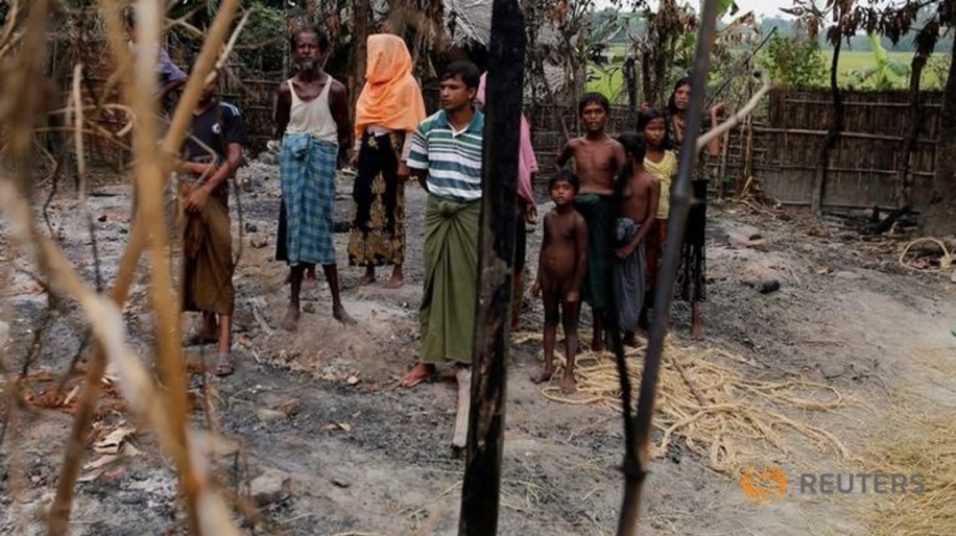
Myanmar bersetuju untuk memulakan rundingan dengan Bangladesh berhubung 65,000 Muslim Rohingya yang melarikan diri dari wilayah Rakhine di Myanmar sejak serangan-serangan dilancarkan ke atas tiga pondok kawalan dekat sempadan yang memisahkan kedua-dua negara itu tiga bulan yang lalu.
Demikian menurut seorang pegawai kanan Myanmar pada Khamis (12 Jan).
Pemimpin Myanmar Aung San Suu Kyi mengerahkan seorang utusan khas ke Dhaka minggu ini untuk memulihkan hubungan antara kedua-dua negara jiran itu, yang menyifatkan kaum Rohingya sebagai bukan masalah negara masing-masing.
Perdana Menteri Bangladesh Sheikh Hasina memberitahu Timbalan Menteri Ehwal Luar Kyaw Tin pada Rabu (11 Jan) bahawa Myanmar harus mengambil semula kesemua “warga Myanmar” di Bangladesh, menurut jurucakap Bangladesh.
Aye Aye Soe, ketua pengarah kementerian ehwal luar Myanmar, berkata kedua-dua negara itu akan memulakan rundingan mengenai “proses pengenalan dan pengesahan”.
“Jika mereka mendapati bahawa mereka berasal dari Myanmar, mereka akan dihantar balik ke negara asal mereka pada masa yang sesuai,” jelasnya, sambil menambah bahawa “tiada garis masa” bagi rundingan tersebut.
Persetujuan itu adalah satu petanda baik yang jarang-jarang berlaku dalam hubungan kedua-dua negara itu, yang sering dirumitkan dengan seramai 500,000 orang Rohingya yang tinggal di Bangladesh selepas melarikan diri dari penindasan selama berpuluh-puluh tahun di Myanmar.
Pertubuhan Bangsa-Bangsa Bersatu turut menyatakan bahawa lagi 65,000 orang Rohingya sudah melarikan diri dari Rakhine ke Bangladesh sejak serangan-serangan yang meragut nyawa sembilan pegawai polis di sempadan Myanmar pada 9 Oktober.
Para penduduk dan pelarian berkata bahawa askar dan polis membelasah, menyerang secara seksual dan melakukan pembunuhan secara beramai-ramai, serta sewenang-wenangnya memberkas para penduduk kampung dan membakar rumah mereka.
Myanmar bagaimanapun menolak keras dakwaan tersebut.
Myanmar State Counsellor Aung San Suu Kyi, reflect on your own complicity in the genocide of my fellow Rohingya people, instead of dismissing well-documented allegations of crimes against humanity, ethnic cleansing and genocide as “exaggerations” and “fabrications”
Myanmar State Counsellor and Nobel Peace Prize winner Aung San Suu Kyi, both personally and from her Office, attack the growing allegations of her government’s policies of persecution of Rohingya people.
This is the latest and official attack on the video-clip which has been viewed over 96,000 times on YouTube.
I am a Rohingya activist and professional, fluent in Burmese, Rohingya and English languages, living in exile. I made the 2-minutes video-clip with English language subtitles and posted it on YouTube with the purpose of exposing Aung San Suu Kyi’s culpability and complicity in the crime of genocide against my peoples, including babies, children, women, men and elderly people.
Here is my subtitled video of you LAUGHING OUT LOUD at the genocide allegations.
The clip was a complete Burmese language exchange between a questioner and the State Counsellor from the live webcast of her public meeting with the Burmese in Singapore on 1 Dec 2016.
The literal translation of both the question, submitted in writing, which Aung San Suu Kyi herself read to the audience, and her own Burmese language response, was – and still is -100% impossible. For the whole Q and A exchange was coded.
Therefore, the inferences were made against the backdrop of Myanmar’s overwhelming public and official dismissal as “exaggerations” and “fabrications” the Rohingya identity, existence and genocidal policies – all to the best of my linguistic capabilities and in complete honesty.
This dismissal has dominated the Burmese public discourse, official statements by the governments (both the previous Government of Thein Sein and the current NLD Government or formerly opposition party) and in the social and real time mass media in Burmese language, over the past 4 years since the two bouts of large scale organized violence against Rohingyas broke out in June and October of 2012.
In her press meetings, Aung San Suu Kyi has used consistently the word “exaggerations” in reference to allegations of ethnic cleansing and genocide of the Rohingya people in the months leading up the election in November 2015. She has also reportedly used that expression “fabrications”, “biases” and “exaggerations” in her official meetings with foreign diplomats whom she chided them as relying on false or biased media reports.
The subtitles were the result of the deciphering of what those “fabrications” might be, when she laughed them out, apparently finding these “exaggerations” and “fabrications” to be nothing more than a laughing matter.
Even a YouTube which was posted by a Facebook user named “Thura Soe”. in Aung San Suu Kyi’s defence in the comment session in the State Counsellor Office’s Facebook page Myanmar State Counsellor Aung San Suu Kyi needs to reflect on her own complicity in the genocide.
In that alternative deciphering or interpretation of the completely coded Q and A ‘fabrications’ were interpreted as “reference to the military-backed Union Solidarity and Development Party” or USDP.
The fact is USDP is never referred to by either Aung San Suu Kyi or her government’s Information Committee led by former USDP Government spokesperson ex-Major Zaw Htay. Nor USDP, which NLD dealt a crushing electoral defeat, has presented Aung San Suu Kyi any major headache, unlike the growing and worldwide accusations and criticisms of her complicity and silence.
Furthermore, Aung San Suu Kyi herself has openly dismissed any credible allegations of genocide and ethnic cleansing as “biased” or “fabrications” or “exaggerations”.
Additionally, the Myanmar Information Committee from her office has directly scathing if baseless accusations against Human Rights Watch, BBC, CNA, CNN, Reuters, etc. rejecting even the satellite images of charred Rohingya villages.
Both these pieces of contextual information and the reports of Ms Suu Kyi’s dismissal of our Rohingya people’s collective plight as ‘exaggerations’ as well as her reported and repeated characterisation of Rohingya – including our identity as a once officially recognised ethnic minority of the Union of Burma – as “non-factual” had compelled me to come up with the only plausible deciphering as reflected in my subtitle.
I had also checked with other native speakers of Burmese who are fluent bi-lingual English-Burmese speakers and scholars. They all agreed with my deciphered subtitles.
Of course, you can also deny because the Burmese speech pattern that you resorted to will allow you “the space of deniability.” Admittedly, I could never presume to know exactly what you had in your anti-Rohingya, anti-Muslim racist mind.
However, I would like to ask Ms Suu Kyi to tell me, the accused, what exactly was coded in that Q and A on 1 Dec.
Finally – and more importantly, as a Rohingya in exile, I would like to urge strongly Ms Suu Kyi to search her soul deep and see why she finds these well-researched findings of ethnic cleansing, genocide and crimes against humanity “exaggerations”.
How could you, Ms Suu Kyi possibly know, let alone dismiss, these international allegations, since you have never documented any human rights abuses in your entire life, nor ever bothered to travel to the crime scenes of my birthplace – N. Arakan – and set foot on a Rohingya IDP camp or an impoverished and oppressed Rohingya village?
After all, the name of the crime of Rohingya persecution have been accepted as crimes against humanity, ethnic cleansing or genocide by some of the most world’s credible organizations, university research centres, UN special rapporteurs – including Ms Suu Kyi’s friend and teacher Nobel Laureates Amartya Sen, Desmond Tutu, Jodi Williams and Jose Ramos-Horta, Human Rights Watch, Yale University Human Rights Law Clinic, respected legal scholar and practitioners Sir Geoffrey Nice and Katherine Southwick (of Yugoslavia), renowned scholars of mass atrocities Professors Gregory Stanton and Penny Green, Human Rights Watch, Nicholas Kristof of the New York Times, US Ambassador to the UN Samantha Power, just to name a few.
— Eye-opener on genocide against my People:
Amartya Sen, “The Term ‘slow genocide’ is appropriate because you deny [Rohingya] people health care, nutritional opportunities.” –
George Soros, “In Aung Mingalar, I heard the echoes of my childhood. You see, in 1944, as a Jew in Budapest, I too was a Rohingya. Much like the Jewish ghettos set up by Nazis around Eastern Europe during World War II, Aung Mingalar has become the involuntary home to thousands of families who once had access to health care, education and employment. Now, they are forced to remain segregated in a state of abject deprivation. The parallels to the Nazi genocide are alarming.”
Desmond Tutu, “The government of Myanmar has sought to absolve itself of responsibility for the conflict between the Rakhine and the Rohingya, projecting it as sectarian or communal violence. I would be more inclined to heed the warnings of eminent scholars and researchers including Amartya Sen, the Nobel laureate in economics, who say this is a deliberately false narrative to camouflage the slow genocide being committed against the Rohingya people.” (source: http://www.tutufoundationusa.org/2015/05/29/desmond-tutu-the-slow-genocide-against-the-rohingya)
Malaysia’s prime minister will be joining a gathering organized by the government to protest violence against Rohingya Muslims in Myanmar, according to his deputy.
Deputy Prime Minister Ahmad Zahid Hamidi told a press conference that the Dec. 4 gathering would later determine Malaysia’s diplomatic ties with Myanmar’s government if it decides to continue military operations in troubled Rakhine State — home to around 1.2 million Rohingya.
“The gathering would be attended by Prime Minister Najib Razak and other political leaders. To-date, PAS President Abdul Hadi Awang has confirmed his participation,” he said late Saturday, referring to the Malaysian Islamic Party.
Hamidi also urged other major opposition political parties, namely the People’s Justice Party and the National Honest Party, to join the gathering.
“We put aside our political differences and as Muslims we gather to express our concern for our fellow Muslims in Myanmar,” he underlined.
The announcement came after thousands of people protesting violence against Rohingya joined demonstrations Friday in the capitals of Malaysia, Indonesia and Thailand.
Over the past six weeks, rights groups have expressed concern over reports of killings, rapes, arbitrary arrests and other violations in villages predominantly inhabited by Rohingya in Rakhine amid military operations launched after fatal attacks on police outposts last month.
Myanmar has said that since Oct. 9, at least 86 people — 17 soldiers and 69 alleged “attackers” (among them two women) — have been killed, and property destroyed in the area.
Rohingya groups, however, claim that the number killed in one weekend alone earlier this month could be as high as 150 civilians.
Humanitarian outfits have called for independent investigations into the initial attacks, the ongoing operations and reported rapes and rights abuses in Rakhine, as with the area placed under military lockdown, rights groups and international reporters have been unable to enter.
Hamidi said Malaysia remains firm on the principle that it cannot interfere in the affairs of other countries, but said that on humanitarian grounds, it must express its concern to Myanmar authorities.
“We are not belittling other countries, but we have demonstrated our deep concerns over the Rohingya issues because as fellow Muslims we can feel their sufferings,” he stressed.
The deputy premier also said the gathering would discuss, and state the country’s stance, on calls for the withdrawal of the Nobel Peace Prize awarded to Myanmar’s democracy icon Aung San Suu Kyi, currently the country’s state counselor-cum-foreign minister.
“If someone who is given the award can no longer maintain peace, it [the conferment] can still be questioned,” Hamidi underlined.
Meanwhile, Malaysia’s government is also due to send a protest note to the Myanmar government to demand their concern regarding persecution faced by the stateless Rohingya community.
“A cabinet meeting has decided to send a protest note to the Myanmar Embassy in Kuala Lumpur,” Hamidi added.
A law passed in Myanmar in 1982 denied Rohingya — many of whom have lived in Myanmar for generations — citizenship, making them stateless.
The law denies the Rohingya rights to Myanmar nationality, removes their freedom of movement, access to education and services, and allows arbitrary confiscation of property.
Myanmar nationalists have since taken to referring to the Rohingya — which the United Nations calls one of the most persecuted people in the world — as Bengali, which suggests they are not Myanmar nationals but interlopers from neighboring Bangladesh.
Sir, with all due respect, forgive me for trying to reach out to you on a seemingly informal channel like FB. I just believe it is one of the most powerful channels today to directly communicate with leaders and other people. And instead of sending a private message, I have made it public to help spread news of the apparent issues in Myanmar and encourage others to speak to their leaders to do something about it. So pardon the medium and heed the message please.
Prime minister, I am deeply troubled and saddened by what is happening in Myanmar and as a citizen of this country, I humbly ask for our government to help and/or tell me what I can do to assist in this humanitarian crisis at our very doorstep. As published in Channelnewsasia, a UN official claims that the government of Myanmar is “pursuing ethic cleansing of Rohingya” (http://www.channelnewsasia.com/…/myanmar-pursu…/3317908.html). The article speaks of genocide, civilians being killed, raped and tortured in a neighboring country. I shudder to think of the horrors Rohingya men, women and children are going through this very moment, should these reports be true and pray for their safety and comfort.
Sir, I am no expert in the matter but I would like to help, and am sure many others would like to help too but simply don’t know how. It’s not like they are suffering from just severe poverty or famine, in those types of situations, at the very least, people could donate money but here the situation is worst, they are systematically being wiped out. I am humbly turning to you, the leader of our very powerful government, as an ordinary Singaporean, to help find a peaceful solution to the problem. Pressure and work with Myanmar leaders to ensure that the crisis is handled in a more humane manner.
This is not the first time in recent history that the powers that be in Myanmar have resorted to violence against civilians. But I hope these acts of seemingly state sanction terrorism stop. And I hope Singapore plays a big part in bringing about and maintaining peace in the region.
We live in a most peaceful multiethnic, multi-religious country, yes there are flaws, but it is something in Singapore I am so very proud of and grateful for. It’s a thing of beauty. So how can we sit idly by while others in Asean are literally being killed simply because of their religion, claimed ancestry or colour of their skin? We have to be a force for good in the region, we are Singapore. Siapa tidak kenal Singapura, negara terindah berbilang bangsa?
Our silence will not save them. Let’s do something to help now.
Myanmar leader Aung San Suu Kyi has a moral responsibility to try to ease tensions between majority Buddhists and minority Rohingya Muslims, her fellow Nobel laureate, the Dalai Lama, said on Monday.
The Tibetan spiritual leader said he had stressed the issue in meetings with Suu Kyi, who came to power in April in the newly created role of state counsellor in Myanmar’s first democratically elected government in five decades.
“She already has the Nobel Peace Prize, a Nobel Laureate, so morally she should … make efforts to reduce this tension between the Buddhist community and Muslim community,” he told Reuters in an interview in Washington.
“I actually told her she should speak more openly.”
Violence between majority Buddhists and minority Muslims in recent years has cast a cloud over progress with democratic reforms in Myanmar. Rights groups have sharply criticized Suu Kyi’s reluctance to speak out on the Rohingya’s plight.
The Dalai Lama said Suu Kyi, who won worldwide acclaim and a Nobel Peace Prize as a champion of democratic change in the face of military persecution, had responded to his calls by saying that the situation was “really complicated.”
“So I don’t know,” he said.
There is widespread hostility towards Rohingya Muslims in the Buddhist-majority country, including among some within Suu Kyi’s party and its supporters.
More than 100 people were killed in violence in western Rakhine state in 2012, and some 125,000 Rohingya Muslims, who are stateless, took refuge in camps where their movements are severely restricted.
Thousands have fled persecution and poverty in an exodus by boat to neighboring South and Southeast Asian countries.
The Dalai Lama said some Buddhist monks in Myanmar “seem to have some kind of negative attitude to Muslims” and Buddhists who harbored such thoughts “should remember Buddha’s face.”
“If Buddha happened, he certainly would protect those Muslim brothers and sisters,” he said.
The new Myanmar government announced late last month that Aung San Suu Kyi would lead a new effort to bring peace and development to Rakhine State.
The announcement offered no details on how the group would go about addressing the state’s multitude of problems.
Suu Kyi said during a visit by U.S. Secretary of State John Kerry last month that the country needed “enough space” to deal with the Rohingya issue and cautioned against the use of “emotive terms”, that she said were making the situation more difficult.