Tag: Dr Mahathir Mohamad

  • Dr Mahathir Mohamad: Some Muslims Not Living As Muslims, Conduct Their Lives In Accordance With Spirit Of Quran

    Dr Mahathir Mohamad: Some Muslims Not Living As Muslims, Conduct Their Lives In Accordance With Spirit Of Quran

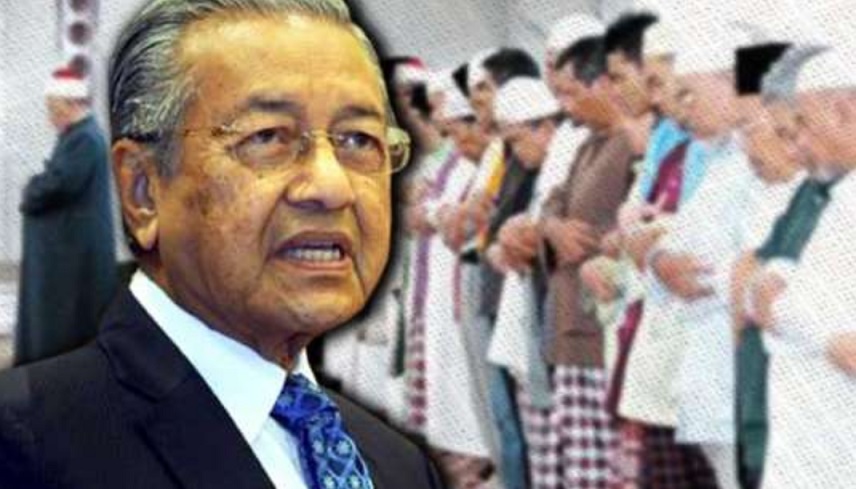
    Pakatan Harapan chairman Dr Mahathir Mohamad has denounced Muslims who display piety through conspicuous acts of worship but do not conduct their lives in accordance with the spirit of the Quran.

    Speaking at a forum in Bangi, he said such Muslims would focus only on “fardhu ain (obligatory acts of worship)” such as prayer, fasting, charity and the Haj, ignoring many other Quranic injunctions, such as those that would lead to mercy and compassion among human beings.

    He said unrest in some Muslim countries was the result of defiance against such teachings.

    Referring to the Islamic State (IS) terror group, he said it was obvious that its members were defying the Quran.

    He said he wondered whether the terrorists, when slaughtering their victims, would invoke God’s attributes of Grace and Mercy like Muslims were supposed to do when slaughtering animals for food.

    He said this was why it was important for Muslims to read and understand the Quran.

    “When I read the Quran,” he said, “I also read the translations so that I understand what I’m reading, and I will find out whether those translations are correct by reading other translations.

    “If I find two or three translations that are similar, then I can safely assume that the translation is accurate.”


    Source: http://www.msn.com/

  • PRC Netizens Irked By Dr Mahathir’s Remarks On Forest City Project, Wants To Boycott Malaysia

    PRC Netizens Irked By Dr Mahathir’s Remarks On Forest City Project, Wants To Boycott Malaysia

    BEIJING — Chinese netizens have criticised former Malaysian prime minister Mahathir Mohamad over his comments that China’s investment in the Forest City property project in Johor Baru is a threat to Malaysian sovereignty.

    “Being an old friend for over a decade, Dr Mahathir had turned on China. It’s a big deal,” influential state-run tabloid Global Times quoted netizen yuchundaxianglianzhuli as saying.

    “Shall we boycott Malaysia for this?” netizen jiemohu wrote on Sina Weibo.

    Writing in his blog, Dr Mahathir had attacked the Forest City project as a “foreign enclave”.

    “Much of the most valuable land will now be owned and occupied by foreigners,” noted the 91-year-old, who was current Malaysian premier Najib Razak’s former mentor and now one of his biggest critics.

    “In effect, (land occupied by the Forest City initiative) will become foreign land,” Dr Mahathir added.

    He also claimed that more than 700,000 Chinese nationals will be brought into Forest City, alleging that the Chinese citizens would be given identity cards to enable them to vote in the coming general election.

    The Chinese embassy in Malaysia has criticised Dr Mahathir’s remarks.

    In a statement released on its official website, the embassy said: “Somebody applauded Sino-Malaysian relations in office but fanned the flame of anti-Chinese sentiment after.

    “We can expose the lie behind claims that Chinese investment is stealing job opportunities from Malaysia.”

    Sultan Ibrahim of Johor has also reprimanded Dr Mahathir over his Forest City claims.

    “He is giving the impression that Johor is surrendering land to the Chinese and that we are giving up our sovereignty, comparing even how we gave up Singapore to the British, the sultan told The Star.

    Sultan Ibrahim also accused Dr Mahathir of fearmongering by playing racial politics that he said had no place in Johor.

    Forest City is a US$100 billion (S$143 billion) property development by Chinese firm Country Garden.

    The firm has partnered Esplanade Danga 88, an associate company of Kumpulan Prasarana Rakyat Johor, which is the southern state’s investment arm. The largest shareholder of Esplanade Danga 88 is Sultan Ibrahim.

    The 1,386ha Forest City encompasses the development of facilities for business, tourism, hotel, residence, services and others, built on four man-made islands in Iskandar Malaysia.

    Construction began in February last year and about 8,000 apartments have been sold, the company said.


    Source: www.todayonline.com

  • Four Decades Of A Malay Myth

    Four Decades Of A Malay Myth

    Masturah Alatas takes a close look at the legacy and impact of her father’s seminal study of ‘Malayness’, The Myth of the Lazy Native, which turns 40 this year.

    “Our Production Manager estimates that we would very likely have finished copies of both books in December, and would therefore be able to publish in January, 1977.”

    With these long-awaited words that reached Singapore in a letter dated 14 September 1976, Malaysian sociologist Syed Hussein Alatas (1928-2007) received confirmation that his books, The Myth of the Lazy Native and Intellectuals in Developing Societies, would finally be published in London by Frank Cass.

    Murray Mindlin was the Cass editor who wrote the letter. He also happened to be the Hebrew translator of James Joyce’s Ulysses, a fitting fact since The Myth of the Lazy Native (henceforth Lazy Native) was caught up in its own, long-drawn-out publishing odyssey. Shunned by publishers in Malaysia and Singapore, Alatas first submitted Intellectuals to Frank Cass in early 1972 at the suggestion of social anthropologist, Ernest Gellner. In corresponding with Cass editors about that book, later the same year Alatas casually mentioned that he was completing the Lazy Native that he had started working on in 1966.

    “At the moment I am finishing a manuscript of about 100,000 words on the myth of the lazy native in the Philippines, Indonesia and Malaysia, from the 16th to the 20th centuries. It is a study of the function and origin of this myth in the colonial ideology. Dutch, Malay and English sources are used. The discipline applied is the sociology of knowledge. To the best of my knowledge, this is the first work of its kind,” Alatas wrote.

    Young editor Jim Muir, who would later become the BBC’s correspondent for the Middle East, immediately asked to see the manuscript. Struck by the title and subject, he felt Lazy Native “would probably fit very well into our Library of Peasant Studies.”

    The story of the publishing vicissitudes of Lazy Native is documented in my book, The Life in the Writing (2010), as is the work’s international reception by the likes of Victor Gordon Kiernan, Edward W Said, Ziauddin Sardar and many others.

    There are several ways to assess the status of Lazy Native in the 40 years of its existence. We can check databases to see where it has been cited and syllabi to know where it is taught. Social media will give us an idea of who is reading it, talking about it, and going to conferences, seminars and festivals where it is studied.

    One could say that a revived interest in the book is due, in part, to the efforts of his son and my brother, Syed Farid Alatas, a sociologist at the National University of Singapore, not just through teaching, public speaking and his own writing but also because he solicited a reprint of a paperback and more affordable edition of Lazy Native from Routledge (2010). Malaysians will remember that the hardback Cass edition of Lazy Native once went for over 400 ringgit (roughly $US90 in today’s money). Syed Farid Alatas was also proactive in getting a second edition of the Malay translation of the book, Mitos Pribumi Malas, reissued with Dewan Bahasa dan Pustaka (2009).

    It is worth mentioning—as translation studies scholar Nazry Bahrawi has noted—that the Malay translation, or rather adaptation of Lazy Native from the 1987 Indonesian translation, contains some omissions, including excluded lines and passages that are present in both the English and Indonesian versions. One omission is the line “The degradation of the Malay character is an attempt by the ruling party to absolve itself from blame for real or expected failures to ensure the progress of the Malay community” (Lazy Native, 1977, p 181). The book contains no note from the translator, Zainab Kassim, as to the reasons for these omissions.

    Whatever the case, we can conclude that irrespective of the availability of the book in English and Malay, what the quality of the Malay translation is, or how much or little it is actually read and talked about, Lazy Native seems to have found its place in the sun as a classic, and not just because Bahrawi and other scholars recognise it as a seminal text located within postcolonial theory. Not only has the Lazy Native walked right out of the Library of Peasant Studies into the libraries of Malay studies, cultural studies, sociology, history and literature—not to mention the personal libraries of many Malaysians— the book also seems to be sitting in the collective Malaysian imagination as a disgruntled trope, even though Syed Hussein Alatas himself had doubts about how many people had actually read and understood it.

    It is therefore legitimate to ask: after 40 years, is the myth of the lazy native still a myth? Former Malaysian Prime Minister Tun Dr Mahathir Mohamad seems not to think so. According to him, the Malays are lazy because they don’t study hard enough, they can’t master English and they prefer to become Mat Rempit (motorcycle gangsters). What is missing from the narrative is if it is laziness or hard work that has to do with how the current Prime Minister, Najib Razak, was able to allegedly channel more than $1 billion into his personal bank accounts.

    Historian Zaharah Sulaiman, instead, believes that if “Malays are called lazy and not innovative, it’s because the knowledge, the peoples who have the knowledge have gone extinct,” and that ‘foreign invasions’ that led to the ‘grabbing’ of riches has a lot to do with the extinction of this knowledge.

    But in the chapter “The disappearance of the indigenous trading class”, Alatas does not so simplistically attribute the destruction of the trading class to foreign invasion. If anything, he provides sociological analysis showing how local rulers were sometimes complicit with colonial masters in bringing about the disappearance of the native trading class — for example when local chiefs acted as agents for the Dutch East India Company.

    Alatas framed his critique of colonial capitalism that exploited the image of the lazy native with economic and sociological analyses. Indeed, he called it “colonial capitalism” and not white capitalism. And nowhere in Lazy Native does he blame the other ethnicities of Malaysia—the Chinese or the Indians—for the condition of the Malays.

    It is important to understand this to distance the kind of critique Alatas performs in Lazy Native and the language he uses from, say, rants about  “Chinese privilege” in Singapore, in which the term itself makes a direct link of ethnicity—one ethnicity in particular—to majority class and political privilege, and abuse of power. If Alatas has tried to help us see the wrongness in the ideological necessity of giving laziness a Malay face, we are invited to think about the wrongness in the ideological insistence of giving a Chinese face to privilege.

    Finally, Lazy Native has inadvertently generated it own myth that needs to be debunked if we are to understand what unique scholarship really means— the claim that the book contributed to Edward W Said’s thesis on Orientalism. This claim has been made by several scholars all over the world.

    Orientalism (1978) was already written and sent off to the publisher when Alatas’ book came out the year before Said’s did. At the time, the two men never even knew or corresponded with each other.

    I know this because both men told me so.

    Masturah Alatas is a writer and teacher who lives in Macerata, Italy. She is the author of The girl who made it snow in Singapore (2008) and The life in the writing (2010), a memoir-biography about her father, Syed Hussein Alatas.

    The Myth of the Native Lazy marks 40 years of publication today.


    Source: www.newmandala.org
  • Thousands Of Malaysians Participated In BERSIH March Against Government

    Thousands Of Malaysians Participated In BERSIH March Against Government

    When they were completed in 1998, the Petronas Towers in Kuala Lumpur were the tallest buildings in the world. At 1,483 feet, they beat out Chicago’s Sears Tower — which had held the record since 1973 — by only 10, but all the same, the superlative was a trophy for a Southeast Asian nation that had transformed itself from a sleepy agrarian society into a crucial economic center in less than a quarter of a century. Specifically, they were a point of pride for Prime Minister Mahathir Mohamad, who had led Malaysia in its rebirth; so personal was the accomplishment that he himself chose the fixtures in the skyscrapers’ bathrooms.

    On Saturday, Mahathir was one of the many of thousands of people who gathered in the shadow of the towers to demand that Malaysia’s current Prime Minister, Najib Razak, step down from office. “Time has come for us to topple this cruel regime,” Mahathir said, standing on a portable stage before a crowd of roaring supporters dressed in yellow. “Najib is no longer suitable to be the prime minister. He is abusing the law.”

    Saturday’s protest, organized by a group of pro-democracy and anti-corruption activists collectively known as Bersih (the Malay word for “clean”), was the second massive display of outrage towards Najib since July 2015, when the Wall Street Journal and investigative news website Sarawak Report reported that his personal bank accounts held nearly $700 million in cash apparently siphoned from a state development fund called 1Malaysia Development Berhad (1MDB). Najib has strenuously denied the allegations.

    The rally — which attracted around 40,000 people, according to local media reports, though one organizer placed it at twice that — was peaceful, even festive, despite the endemic frustration here. Attendees blew vuvuzelas and shared bottles of water when the equatorial heat proved too oppressive. (Before afternoon thunderstorms accumulated overhead, the thermostat hit close to 90 degrees.) Police blocked access to Merdeka Square, where the march was scheduled to culminate, so organizers deftly regrouped and informed participants over social media that they would instead head to the Petronas Towers. Reports that violent pro-government groups would be there to provoke demonstrators proved false.

    “We’re not out here to create any sort of problems — we just want to be seen and be heard,” 37-year-old Rizal Ahmad, who says he is currently unemployed, tells TIME. “The situation is getting worse, and people are becoming more desperate. We need to be heard.”

    Fahmi Reza, a street cartoonist who has previously been arrested for his work, is blunter. “We live in a country that’s full of clowns and crooks stealing money from us,” he says, raising over his head a large cutout of a caricature of Najib.

    It is hard to discredit their frustration. Najib took power in 2009 promising to bring the country into the 21st century, emphasizing ethnic plurality, economic growth, and good governance. Instead, he has supported not only policies that not only reinforce the country’s ethnic tensions — Malaysia is about 60% ethnic Malay, 25% Chinese, and 10% Indian — but plot the blueprint of a security state. In the year and a half since the 1MDB scandal erupted, he has penalized his detractors, shutting down or prosecuting media outlets that aspire to transparency in their political reporting. His party, the right-wing United Malays National Organization (UMNO), is stronger than ever.

    “We are looking at a collision between what has been a clubby, insular Malaysian political order and the norms and the expectations of the wider world,” Michael Montesano, a researcher at Singapore’s Institute of Southeast Asian Studies, tells TIME. “The nagging question is whether movements like Bersih point to patterns in social change in Malaysia that will lead to a different outcome.”

    The prelude to Saturday’s protest was an anxious one. The night before, it was reported that Maria Chin Abdullah, Bersih’s chairperson, and her colleague Mandeep Singh had been arrested at the Bersih headquarters on charges of “activity detrimental to parliamentary democracy.” On Monday, Rafizi Ramli, a prominent opposition politician, had been sentenced to 18 months in prison for revealing “state secrets” concerning the 1MDB scandal.

    The prosecution of two largely popular progressive figures “tipped the scales,” opposition lawmaker Wong Chen says, prompting Malaysians to flood the streets rather than stay at home. “The government really wants to keep people away, and I think it’s backfiring,” Ambiga Sreenevasan, a human-rights lawyer who organized earlier iterations of Bersih, tells TIME. “The Malaysian people are fuming.”

    Rafizi Ramli is currently out on bail, and when he showed up at Saturday’s demonstration, he was treated as a celebrity. He was a good sport about the dozens of selfies he was asked to pose for.

    “I’ve been in the so-called reform movement since I was 21, and every year we make gains inch by inch,” he told TIME late in the afternoon, as rain began to fall over the city. “It may not seem momentous, but it’s 10 or 15 times more than what it once was. The fact that people come out, in spite of all the intimidation, means that we have reached something that is unstoppable.”


    Source: http://time.com

  • Mahathir ‘Iri Hati’ Dengan Kerajaan Pimpinan Najib Yang Kian Rapat Dengan China

    Mahathir ‘Iri Hati’ Dengan Kerajaan Pimpinan Najib Yang Kian Rapat Dengan China

    Komen terbaru Dr Mahathir Mohamad terhadap kerajaan Malaysia adalah kerana beliau cemburu dengan keupayaan Perdana Menteri Najib Razak menarik pelaburan bernilai berbilion dolar dengan China, kata Menteri Pelancongan dan Kebudayaan Nazri Aziz hari ini (3 Nov).

    Encik Nazri menyifatkan komen mantan perdana menteri itu sebagai iri hati kerana sepanjang 22 tahun beliau berkhidmat sebagai perdana menteri Dr Mahathir gagal meraih pencapaian sedemikian.

    “Saya rasa Dr Mahathir sedang memikirkan waktu beliau menjadi PM atau menteri. Pada masa itu China adalah sebuah negara komunis tetapi China kini sudah berubah.”

    “China sekarang berbeza daripada yang dulu. Beliau cemburu, saya rasa. Beliau tidak suka perkara ini sebab itu beliau masih berkata tentang keyakinan pelabur yang konon-kononnya sudah merosot dan kami akan menjadi bankrap,” kata Encik Nazri kepada para wartawan di lobi Parlimen.

    Menurut Encik Nazri, ia bukan mudah untuk mendapatkan pelaburan bernilai hampir RM144 bilion (S$48 bilion), walaupun dari sebuah negara seperti China.

    “Apabila China mahu melabur sebanyak itu di Malaysia, (ia) menunjukkan bahawa China yakin (dengan) bagaimana PM mentadbir negara,” kata Encik Nazri.

    Source: Berita MediaCorp