Tag: family

  • Why My Aunts Always Talk Bad About Me?

    Why My Aunts Always Talk Bad About Me?

    I feel terbuang. dari remaja i always dihina with my mum family side(my aunties). Even lepas masa i kenal kan my husband( masa before married), they like ckp asal la “sya” kenal dgn “dilla” kalau tak blh cik kenal kan dgn “yana”(my cousin). Then another aunty say “sya” ni baik.. sayang “sya” pegi dgn dilla.

    Bila da kawin tgh ngandung my aunty said to me kau ni jahat antara adik beradik kau, kau la perangai paling teruk.

    Then it stop awhile pasal i start not to mix around sgt with my side until my mum buat kenduri for rumah baru again things happen my aunty husband pulak malu kan i and husband depan semua org ckp “u know this guy (my husband) scare of his wife” just because i suruh my husband tolong2 my elder sis kat dapur as i tgh urus my both daughter and he even tell budak2 yg nak main dgn my gals “dont play with this 2 gals coz the mother very fierce”.

    Recently pulak bila my 2nd sister dapat baby i lagi kena my aunty ask where she get the play pen when she said from me, my aunty start to say “rin pakai bekas dia?”

    Not only my family even in laws are doing this, depan lain belakang cerita pasal i kat kedai kopi dgn members ckp i ni teruk tak tahu buat semua benda…

    Whats wrong with me. At times i just tell my husband “even my family dont accept me how can others accept me.” I totally give up. I sedar i ni pernah jahat masa zaman remaja but dont i deserve a 2nd chance? Im not what i use to be. Why am i being treated this way?


    Source: Nisa Tahir

  • Why Your Helper Should NOT Be Part of the Family

    Why Your Helper Should NOT Be Part of the Family

    Today, why treating your helper as part of the family may not be as good an idea as it sounds.

    Many employers like to say, ‘we are good to our helper, we treat her like part of the family.’ Sounds nice, doesn’t it? So what is wrong with this statement? The problem is, people treat their family in all sort of ways. Good, or like garbage, there are no hard and fast rules. If you shout at your family, take advantage of their kindness, or wake them up in the middle of the night, they will still love you. They know you’d do the same for them.

    Between domestic workers and employers, things are different. The relationship between a domestic worker and her employer is not equal: one person has power over the other, which makes the latter dependent and vulnerable. This is similar to a relationship between parent and child, but you have to keep one thing in mind here: a domestic worker is an adult. She does a paid job for you, and unlike family members, she might at some point wish to leave you; changing employers is a natural part of any career, and something you would accept in a formal employer-employee relationship without taking it personally.

    ☝🏻Helper’s Rights

    Helpers need, is to be treated as formal workers, with the protection of the law that comes with that. Unfortunately, in Singapore, domestic workers are not covered under the Employment Act. The state says that since domestic workers work and reside inside the house of their employer, it is difficult to regulate what happens there.

    ✍🏼 Expectations

    It means domestic workers have no regulated working hours, many have days as long as 14-16 hours with limited breaks, and no paid overtime. They have no right to be paid annual leave, no sick leave, no guaranteed weekly day off nor a minimum salary. By law they are required to live in with their employers, which puts them on call 24/7. All of this leaves domestic workers vulnerable to exploitation.

    📌 Exploitation

    Overwork is one of the complaints domestic workers most often have when they approach HOME, and with them being excluded from the Employment Act, there are no legal implications for an employer imposing excessive working hours on a domestic worker. Neither do domestic workers have access to Labour Court or the Employment Claims Tribunal when their employer does not pay their salary.

    Set out clear expectations of workload and scope of work, define what areas a helper will be responsible for and prioritise those instead of expecting every single job to be covered. Is looking after multiple kids the focus, or looking after an elderly relative as well as doing light housework, or is she mainly responsible for all the housework and cooking.

    Allow for proper training in areas where you have high expectations, especially if hiring “directly” from abroad versus a transfer helper who may have been previously trained and have more experience.

    Allow your domestic worker her privacy and freedom outside of working hours. Even though her hours can’t always be clearly defined, it is good to go through your requirements on a weekly basis: which nights do you require her for babysitting, or a dinner party, and which can she spend at her leisure?

    If she is not the right fit for you, that does not mean she won’t do well in a family with a different setup. Allow her to transfer and change employers if she wishes – with reasonable notice.

    #domestichelper
    #knowyourrights

    Source: Suriani Yani

  • Diabetes In Singapore: Here Are Facts Based On What The Government Has Documented

    Diabetes In Singapore: Here Are Facts Based On What The Government Has Documented

    DIABETES IN SINGAPORE – AS REPORTED & DOCUMENTED

    Following up from my last post (Thanks everyone for the colourful comments! It was a cracker to read! Didn’t think such a post would have gathered such traction), here are the facts based on what the government has documented.

    This time, I’ll use 2013 statistics (2016/2017 statistics last I checked weren’t ready yet).

    ‘The majority of adults with self-reported diabetes were men (53.3%) and almost two-thirds (65.2%) were Chinese. More than three-quarters (81.2%) had an educational level of secondary/GCE O/N level and below. Slightly more than half (54.8%) were not working. One-quarter (26.3%) of these self reported diabetic adults resided in HDB 1-3 room flats.

    The mean age of onset of diabetes reported by these diabetic adults was 50 years old. The mean duration of diabetics reported was 11 years. Four in five (80.9%) were currently on oral hypoglycemic agents.’

    ‘One in five (19.3%) of the adults with self-reported diabetes were obese.’

    ‘Almost two-thirds (65.3%) of the adults with self-reported diabetes did not participate in any physical activity during leisure time, compared with 48.3% of the general population.

    Top reasons for not doing so were:
    1 – No time due to work or family commitments (36.3%)
    2 – Too old (19.6%)
    3 – Poor health (18.4%)’

    Okay, so why did diabetes made it to NDR 2017? This is probably why.

    ‘The Ministry of Health (MOH) has declared war on diabetes to stem a healthcare threat that is costing the Government more than $1 billion annually.

    This figure could rise to $2.5 billion in 2050 after taking into account both medical costs as well as indirect costs such as loss of productivity and premature mortality.’

    So much so that a ‘Diabetes Prevention & Care Task Force’ has been setup.

    ‘In Singapore, one out of 9 people aged 18 to 69 has diabetes. That’s about 11.3% of our population or more than 400,000 people!’

    Since diabetes is primarily a self-managed condition, what can we do especially if you are prone to it?

    As a person who is prone to diabetes based on family condition, I am also particularly concerned and worried about my own health. So, for the past year I’ve been tracking my health status using a simple mobile app available on both Android and Apple, Tactio Health.

    Hopefully this will be helpful for you as well. Diabetes is a sucker of an illness. My late grandmother suffered from it, my dad is keeping it under control and I certainly hope that I can manage by staying healthy through regular exercise and eating healthy.

    But I admit that eating healthy isn’t easy in Singapore, I find myself eating fast food more often than I should. But I guess, that’s how life in Singapore is. We’re so busy working trying to make ends meet that we don’t have enough time to exercise and if we do have time, we would rather spend it with our family members.

    Perhaps, we can incorporate exercise as part of family activities and hopefully, we can keep diabetes under control, one family at a time.

    https://www.moh.gov.sg/…/national-population-health-survey-…

    https://www.singstat.gov.sg/…/pub…/health/ssnsep16-pg5-9.pdf

    https://www.reach.gov.sg/…/multipronged-approach-in-battle-…

    https://www.moh.gov.sg/…/P…/Annex%20B%20-%20TF%20Members.pdf

    http://www.diabetes.org.sg/

     

    Source: Abdillah Zamzuri

  • Malay Family Used To Prove A Point On Meritocracy, But Singaporean Malays Generally Still Sidelined

    Malay Family Used To Prove A Point On Meritocracy, But Singaporean Malays Generally Still Sidelined

    Talking about meritocracy when the Malay community are still being marginalised? 

    If you are really serious about meritocracy, these are some of the things you can do for the Malay community since a “Malay family” has been specifically chosen for the National Day Rally speech.

    Abolish the SAP school system. It is racist for non Chinese students who are deprived of this opportunity, and all schools are not equal for as long as SAP schools are still around.

    Employ more Malays in the defense sectors as much so as other races are able to apply and secure a job. Equal opportunity and ability-based. Malays are not stupid or incapable.

    Don’t use always use Malay CNB officers to catch drug addicts which usually are Malays. Other races too can do a similar job as their Malay colleagues in apprehending those criminals.

    Mendaki and the government must render help to all Muslims no matter Malays or Indians or Arabs.

    Don’t have the impudence to call it a meritocracy if all these problems still persist.


    Rilek1Corner


  • PM Lee’s National Day Rally Speech Puts A Malay Family In The Spotlight As Exemplary

    PM Lee’s National Day Rally Speech Puts A Malay Family In The Spotlight As Exemplary

    In January, I presented Edusave Awards to my residents in Teck Ghee. One family I met moved me.

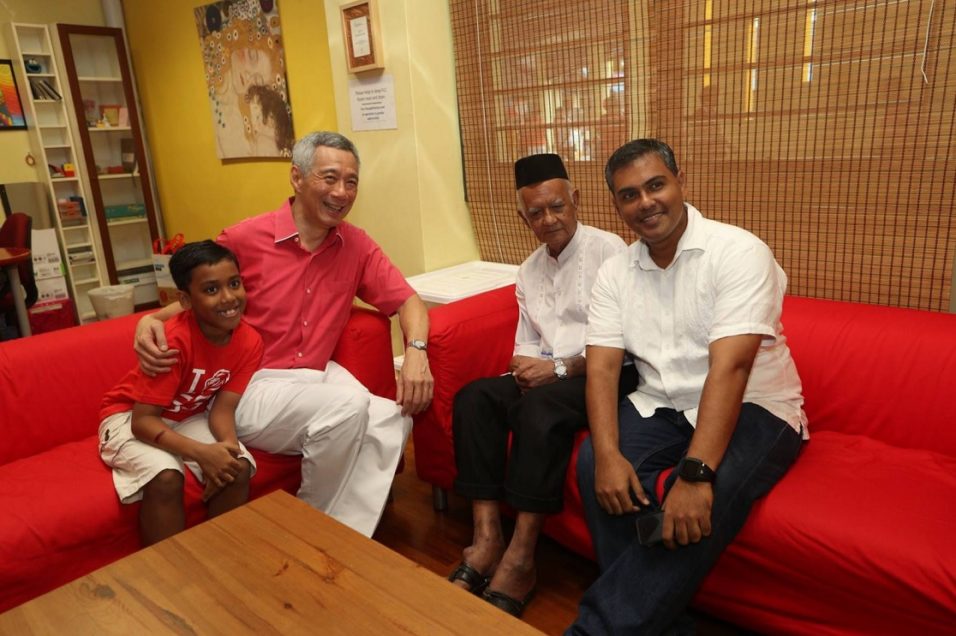
    I presented an Edusave Merit Award to Adam, a student from Teck Ghee Primary School. After the ceremony, I met Adam’s father, Aziz. He showed me an old photo of him, receiving an SBC House Union Bursary from me in 1986! So I have presented awards to father and son, 31 years apart! It was a special moment for Aziz, Adam, and also for me.

    I also met the grandfather, Ahmad, who was a gardener with SBC, the old Mediacorp. That is why Aziz qualified for the Bursary all those years ago.

    It is my Government’s duty to build for our future, so that every family can be like Ahmad, Aziz and Adam. This is the Singapore of the last half century: Every generation striving and building for the next, keeping our eye on tomorrow and investing in our children. Undaunted by challenges, but instead working together to overcome obstacles, seize every opportunity and realise a bright future for all of us.

    Thank you and Good Night!


    Source: Lee Hsien Loong / MCI