Tag: Malay community

  • How Singapore Elected A President Without A Vote: Only One Eligible Candidate Thus Victorious By Default

    How Singapore Elected A President Without A Vote: Only One Eligible Candidate Thus Victorious By Default

    Singaporeans were meant to go to the polls at the end of next week to vote for a new president, but they’ll no longer have the chance, with only one candidate qualifying for the race. Former Speaker of Parliament Halimah Yacob has emerged victorious by default, after other presidential hopefuls fell foul of new rules.

    “I can only say that I promise to do the best that I can to serve the people of Singapore and that doesn’t change whether there is an election or no election,” she told reporters Monday. What should be a moment of celebration — Halimah will be Singapore’s first female president — has proved contentious for several reasons and appears at odds with Singapore’s reputation as a technocratic and efficient city state. While the office of president is largely a ceremonial role in Singapore, he or she has power to veto some of the government’s decisions, for example in fiscal matters that touch on the country’s reserves, or key appointments in the public service. “The only beneficiaries from this reserved presidential election are Halimah Yacob and her team, as well as Singapore’s opposition, which now has a new line of attack against the PAP (People’s Action Party). The rest of Singapore has suffered,” Sudhir Vadaketh, a Singapore author and commentator, told CNN. Halimah was, until recently, a loyal member of the ruling PAP, which dominates Singaporean politics.
    “All Singaporeans are unhappy that meritocracy and electoral fairness, core Singaporean values, have been eroded to fulfill perceived political goals.”

    Racial politics
    In this election, for the first time, candidates to become Singapore’s president could only come from one racial group: Malays. It’s a radical policy that would likely prove divisive elsewhere but it’s one the Southeast Asian nation said was necessary to ensure better representation among the country’s three main races: Chinese, Indian and Malay.
    “It shows we don’t only talk about multi-racialism, but we talk about it in the context of meritocracy or opportunities for everyone, and we actually practice it,” Halimah told The Straits Times newspaper, before declaring her intention to contest the election.

    The new rules also set stricter criteria on the background of candidates. For example, those from the private sector are required to be a chief executive of a company, with at least $370 million in shareholders’ equity. The two other Malay presidential hopefuls — businessmen Salleh Marican and Farid Khan — failed to gain Certificates of Eligibility from the Presidential Elections Committee on these grounds, although the Presidential Elections Committee could have exercised its discretion to allow them to run for the office. Critics charge that the new rules are a way for the government to stage-manage the election and prevent opponents from running.

    In August, Singapore’s appeal court ruled against a legal challenge to the new system by ruling party lawmaker turned critic, Tan Cheng Bock. Tan had narrowly lost the previous presidential election in 2011 to Tony Tan, a former deputy prime minister widely recognized as the government-favored candidate, and planned to run again. Singapore’s population is 74% Chinese, 13% Malay, 9% Indian and 3.2% are the ambiguously named “Others.”

    New rules
    The announcement late Monday by the Elections Department that only one candidate had qualified marks an underwhelming conclusion to a controversial election carried out under changes to the elected presidency system in Singapore voted through Parliament earlier this year. Specifically, the amendment states that an election will be reserved for candidates from a particular racial group if the previous five elections have not produced a president from that racial group. In Singapore, it’s dubbed a “hiatus-triggered model.”

    “Every citizen, Chinese, Malay, Indian or some other race, should know that someone of his community can become President, and in fact from time to time, does become President,” said Lee Hsien Loong, Singapore’s prime minister, last November before the new rule was introduced. Singapore hasn’t had a Malay president since the country’s first President Yusof Ishak, who served as head of state from 1965 to 1970. Subsequent presidents have been from the Eurasian, Chinese and Indian communities.

    Debate
    The election has also triggered debate on who is Malay and raised questions over how an individual’s race can be determined. Candidates were required to be assessed by a five-member community panel to certify their race as Malay as part of the qualifying criteria. Halimah, who has successfully stood as a Malay candidate in previous general elections, is reported to have an Indian father. Moreover, Salleh Marican also has an Indian father, while Farid Khan’s identity card lists his race as “Pakistani,” the government-controlled Straits Times reported. What’s more, critics point out that, if the goal really was to improve racial representation and justice, more meaningful measures could be adopted.

    The Chinese form the majority in Singapore and often dominate in positions of power and influence. Singapore’s prime minister has always been Chinese, and it was only in 2015 that the country finally had more than one Malay minister in the Cabinet at one time. The Malay community typically have lower incomes and grapple with institutional discrimination, such as in the armed forces.

    “While reserving the presidential elections for only Malays is a highly symbolic gesture, there is a need to do more for concrete issues faced by the Malay community such as discrimination, lack of social mobility and relative poverty,” lawyer Fadli Fawzi told CNN. “I think that it is more important to focus on removing barriers and improving the lot of the man on the street rather than reserving slots for one or two individuals.”

    Speaking at a forum on Friday, Chan Chun Sing, a minister in the Prime Minister’s Office, acknowledged the unpopularity of the new system, saying that it would be a “hard journey” to convince Singaporeans that the change was necessary. He denied accusations that the amendments were made for political gain. “We are prepared to pay the political price, because we think the future of our country is much more important than any political capital that we may have,” he said.


    Source: http://edition.cnn.com

  • Commentary: In A Perverse Way, The Outcome Was A ‘Fitting Finale’ To The Reserved PE2017

    Commentary: In A Perverse Way, The Outcome Was A ‘Fitting Finale’ To The Reserved PE2017

    In a perverse way, the outcome of the first Reserved Presidency, a non-event, was a fitting finale to the reserved presidential election (which has now become a non-election).

    How so?

    * The Malay community never asked for a Malay president, and now we have one. I wonder how many in the community will be jubilant.

    * A confirmation that meritocracy is not sacrosanct, and it can be disapplied selectively. We wonder when the next disapplication will be.

    * An affirmation of the perception that Malays need a crutch and will only “succeed” upon affirmative action.

    * The question that is begged to be answered is why the Community had failed to come up with a qualified candidate for the Presidency (other than Mdm Halimah)? Has the bar been set too high that it excludes others who would be willing and able to be President? Or is the community not good enough?

    * Singaporeans generally will not be pleased. Apart from the fact that other non-Malay communities have been denied the opportunity to field candidates, Singaporeans too have been denied the opportunity to cast votes, the most basic form of democracy.

    * Mdm Halimah can’t be too pleased. She would have won a presidential election which was open. She would have won a presidential election that was reserved. But she has been denied that opportunity to have the electorate’s mandate.


    Source: Nizam Ismail

  • Attention: Malay Population In Singapore At Its Peak Due To All Muslims Considered A Malay

    Attention: Malay Population In Singapore At Its Peak Due To All Muslims Considered A Malay

    It’s getting more and more confusing now. Or is it not?

    If “people” are saying that religion determines the race then this a development in a way. Let’s do some mathematical analysis.

    The given arguments are:

    A Malay is not a Malay only if he/she is a Christian. (lose)

    An Indian is a Malay if he/she is a Muslim. (add)

    So going by the same argument,

    If a Chinese or a Caucasian(others) are Muslims, he/she is a Malay. (add)

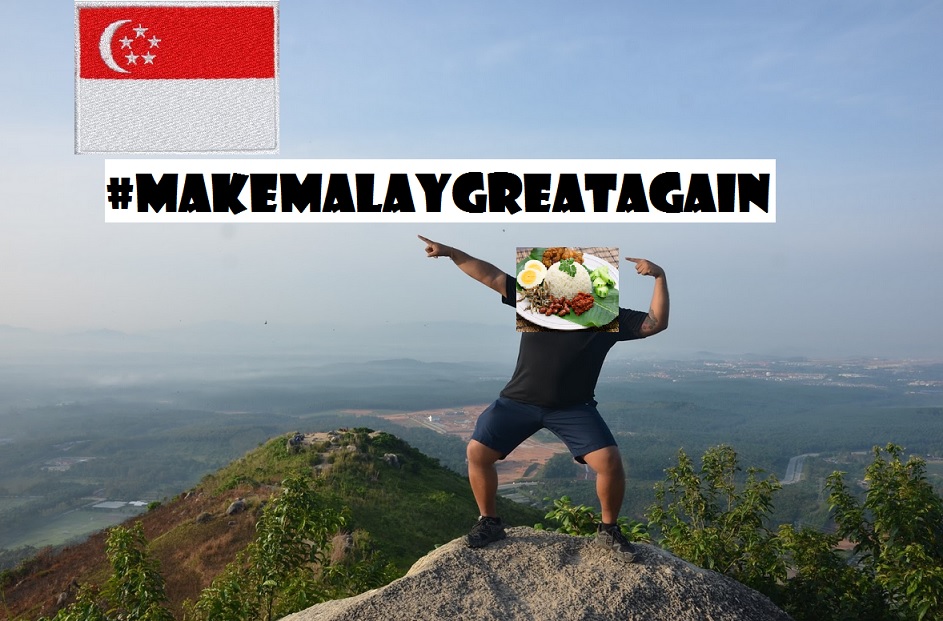
    Well then let’s revise the national population ratio. Overall there should be more Malays now because technically all Muslims are considered as Malays. And there should be a reduction of in the population of Indians and Chinese now that their Muslims brethren are classified as Malays. So hurray! Our Malay population has grown! #makemalaygreatagain

    (What about Indians or Chinese who are Christians? Because generally Indians are Hindus and Chinese are Taoists or Buddhists. Jeng jeng jeng….)


    Rilek1Corner

  • Confirmed That Malay Race Is Essentially Muslim, All Indian Muslims Are Malays But Christian Malays Are Not Malays

    Confirmed That Malay Race Is Essentially Muslim, All Indian Muslims Are Malays But Christian Malays Are Not Malays

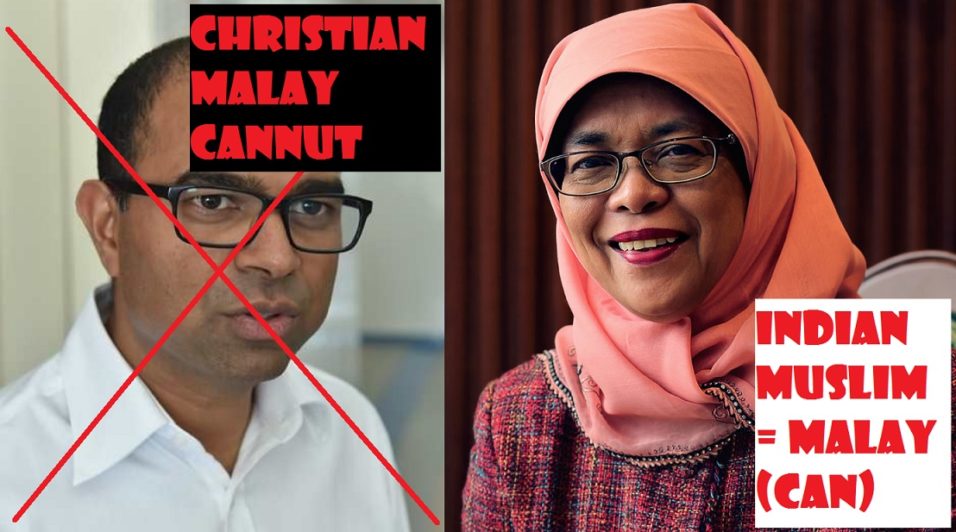
    At the Institute of Policy forum yesterday (Sep 8), Minister of State Chan Chun Sing and Senior Minister of State Janil Puthucheary both confirmed that the Malay race is essentially Muslim and that all Indian Muslims are Malays, and Christian Malays are not Malays.

    The two Ministers were responding to a Malay Christian IPS professor Dr Mathew Mathews and NUS law professor Dr Kevin Tan. Minister Chan Chun Sing said it is “common-sensical” a person’s race is decided by the 16-member committee under Lee Hsien Loong:

    “A 16-member committee will certify a prospective candidate’s racial group. The very concept of race evolves and the system to determine one’s race should not take a definitive, restrictive, exclusive approach. The community must come to terms (with) who best represents them. If the community accepts someone… then who else outside the community will want to dispute that and who else in the community will want to dispute that? So it’s a very common-sensical way to allow the community to decide for themselves.”

    Senior Minister Janil Puthucheary told Dr Mathew Mathews that he might be a Malay but he will be denied the contest because he is Christian. The Minister then tell the Christian Malay to contest in an “open” election:

    “If the Malay community changes its aspirations and its sense of what makes a Malay five years from now, there should be a way to reflect that in the choice of candidate, without us having to go for a potentially very divisive Constitutional amendment. The hypothetical individual mentioned by Dr Mathew could feel excluded, but the individual could still contest in an open election.”

    NUS law professor Dr Kevin Tan confirmed that the government having the final call on what race a person is is unconstitutional:

    “That the decisions of the Community Committee— which also assesses minority candidates under the Group Representation Constituency system in General Elections — are final, is also a problem. That is probably unconstitutional… The basic fundamental principle about the separation of powers is that if the court has to interpret the constitution, no branch of the Government can tell the court what to do.”


    Source: https://statestimesreview.com

  • Damanhuri Abas: Reserved PE Is A PAP’s Ploy, Sadly A Compliant Malay Community Will Only Served Their Plan To The Tee

    Damanhuri Abas: Reserved PE Is A PAP’s Ploy, Sadly A Compliant Malay Community Will Only Served Their Plan To The Tee

    Today we are sadly living in times when values are mere rhetorical slogans thrown around with no sense of truth that it becomes meaningless.

    Few years ago they said to attract good leaders in government, peg ministers pay to top private salary bracket. The assumption is that this would bring the so-called talent from private to the public sector. What it failed to explain is the logic of correlating two different positions and roles with two different objectives and responsibilities. Yet we seemed to swallow it. A dismal flow of ‘quality’ people from private to public since they up the salary is a damning exposé on its illogical logic.

    Actually all this strange logic is only possible because the whole process only went to a parliamentary route which is already a biased one as the overwhelming power of one party would simply allow them to use it to push through their preferred decisions. The fair route would have been to allow thorough public debate which would have prevented this and other changes from seeing the light of day but alas we killed that possibility by allowing such a lopsided parliament to exist in the first place.

    And the rest is history.

    This PE being reserved is but another similar episode of the PAP simply using their power to get away with what they want. The full machinery of control is then used to validate a clearly unjustified ruling. A compliant Malay community do not help as they simply served the PAP plan to the tee.

    This will not end and more crazy changes will take place so long as we the people continue to allow them to do so by our own failure to act according to our conscience.

    Today the PAP has set the ground rules to ensure that the chance or possibility of a political breakthrough for the opposition to be minuscule if not impossible. With the GRC and the gerrymandering, they effectively already won even before election is called. If we factor in the exclusive access to public broadcast where they no longer even bother to hide their utter blatantness in utilizing the public media to propagandized and even bring disrepute to oppositions, the outlook and prospect gets only worst for the opposition.

    This is the state of the nation today.

    The fundamental role of check and balance, fairness and justice no longer exist in so far as political space and reality are in Singapore. We collectively are responsible for this situation. History has shown how this is unsustainable and will lead to abuse and suppression or even oppression on any segment of society that dare to challenge their dominance.

    We had a window of hope in 2011 but 2015 showed how we chose to follow our emotions rather than our rational mind and logic. By the way things are, and the slew of changes to strengthen their almost absolute control, 2020 may be worst.

    Without unhindered political space, unlike most other regional nations, we remained sadly behind the political maturity curve. This stagnation or even regression is taking place amidst a changing economic reality that are driven primarily by freedom and space accorded for dynamic social growth in which political freedom is key.

    Therefore it do not augur well for our future that today we remained stuck in this clearly debilitating discourse over the highest office in the land not over the critical role and function that it meant but the secondary or even minor issue of racial equality totally misplaced and clouded with so much questions, half-truths to even strange redefinitions. It is really painful to see the acting by all parties to this national charade.

    To think that with all the intelligent minds that we have produced as a nation and to see such outright dumbing down of the people for vested political interest of the PAP is a damning indictment on our ownself. No one else is to blame really.


    Source: Damanhuri Bin Abas