Tag: Melayu

  • Hanifa Kahar, Orang Bukan Cina Pertama Jadi Presiden Kelab Pidato Mandarin

    Hanifa Kahar, Orang Bukan Cina Pertama Jadi Presiden Kelab Pidato Mandarin

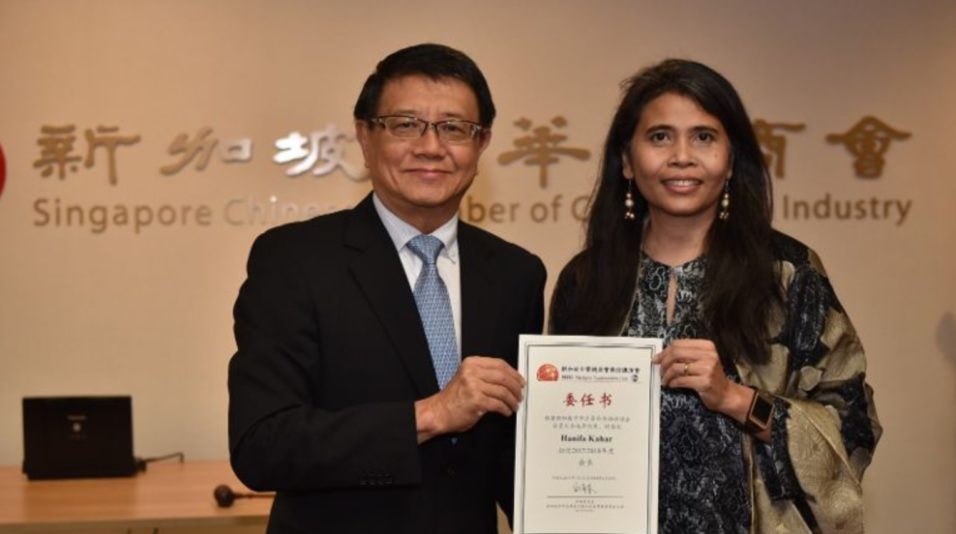
    Buat pertama kalinya seorang anak Melayu/Islam dilantik sebagai Presiden bagi Kelab Pidato (Toastmaster) Mandarin, Dewan Perniagaan dan Perusahaan Cina Singapura (SCCCI).

    Walaupun bukan berbangsa Cina, Cik Hanifa Kahar, 52 tahun, diberi kepercayaan untuk menerajui kelab pidato tersebut oleh lembaga SCCCI, sekaligus mencipta sejarah.

    Cik Hanifa memberitahu BERITAMediacorp beliau mula menyertai kelab pidato Mandarin itu sebagai anggotanya dan menyampaikan pidato pertama dalam bahasa Mandarin pada tahun 2015. Beliau juga pernah dilantik menyandang jawatan sebagai Naib Presiden Keanggotaan Kelab.

    SESINGKAT 2 TAHUN SAHAJA JADI ANGGOTA, KEMUDIAN DILANTIK JADI PRESIDEN

    Ini bermakna beliau dilantik sebagai presiden kelab tersebut dalam tempoh hampir dua tahun. Ternyata, kecekapan dan kewibawaan Cik Hanifa meyakinkan pihak lembaga SCCCI untuk memilihnya.

    “Semasa saya menjadi Naib Presiden Keanggotaan, Presiden dan dua lagi Naib Presiden Pendidikan ketika itu berasal dari China. Jadi, semua urusan baik menerusi panggilan telefon mahupun Whatsapp perlu menggunakan bahasa Mandarin, jika tidak saya tidak dapat menjalankan tugasan saya,” kongsi Cik Hanifa.

    “Oleh itu, saya belajar bahasa Mandarin di kelab pidato itu, jalankan tugasan, tulis teks pidato dan dapatkan bantuan mereka untuk menyuntingnya. Proses-proses tersebut secara tidak langsung membentuk diri saya yang sekarang. Apabila tiba masa untuk melantik seorang Presiden baru, agak jelas, saya menjadi pilihan mereka,” cerita Cik Hanifa kepada BERITAMediacorp.

    Menurut Cik Hanifa, peranan beliau sebagai presiden kelab pidato tersebut adalah untuk menaikkan profil kelab dan memancing minat orang ramai supaya datang ke mesyuarat-mesyuarat mereka untuk lebih memahami tentang kelab itu dan juga SCCCI sendiri.

    Meskipun Kelab Pidato Mandarin SCCI adalah kelab yang “inklusif”, Cik Hanifa berkata setakat ini anggotanya terdiri daripada masyarakat Cina dan seorang rakyat Jepun.

    SIAPA HANIFA KAHAR?

    Cik Hanifa adalah pengasas laman Childhoodspeech – di mana beliau berkongsi pengalamannya mendidik anak beliau menjadi seorang yang boleh bertutur melebihi satu bahasa dan berharap ia dapat memberikan inspirasi kepada para ibu bapa lain.

    Selain itu, Cik Hanifa juga sering memberikan ceramah-ceramah motivasi dan perjalanan hidupnya membuatkan rakan-rakan serta masyarakat lebih menghargai keindahan bahasa apabila ia berjaya dikuasai.

    Beliau juga merupakan penulis buku bertajuk ‘Parenting Inspired! Follow The Path Where The Child Loves To Grow’, di mana beliau bercerita tentang pengalaman sendiri yang mendapat inspirasi daripada anak tunggalnya, sehingga beliau berjaya membangunkan Childhoodspeech pada tahun 2008.

    “Saya mahu memahami lebih lanjut bagaimana saya sendiri bermula bertutur dalam beberapa bahasa sejak kecil lagi dan bagaimana saya boleh mendidik anak perempuan saya. Saya mahu beliau juga belajar bahasa Mandarin. Oleh itu saya berkongsi di laman tersebut,” ujar ibu kepada seorang anak remaja berusia 16 tahun ini.

    IBU BAPA JAWA-PALEMBANG, TAPI GALAK ANAK BELAJAR MANDARIN

    Bahasa Mandarin sebenarnya bukanlah bahasa yang begitu asing dan baru dipelajari Cik Hanifa.

    Menurut Cik Hanifa, ibu bapanya yang berketurunan Jawa-Palembang memastikan beliau, abang serta kakaknya mempelajari bahasa Mandarin meskipun mereka sendiri tidak boleh bertutur dalam bahasa itu.

    “Semasa kecil, saya sudahpun mempelajari bahasa Mandarin di sekolah. Kami tinggal di Beach Road pada waktu itu dan bapa saya menghantar kami adik-beradik belajar bahasa Mandarin. Bapa saya seorang yang berpandangan jauh dan mengetahui manfaat bahasa Mandarin ke atas pendidikan dan masa depan kami,” kongsi Cik Hanifa, anak bongsu daripada tiga adik beradik – satu lelaki dan dua perempuan.

    Cik Hanifa bersama ibunya. (Gambar: Shamsuddin Kahar/Facebook)

    Cik Hanifa juga boleh bertutur dalam empat bahasa lain, termasuk 1 bahasa dialek – Melayu, Inggeris, bahasa Indonesia dan juga Hokkien.

    BERBUAL DIALEK HOKKIEN DENGAN ADIK-BERADIK

    Ini satu lagi fakta yang boleh membuat anda terpegun. Cik Hanifa dan adik-beradiknya hanya berbual dalam dialek Hokkien sejak kecil sehingga sekarang!

    Walaupun sudah biasa dengan bahasa Mandarin selama hampir 50 tahun, Cik Hanifa berkata beliau perlu terus mengamalkannya dalam sekitaran yang dapat membantu memantapkan penguasaan bahasa itu.

    Bagi Cik Hanifa, itulah cara paling baik supaya beliau dapat membantu dan mengajarkan bahasa Mandarin kepada anaknya dengan cara yang lebih berkesan.

    “Saya menyedari yang saya perlu bertutur dalam bahasa Mandarin dengan anak saya, jadi saya terus mempelajari bahasa itu supaya saya dapat mengajar beliau. Saya mahu memberi inspirasi kepada anak saya dan diri sendiri untuk mendalaminya,” Cik Hanifa memberitahu BERITAMediacorp.

    Cik Hanifa menambah: “Saya juga yakin dengan melibatkan diri dengan kelab pidato ini, saya harap saya boleh mendapat inspirasi untuk terus mempelajarinya supaya pendidikan dan asas yang sudah ada tidak sia-sia.”


    Source: http://berita.mediacorp.sg
  • Maklumat Penting Mengenai 35,000 Kubur Islam Yang Terjejas Di Pusara Abadi

    Maklumat Penting Mengenai 35,000 Kubur Islam Yang Terjejas Di Pusara Abadi

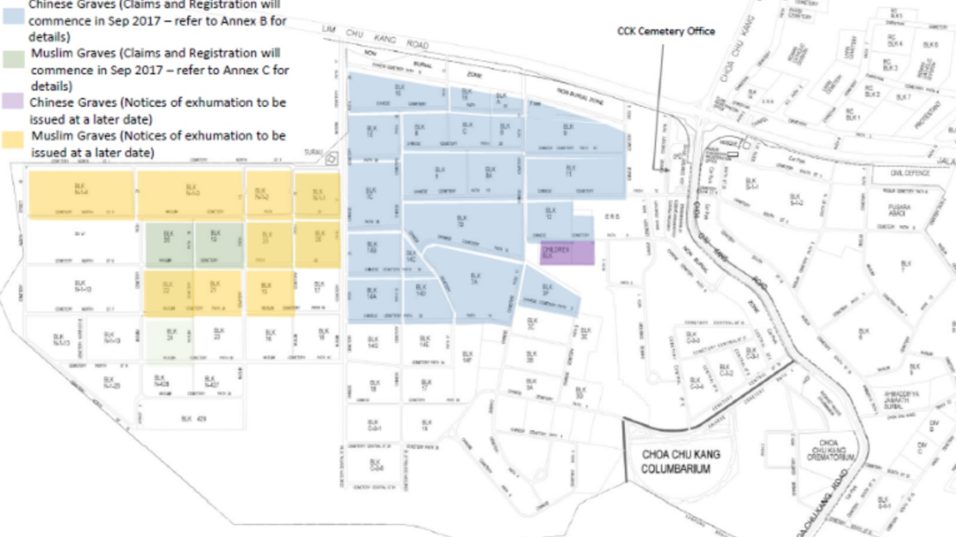
    35,000 kubur orang-orang Islam di Pusara Abadi akan terjejas dengan proses penggalian semula dan pengambilan tapak tanah bagi projek perluasan Pangkalan Udara Tengah, di bahagian barat laut Singapura.

    45,500 kubur Cina juga akan terjejas dalam proses itu, menjadikan kesemuanya 80,500 kubur terjejas di Choa Chu Kang.

    Ini diumumkan secara bersama dalam satu kenyataan media hari ini (18 Jul) oleh Kementerian Pembangunan Negara (MND), Agensi Sekitaran Kebangsaan (NEA) dan Penguasan Tanah Singapura (SLA).

    MULAI SEPTEMBER INI, 5,000 KUBUR ISLAM BOLEH DITUNTUT

    Mulai September ini, sebanyak 5,000 kubur orang Islam di Pusara Abadi, dan 45,000 kubur orang Cina, akan menjalani mendaftaran untuk dituntut.

    Proses tuntutan dan pendaftaran itu melibatkan plot-plot kubur Pusara Abadi bagi Blok 19 dan Blok 20.

    Kesemua kubur itu sudah memenuhi tempoh pengebumian selama 15 tahun.

    Notis bagi penggalian lagi 30,000 kubur orang Islam akan keluarkan kemudian, setelah kubur-kubur itu juga mencapai tempoh pengebumian 15 tahun.

    (Gambar kawasan kubur Islam yang terjejas bewarna hijau dan kuning Gambar: NEA) 

    30,000 kubur itu terletak di blok-blok berikut:

    Blok 15
    Blok 21
    Blok 22
    Blok 25
    Blok 26
    Blok N-1-1
    Blok N-1-2
    Blok N-1-3
    Blok N-1-4


    Source: http://berita.mediacorp.sg

  • How Malays Define Malayness? Well Truth Is Its Very Confusing And Inconsistent

    How Malays Define Malayness? Well Truth Is Its Very Confusing And Inconsistent

    So how does one define who is or isn’t Malay? Having actually researched this for my thesis for the past two years, please let me share with ya’ll SOME of what I’ve learned.

    How Malays define Malayness has always been head-scratchingly confusing to those who are not Malay and even to us who identify as Malay in Singapore, it’s blatantly inconsistent. It is something of a pet passion of mine, probably because people keep assuming I’m chinese. Also, why is Malayness confusing? This is because there are actually competing definitions of Malayness. Dr. David Tantow identifies three which can be found in Sg:

    1) there is the Islamic ummah, which basically imagines ALL Muslims in the Malay archipelago regardless of ethnicity as being part of the larger Malay community (basically, it’s: you are Arab? Pakistani? Well, hello, welcome, cuz as long as you Muslim, you my bro). Apparently, This emerged as kind of an identity-based counter to Western imperialism and colonialism in the 19th and early 20th centuries but which has now gotten a pretty bad rep because talk about a southeast Asian caliphate now (which is what this definition alludes to) and people will be like, eh, don’t become Isis leh, I call police.

    2) Then, for the second, we have Malayness defined by cultural signifiers and codes, where we talk about people who practise Malay customs (adat), speak the Malay language (Bahasa), and practise Islam (agama). These three thingies form the basis of whether someone is either Malay (Melayu) or if that person has “enter (has become) Malay” (masuk Melayu). What confuses people about THIS definition is that it does NOT take genetic heritage into account. Basically, it’s: oh, you have Pakistani parents? But you now speak Malay, love motorcycles, know how to eat nasi ambeng, and go Friday prayers? Then we same-same Melayu lah bro.

    3) The third definition is the one Mendaki and the gahmen loves cuz it’s the simplest one; using parentage/ancestry or “genetic and territorial qualifiers”. It’s really just, oh, your father is Malay, your mother is Malay, then two plus two equals four cikgu. It’s the most exclusive kind of Malayness but also one that people who are not Malay are least confused by. Also, can anyone spell “administrative convenience”?
    (Source: www.tandfonline.com/doi/abs/10.1080/13639811.2012.725553)

    4) THEN, as if these three ways of defining Malayness is not enough, we’ve not even touched on the fact that “Malay” also refers to an umbrella term for “the Malay races”, which is when we further divide Malays up into whether they are Minang, or Bawean (Boyan), or Javanese, or Bugis, even Filipinos and Orang Asli,etc, etc, oh so many many, many of which have their own languages, customs, even religious practices, some of whom are chill with being called Malay and others who are less chill because of reasons. All of them are represented in singapore so JOY.

    5) THEN, as if I don’t have a migraine already, not only are all these different ways of defining Malays competing with each other, they are COEXISTING in some kind of strange equilibrium because, you know, we Malays don’t have enough problems in our lives. It’s why some of us say, Wah, this Marican cannot Bahasa Melayu, is he really Melayu (second definition)? Then with Khan, whom no one has criticised for not being able to speak Malay, people are like, eh, he Pakistani ancestry means he’s not Malay right (third definition).

    6) THIS EQUILIBRIUM SHIFTS, because Malays cannot duduk diam-diam, between each other but also internally within the three definitions as well. For example, increased religiosity in recent decades means many Malays absolutely require someone to be Muslim to be considered Malay while others like the 1960s Malay nationalists placed a premium on customs and heritage. Before that, there was also the phrase “Bahasa jiwa bangsa” (language is the soul of a nation) which was a huge draw for the malay intelligentsia because they ardently believe that MALAY LIT IS MORE LIT THAN YOUR ROKOK. It’s only really with the (racist) British system of colonial administration, and later on with the (rac-Er-problematic) CMIO system that the third definition really became much more dominant in the lives of Malays in sg. All in all, these shifting lines evolve to adhere to historical and cultural changes.

    7) So, really, what I am trying to say is defining who is Malay and how has been one long historical ?&$?? that has resulted in the inconsistency many people are now seeing in how the Malay community is treating the candidates. ALSO, AND MOST IMPORTANTLY, it has resulted in me extending my MA Programme by one semester, WHICH LIKE WAHLAO NI MELAYUNESS MAKAN MELAYU KE PE, incidentally. Now, with this development in the Presidential Election, this headache is finally going to be passed on to, as it usually happens here, a committee. I’m kinda looking forward to what they’re gonna say. For research purposes. Of course, they could just use the simplest, most boring way which is the third, genetically defined one, which will disqualify Khan. But this would leave us with Marican who many Malays would like to instinctively disqualify because of the second definition.

    Of course, likely, both will be disqualified because of the 500 million dollar in whatever equity rule, neatly avoiding this headache, which will mean, happily, that this migraine will continue, resulting in more MC days for my Malay brethren and me.

    Disclaimer: While Malay identity is important to my thesis, it’s not the main subject I am investigating for my research project. As such, what I know is limited and no doubt incomplete. So please feel free to add in any gaps or correct any inaccuracies as you spot them.


    Source: Hidhir Razak

  • Amrin Amin Turun Padang Sertai Operasi Serbuan Banteras Salah Guna Dadah

    Amrin Amin Turun Padang Sertai Operasi Serbuan Banteras Salah Guna Dadah

    Ini jarang-jarang kita saksikan – iaitu Anggota Parlimen sama-sama menyertai operasi anti-dadah di lapangan. AP yang dimaksudkan ialah Setiausaha Parlimen Ehwal Dalam Negeri Amrin Amin, yang turun padang menyertai para pegawai Biro Narkotik Pusat (CNB) pada awal pagi Rabu (12 Jul) untuk melancarkan serbuan ke atas pesalah-pesalah dadah.

    Serbuan tersebut dijalankan ke atas sebuah pusat hiburan malam di kawasan Orchard, dan dilakukan dari waktu tengah malam hingga 4.00 pagi dinihari tadi (12 Jul).

    Seramai lima orang yang disyaki pesalah dadah dicekup semasa serbuan itu, dedah Encik Amrin, menerusi laman Facebook beliau.

    Encik Amrin menyatakan: “Penguatkuasaan adalah teras utama bagi strategi anti-dadah kami. Para pegawai CNB kami bekerja keras, melancarkan serbuan kerap bagi memastikan kelab-kelab dan jalanan kami bebas dadah, di samping selalu mengutamakan negara sebelum diri mereka.”

    CNB: BUKAN LUMRAH, AP SERTAI SERBUAN ANTI DADAH

    BERITAMediacorp difahamkan bahawa bukan menjadi suatu kebiasaan bagi seseorang Anggota Parlimen untuk menyertai operasi serbuan seumpama itu.

    “Encik Amrin menyertai serbuan tersebut untuk lebih memahami dengan lebih lanjut apa yang berlaku di sebalik suatu serbuan itu. Ini bukanlah suatu yang lumrah,” dedah seorang jurucakap CNB kepada BERITAMediacorp.

    Dalam serbuan tersebut, Encik Amrin turut berkongsi beliau menyaksikan sendiri “dedikasi penuh” para pegawai CNB.

    Ini termasuk merancang serbuan itu dengan “teliti”, menguji mereka yang disyaki menyalahgunakan dadah dan menguruskan individu-individu yang ditangkap.

    “Saya berasa penuh yakin dan bangga dengan adanya para pegawai cekap seperti itu yang berkhidmat untuk Singapura. Terima kasih!” tulisnya lagi.

    (Gambar-gambar: Amrin Amin/Facebook)

    KEMPEN ANTI DADAH MASYARAKAT MELAYU/ISLAM

    Antara usaha memerangi dadah di kalangan masyarakat Melayu/Islam, yang sudah dijalankan Encik Amrin selaku Setiausaha Parlimen MHA, ialah memperhebat kempen menangkis najis dadah.

    Pada 30 April lalu, Encik Amrin turut melancarkan kempen “Dadah Itu Haram” demi meningkatkan kesedaran tentang gejala negatif dadah.

    Satu pakatan masyarakat Melayu/Islam untuk memerangi masalah dadah turut didedahkan semasa pelancaran kempen itu.

    Kempen itu dipimpin oleh golongan asatizah, iaitu Persatuan Ulama dan guru-guru Agama Islam (PERGAS) dan mesej kempen itu disebarkan oleh sekurang-kurangnya enam badan Melayu/Islam tempatan.


    Source: http://berita.mediacorp.sg

  • Marine Company Chairman Farid Khan Born In Geylang Serai Is Running For Presidency

    Marine Company Chairman Farid Khan Born In Geylang Serai Is Running For Presidency

    An entrepreneur of Pakistani descent yesterday announced his bid to become the next president.

    Mr Farid Khan Kaim Khan, 62, the chairman of marine services provider Bourbon Offshore Asia Pacific, said he intends to stand in the upcoming presidential election (PE) because he wants to “serve the nation” and feels “capable of doing so to the best of my knowledge and ability”.

    This PE, due in September, has been reserved for Malay candidates after the Presidential Elections Act was amended to ensure the presidency is representative of the country’s multiracial society.

    Speaking in English and Malay, Mr Farid told reporters at the Village Hotel Changi that his identity card indicates he is Pakistani but he was born in Geylang Serai and celebrates Hari Raya every year.

    “I am of Pakistani descent and my wife is of Arabic descent. Yet our family and relatives speak Malay and practise the Malay culture. So I am part of the Malay community,” he said.

    In his speech, Mr Farid outlined five areas of concern: the growing threat of radicalism, strengthening the trust among the people, helping the needy, enhancing Singapore’s prosperity and strengthening families.

    He is the second candidate to throw his hat into the ring.

    Second Chance Properties founder and chief executive officer Mohamed Salleh Marican, 67, said on May 31 that he planned to run for president.

    Political analyst Mustafa Izzuddin told The New Paper that Mr Farid addressed his ethnicity head-on to clear the air in the hope of quelling any doubts about his candidacy.

    “He did not want the question whether he is Malay to hijack other issues he wants to discuss, and probably anticipated it,” he said.

    ELIGIBLE

    Associate Professor Eugene Tan, a law don at the Singapore Management University, echoed Dr Mustafa’s observations, noting that Mr Farid wanted to reassure his stakeholders by “asserting his claim to be eligible”.

    He said: “Certainly now that he has indicated he would make an application, there is the question of eligibility.”

    Dr Mustafa said the decision whether Mr Farid is Malay lies with the Community Committee.

    Prospective candidates must submit a form to the Presidential Elections Committee (PEC) to get a certificate of eligibility, and another form to the Community Committee to declare that they are part of the Malay community to obtain a Community Certificate.

    “I suspect the committee is going to stretch the definition to consider not just what you are born as, but what your experience is like, your environment, and whether or not the community sees you as Malay,” Dr Mustafa said.

    Prof Tan also weighed in on another requisite – private sector candidates have to helm a company with at least $500 million in shareholder equity.

    However, the PEC has the discretion to waive this requirement.

    Bourbon Offshore Asia Pacific, a subsidiary of a French multinational marine company, reportedly has shareholder equity of US$300 million (S$415 million), but Mr Farid said he is confident of qualifying.

    Mr Farid, who is married to Madam Naeemah Shaikh Abu Bakar, 61, with a daughter, 23, and son, 18, has been with the company for more than 10 years.

    It has about 800 workers in the region.

    Said Prof Tan: “If it does not appear that he qualifies outright, then he will have to go under the discretionary route, and the PEC will have to decide.”


    Source: http://www.tnp.sg