Tag: presidency

  • Dr Tan Cheng Bock: Don’t Be Afraid To Fight For What’s Right

    Dr Tan Cheng Bock: Don’t Be Afraid To Fight For What’s Right

    Happy National Day 2017

    Dear Singaporeans,
    This year has been an eventful year for me. In all that I have done, I believe that it has been for the good of our country. I want future generations to be proud of Singapore and all its achievements. Let us have the courage to stand up for our convictions. Never be afraid to fight for what is right. We all want the best for our nation.

    I look forward to celebrating National Day with my family and friends, and enjoying my grandchildren.

    My family and I wish you all a Happy National Day.


    Source: Dr Tan Cheng Bock

  • PAP Put Spotlight On Race When They Reserved This Presidential Election For Malays

    PAP Put Spotlight On Race When They Reserved This Presidential Election For Malays

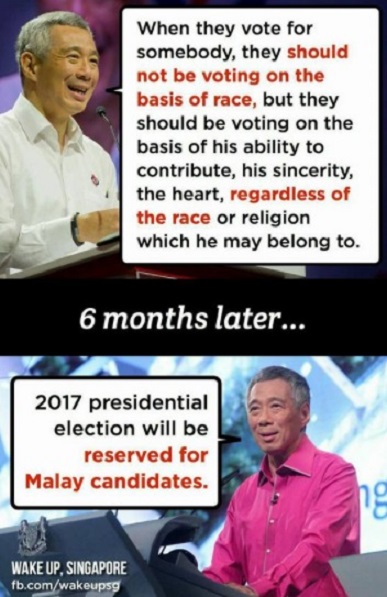
    Don’t talk about their Malay-ness, discuss their capabilities instead. This is generally what many PAP supporters are saying. They remind us not to focus on the race.

    Excuse me! In the first place, who made this election about race?

    Malay Singaporeans didn’t ask for this election to be reserved for the community. We were capable of looking beyond race to vote someone capable and independent like Dr Tan Cheng Bock as President if he had been allowed to contest an open PE.

    The Malay community didn’t say we are not going to participate in any Presidential elections because no Malays were contesting.

    It was the PAP who made this election about race. So, naturally, we will discuss how Malay those aspiring Presidents are. If the person is not adequately Malay to the community, then having that candidate as our President does not make us proud and will continue to perpetuate the perception that the community is being excluded from the presidency.

    Don’t make our community the scapegoat.


    Rilek1Corner

  • Marine Company Chairman Farid Khan Born In Geylang Serai Is Running For Presidency

    Marine Company Chairman Farid Khan Born In Geylang Serai Is Running For Presidency

    An entrepreneur of Pakistani descent yesterday announced his bid to become the next president.

    Mr Farid Khan Kaim Khan, 62, the chairman of marine services provider Bourbon Offshore Asia Pacific, said he intends to stand in the upcoming presidential election (PE) because he wants to “serve the nation” and feels “capable of doing so to the best of my knowledge and ability”.

    This PE, due in September, has been reserved for Malay candidates after the Presidential Elections Act was amended to ensure the presidency is representative of the country’s multiracial society.

    Speaking in English and Malay, Mr Farid told reporters at the Village Hotel Changi that his identity card indicates he is Pakistani but he was born in Geylang Serai and celebrates Hari Raya every year.

    “I am of Pakistani descent and my wife is of Arabic descent. Yet our family and relatives speak Malay and practise the Malay culture. So I am part of the Malay community,” he said.

    In his speech, Mr Farid outlined five areas of concern: the growing threat of radicalism, strengthening the trust among the people, helping the needy, enhancing Singapore’s prosperity and strengthening families.

    He is the second candidate to throw his hat into the ring.

    Second Chance Properties founder and chief executive officer Mohamed Salleh Marican, 67, said on May 31 that he planned to run for president.

    Political analyst Mustafa Izzuddin told The New Paper that Mr Farid addressed his ethnicity head-on to clear the air in the hope of quelling any doubts about his candidacy.

    “He did not want the question whether he is Malay to hijack other issues he wants to discuss, and probably anticipated it,” he said.

    ELIGIBLE

    Associate Professor Eugene Tan, a law don at the Singapore Management University, echoed Dr Mustafa’s observations, noting that Mr Farid wanted to reassure his stakeholders by “asserting his claim to be eligible”.

    He said: “Certainly now that he has indicated he would make an application, there is the question of eligibility.”

    Dr Mustafa said the decision whether Mr Farid is Malay lies with the Community Committee.

    Prospective candidates must submit a form to the Presidential Elections Committee (PEC) to get a certificate of eligibility, and another form to the Community Committee to declare that they are part of the Malay community to obtain a Community Certificate.

    “I suspect the committee is going to stretch the definition to consider not just what you are born as, but what your experience is like, your environment, and whether or not the community sees you as Malay,” Dr Mustafa said.

    Prof Tan also weighed in on another requisite – private sector candidates have to helm a company with at least $500 million in shareholder equity.

    However, the PEC has the discretion to waive this requirement.

    Bourbon Offshore Asia Pacific, a subsidiary of a French multinational marine company, reportedly has shareholder equity of US$300 million (S$415 million), but Mr Farid said he is confident of qualifying.

    Mr Farid, who is married to Madam Naeemah Shaikh Abu Bakar, 61, with a daughter, 23, and son, 18, has been with the company for more than 10 years.

    It has about 800 workers in the region.

    Said Prof Tan: “If it does not appear that he qualifies outright, then he will have to go under the discretionary route, and the PEC will have to decide.”


    Source: http://www.tnp.sg

  • Damanhuri Abas: The Malay Reserved President Is A Done Deal

    Damanhuri Abas: The Malay Reserved President Is A Done Deal

    The Malay Reserved President is a done deal no matter how much Dr Tan Cheng Bock try to argue for an Open Election. He will be admired for his tenacity and resolve to truly serve the people he love. So what can Singaporean hope for after Dr Tan Cheng Bock?

    Looking at the rank and file in Government, they are still mostly dominated by career civil servants from the uniformed or non-uniformed services. This reality undermines the Government’s claim that pegging Ministers salary to that of top private sector senior management will lead to more coming forward to join politics and becoming Ministers.

    In fact since the Government calibrated the salary of Ministers to be on par to that of private sector senior management, we have not seen any ground-breaking move that is worth mentioning. The truth is, if one has attained senior management position in business it is most unlikely that a political career is anywhere in his or her radar. Instead it is those who don’t see financial prospect in the private sector that will grab a chance of making big bucks as politician. It is definitely rare and extremely far between to expect anyone who is earning a handsome annual pay comfortably in the private sector to be so driven by a calling to serve the people.

    Singaporean yearns for that truly fresh face to rejuvenate their hopes and dreams amidst the gloom of a Machiavellian driven politically sterile landscape dominated by the powerful elite and their avarice. For now, such a one is imperceptible in both the near and far vista of our political horizon.


    Rilek1Corner

    Source: Damanhuri Bin Abas

  • Contradictions On The Slippery Slope Towards The Reserved Elected Presidency

    Contradictions On The Slippery Slope Towards The Reserved Elected Presidency

    This is a summary of my thoughts that I shared at a Discussion Session with undergraduates from the University Scholars Program at Cinnamon College, NUS on 3 Apr 2017.

    I was asked to broadly comment on the following issues:

    1. Given the varying responses to the Reserved Presidency, how this will affect the unity of the Malay community.
    2. How this will affect the standing of the Malay community in Singapore’s political landscape.

    The announcement of the next Presidential Elections in Singapore being reserved for a Malay candidate has evoked mixed reactions from the Malay community in Singapore.

    There are 3 broad reactions to the notion of a Malay Reserved President.

    1. Disinterest. This is not so much driven by apathy, but a sense of resignation that the limited role of the Presidential will not have much impact on the Community, or that the outcome is a foregone conclusion (with the Government-supported candidate winning).  It did not help that Mdm Halimah Yacob has been referred to as “Madam President” in Parliament by Minister Chan Chun Sing (albeit by mistake).
    2. Agreement. The reactions from this group within the community stem from a belief that it is important for the Community to have a reference point as a beacon of hope for the community, and to also project the President as a symbol of multiculturalism in Singapore.  There are those who express an underlying defeatism – that the Community will not get a chance to have a Malay candidate through meritocratic process. An IPS survey to the effect that Singaporeans will vote along ethnic lines is thrown in to support this view. There are also those from the Community who exhibit opportunism – an attitude of “it’s there, so just grab the opportunity, and don’t be apologetic.”
    3. Disagreement. I belong to this group.

    What are the Objections?

    The Malay Community has never asked for a reserved Malay president in recent times. This was never raised as an issue by any Malay-Muslim Organization (MMO), any Malay Member of Parliament or any thought leader within the community.

    In fact, the announcement of a presidential race for Malays came as a complete surprise to most within the community.

    This announcement came as the Community grapples with are more fundamental problems that need fixing – gaps in educational attainment (relative to other communities in Singapore), lower socio-economic standing, over-representation in crimes/drugs, discrimination.

    A prevailing sentiment was that if there was indeed a commitment to uplift the Malay community, why not fix the various gaps and issues within the Community?  The Community would want to product a Malay presidential candidate can make the qualifying criteria and be elected in a national elections on his or her own footing.

    There is also strong perception that genesis for the Reserved Presidency was to exclude a certain Chinese candidate from qualifying.  Hence, the perception was that the Reserved Presidency was not borne out of a desire to promote the interests of the MMC. Consequently, those who hold that perception felt upset that the Malay community is used an instrument in this game.

    The Government has always said that meritocracy is sacrosanct. That was what defined Singapore and made us different. This mantra was oftentimes cited as a differentiating factor for Singapore in the wake of Singapore’s eviction from Malaysia. This call was made consistently, even long after Singapore’s independence.

    Interestingly and perhaps ironically, Madam Halimah Yacob herself, during her speech during a National Day Rally in 2012 mentioned the significance of meritocracy in Malay (obviously addressed to the Malay community):

    “Kita perlu beri sepenuh perhatian dan jangan jemu jemu bekerja keras demi kebaikan semua.

    Tuan-tuan dan Puan-puan, Saya yakin dibawah sistem meritokrasi, dan bermodalkan usaha gigih kita, masyarakat Melayu/Islam mampu mendaki tangga kejayaan yang jauh lebih tinggi.”

    English translation: “We have to give full attention and cannot shun hard work for the collective good.”

    “Ladies and Gentlemen, I am confident that under our system of meritocracy, and based on our hard work, the Malay/Muslim community can ascend the steps of success”

    In trying to address this anomaly, an argument had been made is that the principles of meritocracy is not sacrificed as a Malay candidate will need to meet the stringent qualifying criteria for President.

    However, meritocracy is not just about setting minimum qualifying standards for a candidate.  It is about picking the best person for the job.

    This was the argument made by the Establishment in the past against any ethnic-based affirmative action programs.

    But yet, we make exceptions to meritocracy where it appears to be expedient to do so.

    This gives rise to a slippery slope – where do you stop disapplying meritocracy?  Apart from the reserved Presidency, the Group Representation Constituency, which guarantees minority representation, is another instance of meritocracy being disapplied (though the evidence seems to point towards more minority representation in parliament before the GRC were introduced, but that is another matter).

    So where do you stop in disapplying meritocracy?

    • Should we have a reserved Prime Minister?
    • A reserved Deputy Prime Minister?
    • Reserved Ministers in “heavyweight” ministries (such as Finance, Defence, Trade and Industry, Foreign Affairs) ?
    • Reserved Permanent Secretaries?

    The argument – that the elected Presidency embodies the multicultural aspect of Singapore – must similarly apply to other roles above.

    It can be argued that it is important to have multicultural representation on senior policymaking roles, no?

    Lest I be misunderstood, I am not advocating reserved positions or ethnic-based affirmative action programs for these position.

    But by having a Malay reserved President, have we set a wrong precedent for Singapore?

    Another argument against the Reserved Presidency is the belief that contrary to the IPS survey, Singaporean voters will not be blinded by ethnic affiliations in voting.  Consider the fact that the GRC led by Tharman Shanmugaratnam had garnered the highest percentage of votes at the last General Elections.  Muralidharan Pillai, a first-time candidate, had defeated Dr Chee Soon Juan at the Bukit Batok By-Elections.  There is thus evidence that Singaporeans look beyond ethnic affiliations.

    There is yet another disconnect.  On the one hand, statements have been made to the effect that Singapore is not ready for a minority Prime Minister (even if polls done by research company Blackbox Research show that DPM Tharman, a minority, is seen as the most credible candidate for Prime Ministership).

    And so, in the context of the Prime Minister’s position, the assertion is that minorities are not ready to assume leadership of Singapore as a country.

    However, a diametrically-opposed position is taken for the Presidency – in that it is now important for Singapore to have a minority as the President.

    Why the contradictory stance?

    Crutch Mentality.  The other fear is that having a reserved presidency perpetuates the perception that the MMC will not succeed unless there is affirmative action.

    Will a Malay Reserved President therefore have the legitimacy and respect?

    Already, there is already resentment amongst quarters of the non-Malay Singaporean community.

    Also, if Singapore wants to be truly inclusive, why not reserve the Presidency for women? Or for people coming from lower socio-economic backgrounds?  True inclusivity must move beyond ethnicity.


    Source: https://nizamosaurus.wordpress.com