Tag: property

  • (Reader Contribution) Rakyat Malaysia Ditindas Oleh Orang Luar

    (Reader Contribution) Rakyat Malaysia Ditindas Oleh Orang Luar

    This reader, a Malaysian, mentioned that foreigners like those from Singapore and Australia are taking advantage of the good exchange rate for Malaysian currency by purchasing properties and assets in Malaysia, not just one or two, but more than that. Do you agree with him?

    ***

    Maaf, saya nak berkongsi rasa. Saya join group keluarga Singapura. Group ni terdiri dari saudara mara saya di Singapura dan Australia. Baru sempat baca whatsapp mereka petang tadi. Hari ni mereka upload gambar penduduk singapura dan australia reramai keluar beratur panjang beli duit ringgit kita sebab duit kita jatuh teruk. Berita tentang negara kita memang panaslah kat negara luar.

    Penduduk luar sangat gembira dengan kejatuhan ringgit ni termasuklah saudara mara saya. Saudara mara saya banyak beli aset di Malaysia. Saudara mara saya bukan beli aset satu dua aje di Malaysia tapi lebih. Hampir setiap dari mereka ada aset di sini. Rumah, tanah, rumah kedai yang tak mampu kita termasuk saya miliki, mereka mampu beli.

    Saya rasa sedih sangat. Bukan sebab cemburu or dengki tapi kesian pada nasib kita rakyat Malaysia ni. Saya guru sejarah, paatriotik saya terusik. Saya bimbang satu hari nanti kita hanya bangga sebagai rakyat Malaysia tapi kita dhaif tak punya apa-apa di negara kita sendiri. Keadaan itu sudah hampir jadi realiti. Bila kita kejar keuntungan, kita jugak yang rugi akhirnya. Adik saya jurutera di putrajaya holdings, buat rumah semi d, harga rm6 juta.

    Saya tanya habis tak terjual. Adik saya kata habis, dibeli oleh orang luar singapura, taiwan, australia. Sedih kalau kita terpaksa merempat di bumi kita sendiri. Nak salahkan mereka? Tepuk dad, sesamalah kita renungkan. Saya tak salahkan mereka bila kita sendiri yang membuka ruang, peluang dan kesempatan untuk mereka.


    Source: Bukhari

  • Property Agents Unhappy With PropertyGuru’s Impending Price Hike

    Property Agents Unhappy With PropertyGuru’s Impending Price Hike

    Local property search portal PropertyGuru’s decision to increase prices for property agents to list on its platform has sparked a backlash among some real estate agents.

    According to a notice PropertyGuru sent to its subscribers on Jul 31, prices of new agent packages will range from S$880 per year to S$9,880 per year from Friday (Aug 4) – up from the current annual cost of S$630 to S$2,240.

    These packages also include the number of concurrent listings an agent can have on its site, and a pool of credits agents use to put up their listings, or “boost” it such that it appears at the top of the page.

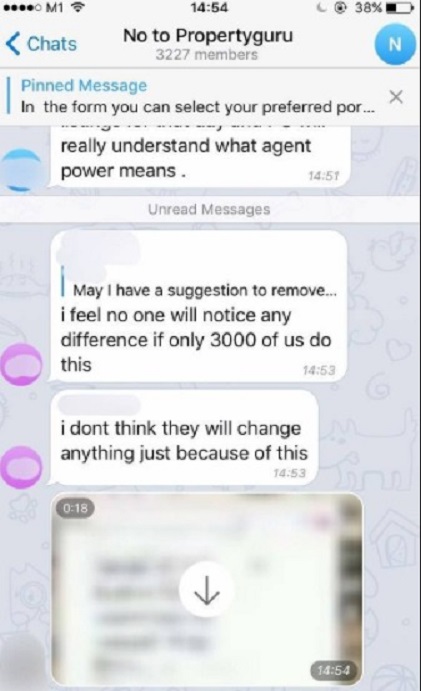
    More than 3,000 agents have joined a Telegram chat group called “No to Propertyguru” to discuss the issue, with some calling for a switch to other similar portals once their subscription with PropertyGuru ends.

    Agent packages on 99.co, another real estate portal, cost between S$388 and S$588 per year, while rates on SRX Property are between S$499 and S$4,299 a year, according to their websites.

    Mr Jeff Koh, the agency relationship director at 99.co, said his platform does not have a credit system. Instead, agents can click a “refresh” button every 12 hours on a listing so that it comes up on the site’s front page.

    PropertyGuru told Channel NewsAsia that the changes were made in order to “improve the property seeker’s experience”, which will “ultimately deliver more leads to the agents”.

    However, real estate agents Channel NewsAsia spoke to said they were unhappy with the price hike, particularly as PropertyGuru is the most popular site among clients, with a majority of their enquiries via real estate portals coming from there.

    A screengrab of the “No to Propertyguru” chat group on messaging app Telegram. 


    A 29-year-old, who declined to be named because she belongs to a well-known property agency, said the price hike might make it harder for agents with fewer years in the industry like her to reach potential clients.

    The “top producers” will continue to receive queries from house hunters as they have the capital to spend on online listings, she said, while younger agents will have difficulty “getting on the front page”.


    Source: www.channelnewsasia.com

  • You Don’t Have To Be Born With Silver Spoon To Change Your Life

    You Don’t Have To Be Born With Silver Spoon To Change Your Life

    “Does Rozi live in a condo or a house?”

    “She seems like the kind who lives in a condo.”

    I got the above throughout my growing up days till today.

    On the contrary, I was not born with a silver spoon. Yes, I have been blessed to be able to attend top schools in Singapore, but my family has never been rich.

    I actually used to push the janitor trolley (trolley tong sampah / rubbish bin trolley) when I followed my grandparents sweep the floors of HDB flats. I was then in my primary school days. My younger sister who was then about five or six years old used to follow us too. We got stares by people who own cars at the carpark and it was that resolve that I believe, made us aspire to always do well in life. (Plus early nights and strictly no drinking of coffee till we enter uni. My late grandfather’s advice. ?)

    Most of us live in HDB flats while I had friends living in condos, Sixth Avenue all the way Third Avenue and Good Class Bungalows all over Singapore. Whichever house type you stay and choose to stay in, it is of utmost importance that your heart is at rest.

    And that is what I aspire to help you attain today.

    So coffee (now that I can drink kopi), tea or property? Call me.


    Source: Rozi Faith

  • A Chinese-Singaporean Husband’s Dilemma – ‘Sorry Your Wife Is Indian. Landlord Won’t Rent To You’.

    A Chinese-Singaporean Husband’s Dilemma – ‘Sorry Your Wife Is Indian. Landlord Won’t Rent To You’.

    Darius Cheung, founder of Singapore-based property listing site 99.co, is married to Indian-Singaporean wife Roshni Mahtani, who’s also an entrepreneur (she started parenting portaltheAsianparent).

    Late last year, they began searching for a property to rent, thinking that an oversupply of apartments would make it easy. They were wrong.

    You see, as a Chinese Singaporean man, Darius had been sheltered from the everyday racism felt by minorities. He was about to get an education.

    “I began to notice something very odd as we went for these viewings, something I never encountered before in the dozen years that I’ve been renting,” he writes on the company blog.

    “On several occasions, the agents seemed eager to end the viewings quickly, sometimes without even discussing the offer. I would text them afterwards to negotiate on the price, but one of the responses we got was a shocking ‘Sorry your wife is Indian, landlord won’t rent to you. Next time please indicate earlier, so we both don’t waste time.’”

    He did precisely that. True enough, 20 percent of their enquiries were rejected right away because Roshni was mentioned in the text message.

    “In one case, after the typical vague response of ‘profile doesn’t match,’ I pushed harder to ask ‘Is it because my wife is Indian?’, and the response was a dead-pan ‘yes, thanks for your understanding.’”

    They ended up paying 15 percent more than what they should have because of their difficulty finding a place.

    The event led to some soul-searching. They wanted to include both parents’ surnames in their daughter’s name. They thought about dropping the Indian surname to protect her, but decided against it.

    So Darius sought to do something about racial discrimination in the property market. He writes:

    If you google ‘No Indian No PRC’, you will find actual rental listings in Singapore in the top results. The problem is so prevalent that even BBC had extensive coverage on it some time ago.

    Enquiries about rental properties often come with a series of profiling questions that includes ‘What race are you?’, ‘Where are you from?’, or outright rejection by stating ‘Profile doesn’t match.’ The top two groups of people who receive discriminatory responses are Indians and PRCs (referring to those from the People’s Republic of China).

    Landlords often cite reasons like “lack of cleanliness”, “likelihood of damaging the apartment,” and even “I don’t like them.”

    99.co is now tackling this by introducing an “all-races-welcome” indicator on its website. What this means is that agents and landlords can positively indicate that their properties can be rented by anyone regardless of ethnicity. Such listings will get prominent placing on the website.

    “The idea is to give renters peace of mind during their home search journey – reducing instances of rude comments and unpleasant experiences while enquiring about listings.”


    Source: www.techinasia.com

  • Is Living In Malaysia A Good Move For Singaporeans?

    Is Living In Malaysia A Good Move For Singaporeans?

    Thousands of people cross over the Tuas Second Link and Woodlands Causeway to Singapore daily for work or school. Among them is a growing number of Singaporeans who have chosen to move to Malaysia, and still continue to work in Singapore.

    To some people, living in Johor Bahru or Iskandar, and commuting daily to Singapore seems like a crazy idea – just think of the endless long queues at Customs and perennial Causeway jams. Yet, in view of the favourable currency exchange (Singapore dollars to Ringgit), you would have to agree that such a move does come with huge potential savings and other non-tangible benefits.

    So then, what are some of the major pros and cons of living in our neighbouring country?

    Pros:

    1. Huge potential savings

    As mentioned earlier, with the Ringgit hitting a new record low against the Singapore Dollar, it is as good as having a “pay increment” when you work here and spend in Malaysia.

    Iskandar is three times the size of Singapore. Given the sheer land amount of land available, one of the biggest pull factors that has drawn many Singaporean investors, is the size of the property that you could not possibly buy here for the same amount of money. In other words, you get more land for less money in Malaysia, and also the opportunity to design and build your own home at a more reasonable price.

    In addition, the prices of Johor properties have weakened significantly over the recent months, making now a good time to consider buying a house in Malaysia if you plan to stay there for long. Even if ownership is not in the pipeline, rental there is still very much affordable which means your salary can go further.

    2. More holistic living environment

    As much as we love watching movies and shopping, recreational choices are pretty limited in Singapore. Yet for families who stay in Malaysia, they have easy access to a wide variety of activities at affordable prices, not to mention that Legoland and national parks are all within a short driving distance as well. For them, mall visits and staycations are no longer necessary, as they can easily drive up to Malacca, or even Tioman, for a relaxing, foodie or sightseeing trip over the weekends.

    A bigger house also means more room to cultivate new hobbies that were once not feasible due to a lack of space, like gardening. Imagine the joy of growing your own spice garden at the back of your house, or teaching your young kids how to cycle on your spacious front porch.

    This is this peaceful and laid-back lifestyle that captivated many locals who have made their way across. A slower pace of life, and easy access to a range of wholesome activities are essential, attractive qualities that contribute to a more holistic lifestyle. Quiet nights without hearing the sound of vehicles zooming past, and seeing greenery instead of another concrete block each time you look out the windows, adds icing to the cake.

    Cons:

    1. Traffic is a killer

    Nothing is perfect in this world and living in a foreign land definitely has its fair share of challenges. For Malaysia, traveling from place to place can be rather tricky without a car, especially if you need to travel to and from Singapore. Hence, your daily transportation mode is an important factor to consider before you cross over.

    Even if you do own a car, having to wake up early before 6am to ensure that you beat the jams and reach your office on time, in addition to the exhausting Causeway commute and “gung-ho” driving of fellow Malaysians, can add further stress to an already sleep-deprived mind.

    Staying in Malaysia might work out better for those lucky ones who have flexible working hours or can work from home, as they can avoid the peak hours and enjoy smoother traffic when traveling in and out of Singapore.

    2. Higher reported crime rates

    Let’s face it: we are all too familiar with scary tales of robberies and thefts in Malaysia. To live in constant fear of being robbed can be rather daunting for some of us, and night life is definitely a big no-no for those who prefer to be cautious.

    Not only is installing a home alarm system a necessity in Malaysia, being vigilant on the roads and in public places is also a must if you do not wish to fall prey to lurking thieves.


    Source: www.propertyguru.com