Tag: Singapore

  • Singapore’s Stagnant Start-Ups

    Singapore’s Stagnant Start-Ups

    Facebook, Amazon, eBay. Other than cultures of innovation, disruption and now serious valuations, something that all these once start-ups now tech-giants have in common is that they aren’t Singaporean.

    Ok, obviously global tech start-ups are largely an American phenomenon. But even at the level of local and regional start-ups, the Little Red Dot is lagging behind with very few recognisable names in the start-up game.

    What about Grab taxi, you ask? Well, it is Malaysian-founded, though now Singaporeanised thanks to investment and this too is another recurring problem where local start-ups are struggling despite Singapore’s financial ecosystem pouring money into regional ventures.

    With strong intellectual property legislation, excellent connectivity, a range of government programs in support of innovation and diverse options for funding, Singapore is — on paper at least — a paradise for start-ups.

    However, as regional ventures have flourished on Singapore’s soil local entrepreneurs appear to be missing out. According to a recent Tech in Asia article, local ventures have raised only a fraction of the funding raised by their foreign counterparts.

    Singapore has much to celebrate and be proud of… but it needs to relook its start-ups policy. This after billions of dollars’ worth of government funding directed at local start-ups for several years.

    To some extent, of course, the discrepancy in the performance between local and regional ventures is inevitable. Start-ups operating in Indonesia, India or China benefit from huge domestic markets and are an attractive proposition to investors.

    Also there are clear gaps to be filled in these markets that don’t always exist in Singapore where international companies already operate comfortably.

    However, Singapore with its sizeable economy and talent pool should be producing internationally and regionally competitive start-ups. Just look at Israel, a country with a similar population, GDP and high-tech base, which is churning out start-ups at a formidable pace including the home-grown navigation app Waze which was bought by Google for US$1 billion (RM4.47 billion).

    Something isn’t quite right, our start-up ecosystem is not working for local entrepreneurs and this is a problem.

    Though some might say it’s simply meritocracy with foreign start-ups having better revenue models and harder working teams, the reality is that Singapore as a nation must develop its core at every level particularly at the level of tech-innovation and entrepreneurship.

    If you look at the labour market, Singaporeans are now heavily favoured — with restrictions on S-passes and employment passes benefiting qualified Singaporeans.

    But in terms of the start-up ecosystem, we seem to be at an active disadvantage, seen as consistently less worthy of investment than those operating in larger markets with lower barriers to entry.
    Here’s my hypothesis:

    1. Singapore start-ups haven’t moved to capitalise on the country’s competitive advantages. While we don’t have a large market we do have a sophisticated research base, and a more complex financial ecosystem than most of our neighbors. This means Singapore can compete in niche products like genetics and robotics, but for too long our local start-up offerings have been along the lines of retail solutions, payment gateways etc. simple clones that haven’t developed deeper technologies even though we should have the talent to do so.

    2. The second problem may also be the government’s own largesse. Billions of dollars’ worth of grants, incubators and ambitious funding programs don’t guarantee success. One of the dangers of these schemes is that a lot of start-ups become vehicles for obtaining funding and don’t have the business plans and commitment needed for success. Better targeted funding which offers to co-fund or match funding raised by founders with clearer milestones is essential to propelling a healthy start-up economy.

    3. The global start-up narrative has focused on a small number of visionaries — fearless leaders in their garages and basements ingeniously disrupting their way to success. It must be noted though that most successful businesses in Asia are family businesses with family and community support structures. It might be time our funding and development models reflected this with family units encouraged to fund projects and ownership structures, loans etc that facilitate this. While this is somewhat unconventional, involving the family/community has the advantage of removing the fear of failure many isolated Singaporean entrepreneurs have — as risks are now shared.

    4. Finally, the key weakness in terms of creating successful start-ups is our increasing distance from  our immediate region. Despite amazing transport connectivity to every part of Asia, Singaporeans are too used to seeing the country as a bubble. As such, Singapore’s conditions do not reflect those of the region and Singaporeans are not geared to solving the regional problems which present the largest opportunities. A population that’s increasingly speaking Mandarin and English but not Malay, leave alone Tagalog or Bengali, is not well-equipped to succeed where we have the greatest competitive advantage – our neighbourhood. Raised to see our neighbours as dirty and dangerous, young Singaporeans are not willing or able to scrap it out on the streets of Jakarta or Dhaka but this is where the opportunities are and if we don’t break down these psychological barriers, start-up success will remain elusive.


    Source: themalaymailonline

  • Aku Tak Kenal Siapa Shia

    Aku Tak Kenal Siapa Shia

    I never had a friend who is Shia or anything other than Sunni. I was brought up in Singapore as a normal Muslim child. went to school, had a decent education and made several friends of different ethnicity.

    As i grew older, i had to fill up more forms like the G50, insurance papers or even resume and interview details of myself, and i got to know about my sect. that was when i learnt that i am a sunni. embarrassingly, i was a drop out from religious school back then when i was younger due to certain circumstances so this was something new to me. “Ini kau letak je sunni”, that was what i was told to write by a friend without any hesitation. And i still remembered it till today.

    So out of curiosity i asked him what the other side of sunni was (if there is any) and i was told about Shia. A small community of muslims that are of different teachings from us that we should not really speak of or supposed to know of. It was a surprise to me but i did not pursue the issue any further. Perhaps i would never know anything more anyway.

    I don’t know anything about shia or who are these shias in singapore. some people say that they may be among us and we would not know it. the question now comes down to how can we effectively embrace everyone in Islam, if there are like “closeted” muslims living around us though abiding by the same religion Islam? can they come out? Or are they not supposed to come out?


    Teh O

    Reader’s Contribution

  • Call To Embrace Diversity In Islam

    Call To Embrace Diversity In Islam

    There is a growing confidence in the Malay-Muslim community about its place in Singapore, said Minister-in-charge of Muslim Affairs Yaacob Ibrahim.

    But even as it enjoys successes, challenges remain, he said, highlighting the need for the community to embrace diversity in Islam.

    In an interview with Malay newspaper Berita Minggu, Dr Yaacob said the community has made progress in three areas.

    First, Malay students are doing better in education. Besides more of them scoring well in national exams at the primary, secondary and polytechnic levels, there were also more who achieved first-class honours in universities last year, he said.

    There was progress made in the religious life of Malay Muslims too, he added. He cited how donations to mosques have increased, and low-income families are getting help through their programmes, among others.

    A third area of progress, which Dr Yaacob described as “more innate”, is that more Malays are stepping forward to do more not just for the community but also for other Singaporeans. Some have launched start-ups, while others do community work such as serving food and cleaning the homes of poor Singaporeans of other races.

    The community has progressed on many fronts, Dr Yaacob said. “Divorce rates are coming down, our educational achievements are going up, home ownership is stabilising, wealth is increasing in the community, (there are) better jobs and there is a greater diversity of talent.”

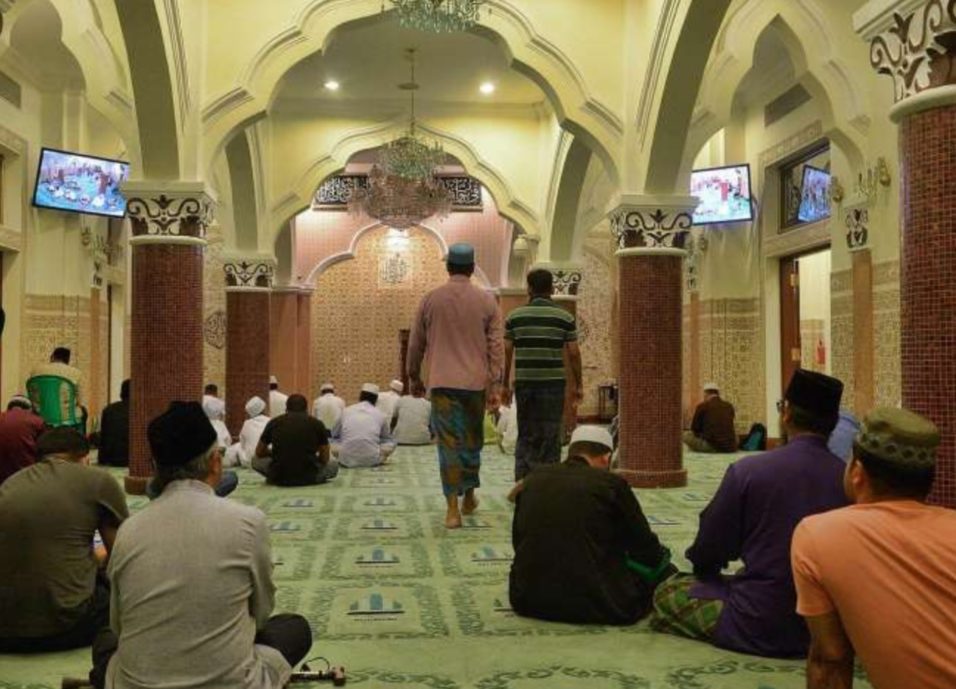
    But as the community grows in self-confidence, it also has to embrace diversity in Islam. The Islamic faith is “very diverse” and there is a need to respect differences, he said.

    As a vocal minority online and in the region has sought to sow discord against Shi’ites, Dr Yaacob said there is a need to respect minority Shi’ite Muslims in predominantly Sunni Muslim Singapore, noting that senior Muslim scholars have all along considered Shi’ites as part of the mainstream in Islam.

    “They pay MBMF (Mosque Building and Mendaki Fund). They come to our mosques. They pray together with us. They celebrate the same Hari Raya. So why are we not treating them as fellow Muslims but different?” he said.

    He gave the example of how the chairman of the Moulana Mohamed Ali Mosque at UOB Plaza, Mr Mirza Namazie, is Shi’ite while the majority of its board is Sunni. “That’s a great example of how we deal with diversity, and we have to continue with that,” he added.


    Source: The Straits Times

  • Undergrad Part-Time Tutor Rejected By Tuition Agency Due To Parents’ ‘Racial Preferences’

    Undergrad Part-Time Tutor Rejected By Tuition Agency Due To Parents’ ‘Racial Preferences’

    Tuition has become a staple for school-going children in Singapore.

    While it is understandable that each child — and by extension, family — may seek specific tutors for specific needs, one tutor has come forward to share her experience of being repeatedly rejected for tuition jobs — despite being more than qualified for it.

    The tutor is an undergraduate student from a local university and is seeking part-time work at a local tuition agency for extra income.

    The agency essentially acts as a middleman by matching families with the tutors for the required subjects.

    Compiling all the requests of the different families, the tuition agency then sends them out to the tutors under them. Interested parties can apply to take up the vacant slots.

    censored-without-codecensored-without-code-2

    As the tutor in question specialises in English and Literature, she has repeatedly applied for positions that required tutors for those two subjects.

    However, time and time again, she has met with responses from families like the one below:

    rejected-profile-without-code


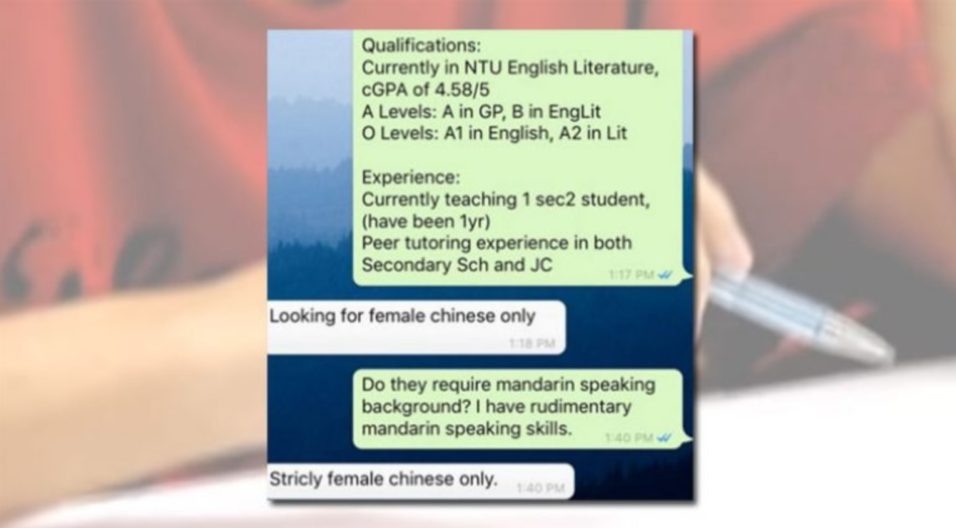
    Recently, it was more blatantly put across to her:

    screenshot-4


    Deep-rooted problem 

    Speaking to Mothership.sg, the tutor said she feels frustrated that she has to deal with this kind of issue time and time again.

    This is despite the fact that she is a first-class honours student.

    She also related that she has even met with a situation where after she was rejected by the family, the same tuition gig was offered to someone she knew, who is Eurasian Chinese.

    She also said any language or communication barrier with non-English-speaking families should not be a problem, particularly in her case, as she is from a mixed Malay-Chinese family.

    Acknowledging the sensitivity of the issue, she doesn’t demand recourse.

    Instead, she said she understands that some people just don’t feel comfortable with certain races.

    What have the authorities said about such practices

    According to TAFEP’s job advertisement guidelines stated in its fair employment practices handbook,

    “Employers who advertise a position requiring a specific attribute which may be viewed as discriminatory should ensure it is indeed a requirement of the job and state the reason for the requirement in the advertisement…

    Race should not be a criterion for the selection of job candidates as multiracialism is a fundamental principle in Singapore. Selection based on race is unacceptable and job advertisements should not feature statements like ‘Chinese preferred’ or ‘Malay preferred’.

    Religion is unacceptable as a criterion for recruitment except in cases where employees have to perform religious functions as part of the job requirement. In such cases, the requirements should be clearly and objectively presented”.

    But such practices are normalised

    However, a quick check on forums has shown how prevalent racial preference in tuition has become in Singapore.

    screen-shot-2017-01-06-at-11-12-39-amscreen-shot-2017-01-06-at-11-13-55-amscreen-shot-2017-01-06-at-11-19-30-am

    Ultimately, the student tutor said she hopes people, especially parents, can have a more open mindset towards tutors like her.

    She said: “I just wish that it wasn’t this way because it hasn’t changed since my mum’s time.”


    Source: mothership.sg

  • Cat Issue Likely To Become The “Solution” For Annoyed Cat Haters To Retaliate

    Cat Issue Likely To Become The “Solution” For Annoyed Cat Haters To Retaliate

    “Cats are not allowed in flats. They are generally difficult to contain within the flat. When allowed to roam indiscriminately, they tend to shed fur and defecate or urinate in public areas, and also make caterwauling sounds, which can inconvenience your neighbours.”

    I saw that my buddy Sameer Ab. Kadir received a HDB letter as a result of a neighbour complaining. So, decided to check the HDB website for the law on this and true enough, they did list it down.

    The ruling also didn’t provide any provision, unlike they had for dogs. So, if the cat can be contained, does not roam indiscriminately, shed fur, defecate or urinate in public areas nor make caterwauling sounds, shouldn’t the cat then be allowed?

    I believe that HDB needs to assess such complaints on a case by case basis. To go down to the location to conduct a personal observation to assess before issuing such a letter informing the owner that they will have the said pet removed from the premises by a certain date.

    The pet cat, like the pet dog, is a part of the family and being dependent on the owner for its sustenance, it will suffer its own form of PTSD or panic attack when removed from familiarity and may not survive in a new environment.

    Hope that HDB will be able to exercise discretion in handling this matter and to the neighbour who made the complain, I hope you spend a little bit more time with animals.

    My fear with such a complain going viral is that it then provides others who hate cats an ‘exit solution’ to their annoyance for cats and abuse the law to their own convenience.

    I’m sure a lot of people are shocked and will be standing in solidarity with Sam on this though.

    Hope your cats will get a fighting chance to stay at your home Bro. Give them that fight.


    Source: Ab Di Lar

deneme bonusu