Tag: Singapore

  • PAP Put Spotlight On Race When They Reserved This Presidential Election For Malays

    PAP Put Spotlight On Race When They Reserved This Presidential Election For Malays

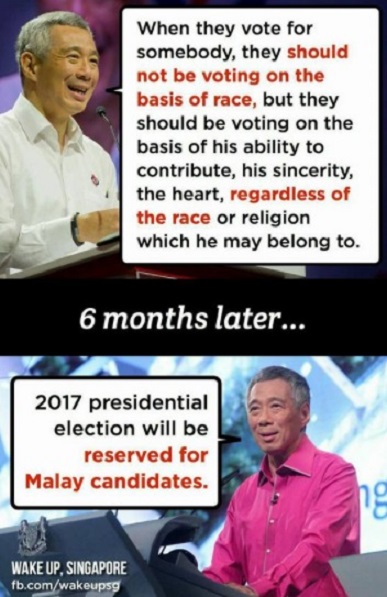
    Don’t talk about their Malay-ness, discuss their capabilities instead. This is generally what many PAP supporters are saying. They remind us not to focus on the race.

    Excuse me! In the first place, who made this election about race?

    Malay Singaporeans didn’t ask for this election to be reserved for the community. We were capable of looking beyond race to vote someone capable and independent like Dr Tan Cheng Bock as President if he had been allowed to contest an open PE.

    The Malay community didn’t say we are not going to participate in any Presidential elections because no Malays were contesting.

    It was the PAP who made this election about race. So, naturally, we will discuss how Malay those aspiring Presidents are. If the person is not adequately Malay to the community, then having that candidate as our President does not make us proud and will continue to perpetuate the perception that the community is being excluded from the presidency.

    Don’t make our community the scapegoat.


    Rilek1Corner

  • Hanifa Kahar, Orang Bukan Cina Pertama Jadi Presiden Kelab Pidato Mandarin

    Hanifa Kahar, Orang Bukan Cina Pertama Jadi Presiden Kelab Pidato Mandarin

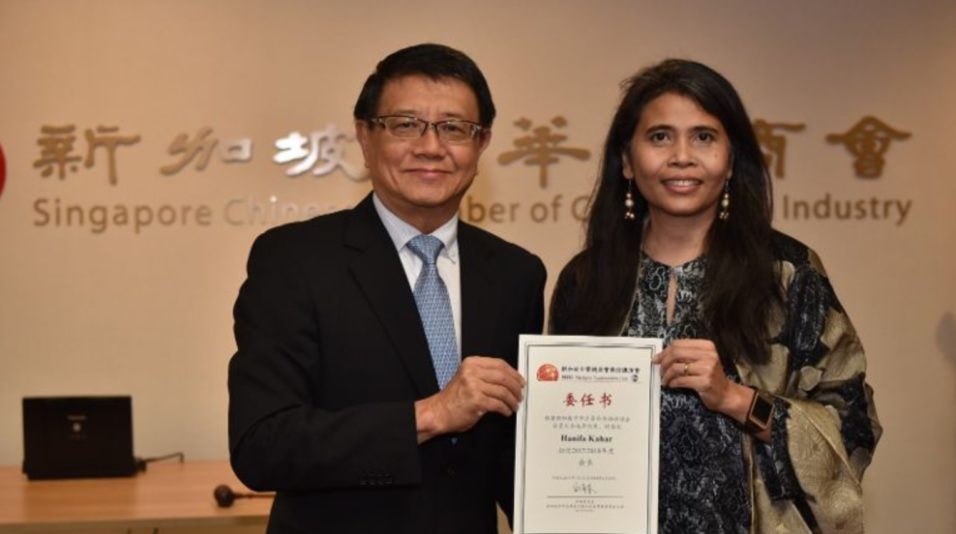
    Buat pertama kalinya seorang anak Melayu/Islam dilantik sebagai Presiden bagi Kelab Pidato (Toastmaster) Mandarin, Dewan Perniagaan dan Perusahaan Cina Singapura (SCCCI).

    Walaupun bukan berbangsa Cina, Cik Hanifa Kahar, 52 tahun, diberi kepercayaan untuk menerajui kelab pidato tersebut oleh lembaga SCCCI, sekaligus mencipta sejarah.

    Cik Hanifa memberitahu BERITAMediacorp beliau mula menyertai kelab pidato Mandarin itu sebagai anggotanya dan menyampaikan pidato pertama dalam bahasa Mandarin pada tahun 2015. Beliau juga pernah dilantik menyandang jawatan sebagai Naib Presiden Keanggotaan Kelab.

    SESINGKAT 2 TAHUN SAHAJA JADI ANGGOTA, KEMUDIAN DILANTIK JADI PRESIDEN

    Ini bermakna beliau dilantik sebagai presiden kelab tersebut dalam tempoh hampir dua tahun. Ternyata, kecekapan dan kewibawaan Cik Hanifa meyakinkan pihak lembaga SCCCI untuk memilihnya.

    “Semasa saya menjadi Naib Presiden Keanggotaan, Presiden dan dua lagi Naib Presiden Pendidikan ketika itu berasal dari China. Jadi, semua urusan baik menerusi panggilan telefon mahupun Whatsapp perlu menggunakan bahasa Mandarin, jika tidak saya tidak dapat menjalankan tugasan saya,” kongsi Cik Hanifa.

    “Oleh itu, saya belajar bahasa Mandarin di kelab pidato itu, jalankan tugasan, tulis teks pidato dan dapatkan bantuan mereka untuk menyuntingnya. Proses-proses tersebut secara tidak langsung membentuk diri saya yang sekarang. Apabila tiba masa untuk melantik seorang Presiden baru, agak jelas, saya menjadi pilihan mereka,” cerita Cik Hanifa kepada BERITAMediacorp.

    Menurut Cik Hanifa, peranan beliau sebagai presiden kelab pidato tersebut adalah untuk menaikkan profil kelab dan memancing minat orang ramai supaya datang ke mesyuarat-mesyuarat mereka untuk lebih memahami tentang kelab itu dan juga SCCCI sendiri.

    Meskipun Kelab Pidato Mandarin SCCI adalah kelab yang “inklusif”, Cik Hanifa berkata setakat ini anggotanya terdiri daripada masyarakat Cina dan seorang rakyat Jepun.

    SIAPA HANIFA KAHAR?

    Cik Hanifa adalah pengasas laman Childhoodspeech – di mana beliau berkongsi pengalamannya mendidik anak beliau menjadi seorang yang boleh bertutur melebihi satu bahasa dan berharap ia dapat memberikan inspirasi kepada para ibu bapa lain.

    Selain itu, Cik Hanifa juga sering memberikan ceramah-ceramah motivasi dan perjalanan hidupnya membuatkan rakan-rakan serta masyarakat lebih menghargai keindahan bahasa apabila ia berjaya dikuasai.

    Beliau juga merupakan penulis buku bertajuk ‘Parenting Inspired! Follow The Path Where The Child Loves To Grow’, di mana beliau bercerita tentang pengalaman sendiri yang mendapat inspirasi daripada anak tunggalnya, sehingga beliau berjaya membangunkan Childhoodspeech pada tahun 2008.

    “Saya mahu memahami lebih lanjut bagaimana saya sendiri bermula bertutur dalam beberapa bahasa sejak kecil lagi dan bagaimana saya boleh mendidik anak perempuan saya. Saya mahu beliau juga belajar bahasa Mandarin. Oleh itu saya berkongsi di laman tersebut,” ujar ibu kepada seorang anak remaja berusia 16 tahun ini.

    IBU BAPA JAWA-PALEMBANG, TAPI GALAK ANAK BELAJAR MANDARIN

    Bahasa Mandarin sebenarnya bukanlah bahasa yang begitu asing dan baru dipelajari Cik Hanifa.

    Menurut Cik Hanifa, ibu bapanya yang berketurunan Jawa-Palembang memastikan beliau, abang serta kakaknya mempelajari bahasa Mandarin meskipun mereka sendiri tidak boleh bertutur dalam bahasa itu.

    “Semasa kecil, saya sudahpun mempelajari bahasa Mandarin di sekolah. Kami tinggal di Beach Road pada waktu itu dan bapa saya menghantar kami adik-beradik belajar bahasa Mandarin. Bapa saya seorang yang berpandangan jauh dan mengetahui manfaat bahasa Mandarin ke atas pendidikan dan masa depan kami,” kongsi Cik Hanifa, anak bongsu daripada tiga adik beradik – satu lelaki dan dua perempuan.

    Cik Hanifa bersama ibunya. (Gambar: Shamsuddin Kahar/Facebook)

    Cik Hanifa juga boleh bertutur dalam empat bahasa lain, termasuk 1 bahasa dialek – Melayu, Inggeris, bahasa Indonesia dan juga Hokkien.

    BERBUAL DIALEK HOKKIEN DENGAN ADIK-BERADIK

    Ini satu lagi fakta yang boleh membuat anda terpegun. Cik Hanifa dan adik-beradiknya hanya berbual dalam dialek Hokkien sejak kecil sehingga sekarang!

    Walaupun sudah biasa dengan bahasa Mandarin selama hampir 50 tahun, Cik Hanifa berkata beliau perlu terus mengamalkannya dalam sekitaran yang dapat membantu memantapkan penguasaan bahasa itu.

    Bagi Cik Hanifa, itulah cara paling baik supaya beliau dapat membantu dan mengajarkan bahasa Mandarin kepada anaknya dengan cara yang lebih berkesan.

    “Saya menyedari yang saya perlu bertutur dalam bahasa Mandarin dengan anak saya, jadi saya terus mempelajari bahasa itu supaya saya dapat mengajar beliau. Saya mahu memberi inspirasi kepada anak saya dan diri sendiri untuk mendalaminya,” Cik Hanifa memberitahu BERITAMediacorp.

    Cik Hanifa menambah: “Saya juga yakin dengan melibatkan diri dengan kelab pidato ini, saya harap saya boleh mendapat inspirasi untuk terus mempelajarinya supaya pendidikan dan asas yang sudah ada tidak sia-sia.”


    Source: http://berita.mediacorp.sg

  • Policeman Misused Police Database To Check On Girlfriend

    Policeman Misused Police Database To Check On Girlfriend

    A policeman has got into trouble with the Law in Singapore for misusing Police database to check on his girlfriend. Hafidz Hamzah, who have since been suspended from duties since December last year, was a sergeant at the Central Police Division, when he used his own account or a colleague’s account to conduct multiple illegal searches on his girlfriend on the police computer system.

    He was trying to check if his girlfriend had a criminal record or was involved in criminal activities. Hafidz had befriended Ms Maizurah Abdullah, then 25, in August 2015, and started a relationship with her. Between August and October that year, Hafidz accessed the Criminal Records Office (Cross) and the Frontline Officers’ Computerised System (Focus) portals in Police Cantonment Complex and using Ms Maizurah’s name, mobile number and identity card number, conducted a search for her records. Ms Maizurah did not give him her IC number. The portals, which come under the Home Affairs Ministry, can only be used for official purposes.

    He had used his own account, or that of his colleague to abuse the system He had tricked his colleague into giving his login details after Hafidz’ account was suspended pending his transfer to Rochor Neighbourhood Police Centre. In a separate case, it was also reported that Hafidz came to know a woman who was staying in a Geylang hotel in March last year, and they began a relationship. During a heated argument on Feb 27 this year, Hafidz hit her. He took her mobile phone and threatened to post her nude photos on the Internet. The prosecutor said the victim herself had sent nude photos of herself to him, and she was afraid he would carry out his threat and tarnish her reputation.

    Hafidz has been sentenced to one months and eight weeks in jail for the offences.


    Source: www.allsingaporestuff.com

  • Doubts About Presidential Hopefuls Not Being Malay Enough Are Off Track

    Doubts About Presidential Hopefuls Not Being Malay Enough Are Off Track

    Singapore’s Malay community has long held an expansive view of race, a stand that reflects its confidence.

    The coming presidential election is the first to be reserved for candidates from the Malay community, following changes to the Constitution to ensure the highest office of the land reflects Singapore’s multiracial society.

    Yet there has been some contention on social media over the “Malayness” of would-be candidates, with some asking whether any of the aspirants who have stepped up or are mulling over a bid is “truly Malay”.

    It is as if the very nature of this year’s contest has misdirected energies towards securing the “most authentic” candidate instead of a Malay candidate who would make the best head of state.

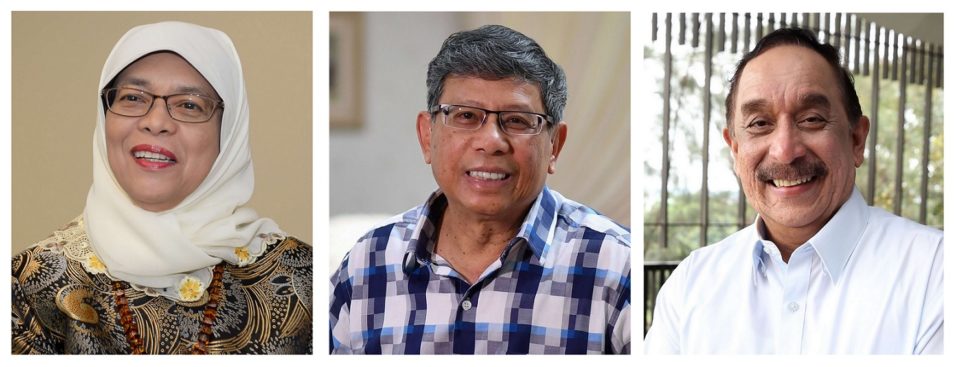
    Ironically, all three hopefuls – businessmen Salleh Marican and Farid Khan, and Speaker of Parliament Halimah Yacob – have been acknowledged by the community, peers and the media as prominent Malay individuals.

    They speak Malay, follow Malay customs and are, to some extent, role models for the community in business and public service. Why, then, has the question of whether they are “pure Malays” or “Malay enough” cropped up when it comes to the presidential election?

    Media attention on them may have played a part. Businessman Mohamed Salleh Marican, whose father is Indian, has been criticised for not being fluent in Malay, after his fumbling during a Facebook Live interview conducted outside the Elections Department where he had gone to collect the forms for the elected presidency contest.

    Businessman Mohamed Salleh Marican has been criticised for not being fluent in Malay, after his fumbling during a Facebook Live interview. ST FILE PHOTO

    Marine company chief Farid Khan has been panned for stating openly his Pakistani ethnicity, while declaring that he has always seen himself as a member of the Malay community as he speaks the language, practises the customs and gives back to it.

    Madam Halimah too has been pressed on the issue – past media reports noted her father was Indian – but she considers herself as very much a member of the Malay community, and has contested four general elections as a Malay candidate in a GRC or Group Representation Constituency.

    A number of community leaders and observers say the critics’ obsession with authenticity and purity flies in the face of tradition – it neglects the open, inclusive view of race that many Malays have adopted in welcoming new members to the community, which includes a wide range of admixtures and ethnicities.

    Mr Farid Khan has been panned for stating openly his Pakistani ethnicity, while declaring that he sees himself as a member of the Malay community. ST FILE PHOTO

    What is a Malay?

    Official records since 1824 have classified inhabitants of Singapore into four broad races – Malays, Chinese, Indians and Others. While Chinese and Indians have generally been understood to refer to people with forebears from China and India and migrants from the archipelago who trace their roots to these countries, Malay has included a variety of ethnicities regarded as indigenous to this region: Acehnese, Baweanese, Bugis and Javanese, among others.

    Yet the sense of affinity to a Malay identity was not strong up till the 1930s, when the burgeoning Malay-language press helped promote a nationalism that sought to improve the lot of the Malay community.

    The formation of the United Malays National Organisation in 1946 in Johor Baru – just across the Causeway – focused the minds of many Malays on issues of identity at a time of rapid change. For the first time, Malay would be clearly defined. Because the vast majority of Malays were Muslims and Islam had become closely associated with the Malay identity, the official definition of Malay in the Federation linked race with religion.

    Past media reports on Madam Halimah noted that her father was Indian – but she considers herself very much a member of the Malay community.   BH FILE PHOTO

    Article 160 of the Malaysian Constitution thus defined “Malay” as a person who professes the religion of Islam, habitually speaks the Malay language, conforms to Malay custom – and was before Merdeka Day born in the Federation or in Singapore, or one of whose parents was born in the Federation or in Singapore or living in both places; or is the issue of such a person.

    Article 152 of the Singapore Constitution also made clear the Government’s responsibility to constantly care for the interests of minorities, and referred to the special position of the Malays, “who are the indigenous people of Singapore”, and whose interests and language it had a duty to safeguard and support.

    After Separation, a Constitutional Commission headed by Chief Justice Wee Chong Jin discussed the issue of safeguards for minorities as well as, among others, the definition of Malay. It rejected calls to expand the definition to non-Malay Muslims and have Islam as a marker of Malayness. Instead, it chose not to explicitly define the races, languages or religious minorities in Singapore, in the hopes of a “united, multiracial multicultural society”.

    GRC debates

    However, concern over ensuring enough Malays will be represented in key institutions – Parliament, and more recently, the Presidency – meant there was a need to define who is a Malay in Singapore’s context.

    Thus when the concept of Team MPs – later GRCs – was discussed in the late 1980s, it was inevitable that the debate on what is a Malay should resurface.

    The Government said the idea behind GRCs was to ensure Parliament remained multiracial and to prevent the spectre of a House that might one day be without minorities.

    A Select Committee held hearings involving a wide range of representatives in 1987 and 1988, and many Malay leaders felt strongly about having Islam included in the definition of a Malay.

    The committee took the view that as Singapore is a secular state, it would not be appropriate for the state to spell out that a Malay must also be Muslim to contest in a GRC.

    There was one other issue: a good number of Malays had Indian, Arab or Other on their ICs due to their ethnicity or parentage, even though they had long associated with the Malay community.

    The Select Committee recognised this point. It also accepted a submission that sociologically, self-definition is the only valid way to define an ethnic group. “A person belonging to the Malay community must think of himself as Malay, and must be acceptable to the Malay community,” it said. “Therefore the legislation should not lay down prescriptive criteria as to who does or does not belong to the Malay community, but should define a mechanism to let the community decide for itself.”

    This mechanism has taken the form of a community committee, which the Select Committee report said would be “a safeguard against an unacceptable candidate being wrongly certified as a member of the Malay community”.

    At the same time, the Parliamentary Elections Act – and the latest amendments to Article 19B of the Constitution – define a person belonging to the Malay community as “any person, whether of the Malay race or otherwise, who considers himself to be a member of the Malay community and who is generally accepted as a member of the Malay community by that community”.

    A similar approach has been adopted for aspiring candidates for the presidential election in the latest round of changes to the law.

    Associate Professor Eugene Tan of the Singapore Management University School of Law notes the criteria for running as a minority in a GRC is the same as that for a presidential election.

    And during the debate on changes to the Presidential Elections Act on how race is defined earlier this year, MPs called for a broad, inclusive approach to be adopted.

    Singapore’s Malay community has long held an expansive view of race – and been open to newcomers and others keen to identify with it.

    It is a signal of confidence and courage – and nothing could be further from that than questioning whether someone who identifies as Malay and is accepted as Malay is “pure Malay” or “Malay enough”.

    So long as a person identifies as Malay and is generally accepted as such by the community, his Malayness should not be questioned.


    Source: http://www.straitstimes.com

  • Accident @ Junction Of Woodlands Centre Road; Appealing For Any Witness Or Video Recordings

    Accident @ Junction Of Woodlands Centre Road; Appealing For Any Witness Or Video Recordings

    Hi FBians,

    Please help to share this post. Your help is greatly appreciated.

    I am looking for witnesses/video recordings of an accident involving an FZ16 plate FBJ2974A and a Malaysian Lorry on the morning of 18th July 2017 between 5.45am-6.15am at the junction of Woodlands Centre Road before An-Nur Mosque.

    The rider, my uncle, is currently warded in KTPH with internal and external injuries.

    Witnesses/owners of video recordings can PM me or contact Shahrul @ 92316734.

    Thank you!


    Source: Faiz Dawood

deneme bonusu