Tag: Singapore

  • Why Are There So Many Foreign Freelance Prostitutes In Singapore?

    Why Are There So Many Foreign Freelance Prostitutes In Singapore?

    I would like to remain anonymous on this submission. This is merely to highlight and I am not a victim of the issue/matter. I have also reported what I know about this issue to the police based on the fact that it is a criminal offence – illegal prostitution. I hope TRS will put this up to not only question why such people are imported into the country but also to warn people out there.

    I came across this chat on a 22 year old Chinese National soliciting for prostitution jobs via social media chat app, WeChat, in Singapore. She offers freelance sex, with or without condom. She accepts payment via her qq account which can be paid via AXS. (Why is this even allowed on our AXS?!?)

    As all of you should know by now, this is obviously illegal as legal prostitution takes place in Geylang via a registered prostitution house. Legal prostitutes are issued with the yellow pass and undergo HIV tests monthly.

    This is also a threat to social well-being. What if she gets pregnant and blackmails the man since all of them are eager to get citizenship/pr over here. It is going to break up families. Most of you will be saying that too bad the man who did it chose it and should face the consequences. However, think again, why should we even allow a chance for such things to happen?

    As we all should also know by now, WeChat have already caused distress among women here in Singapore but yet no actions can be taken or be taken. If we can have a censorship board that censors many parts of the movie, media that is controlled, does the media authority not have the right to shut down this app here in Singapore?

    However, what I am truly perturbed by is why is the Singapore government importing such people into the country? She has only been in the country for 6 months and this implies that she is one of the newer batches granted a work pass here in Singapore. We are importing vices into our country!

    LY

    TRS Contributor

    Source: www.therealsingapore.com

  • Gongsi Raya: How Non-Chinese In SIngapore Celebrate Chinese New Year

    Gongsi Raya: How Non-Chinese In SIngapore Celebrate Chinese New Year

    With almost every shop draped in red and gold screaming dong dong jiang at maximum volume, I think it’s safe to say that a big chunk of our population is onto Chinese New Year fever.  Chinese New Year on our little red dot is almost like a nationwide holiday. But amidst all the dusting and eating, have you ever wondered our non-Chinese friends are up to during the long holidays (this year’s especially)? There is apparently, more to the Chinese New Year for our non-Chinese friends than just mindless lo hei meals and visits to their friends’ house for pineapple tarts and bak kwa.

    How could anyone not get into the Chinese New Year spirit with shops draped in red and gold?

    Malay Mr. Muhammad Aaron Ridzuwan bin Roslan has been paying New Year visits to his Chinese friends since the age of 13. He commented on how Chinese New Year “is like Hari Raya” where he’d take the chance to catch up with his friends over steamboat meals. When asked if the meal has to be Halal, he graciously answered, “It’s the Chinese’s occasion, so as long as there is no pork, it’s fine with me.” It was particularly meaningful when Hari Raya and Chinese New Year last fell on the same month from 1996-1998. The term ‘Gongsi Raya’ was coined to symbolized the double celebrations within the two ethnic communities. Both Muslims and the Chinese had kept their house open for visitations that promoted the respect and tolerance for our well-known cultural diversity.

    Some of our non-Chinese friends don’t only partake in lo hei, they actually think of it as a fun Chinese tradition.

    But it turns out not all of our non-Chinese friends are actively partaking in house visits. For Indian student Ms. Shreeya Valentina Rai, instead of lo hei-ing with her friends, she will be spending the holiday bartending at Tippling Club. “Hey, it’s double pay after all,” laughs the 23-year-old NTU student. “But on the rare occasion that our family gets invited for a Chinese New Year meal, I participate in the lo hei; it’s quite fun actually.”

    Instead of working their holidays away, some would on the other hand, take the chance to organize a get-together with their family. Working aside, Ms. Shreeya does also take the holidays to spend time with her family. “It’s a public holiday so everyone is free,” she quips. Ms. Shahidah Sayadi, a Malay Muslim who works at the Ministry of Law, agrees.  “We’d mostly sit at home and watch the holiday special shows! But sometimes we have family gatherings and we’ll arrange for potluck dinners.” For our Indian friend Mr. Rahul Rajasabhal, a 25-year-old NUS undergraduate, spending quality time with his family during the holidays is not just limited to lounging by the sofa, where he chooses to get more into the Chinese New Year spirit. “I’d usually help my mum and grandma bake pineapple tarts because my sister and I love to eat them! I really look forward to the food and I’ll use the time to just relax and catch up on work. I’d also, somehow, use the holidays to tidy up my room because it’s nice to have a fresh start even though I don’t really celebrate it.”

    Things are of course, a little different for the mixed ethnicity couples. Fashion Blogger Andrea Chong says that Imran Rahim, her Muslim boyfriend, will accompany her to house-visits on the first day of Chinese New Year. Besides treating it like a “normal family gathering”, Malay Muslim Imran also pays his respect to the Cantonese elders by greeting them “gung hei fat choi”! Besides house visiting, some mixed ethnicity couples will also travel to the hometown of his/her significant other to celebrate the New Year with the other side of the family. The act of travelling overseas to get into the New Year atmosphere can also be seen in the Chinese as well! I mean, it is after all, a long weekend with four days of holidays.

    For those who are on an exchange programme with our local universities, they got into the Chinese New Year spirit by hanging out at the gaily-lit Chinatown. Mikael Gross, a Swiss exchange student who has returned to Switzerland, recounted how he spent the holiday with a group of other students on exchange. “To celebrate Chinese New Year in Singapore was kind of ‘special’ because Singapore is a city with a huge Chinese community… feels kind of authentic”. After a dinner at “one of those tourist trap restaurants”, they joined the annual Chinese New Year parade where he enjoyed the cheerful crowd. “The truth is Chinese New Year wasn’t as exciting as they say on the internet.  But we enjoyed it nevertheless, like everything on exchange.”

    So whilst you are busy indulging in the Chinese New Year festivities, don’t forget about your non-Chinese friends and have them over for a short get-together for two. Have them also share what it’s like during their New Year celebrations and perhaps join them for a more complete food and culture exchange experience.


    Source:www.makansutra.com

  • Maliki Osman: Malay Servicemen Have Progressed Significantly In SAF

    Maliki Osman: Malay Servicemen Have Progressed Significantly In SAF

    Minister of State for Defence Mohamad Maliki Osman has weighed in on the issue of Malays in the Singapore Armed Forces, saying Malay servicemen have made significant progress.

    “Our Malay servicemen have made significant progress in all the services in the SAF based on their capabilities and merits, and I am confident many more will do so in the future,” Dr Maliki said, in comments to Malay language daily Berita Harian published today.

    His comments came as Defence Minister Ng Eng Hen said at a forum on Monday night that Malays now serve as sailors on board navy ships, and that the SAF does not discriminate against anyone and promotes men based on their ability.

    Dr Ng had been asked why Malays were previously excluded from the navy.

    The issue of Malays not being deployed in certain Singapore Armed Forces units and under-represented among the SAF’s top ranks has been an issue in the community.

    Yesterday, Dr Maliki – the first Malay political office-holder in the Defence Ministry – said the Malay community continues to make positive contributions to Singapore, including in the area of defence and security.

    “I have met many Malay servicemen in every service and formation in the SAF, including as fighter pilots, commandos, and naval combat systems operators,” he said.

    “Whether they are regulars, NSFs or NSmen, all of them serve with pride.

    Many have also contributed to the SAF’s overseas missions in Afghanistan and Timor Leste,” he added.

    Dr Maliki also noted that at the recent SAF50@Vivo exhibition to celebrate Singapore’s jubilee, he met several Malay servicemen serving in the navy.

    He said: “Together with their non-Malay colleagues, they play an important role in keeping our sea and shore safe, round the clock.”


    Source: http://news.asiaone.com

  • Goh Meng Seng: Alternative Media Sites Must Unite To Balance MSM

    Goh Meng Seng: Alternative Media Sites Must Unite To Balance MSM

    According to a survey done on the comparative strength and influence of Main Stream Media (MSM) vs New Media (NM which includes blogs, TRS, TRE, TOC and other key sites), the MSM influence in terms of readership has dropped drastically and the readership of NM has shot up with the popular usage of Smart Phones which allow people to read articles from NM much easier than MSM.

    The influence of NM and MSM has attained equal status. When the survey asks their interviewees where they get their information and news from, NM and MSM have equal share. This situation poses a tremendous challenge to PAP’s continue dominance of political power. Thus, it is of no surprise that the FIXING of New Media will pick up in momentum as the next General Elections is ticking nearer.

    I sincerely hope that all NM like TRE, TRS and TOC will unite and defend this piece of land of Freedom for all Singaporeans. Without the balancing influence of NM, it will be almost impossible for Singapore to advance the dream of building a more democratic system. Hold on there, TRS! Hold on there, TOC!

    Source: Goh Meng Seng

  • SingFirst’s $6 Billion Social Safety Net Will Not Bankrupt Singapore

    SingFirst’s $6 Billion Social Safety Net Will Not Bankrupt Singapore

    SingFirst’s social safety net package is not prepared overnight but is the outcome of several years of research and discussion. It started with the S$60 billion economic plan outlined in the 2011 essay “Creating Jobs and Enterprise in a New Singapore economy – Ideas for Change” by Tan Jee Say, our Secretary-General.

    Our proposal has now been updated following discussions in the last few years with international experts in Finland, Norway, Berlin, Oxford and Harvard. It has also been discussed and debated internally over several months. We took into consideration what the Minister of Finance told Parliament about the use of returns on investment of Singapore’s national assets.

    To help our readers understand our approach, we have decided to use simple illustrations and graphics, rather than post a long article. We believe these simple messages will help to communicate our proposal more effectively and clearly.

    1. The ISSUE – Rising Social Inequality

    Economic growth in Singapore has created a large gap between the rich and poor, leaving a big segment of society behind. Inflation and technology has widened the income gap. Singaporeans have also become the most stressed, unhappiest and least emotional people in the world.

    According to an article in The Economist on 7 March 2014, Singapore is presently the most expensive city in the world as housing, education, healthcare and transport costs are rising day by day.

    ” It has been a long time coming, but Singapore, a tiny city-state of about 5m people, has finally made it: to being the most expensive city in the world. According to the Economist Intelligence Unit (EIU), a sister organisation of The Economist, after a decade of steadily climbing up the table from 18th place, Singapore now occupies the position usually reserved for the Japanese capital, Tokyo. Paris is now the second-most expensive, ahead of Oslo in Norway”.

    – The Economist (article here)

    Singapore has the biggest income gap among developed countries, as indicated by the Gini co-efficient, an international standard of measure of income inequality. The higher the Gini, the greater the inequality.
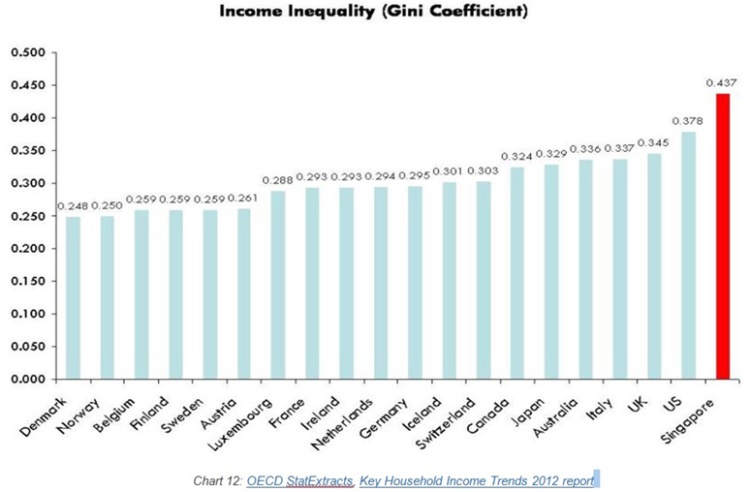
    gini1

    Singapore’s economic inequality is highest because its public spending as a percentage of GDP is the lowest among the developed countries.

    gini2

    2. Our PROPOSAL – Social Spending and Social Investment

    SingFirst wants to increase social spending and reduce social inequalities with

    a. Social Safety Net   (S$6 billion per annum)

    b. Social Investment  (S$8 billion per annum)

    This will be funded by the returns on our investment of national assets

    • GIC, MAS, Temasek Holdings etc generate huge investment returns
    • These huge investment returns are more than SingFirst’s proposed social spending amount
    • Principal sum (capital) of national assets WILL NOT be touched.

    2.1 The Government’s existing framework on NIR (Net Investment Return)

    • Returns on investments (R)     : from GIC & MAS
    • Investment income (I)              : from Temasek Holdings
    • R + I = Net Investment Return (NIR)
    • average annual NIR is about S$16 billion

    2.2  The Government’s existing framework on NIRC (Net Investment Return Contribution)

    • ½ R + ½ I = Net Investment Return Contribution (NIRC)
    • In last few years, NIRC has been estimated as S$8 billion
    • Balance ( NIR minus NIRC) = S$8 billion
    • Currently, this balance is RE-INVESTED into GIC & Temasek Holdings

    nirc 2

    To emphasize the above illustration, investment return contribution from GIC and MAS assets is STABLE, is based on expected long term real rate of return and is NOT AFFECTED by year to year fluctuations in actual returns (similar formula used by Norway and Yale University).

    That means the total NIR of S$16 billion is a stable amount year after year.

    In last few years (see illustration below), annual NIR is estimated at S$16 billion. NIRC is estimated at S$8 billion. So the balance for re-investment is S$8 billion on the average.

    nirc

    In the past 4 years, NIRC hovered around S$8 billion per year. So SingFirst proposes to use the NIRC for funding our S$6 billion social safety net package.

    As we are only using S$6 billion per year (75% of NIRC), this is SUSTAINABLE.

    There is a healthy surplus of S$2 billion per year (25% of NIRC) that is not used.

    3. PROPOSAL 1 – Social Spending

    The table below illustrates our social spending to defray the current high cost of living for all Singaporeans.

    safety net

    3.1 Monthly Benefits for Singaporeans

    A simple illustration below of how our social spending will benefit a family with 2 elderly parents, 2 parents and 2 young children on the monthly basis.

    family

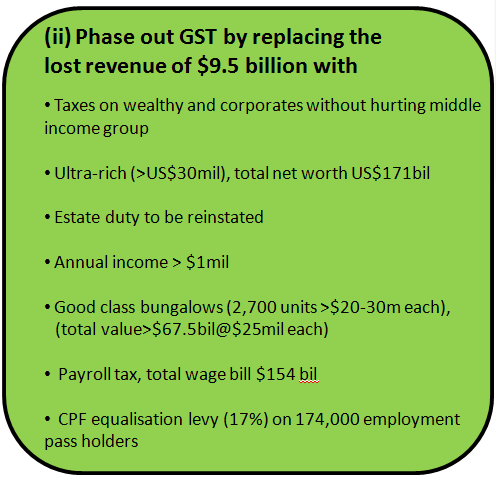
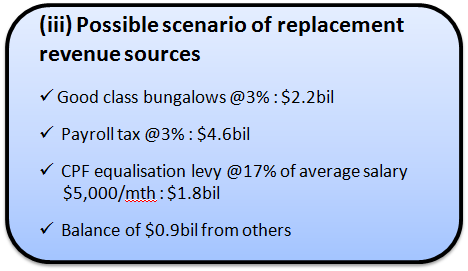
    3.2 Tax Restructuring – to phase out GST

    1

    2

    3

    4

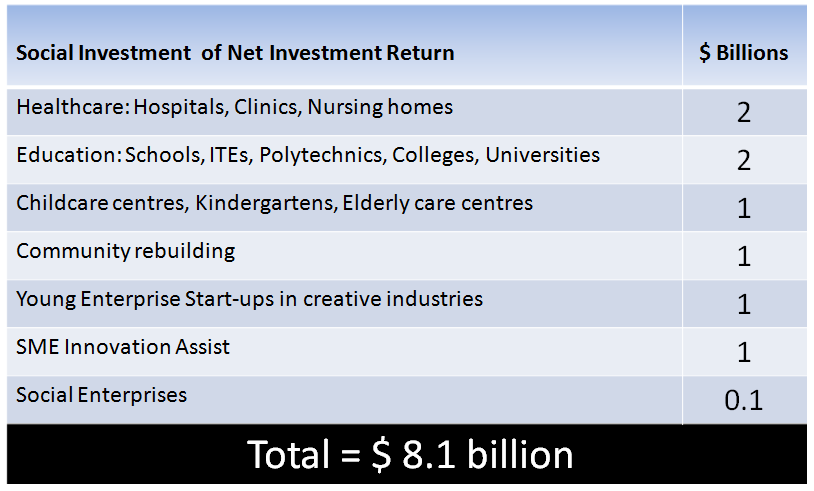
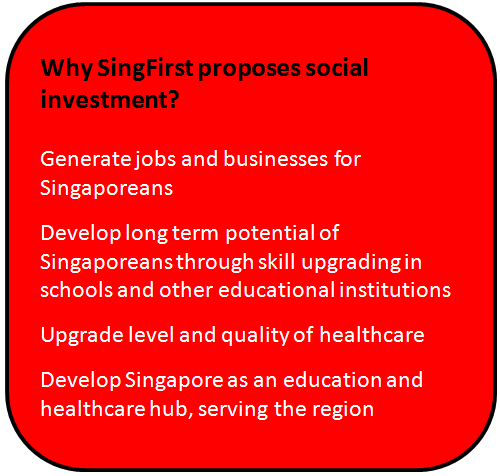
     4. PROPOSAL 2 – Social Investment

    Presently, the Ministry of Finance has re-invested approximately half of the net investment returns back into Temasek and GIC which are then used for Portfolio Investment. SingFirst proposes to broaden re-investment to include social investment (eg hospitals, schools). NOT only back into Temasek or GIC.
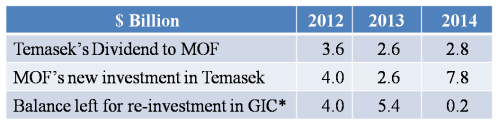
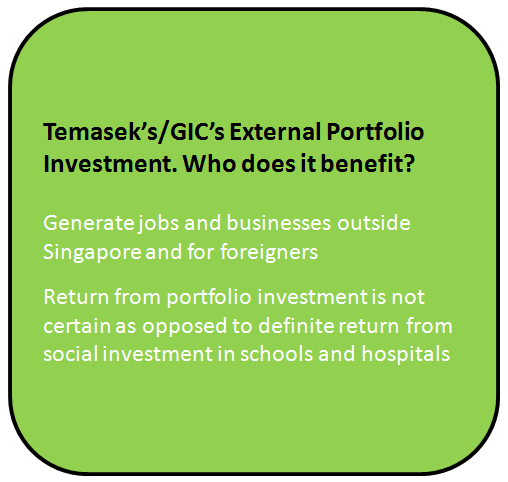
     

    5

    6

    7

     4.1 Our Proposed Initiatives

    9


    4.2 Reserves are not RAIDED by our proposals

    4.3  Pro-growth Social Package

    Our package is not wasteful consumption but will give a strong boost to the local domestic economy. We will create a strong, stable and diversified economy that benefit local businessmen and families.

    • Social safety net                          $ 6 billion
    • Social investment                        $ 8 billion
    • Healthcare (from defence)         $ 5 billion     (over 5 years)
    • Consumer (from GST)                $ 9.5 billion  (over 5 years)
    • Re-investment per year over 5 years   $14 – 28.5 billion

    4.3  Fair Society, Strong Families and Esteemed People

    With this package, SingFirst will deliver
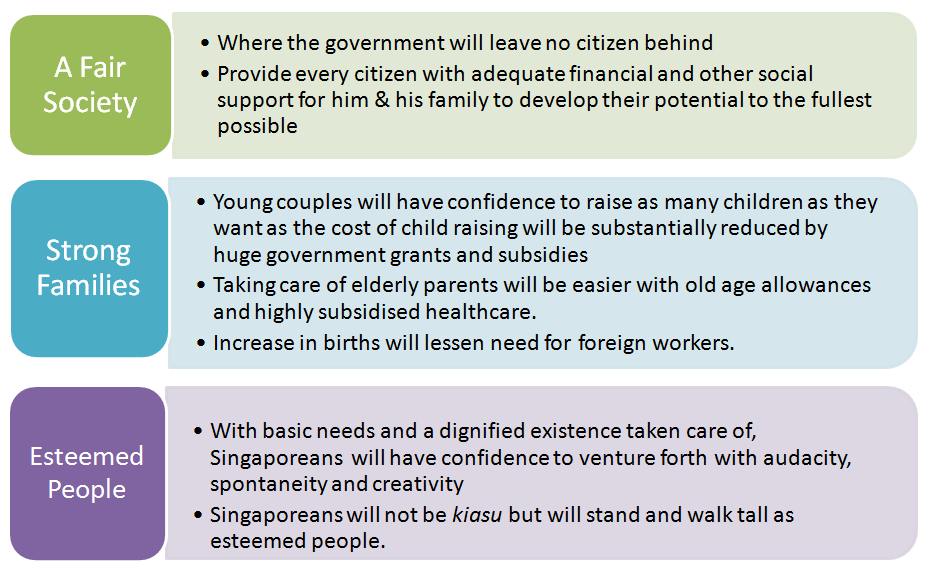
    11

    In Conclusion: Our difference from the PAP

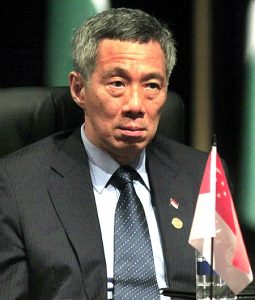
    At the Forbes Global CEO Conference on 28 October 2014, Prime Minister Lee Hsien Loong said that he wanted Singaporeans to always be paranoid about someone else stealing their lunch.
    05slide1

    “Looking forward beyond the 50th anniversary, I think that is what Singapore needs to do – to be aware, to be paranoid so you always know that somebody can take your lunch away…”

    While PM Lee wants Singaporeans to be paranoid (“kiasu”), SingFirst prefers to put esteem into Singaporeans. Do you want to feel inferior and be “kiasu” or do you want to stand tall and be esteemed?

    You have a choice. Choose wisely.

    Stand tall. Vote SingFirst.

    SF_LOGO


    Source: http://singfirst.org


deneme bonusu