Tag: sunnah

  • Nazem Suki: Middle East Political Turmoil – No Military Intervention Needed, Islam Remains Uniting Force

    Nazem Suki: Middle East Political Turmoil – No Military Intervention Needed, Islam Remains Uniting Force

    Many are asking how we, the Muslims in Singapore & in this region, will respond to the current political crisis in the Middle East.

    I put forward these responds;

    1) We do not take sides between one brother state to the other. We love all of them in the spirit of Islamic brotherhood.
    2) We urge all parties to reconcile political differences diplomatically in brotherhood.
    3) We trust the basis of reconciliation is recorded & enshrined in the holy Quran & the Sunnah.
    4) We believe the interest of the Ummah precedes all political interest.
    5) We will not be pressured or forced to fix alliance with one state from the other.
    6) We do not subscribed to military intervention.
    7) Islam remains a uniting force of the Ummah of diverse opinions & political creeds.

    Wallahua’lam


    Source: Mohamed Nazem Suki

  • Khairudin Aljunied: Do Not Fight Evil With Evil, Fight Evil With Good

    Khairudin Aljunied: Do Not Fight Evil With Evil, Fight Evil With Good

    The Imam and the Silly Convert

    Once, there was a convert who was unhappy with what he heard from an Imam. So he went up to the Imam angrily and said:

    Convert: Can you stop saying things that will hurt people?

    Imam: I am sorry brother, but what did I say that might hurt anyone?

    Convert: You said those things and you know it. It’s offensive! I’ve just shared a video of what you said.

    Imam: I was speaking to Muslims in this small congregation but you, my brother, shared it to the world. Now everyone is offended. So was I wrong or you?

    Convert: [already feeling stupid] But you said things that are offensive to others! I must expose you.

    Imam: [gently putting his hand on the convert] Brother, I think you should stop being a Muslim for now.

    Convert: What!!!

    Imam: I read verses from the Quran and these verses have been read on the pulpit every Friday and during Eids since the time of the Prophet Muhammad till this day for over a thousand years. Muslims and non-Muslims lived peacefully even when these verses were read. Things change when you came.

    #sillyconvertmakestheloudestnoise #shareatwill

    The Imam and the Wised Up Convert Reloaded

    And so the silly convert became even more angry by the Imam’s light-hearted comments. He reported the Imam to the authorities. The authorities checked and researched and found that what the Imam read was from the Quran. That all imams in the country read those verses and that imams all over the world do it too. So he decided to take matters in his hands and confront the imam again:

    Imam: Assalamualaikum brother, you are back here again. So nice to see you.

    Convert: Waalaikum Salam. I am here to tell you that I am sorry for what I did.

    Imam: There is no need to apologize. We all commit errors. But I want you to do one thing for me.

    Convert: Yes, I will.

    Imam: Read and study the Quran daily. And learn the Sunnah as found in the books of Hadith. Follow the path of the great Imams and Ulama. Enjoin what is good, defend what is right and spread the message of peace among all mankind. Always remember and memorize the words of our beloved Prophet:

    “Fear of Allah wherever you may be. Follow up an evil deed with a good one, so that the good one will wipe out the evil deed. And behave towards the people with a good behaviour.” (al-Tirmidhi)

    Convert: May Allah assist me and us in this!

    Imam: And may all of us enter into Islam wholeheartedly!


    Source: Khairudin Aljunied


  • What Is Islamic Law? — Jahaberdeen Mohamed Yunoos

    What Is Islamic Law? — Jahaberdeen Mohamed Yunoos

    It may sound ironical to ask the question what is “Islamic law” in the 21st century when it is generally thought that the body of what constitutes Islamic law has already been crystallised and settled.

    If indeed it has crystallised into a recognisable and unchangeable body, then it is logical that there would only be one universal Islamic law. However, an observation of Islamic law between various countries and even between various states in Malaysia would evidence the fact that the laws are not uniform.

    It would seem that what is Islamic law is still developing, in a state of flux and diverse. Shariah, on the other hand is a separate concept altogether.

    Every Muslim would agree that Islam is a simple religion. The pillars of Islam are said to be only five that is, declaration of faith or the syahadah, the daily five times prayer, fasting in the month of Ramadan, payment of the zakat and the performance of the pilgrimage by those who can afford it.

    However, Islam is seen not only as a religion in the typical sense but also as way of life that is complete and encompasses every aspect of our life.

    In other words, Muslims believe and accept that Islam provides the necessary guidance and imposes certain obligatory behaviour in order to achieve the pleasure of God in this life and the next.

    It is this belief that has lead the scholars of Islam to discern principles, precepts and law affecting life from the scriptures and the Sunnah of the Rasul.

    Thus, began the role of the jurists or scholars of law in interpreting and developing various legal, social, economic and religious laws, conducts of behaviour and so on for the Muslim. These active role of the jurists began some many decades after the passing of the prophet.

    I believe they reflected the intellectual response to the needs of a growing civilisation to derive various legal principles and codes of conduct necessary to create an orderly society consistent with the understood commandments of Allah in the Quran and the injunctions of the Sunnah.

    It is from such need and environment that the development of usul al fiqh or Islamic jurisprudence took place.

    In Islamic jurisprudence history, the al madhahib or schools of law that became famous are the Hanafite, the Malikite, the Shafi- ite and the Hanbalite though there were also other schools in the history of Muslim jurisprudence.

    It is important to pause at this stage to reflect and note that prior to the development of these schools of jurisprudence, the primary source then for Muslims was simply the Quran and the Sunnah of the Prophet.

    With the development of the schools of jurisprudence, therefore, the primary sources of Islamic law expanded to become the Quran, Sunnah, Ijma’ (consensus of the jurists) and Qias (judgement upon juristic anology).

    Later, other secondary sources of Islamic jurisprudence were developed. Hence, there clearly was liberalisation of the sources from which Islamic jurisprudence began to expand and develop.

    Any modern lawyer will appreciate this development as law is considered to be a “living creature” that develops as life and its circumstances change and develop.

    However, it is worrisome whether some conservative scholars today are fully aware that no human being’s interpretation of Allah’s will can be absolute because only Allah alone is the Absolute Interpreter.

    If this point is correct and properly understood then “Islamic law” as developed and developing can be relevant to contemporary situations and the very understanding of what embodies “Islamic law” can undergo fresh perspective without departing from its fundamental adherence to the Quran and most authentic Sunnah.

    In the history of Muslim jurisprudence, a study and consideration of what are the objectives of the Shariah also too place. From a modern perspective, this would be an inevitable development.

    The great university professor and scholar of Islam Imam Al Ghazali identified five essentials of the maqasid or the objectives of Syariah namely, preservation of religion, human life, the faculty of reason, progeny and material wealth.

    As to whether or not the objectives or the maqasid should be limited to five is a subject of vigorous debate among the scholars.

    Later scholars have added on to these five for example, the attainment of justice. This debate is understandable and in fact encouraging because life is constantly evolving with new experiences, new sets of circumstances, higher levels of knowledge, information and technology and discovery of new facts.

    Hence, the perception and understanding of life today cannot be limited to the experiences and perception of life by previous scholars alone.

    After all, Muslims believe that the law giver is Allah and any scholar cannot have a claim to monopoly of interpreting Allah’s intent, however knowledgeable he may be acclaimed to be.

    It can, therefore, be seen from the discussion that “Islamic law” is in a state of development as is the case with many other aspects related to Muslim thinking such as political Islam, Islamic economics and so on.

    The field of Islamic law and jurisprudence has become a complex discipline and Muslims must be careful that the legalistic aspect of Islam does not overshadow the spiritual and moral aspect of the religion such that it stifles faith or creativity of the individual Muslim in particular and the society in general.

    In the context of Malaysia, as a Muslim, it is my hope that contemporary Muslim scholars maintain an open mind within the principles of the Quran and the most authentic Sunnah when they discuss and try to apply the Islamic law as developed by classical jurists who, without doubt has made great and laudable efforts.

    There is sufficient evidence in Muslim jurisprudence history that the classical jurists never claimed their interpretations and their views to be beyond criticism or rejection if it is not consistent with the Quran, most authentic Sunnah or not relevant to the times.

    In this regard it may be helpful to realign our Muslim outlook, for example, to evaluate whether some of the legislation that has been passed by our Parliament are in fact consistent with the primary sources of Islamic jurisprudence and hence “Islamic”.

    This may be a better and useful approach than trying to impose classical formulation of laws in contemporary settings which are different.

    If my argument is correct, this may lead to a more holistic understanding of what Shariah is unlike the current trend that what is defined as “shariah laws” are the only ones that are “shariah.” With this approach, probably large segments of what is now classified as “civil laws” may qualify as “shariah.”

    I opine that the government’s effort to introduce the idea of Shariah compliance is a step towards this direction in the long run.


    Source: themalaymailonline

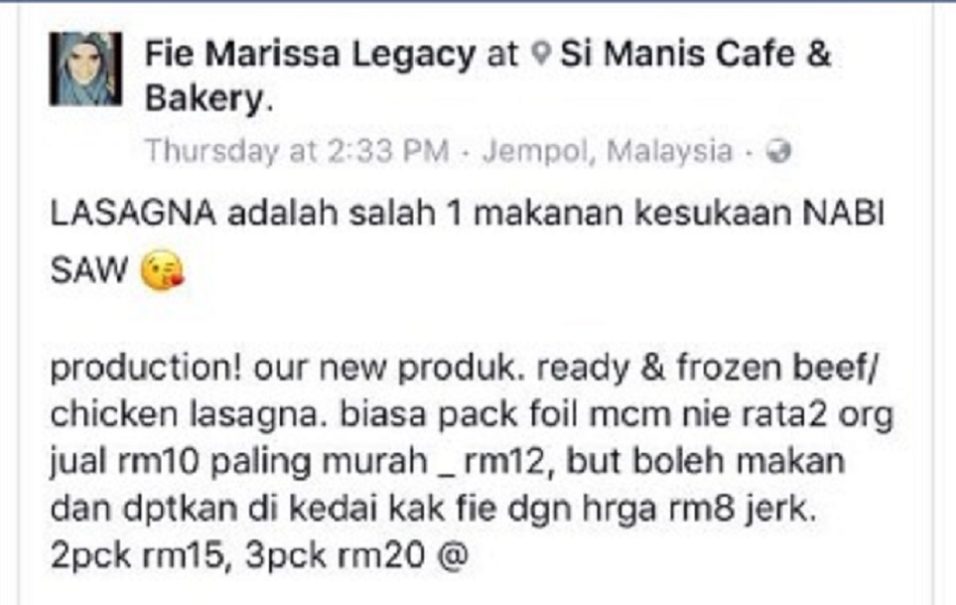
  • Advertising Gimmick: Cafe Claims Lasagna Is One Of The Favourite Food Of Prophet Muhammad

    Advertising Gimmick: Cafe Claims Lasagna Is One Of The Favourite Food Of Prophet Muhammad

    I’m not a pious Muslim by any means but even I cannot take this……who in their right mind would claim that Prophet Muhammad liked eating lasagna?!

    There are so many ways to market your food. You don’t have to resort to this to bolster your sales.

    You are just making it confusing for Muslims and making Muslims the laughing stock of others.

    si-manis-cafe-bakery-1


    Nana

    Reader Contribution

  • Why Sikhs Can Keep Beards But Muslims Cannot in SAF?

    Meet 3SG Jagrnjeet Singh, a regular Infantry specialist who just graduated from the 15/13 Specialist Cadet Course. As a junior commander, he is looking forward to leading his men and giving them a positive time in the SAF. He elaborated, “I am in this not for the money but for my passion. I want to give a different experience to my men and show them that there is much more to National Service than the two years. Having been a trooper before in 4 SIR, I understand how troopers feel and want to make a positive impact on their time in NS”. Very inspiring words, 3SG Singh! — with Jagrnjeet Singh Sidhu.
    Meet 3SG Jagrnjeet Singh, a regular Infantry specialist who just graduated from the 15/13 Specialist Cadet Course. As a junior commander, he is looking forward to leading his men and giving them a positive time in the SAF. He elaborated, “I am in this not for the money but for my passion. I want to give a different experience to my men and show them that there is much more to National Service than the two years. Having been a trooper before in 4 SIR, I understand how troopers feel and want to make a positive impact on their time in NS”. Very inspiring words, 3SG Singh! — with Jagrnjeet Singh Sidhu.

    During my 4th ICT, I have a corporal posted into my unit. He’s a Muslim with facial hair just like our Sikh friend in this picture. Not trying to stir any racial/religion issue here. But upon in pro, he was asked to rid of his facial hair without any second chances.

    In Islam, Muslim men are encouraged to keep beards. But how is it that our dear Sikh brothers are allowed to keep facial hairs but our Muslim brothers are not allowed. This shows that the SAF is cultivating double standards.

    The organization is being biased towards Muslim practising their rights in the SAF. As a Muslim, I am upset that after 40years of developing Asia’s best army, this MAJOR issue has yet to be ironed out.

    Also, the serviceman has a letter from MUIS to allow him to wear track pants instead of the standard issue PT shorts. Sadly, he was not allowed to perform his IPPT due to his attire. Reasons were compromise of safety/possible heat injuries etc. We all know that it can be done but they just want to suppress our rights.

    Harap maaf kerana mengguna bahasa english. Serviceman tersebut adalah FCruz. Saya adalah CSM beliau.

    Authored by Izzat

    ezatbeard in army


    EDITOR’S NOTE

    Followers of the Sikh religion are allowed to keep beard, and wear a turban while still donning military uniform. They do not need special permission in the SAF. 

    MINDEF explained the allowance for Sikhs was passed down from British colonial times. 

    What is your view on this beard issue and what do you think is the best way to resolve this matter?

    letters to R1C banner