Category: Sosial

  • Malays, Easily Stereotyped In NS Always Hear: ‘Kita Melayu Jadi Infantry. Don’t Put Your Hopes Too High.’

    Malays, Easily Stereotyped In NS Always Hear: ‘Kita Melayu Jadi Infantry. Don’t Put Your Hopes Too High.’

    “Kita Melayukan, jadi …. infantry lah …. don’t put your hopes too high.”

    Those were the words uttered to me during my son’s orientation at the beginning of his Officer cadet course almost 10 months ago. Testimony of the effective discriminatory practise embedded for more than 50 years against Malays in the SAF.

    Malays are loyal and trustworthy like all Singaporeans to don the colours of any Arms of the SAF, ever willing to lay our life for this land we are indigenous to. We proved ourselves as a race when 153 malay regiment soldiers sacrificed their lives in defence of Singapore at Bukit Chandu, in February 1942, against the Japanese invaders. Their heroism are etched permanently into the memory of the Japanese army and the Colonial authority that surrendered Malaya to the Japs.

    The Malays have patiently waited and trusted that this collective discrimination on their race will go away one day as promised to them by PAP leaders behind closed door. 50 years on and the situation has not changed except for mere tokenism to feature on occasional pages of the local press or some magazine covers. We have even tolerated the indignation of watching glittering TV ads promoting careers in the Navy etc., knowing fully well that we don’t qualify just because of the colour of our skin.

    This policy of restricting Malays in the SAF has indoctrinated in the minds of other races, the unspoken fallacy that Malays are disloyal and cannot be trusted. Infecting every male serving citizen’s mind during 2 years of full-time national service and later for many more years during reservist, inevitably spilling into the wider society too. This vicious poison of distrust towards the Malays, sown in the minds of the people for more than 50 years must end.

    This discriminatory practise towards Malays lies deep in the hypocrisy of PAP leaders who imposed these policies while preaching meritocracy and practising so-called deceptive affirmative actions selectively when it suits their political interest. Think GRC, HDB race quota, Malay President fiasco, etc. This whole policy and mindset originating from the PAP are the root cause of this discrimination.

    Singaporeans of all races can end this discriminatory policies that has remained as vestiges of our colonial past. We must revive the vision championed by our brave true anti-colonial heroes who are Chinese, Malays, Indians and Eurasians. They suffered their lives to rid this country off the racist colonial policies of the past, so that we can practice and give equal spaces for all citizens regardless of our individual ethnicity and creed. And to consider celebrating Stamford Raffles and his so-called legacy, is a blatant gross affront and a betrayal of the real spirit of the struggles and sacrifices of our founding fathers.

    Image may contain: 2 people, people smiling, people standing

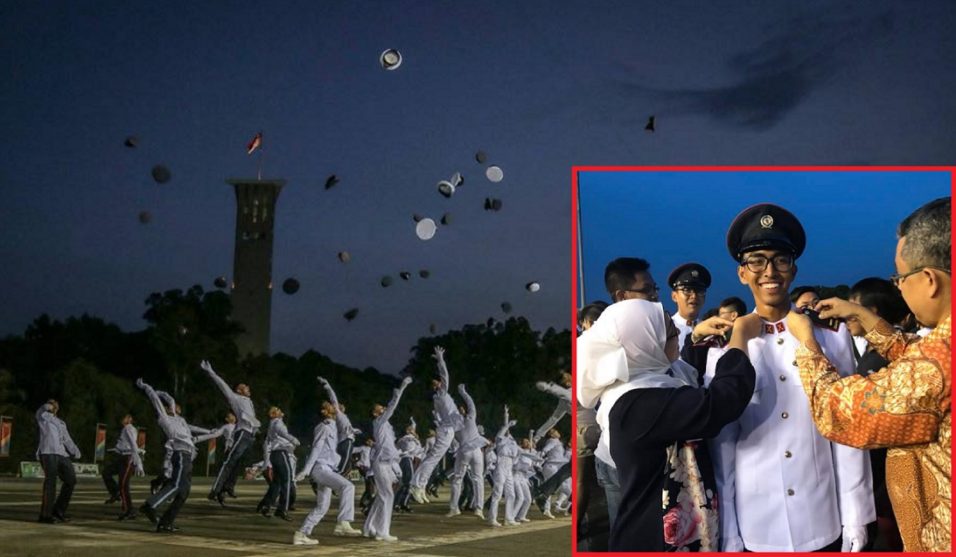
    A proud moment for Fuad and parents as we put his officer rank onto his uniform. A proud and honourable Infantry Officer.

    Today, my son, together with his peers are commissioned as Officers of the Singapore Armed Forces (SAF). Each one of them has earned his or her One Bar through their grit and hard work to be proudly bestowed the dignified role of Officers, leading men and women of the SAF in defending this nation, the Constitution of our Republic and the President. As fellow parents witnessing their Commissioning parade today, we are proud of having our sons and daughters standing in service for our Country and her idealism of a Just and Equal society we all want and love.

    Together, we can and must rebuilt our Nation’s true vision embodied in the colours and symbols on our Flag that we have neglected. To strive and struggle to leave a truly worthy legacy to our next generation, of a country united as one, where all races respect one another equally, instead of allowing ourselves to be divided and exploited by race for unjust self-serving political ends. The discrimination of Malays in the SAF must cease.


    Source: Damanhuri Bin Abas
  • Brave Yale-NUS Students Tired Of Not Having Their Voices Heard Hold Silent Sit-In Protest Against The College

    Brave Yale-NUS Students Tired Of Not Having Their Voices Heard Hold Silent Sit-In Protest Against The College

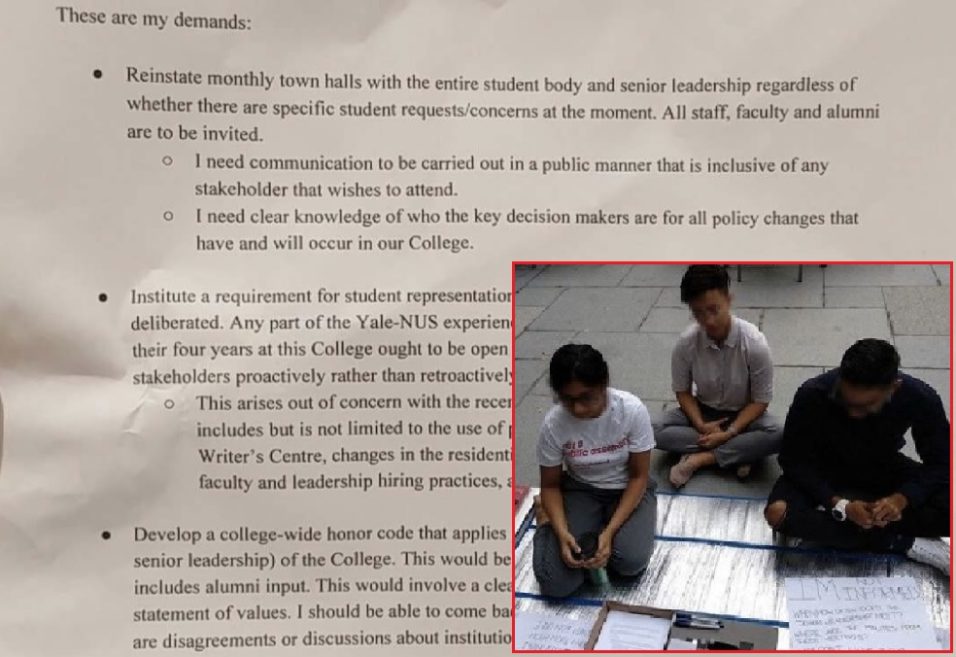
    Dissatisfied with certain school policies and unhappy with the way the school dealt with their opinions, some 29 students from Yale-NUS College conducted a silent sit-in on Friday, March 9.

    According to Channel 8 News, Yale-NUS College has since reached out to the students through public dialogue.

    The student who shared open letter publicly later privatised his account

    Adam Goh, one of the students believed to have taken part in the sit-in, shared an open letter on his Instagram account directed at the college, as well as a picture of three students conducting the sit-in.

    His Instagram account has since been set to private mode, according to the report.

    The open letter also revealed that while the President of Yale-NUS, Professor Tan Tai Yong, made a response earlier, the students thought that it wasn’t sufficient, and called on all students and staff members to share their views.

    The following are the students’ main demands:

    • Reinstating monthly town halls for all students and the senior leadership, as well as an open and transparent communication process
    • Making students involved in the deliberation of any policy that affects the students themselves
    • Developing a college-wide honour code that applies to all stakeholders of the college

    The students explained in the letter that they were tired of not having their voices heard, despite them speaking up and attempting to communicate with the Yale-NUS president.

    As a result, they decided to make their demands known in a manner that’s hard to ignore — physically occupying an area in order to express their concern towards the “future” of the college.

    They also gave an ultimatum, saying that until President Tan makes a written response, there’d be at least one student continuing the sit-in.

    The students added that while they don’t represent the entire student body, they welcome other concerned students and staff to join them in their effort to make their voices heard.

    A letter from the Yale-NUS Student Government has since been circulated on Reddit, saying that monthly town halls with “a cast of senior college leadership” will be organised.

    Apparently, the announcement was made by President Tan in an email previously.

    It is unknown if the sit-in is still being held.

    In a townhall that was held in February last year, students raised their concerns to the school administration over some “troubling” decisions the administration made without involving the student body in the deliberative process.

    Of the decisions that were made unilaterally, according to the students, were the suspension of the Yale-NUS International Relations and Political Association’s activities with no reasons given, as well as the setting up of a new Event Approval Committee to assess the “desirability and feasibility” of holding an event on campus.


    Source: channel 8 news


  • Why Not Make Thaipusam A National Holiday Again Alongside Deepavali, CNY And Hari Raya?

    Why Not Make Thaipusam A National Holiday Again Alongside Deepavali, CNY And Hari Raya?

    Another year, another incident. You’ve probably seen it – that viral video taken at the Thaipusam procession, or at least heard of its existence: How a volunteer officer from the Hindu Endowment Board (HEB) allegedly disrupted a procession over the use of musical instruments and amplification.

    Netizens have criticised the HEB and the authorities for disrupting the procession. Several in the Hindu community that The Pride spoke to feel that the authorities should allow them to carry out their religious rites without interference. The authorities have clarified that they have been accommodating to the Hindu community even if some may have broken the law, and the HEB has also since stated that the most recent incident has been settled amicably with the devotees.

    Yet, each year, what is supposed to be a joyful, religious festival for the Hindus seems only to be remembered for the disputes between devotees and the authorities.

    There have been umpteen calls to lift the ban on musical instruments at the procession – a ban which was put in place to control the noise levels. Those arguing against the ban often point out that lion dance troupes make plenty of noise – in public – too.

    Lion dance troupes with their drums and cymbals that are so active during the Chinese New Year period are arguably a lot noisier and affect far more people over a longer period than the Thaipusam devotees with their hand-held instruments and amplified voices, but Law Minister K Shanmugam, in a Facebook post made three years ago, said that lion dance troupes perform during social or community events and not religious events.

    This ban on music is not in place to discriminate against Hindus. Mr Shanmugam said that Hindus are given exemption from the law against religious foot processions during Thaipusam. He added that the Thaipusam procession goes through major roads – a privilege not afforded any other religious group.

    The procession is by no means a silent one: This year, there were 19 points along the 3.1km stretch from which music was transmitted and three stages along the route where live music was played.

    Retired police officer M Kunalan, 70, carried the spiked kavadi several times during his younger days. He says that there are troublemakers among the younger group of devotees who challenge the authorities and play their music loudly, disturbing the peace in what is supposed to be a solemn occasion.

    “These groups should be investigated and brought to task under the law. They bring shame to the Hindu community during a sacred festival,” he told the Pride.

    But is there a way to be even more accommodating to the Hindu community? Could there be more done to ensure that they are allowed to celebrate Thaipusam – which is to mark the victory of the deity Lord Murugan over evil?

    How about making Thaipusam a national holiday?

    The procession, with devotees bearing elaborate kavadis, is in itself a spectacular affair and communities other than Hindus or the predominantly Tamil devotees could join in the celebrations as respectful observers. Tourists could also soak in the festivities of such an event.

    “Thaipusam is not an easy event to organise. Logistically, it can be a nightmare and the devotees, even those who carry the kavadi, have to go through the added hardship of not having a public holiday on such an important occasion. Making it a holiday would go a long way in helping the Hindu-Tamil community,” said Mr Kalidass SKS, managing director of a security services company.

    The last time a call to turn Thaipusam into a holiday was in 2015, and the Ministry of Manpower (MOM) explained in nine points why not having it as a holiday would best serve Singapore. Thaipusam used to be a public holiday until 1968.

    It is regarded as a religious holiday, but if you considered it a holiday for Indians, which are largely represented by the Tamil community, there seems to be a fair argument for its reinstatement as a public holiday: The Chinese have two days – the first two days of the Chinese New Year, the Malays have Hari Raya Haji and Hari Raya Puasa, and the Indians currently have only Deepavali as a national holiday. Making Thaipusam a public holiday would mean the three main races of Singapore have two public holidays each.

    According to the MOM then, “the decision on which public holidays to give up was reached only after careful consultation with religious groups”.

    But that was in 1968. And the only religious festival that seems to be experiencing any sort of problem appears to be Thaipusam. Could we not all give up one day of work so that Thaipusam can get the space it needs?

    Residents in the area would probably be more forgiving of noise created as a result of the festivities if it were a holiday. Organisers of the procession would have a bigger pool to choose from for volunteers and helpers at the occasion. There will be less inconvenience to traffic if it weren’t a working day. And everybody in Singapore would begin to think of Thaipusam as a Singaporean religious festival instead of dismissing it as a day when Indians struggle in their fight against evil.

    MOM also explained that when the number of public holidays was set at 11 in 1968, the reason was this: “Faced with the British withdrawal and the need to compete in global markets, the government decided to reduce the total number of public holidays, among other things.”

    So never mind the music for now: The British have long departed. Singapore is suitably plugged into and very competitive in global markets. We could leave it to the economists to determine if one day less of work would plunge our economy into recession, and trust that city-planners and the Singapore Tourism Board would capitalise on the event to promote Singapore as a culturally rich and diverse destination.

    So, as the majority of Singaporeans prepare to celebrate Chinese New Year, which is just around the corner, perhaps it’s time to consider giving our Indian countrymen another public holiday.

    Source: PrideKindnessSg


    Rilek1Corner

  • Are Megachurches A Concern For Singaporean Society?

    Are Megachurches A Concern For Singaporean Society?

    The news that Kong Hee won his recent court case should not come as a shock. While it is still too early to judge our society’s reaction over CHC, suffice to say, CHC supporters are satisfied.

    Kong Hee’s verdict is a concern for Singaporeans. The growth of megachurches (which scholars define as churches which have a following of more than 10,000 people and are not aligned to any particular branch of Christianity) in Singapore has led to the development of networks of power and influence with little checks and balances (not even democratic elections), and which could be potentially exploited in the future for problematic purposes. [1]

    Why have megachurches in Singapore been so successful? As Terence Cheong [2] notes, it is because of the “market logic” that these megachurches ascribe to. This includes charismatic leadership culture and the mass-appeal of a Pastor who, instead of wearing archaic dresses, acts as a friendly, cool fatherly figure. This mixture of American evangelicalism with Singaporean capitalism taps on the emotional and spiritual needs of the emerging middle class. It is these factors which have allowed megachurches in Singapore to prosper.

    In comparison, other religions either comply with Singapore’s ethos of social harmony (e.g. Buddhism and Taoism) or are clearly aware of the OB markers for religion here. This applies to mainstream Christian branches and Islam – with the experience of Operation Spectrum, the Silat arrests, and the recent spat over the Islamic cruise in South East Asia ostensibly being a show of force by the government to prevent religious institutions from propagating alternative ideas that may destabilise Singaporean society.

    Therein lies the genius and the success of the megachurches in Singapore – their beliefs are totally in harmony with the State and are popular with the “emerging” middle class. The provision of KPI(s) to followers, recruiting of additional members, the creation of networks, and the amount of megachurch merchandise are consistent with Singapore’s capitalist system. These attributes are familiar to the emerging middle class, not fancily-dressed pastors swinging around incense, and through this, membership in the megachurches are surging.

    Perhaps then, the government found itself in a dilemma – even if it found Kong Hee’s actions problematic, to persecute him as a Marxist provocateur or whatever gobbledygook would have been disastrous for the government. There is no compelling narrative to shatter his reputation in order to dissuade his followers. The government cannot frame him as a Marxist, terrorist, or fundamentalist because Kong Hee is none of that. He is ostensibly a pastor ordained by God who happens to make a few million dollars – if anything, he is a very successful CEO.

    However, I argue when it comes to these megachurches, its CEO is never just a CEO.

    The megachurch is still a church at the end of the day. Its form of charismatic leadership allows a pastor to differ from a CEO. A pastor commands and claims to be ordained by God himself, unlike the CEO of Uber or Microsoft who is ordained by a Board of Directors. This connection to God gives the pastor a level of conviction and influence, and the ability to command his followers in the name of God. This has the potential to provide the Pastor considerable (and perhaps disproportionate) weight in Singapore’s socio-political-economic agora.

    Therein lies the problem, the size of these networks and power structures in these institutions can potentially allow a Pastor to wield considerable influence in business or politics. The system of developing large numbers of followers could see these churches reach the higher echelons of Singapore’s power structure.

    In mainstream churches and mosques, the pastor, minister, or imam has superiors. In the case of the Catholic Church, there is the Archdiocese and the Pope. For the imams, all doctrines come under the auspices of MUIS.

    What about the megachurches? How do we prevent their teachings becoming radicalised or their followers exploited? If all their teachings go through one man/woman, behind closed doors and beyond the regulatory reach of the government, what prevents this message from potentially being corrupted?

    Furthermore, the megachurch system differs from the ways businesses operate. While businesses may networks or connections – they rarely can directly inspire or mobilise the masses for political purposes, and in Singapore’s case there is also no reason to do so. Sembcorp or Keppel cannot, for example, compel their staff to all vote for a particular political party in an election; but what is stopping a leader of a megachurch from doing so in the name of God?

    However, something needs to be made explicit – I do not think that any of these megachurches will, in the near future, undermine security, stability or even the rights of religious and racial minorities in Singapore. Terrence Cheong has highlighted that many megachurches in Singapore have liberal views and are primarily obedient to the overused bible quote regarding Christ and Caesar. The lack of an ideological antithesis to the Singaporean capitalistic model and the ability to mobilise the masses is a concern for society, but not an immediate one.

    Viewing megachurches as cults would not be productive either. Instead, we should consider whether there needs to be checks and balances in play concerning their institutional structure, and the relationship between them and society.

    We need a frank discussion with members of these churches. How do we prevent these networks from being exploited by a power-hungry individual? Kong Hee and other megachurches have only God above them – what if one day someone attempts to exploit this power – not just for monetary gain, but, to disrupt Singapore’s society?

    Source: consensusg


    Rilek1Corner

  • Accuser, Mana ‘Wedding Caterer’ That Dumped Curry Waste Into Pasir Ris River?

    Accuser, Mana ‘Wedding Caterer’ That Dumped Curry Waste Into Pasir Ris River?

    “Just like this picture, we can say many things nowadays through social media. Accuse, report, stomp and simply tarnish someone’s reputation just like that.

    If you have evidence for example pictures of the “caterer” themselves throwing curry waste into the canals that lead to the river, then the necessary actions to be taken by the respective authorities will follow. Else naturally if you don’t have such proof then is it fair to expect people to believe this piece of news?

    Then again, nowadays everything can be made up just to “kill off” somebody for whatever reasons. No justifiable proof, just pick your bullets and post it online. Well maybe this is the Singapura that we know 

    The photo was originally sent in by Shirley Lc Tan.

    “This wedding caterer at the void deck of Blk 408 Pasir Ris (510408) just simply dump their curry gravy into our river next to it. The river where there are plenty of monitor lizards and our beloveds Pasir Ris’ family of otters..”

    Source: Rilek1Corner Reader

    (PS: Please lah Singaporeans don’t anyhow make up stories. When the river colour macam TEH TARIK no one complain.. Rest our case siol!!)


    Rilek1Corner