Blog

  • Dollah Kassim’s Grave Among Those Slated For Exhumation

    Dollah Kassim’s Grave Among Those Slated For Exhumation

    The graves of a local football icon and a former politician known for his anti-drug advocacy work are among those slated for exhumation at Choa Chu Kang cemetery to make way for the expansion of Tengah Air Base.

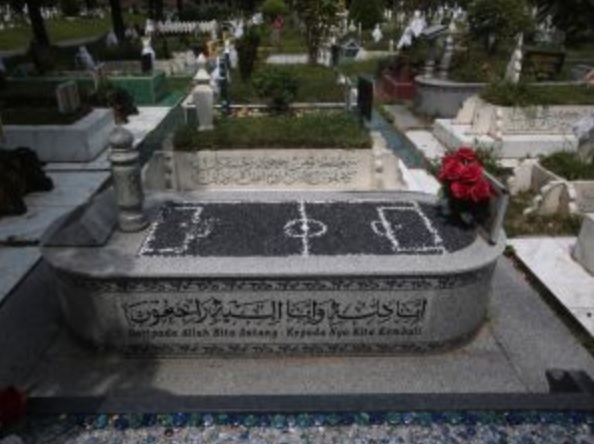
    Abdullah Mohamed Kassim, who died in October 2010, rests in a tomb adorned with a bunch of red flowers and a miniature football pitch formed out of grey and white stones on top of the structure.

    Better known as Dollah Kassim, he represented Singapore between 1968 and 1981, playing centre-forward, and was nicknamed “gelek king” for his graceful and deceptive dribbling.

    Dollah, a respected legend in the region and one of the Republic’s star strikers in the 1970s, suffered a heart attack in October 2009, while playing in a veterans’ exhibition match. He died at 61, after spending a year in a coma.

    Like Dollah, Harun A. Ghani, a former Member of Parliament and political secretary to the Home Affairs Ministry, was laid to rest at one of the 30,000 Muslim graves that will be exhumed at a later date, after they reach the 15-year burial limit.

    Harun, who died aged 66 in August 2005, was known for leading the charge in the war against drugs in the Malay community.

    He pioneered “meet-the-family” sessions, which have become a key component in rehabilitating former drug addicts and other ex-offenders.

    He was often spotted at coffee shops counselling former abusers and their family members.

    In 2005, an education fund dedicated to assisting families struggling with consequences of drug addiction was set up in Harun’s memory.

    A total of 80,500 Chinese and Muslim graves, dated between 1955 and 2000, will be exhumed progressively to make way for the air base’s expansion. The first to go will be 5,000 Muslim graves across two blocks in the fourth quarter of next year.

    TODAY understands that some families have already sought clarifications from the National Environment Agency and Islamic Religious Council of Singapore regarding the exhumation of their ancestors’ graves.

    Heritage enthusiast Raymond Goh said many of the Republic’s founding fathers who died between 1946 and 1978 would have had their graves exhumed in earlier phases.

    Mr Goh — who has embarked on an extensive documentation of graves at the Bukit Brown cemetery with his brother Charles — urged the authorities to work with the claimants to document the graves before they are exhumed.

    “There is a lot you can uncover about the person’s genealogy and ancestry from the inscriptions on the graves,” said the 53-year-old pharmacist.

    Prior to exhumation of graves at the Bukit Brown cemetery to make way for road developments, the Government worked with key stakeholders.

    These included Singapore Hokkien Huay Kuan, The Peranakan Association of Singapore, Singapore Heritage Society, academics and grave experts, to document the graves, as well as memories and rituals associated with the cemetery.


    Source: http://m.todayonline.com

  • Doubts About Presidential Hopefuls Not Being Malay Enough Are Off Track

    Doubts About Presidential Hopefuls Not Being Malay Enough Are Off Track

    Singapore’s Malay community has long held an expansive view of race, a stand that reflects its confidence.

    The coming presidential election is the first to be reserved for candidates from the Malay community, following changes to the Constitution to ensure the highest office of the land reflects Singapore’s multiracial society.

    Yet there has been some contention on social media over the “Malayness” of would-be candidates, with some asking whether any of the aspirants who have stepped up or are mulling over a bid is “truly Malay”.

    It is as if the very nature of this year’s contest has misdirected energies towards securing the “most authentic” candidate instead of a Malay candidate who would make the best head of state.

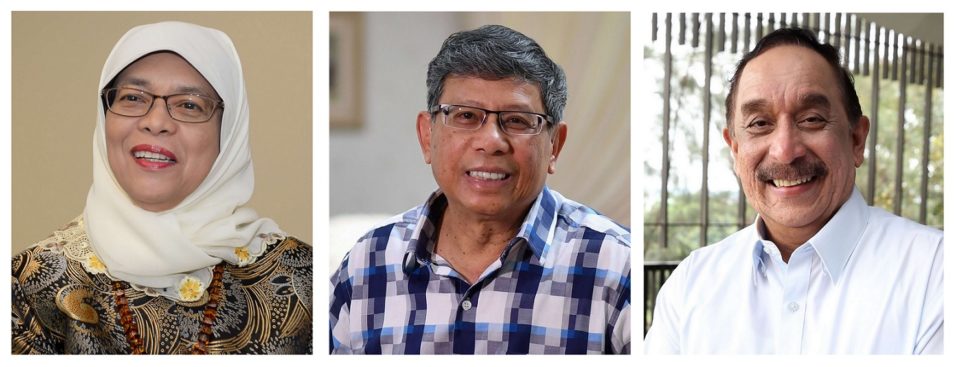
    Ironically, all three hopefuls – businessmen Salleh Marican and Farid Khan, and Speaker of Parliament Halimah Yacob – have been acknowledged by the community, peers and the media as prominent Malay individuals.

    They speak Malay, follow Malay customs and are, to some extent, role models for the community in business and public service. Why, then, has the question of whether they are “pure Malays” or “Malay enough” cropped up when it comes to the presidential election?

    Media attention on them may have played a part. Businessman Mohamed Salleh Marican, whose father is Indian, has been criticised for not being fluent in Malay, after his fumbling during a Facebook Live interview conducted outside the Elections Department where he had gone to collect the forms for the elected presidency contest.

    Businessman Mohamed Salleh Marican has been criticised for not being fluent in Malay, after his fumbling during a Facebook Live interview. ST FILE PHOTO

    Marine company chief Farid Khan has been panned for stating openly his Pakistani ethnicity, while declaring that he has always seen himself as a member of the Malay community as he speaks the language, practises the customs and gives back to it.

    Madam Halimah too has been pressed on the issue – past media reports noted her father was Indian – but she considers herself as very much a member of the Malay community, and has contested four general elections as a Malay candidate in a GRC or Group Representation Constituency.

    A number of community leaders and observers say the critics’ obsession with authenticity and purity flies in the face of tradition – it neglects the open, inclusive view of race that many Malays have adopted in welcoming new members to the community, which includes a wide range of admixtures and ethnicities.

    Mr Farid Khan has been panned for stating openly his Pakistani ethnicity, while declaring that he sees himself as a member of the Malay community. ST FILE PHOTO

    What is a Malay?

    Official records since 1824 have classified inhabitants of Singapore into four broad races – Malays, Chinese, Indians and Others. While Chinese and Indians have generally been understood to refer to people with forebears from China and India and migrants from the archipelago who trace their roots to these countries, Malay has included a variety of ethnicities regarded as indigenous to this region: Acehnese, Baweanese, Bugis and Javanese, among others.

    Yet the sense of affinity to a Malay identity was not strong up till the 1930s, when the burgeoning Malay-language press helped promote a nationalism that sought to improve the lot of the Malay community.

    The formation of the United Malays National Organisation in 1946 in Johor Baru – just across the Causeway – focused the minds of many Malays on issues of identity at a time of rapid change. For the first time, Malay would be clearly defined. Because the vast majority of Malays were Muslims and Islam had become closely associated with the Malay identity, the official definition of Malay in the Federation linked race with religion.

    Past media reports on Madam Halimah noted that her father was Indian – but she considers herself very much a member of the Malay community.   BH FILE PHOTO

    Article 160 of the Malaysian Constitution thus defined “Malay” as a person who professes the religion of Islam, habitually speaks the Malay language, conforms to Malay custom – and was before Merdeka Day born in the Federation or in Singapore, or one of whose parents was born in the Federation or in Singapore or living in both places; or is the issue of such a person.

    Article 152 of the Singapore Constitution also made clear the Government’s responsibility to constantly care for the interests of minorities, and referred to the special position of the Malays, “who are the indigenous people of Singapore”, and whose interests and language it had a duty to safeguard and support.

    After Separation, a Constitutional Commission headed by Chief Justice Wee Chong Jin discussed the issue of safeguards for minorities as well as, among others, the definition of Malay. It rejected calls to expand the definition to non-Malay Muslims and have Islam as a marker of Malayness. Instead, it chose not to explicitly define the races, languages or religious minorities in Singapore, in the hopes of a “united, multiracial multicultural society”.

    GRC debates

    However, concern over ensuring enough Malays will be represented in key institutions – Parliament, and more recently, the Presidency – meant there was a need to define who is a Malay in Singapore’s context.

    Thus when the concept of Team MPs – later GRCs – was discussed in the late 1980s, it was inevitable that the debate on what is a Malay should resurface.

    The Government said the idea behind GRCs was to ensure Parliament remained multiracial and to prevent the spectre of a House that might one day be without minorities.

    A Select Committee held hearings involving a wide range of representatives in 1987 and 1988, and many Malay leaders felt strongly about having Islam included in the definition of a Malay.

    The committee took the view that as Singapore is a secular state, it would not be appropriate for the state to spell out that a Malay must also be Muslim to contest in a GRC.

    There was one other issue: a good number of Malays had Indian, Arab or Other on their ICs due to their ethnicity or parentage, even though they had long associated with the Malay community.

    The Select Committee recognised this point. It also accepted a submission that sociologically, self-definition is the only valid way to define an ethnic group. “A person belonging to the Malay community must think of himself as Malay, and must be acceptable to the Malay community,” it said. “Therefore the legislation should not lay down prescriptive criteria as to who does or does not belong to the Malay community, but should define a mechanism to let the community decide for itself.”

    This mechanism has taken the form of a community committee, which the Select Committee report said would be “a safeguard against an unacceptable candidate being wrongly certified as a member of the Malay community”.

    At the same time, the Parliamentary Elections Act – and the latest amendments to Article 19B of the Constitution – define a person belonging to the Malay community as “any person, whether of the Malay race or otherwise, who considers himself to be a member of the Malay community and who is generally accepted as a member of the Malay community by that community”.

    A similar approach has been adopted for aspiring candidates for the presidential election in the latest round of changes to the law.

    Associate Professor Eugene Tan of the Singapore Management University School of Law notes the criteria for running as a minority in a GRC is the same as that for a presidential election.

    And during the debate on changes to the Presidential Elections Act on how race is defined earlier this year, MPs called for a broad, inclusive approach to be adopted.

    Singapore’s Malay community has long held an expansive view of race – and been open to newcomers and others keen to identify with it.

    It is a signal of confidence and courage – and nothing could be further from that than questioning whether someone who identifies as Malay and is accepted as Malay is “pure Malay” or “Malay enough”.

    So long as a person identifies as Malay and is generally accepted as such by the community, his Malayness should not be questioned.


    Source: http://www.straitstimes.com
  • Women’s Wing Of Malaysia’s Parti Amanah Negara Calls For Airwave Ban On Despacito

    Women’s Wing Of Malaysia’s Parti Amanah Negara Calls For Airwave Ban On Despacito

    The women’s wing of Malaysia’s Islamist party Parti Amanah Negara has called on radio stations in the country to stop playing Despacito, the Spanish hit song, because of its supposedly sexually explicit lyrics.

    Despacito is a single by Puerto Rican singer Luis Fonsi and Puerto Rican rapper Daddy Yankee that features Justin Bieber. The song has reached the top position in weekly charts all over the world, including in Malaysia.

    Angkatan Wanita Amanah Nasional (Awan)’s Arts and Culture chairperson Atriza Umar said that she viewed it seriously as many young children were singing the song without actually understanding its lyrics.

    She said that local Malay radio stations were also playing the song resulting in it becoming a phenomenon that was hard to stop.

    She hoped that Despacito and other songs that have sexual and violent lyrics not suited to Eastern culture and Islam could be banned from being played.

    “I regret that these problematic songs are not censored by the ministries responsible,” she said in a statement on Wednesday (July 19).

    She also praised the artistes and individuals who have taken the initiative to alter the lyrics of the song to make them more decent despite it going against copyright rules.

    Atriza also hoped that local artistes could work together to provide entertainment that was morally upright and yet had high commercial value.

    “We respect the right to be entertained but there should be clearer guidelines so that the entertainment does not spoil people but make them better,” she said.

    Amanah is a splinter party of the other opposition Islamist party, Parti Islam SeMalaysia. It is one of the members of the Pakatan Harapan opposition alliance.

    According to the Billboard music chart, Despacito has led the Billboard Hot 100 chart (dated July 29) for a landmark 10th week.

    On Wednesday, Billboard said that since its release in January, the song has garnered more than 4.6 billion streams across all platforms, setting a record for the most-streamed song of all time.


    Source: http://www.straitstimes.com/

  • SBS Transit Says There Was “No Malfunction In The Fare Gate” Based On CCTV Footage

    SBS Transit Says There Was “No Malfunction In The Fare Gate” Based On CCTV Footage

    A toddler was hurt when the fare gates at Hougang Mass Rapid Transit (MRT) station closed on him unexpectedly on Sunday (Jul 16).

    In a Facebook post that night, the child’s aunt, Ms Kelly Ng, said her three-year-old nephew had tapped his EZ-link card and was about to walk through the gates when they “closed up on him very fast”.

    According to Ms Ng, the child’s mother informed two station staff but neither of them came out to assist her, she said.

    “Out of exasperation and seeing there is no assistance going to be rendered, my sister opened the side gate to get to my nephew fast to check on his injury. He complained about pain on his chest and stomach, and perhaps on his shoulder too,” she wrote.

    Ms Ng said the MRT staff called an ambulance and that when she arrived, the toddler was sitting on a chair “looking scared/shocked and in pain”.

    “The main grouse from my sister is the two staff did not try to assist or come out from their seat to even take a look at my nephew who has been injured by the gates. They even tried to record my sister’s conversation with them. This kind of service standard is totally unacceptable,” the aunt added in the post.

    NO MALFUNCTION OF FARE GATES: SBS TRANSIT

    In response to Channel NewsAsia’s queries, SBS Transit’s senior vice president of corporate communications Tammy Tan said the company was “sorry to hear” that Ms Ng’s nephew was hurt when passing through the fare gates.

    Ms Tan said the team had spoken to the child’s father, Mr Lim, on Monday morning to find out how the child was.

    SBS Transit has also investigated the incident with the help of CCTV footage. “From the footage, we note that the mother, who was pushing a stroller, had tapped in first followed by the child and then the father, Mr Lim,” Ms Tan said.

    “As Mrs Lim was making her way through the fare gate, there was a distance between her and the stroller causing the system to recognise this as entry by two separate entities. The stroller passed through the fare gate on the mother’s card while the mother did so on the child’s card. Therefore, when the child proceeded forward, the flaps of the fare gates closed on him as the system had detected an intrusion. There was no malfunction in the fare gate.”

    Ms Tan said that following the incident, Mrs Lim should have approached SBS Transit staff for assistance in getting her son through the fare gate instead of opening the side door manually for him.

    She added that staff at the passenger service centre were not aware of the incident until the mother came forward to alert them about two minutes later, after she had attended to her son. An ambulance subsequently ferried the child to hospital where he received outpatient treatment, she said.

    “Our staff should have come out from their office to see if the child was hurt and required medical attention,” Ms Tan acknowledged.

    “We could have handled this better and do apologise for any distress caused. We will take the necessary actions to do better … We wish Mr Lim’s son a speedy recovery.”


    Source: http://www.channelnewsasia.com

  • Christian Man In Israel Accused Of Killing Daughter Who Was Dating Muslim Man

    Christian Man In Israel Accused Of Killing Daughter Who Was Dating Muslim Man

    A 58-year-old man has been accused by prosecutors for killing his teenage daughter because she was in a relationship with a Muslim man.

    CNN reported that Sami Karra, an Israeli-Arab Christian, allegedly stabbed 17-year-old Henriette Karra to death in their family home in the town of Ramle, a day after she graduated from high school.

    According to a criminal indictment filed in a district court this week, Henriette’s relationship with the man had triggered “vehement opposition” from her parents.

    This was expressed in violence and threats against her, which caused her to run away from home in late May this year.

    She stayed with her boyfriend’s mother for a period of time, but her family tried to force her to return home by threatening her boyfriend and his mother.

    Her boyfriend’s mother, who was not named, called the police for help, but Henriette refused aid.

    In June, while she was staying at a friend’s home, Karra arrived at the house and started slapping her. He also allegedly shouted that “I would spend my whole life in jail. I don’t care”.

    Henriette returned home two days later following a joint meeting with a social worker, and celebrated her high school graduation at a party on June 12.

    But the next morning, she told a family member – who then informed Karra – that she had mailed $100 to her boyfriend and intended to convert to Islam after his release from prison.

    After hearing the news, Karra took a knife and stabbed his daughter three times.

    He was arrested later that same day.


    Source: http://www.straitstimes.com