Blog

  • Getting Inked: The Islamic Perspective On Getting Tattoos

    Getting Inked: The Islamic Perspective On Getting Tattoos

    Following Fox News’ recent interest in the ‘deep love’ that is intrinsically hidden at the heart of Shias getting tattoos, it really begs the question, what is Islamic and cultural perspective on getting one?

    So what is the deal with tattoos anyway? Fox News suggests that for some people, it is a way that people respond to the pressures of war and daily issues. On a cultural level, many people get tattoos for very personal reasons, either to remember a loved one, showing their political and religious affiliations, and many other reasons that fall under such a wide spectrum.

    For some, the idea is that “There’s something about the impermanence of life these days that makes it necessary to etch ink into our skins. It reminds us that we’ve been marked by the world, that we’re still alive. That we’ll never forget.” [Tahereh Mafi, Unravel Me]

    Islamically, there’s a difference between the opinions on the permissibility of getting a tattoo.

    The Sunni school of thought follows the belief mentioned in a hadith, suggesting that “the Prophet (peace and blessings of Allah be upon him) cursed the one who does tattoos, the one who has a tattoo done.” [Bukhari].

    Conversely, scholars from the Shia school of thought are generally accepting of it and see no issue with both the one getting the tattoo and the one inking them. For example, Sayed Ali Sistani suggests that, “tattoos are permissible irrespective of whether they are permanent or temporary.” and Sayyid  Ali Khamenei, in Practical Laws of Islam, ruling 1220 answered a question about the permissibility of tattoos and said: “Tattooing is not haram.”

    That being said, the main issue that stems from getting a tattoo is before all else, the permanence of obtaining one, and the belief that it causes you to alter the creation of Allah (swt). This begs the question, how does that then differ from dyeing ones hair, getting piercings, tanning, braces, amongst other things which all technically change the way in which a person looks? While these are not permanent when done, they can lead to the permanent alteration in pigmentation and the body in general.

    Another issue is the said unnecessary infliction of pain, which is also considered to be prohibited by some.

    To this, I would like to mention that a majority of tattoo artists would rub the area with numbing lotion that prevents you from feeling anything. It also differs based on the area in which you consider placing it, and your own pain threshold. With this, there are a good many things that people do which cause pain to the body such as waxing, threading and piercings, none of which are considered to be forbidden.

    Further to this, the popular belief is that a tattoo prevents water from reaching the skin, thus preventing taharah, or ritual purity, necessary for wudhu. This is incorrect as when getting a tattoo, the ink is deposited below several layers of skin, and so it does not prevent water from reaching the skin.


    Source: TheMuslimVibe

  • Lelaki Menyamar Sebagai Pegawai ICA Untuk Curi Rokok Seludup

    Lelaki Menyamar Sebagai Pegawai ICA Untuk Curi Rokok Seludup

    Seorang lelaki dijatuhi hukuman penjara selama lima minggu kerana menyamar sebagai seorang pegawai Penguasa Imigresen dan Pusat Pemeriksaan (ICA) dalam percubaannya mencuri rokok-rokok seludup daripada pengedar haram.

    Jasmin Eyple, 33 tahun, merupakan “individu yang memulakan” rancangan itu, kara Timbalan Pendakwa Raya Li Yihong.

    Jasmin menyarankan agar lima daripada rakan lelaki berkenaan pergi ke daerah Sungei Kadut untuk mencuri rokok-rokok seludup daripada para pengedar haram.

    Dia menyangka jika mereka menyamar sebagai pegawai ICA, pengedar tersebut akan berlari meninggalkan rokok-rokok seludup itu.

    Sejurus selepas pukul 11.00 malam pada 18 Ogos 2016, kesemua lelaki tersebut pergi ke tempat meletak kereta berdekatan Blok 2B Woodlands Road, di mana para pengedar haram tersebut mendirikan sebuah kedai di sebelah pagar.

    Salah seorang daripada mereka kemudian menghampiri seorang pengedar dan memberitahu hasratnya untuk membeli empat karton rokok.

    Jasmin kemudian mengeluarkan kad EZ-Linknya dan memekik “ICA”, demikian mahkamah diberitahu.

    Para pengedar tersebut kemudian mengumpulkan barangan haram mereka, memanjat pagar dan berlari masuk ke kawasan perhutanan, sementara semua enam lelaki berkenaan mengejar mereka.

    Bagaimanapun, kesemua enam lelaki berkenaan juga terpaksa melarikan diri mereka, setelah diserang dengan palang besi dan kayu oleh orang-orang yang tidak dikenali yang secara tiba-tiba muncul dari dalam hutan, mahkamah diberitahu.

    Atas kesalahan menyamar sebagai seorang pegawai ICA, Jasmin boleh dijatuhi hukuman penjara sehingga dua tahun dan didenda.

    Satu lagi tuduhan mencuba mencuri rokok-rokok seludup turut dipertimbangkan.

    Empat daripada rakannya yang didakwa bersubahat – Muhammad Assri Zainun, Muhammad Irwanna Saini, Muhammad Sufian Radman dan Muhamad Zul Hijah Saidin – akan dibicarakan di mahkamah pada 10 Februari.

    Lelaki keenam dalam kumpulan itu, Mohamed Syafiq Saidin, masih belum didakwa.

    Source: BeritaMediacorp

  • Muslim States Discuss Rohingya Crisis

    Muslim States Discuss Rohingya Crisis

    The Organisation of Islamic Cooperation (OIC) is holding a special meeting in Kuala Lumpur on Thursday (Jan 19) called by Malaysia to discuss measures to deal with the conflict affecting the Muslim Rohingya minority in Myanmar.

    The OIC represents 57 states and acts as the collective voice of the Muslim world.

  • Life After Graduation: Special Education Students At Work

    Life After Graduation: Special Education Students At Work

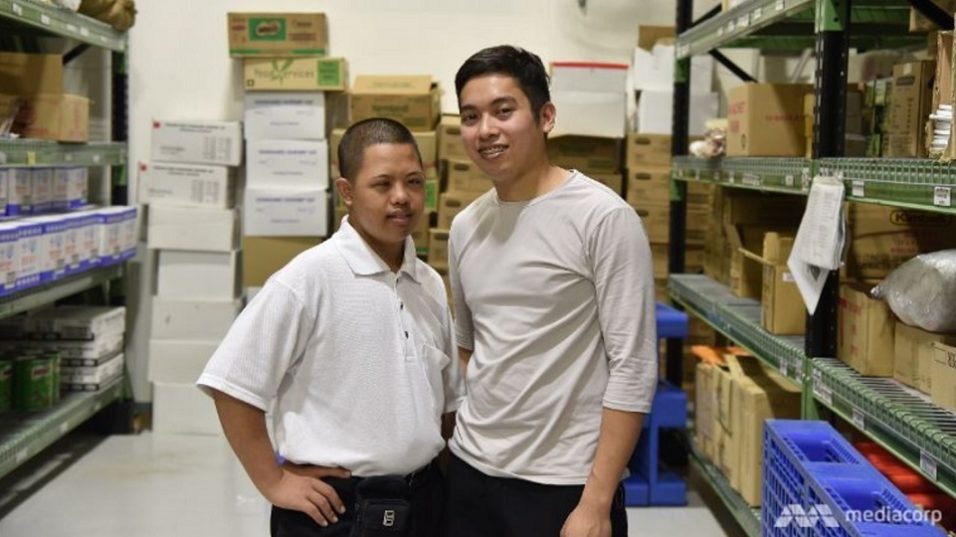
    “Faiz, can you pack all these things into a box and seal it?” asked Mark Maranan, lead cook at the central kitchen of restaurant chain Han’s central kitchen.

    Faiz Muhsin nodded. “One, two, three…,” the 20-year-old started counting while packing the items.

    The task may seem easy to most people, but for Faiz, who has a moderate to severe intellectual disability, it can be quite daunting.

    Faiz has been working at Han’s central kitchen for almost two years. In his final year at the Movement for the Intellectually Disabled of Singapore (Minds) in 2014, Faiz joined the School-to-Work (S2W) Transition Programme which prepares students with special needs to enter the workforce.

    Under the programme, Faiz was trained for about two months by SG Enable – an agency that helps people with disabilities – before he was deployed to Han’s for a nine-month internship.

    After the internship, he was offered a part-time position as a packer at the food and beverage chain. To help Faiz assimilate into the work environment, his supervisor Mr Maranan informed the team about his condition and they accommodated his working style.

    “He’s a quiet person so we need to adjust the way we communicate with him. We need to talk to him a bit slowly and we need to say it in short sentences so he can easily understand what we want him to do,” said Mr Maranan, who also described Faiz as a hardworking person who would often ask questions about his job.

    “Faiz can communicate quite well. Sometimes we also have lunch together. He’s like an ordinary person to me,” he said.

    Faiz’s job scope has also been expanded: He now helps out at the central kitchen, counting and marinating raw pieces of fish or chicken as part of the food preparation process.

    “I like my job. Free lunch, earn money. They (colleagues) are very fun,” Faiz said with a wide grin on his face.

    Faiz’ job scope has been expanded and he is now helping out with the food preparation process. (Photo: Lim Jia Qi)

    Others have not been as fortunate as Faiz. For Grace Cho, who has autism spectrum disorder (ASD) – a condition which hinders communication and interaction with people – there were difficulties in getting along with her co-workers.

    The challenge for the 28-year-old was not about finding for a job, but keeping one.

    After graduating from Mountbatten Vocational School in 2007, Grace took on several jobs before she was referred by an organisation that provides employment services for people with disabilities to work as a vegetable packer at a logistics company.

    Getting along with her co-workers at the company was not easy as she would often be scolded for not being fast enough on her job.

    “There were a lot of vegetables coming in and they (co-workers) started to rush for that. When it got jammed up, the vegetables dropped onto the floor … I was focusing on packing and sealing and I didn’t pick them up. Some of them said to me ‘You didn’t stop and help us pick up, you are not very good’,” Grace recounted.

    “I felt angry. I pushed the boxes and they dropped onto the floor. But they (co-workers) kept repeating that they had enough,” she said.

    Grace eventually left the job after less than a year. Her next job as a packer at a pharmaceutical company did not go well either as she was not clear about the workflow. “I got more things to pack. I don’t have a schedule and I didn’t know which one to do. I got confused,” she said.

    With her mother’s encouragement, Grace sought help from the Autism Resource Centre’s Employability and Employment Centre and she is currently working as a packer at The Green Corridor, where fresh fruits are processed and packaged for the supermarkets in Singapore.

    28-year-old Grace Cho took on several jobs before seeking help at Autism Resource Centre’s Employability and Employment Centre. (Photo: Lim Jia Qi)

    According to the Ministry of Education (MOE), about 300 students graduate from Special Education (SPED) schools each year. About 1 in 3 from each cohort went on to work in different industries including retail, hospitality, medical services as well as food and beverage.

    To help Singaporeans with special needs find employment, MOE has put in place various measures to prepare students in SPED schools for employment.

    These include having a framework for vocational education that guides SPED schools to develop a structured curriculum to help students with special needs gain employable skills.

    Students who obtained either the ITE Skills Certification at Metta School or Workforce Skills Qualification at Delta Senior School may apply for jobs in the open market or attend further training if they meet the pre-requisites for the courses, said MOE.

    President of the Autism Resource Centre Denise Phua said one of the reasons that adults with autism are not able to hold down a job for long could be because many of them were never exposed to the culture of work and what is expected on the job.

    “It is only in recent years that the quality of early intervention and education of students with autism is raised,” said Ms Phua, who is also a Member of Parliament.

    Another reason could also be due to low awareness among employers to put in place autism-friendly worksites, she added.

    While Ms Phua noted that employers have greater awareness than before and the emergence of more dedicated agencies to support people with special needs, more can be done to improve the current situation.

    “It’s about showing models, systems, possibilities and success that employment and work can be done for people with ASD,” she said.

    “It’s also about educating people and employers that there are different models of employment. For example, part time is one of the viable ways for people with special needs to be employed.”

    For Grace, she has been working at The Green Corridor for more than a year. Besides having a job coach onsite to guide her, there are also visual instructions and communication scripts to help her work independently.

    Grace working with her job coach at The Green Corridor located at the Enabling Village. (Photo: Lim Jia Qi)

    “The task that I was given I did it independently. I’m also following given schedule without someone telling me what to do next. I’m happy,” she said.


    Source: CNA

  • Write To MP Against Upcoming Reserved Election

    Write To MP Against Upcoming Reserved Election

    Earlier today, I wrote an e-mail to my MP and Speaker of Parliament, Mdm Halimah Yacob, to express my total disagreement on the coming Reserved Presidential Election.

    Even though I know that what I wrote to her maybe put aside, I still feel that as her resident and as a Singaporean, she should know and be aware of the sentiment on the ground.

    Not all Malays are supporting this reserved Election, as it is a big insult to the community by the PAP Government.

    I will like to urge all who are against the reserved Election to write in to your MPs too.


    Abdul Rashid

    Reader’s Contribution

deneme bonusu