Blog

  • Impermissible to drink “Zero Alcoholic” Beer, Says Office Of the Mufti SG

    Impermissible to drink “Zero Alcoholic” Beer, Says Office Of the Mufti SG

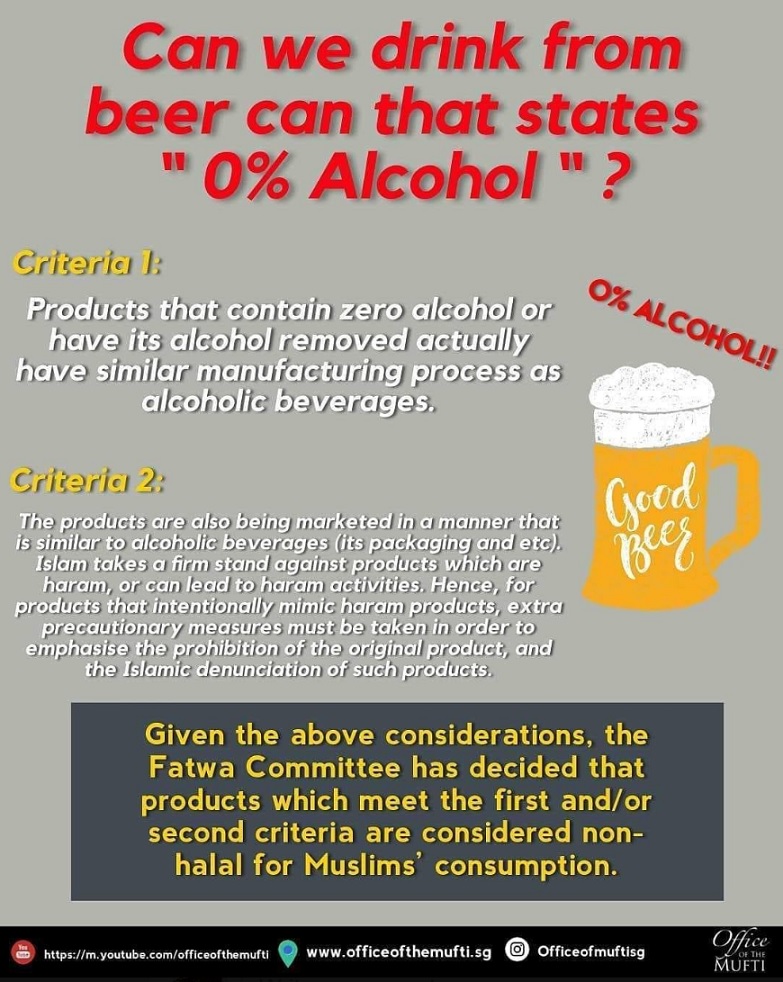
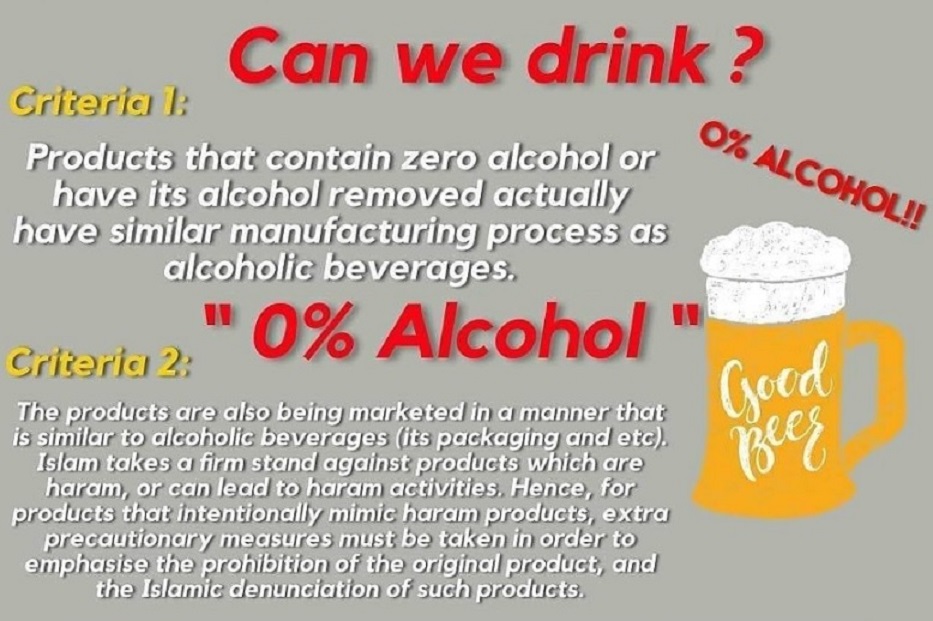
    Can Muslims drink “0% alcohol” beer? The answer is NO. It is not permissible if it meets either or both the criteria below.

    1. The process of making the drink is similar to the process done to make alcoholic drinks.

    (Explanation: Products that contain zero alcohol or have its alcohol removed actually have similar manufacturing process as alcoholic beverages.)

    2. The product is marketed in a similar way to how alcoholic drinks are marketed.

    (Explanation: The products are also being marketed in a manner that is similar to alcoholic beverages – its packaging and etc. Islam takes a firm stand against products which are haram, or can lead to haram activities. Hence, for products that intentionally mimic haram products, extra precautionary measures must be taken in order to emphasize the prohibition of the original product, and the Islamic denunciation of such products.)


    Ruling by Office of the Mufti, Islamic Religious Council of Singapore (MUIS)

    #beer #butterbeer #0percentalcoholbeer


    Rilek1Corner

  • Other Malay Stereotype Stories Surfaces After Viral Google & Canteen Helper Story

    Other Malay Stereotype Stories Surfaces After Viral Google & Canteen Helper Story

    After Singaporean woman, Atikah Amalina, who goes by the handle @thetudungtraveller, shared with the public of her experience with microaggression due to being Malay and wearing a tudung, a similar experience was shared by another lady named Ezura Al-Barakbah.

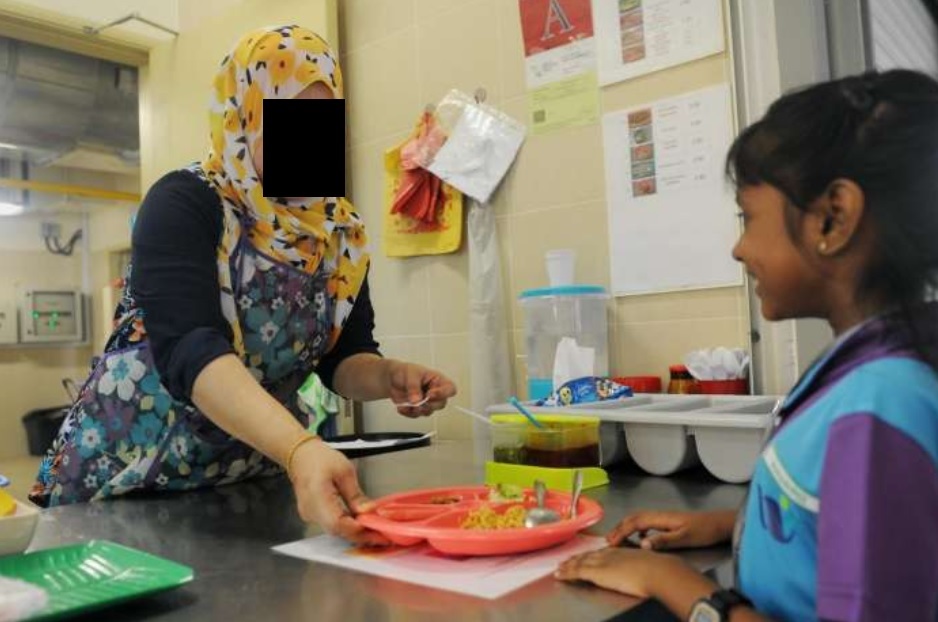
    Like Atikah whom a driver assumed worked in the canteen in Google, Ezura was stereotyped as a “kakak canteen who is uneducated and knows nothing but cooking.” Some even questioned how she got invited to Pesta Perdana and whether she religiously queued up at Mediacorp in order to get her hands on the tickets.

    This was her post in full,

    I know how it feels.

    They stereotype me as kakak canteen who is uneducated and knows nothing but cooking.
    So when they saw Medic Kid on TV then somemore got the cheek to say, ooh i thought you are a fulltime kitchen help.😢

    And asked me how come you got invited to Pesta Perdana ah?
    Is it you go Mediacorp queue up for the tickets ah😅

    I dont care about what others may think about me.
    All i know is i want to help the school and cook for the kids.
    It takes a huge village to raise a kid ok!!!

    I dont care if you look down on me pushing my trolley cart, wearing instant tudung and makeup less.

    Coz at the end of the day I loove cooking for the kids and arranged my busy schedule just to make time to cook for them

    Hey even though if I am just a kakak canteen in your eyes,
    A canteen cook is more knowledgable than you ok!!
    Must know costing, accounts, marketing be it for groceries or marketing on social media

    The stereotypes of a Malay lady wearing a hijab.. what else have you encountered?

    Share with us in the comments section.


    Rilek1Corner

  • Brunei Is An Islamic Country Practising Islamic Law, Is it Wrong?

    Brunei Is An Islamic Country Practising Islamic Law, Is it Wrong?

    “In your countries you practice freedom of speech, freedom of press, freedom of religion, etc. It’s in your constitution. It’s your political system, your national identity, your rights, your way of life.

    In my country, we practice a Malay, Islamic, Monarchical system and we’re going to start practicing the laws of Islam, Shari’ah Law. Islam is in our constitution, our national identity, our rights, our way of life.

    We may find loopholes in your laws and justice system, and you may have found ours, but this is our country. Just like you practice your right to be gay, etc. for this world you live in now, we practice our rights to be Muslims for this world and the Hereafter.

    This is an Islamic country practising Islamic Law. Why don’t you worry about your kids being gunned down in schools, worry about your prisons being unable to accommodate convicts, worry about your high rate of crimes and DUIs, worry about your high suicide and abortion rate, worry about whatever it is that you should be worried about there.

    Many religions are against homosexuality, it’s nothing new. The moment you hear that Islam and Muslims making a stand and trying to reaffirm their faith, you judge, you boycott, you say that it’s wrong, it’s stupid, it’s barbaric.

    Again, go back to those worries that you should focus on I’ve mentioned earlier. Is it not wrong to legalize deadly weapons, is it not wrong to allow unborn babies to be killed, is it not wrong to allow a lifestyle that results in AIDS and discontinuation of the next generation?

    Why do you care so much what’s happening here in an Islamic nation when you didn’t even bat an eyelid about the Syrians, Bosnians, Rohingyas, Palestinians, etc. Thousands are being killed there and you don’t care, not one is killed here under this Shari’ah Law, and you make a big fuss, even when the citizens here who are directly affected by it, accepts it with peace. Punishments may be harsher but it does not mean it’s easier to be carried out. There are processes to go through before an actual conviction. We are fine with it, we are happy.”

    Government of Brunei Darussalam
    May 2014

    #bruneisyariahlaw #proudtobebruneians #worldstandforbrunei


    Source: The Saucy’sside livecook BN

    Rilek1Corner

  • 30 Orang Pertama Dalam ISLAM

    30 Orang Pertama Dalam ISLAM

    30 orang pertama dalam ISLAM
    .
    Dalam sejarah islam, kita cuma mengenal mereka yang kali pertama masuk islam (Assabiqunal Awwalun) tapi kerap kita tidak tahu, siapa saja mereka yang melakukan sesuatu berkaitan dengan islam. Siapakah mereka? Berikut nama-nama sahabat Rasulullah itu.
    .
    Orang yang pertama menulis Bismillah :
    Nabi Sulaiman AS.
    .
    Orang yang pertama minum air zamzam :
    Nabi Ismail AS.
    .
    Orang yang pertama berkhitan :
    Nabi Ibrahim AS
    .
    Orang yang pertama diberikan pakaian pada:hari qiamat :
    Nabi Ibrahim AS.
    .
    Orang yang pertama dipanggil oleh Allah pada hari qiamat
    Nabi Adam AS.
    .
    Orang yang pertama mengerjakan sa’i antara Safa & Marwah :
    Sayyidatina Hajar
    .
    Orang yang pertama dibangkitkan pada hari qiamat :
    Nabi Muhammad SAW.
    .
    Orang yang pertama menjadi Khalifah Islam :
    Abu Bakar As Siddiq RA.
    .
    Orang yang pertama menggunakan Kalender Hijriyyah :
    Umar bin Al-Khattab
    .
    Orang yang pertama meletakkan Jabatan khalifah dalam Islam :Hasan bin Ali RA.
    .
    Orang yang pertama menyusukan Nabi Muhammad SAW :Thuwaibah RA.
    .
    Orang yang pertama syahid dalam Islam dari kalangan lelaki :
    Haris bin Abi Halah
    .
    Orang yang pertama syahid dalam Islam dari kalangan wanita :
    Sumayyah binti Khabbat
    .
    Orang yang pertama menulis hadis di dalam kitab /lembaran :
    Abdullah bin Amru bin Al-Ash
    .
    Orang yang pertama memanah dalam perjuangan fisabilillah :Saad bin Abi Waqqas
    .
    Orang yang pertama menjadi muazzin dan menyerukan adzan: Bilal bin Rabah
    .
    Orang yang pertama sembahyang dengan RasulullahSAW :Ali bin Abi Tholib
    .
    Orang yang pertama membuat mimbar masjid Nabi SAW :
    Tamim Ad-dary
    .
    Orang yang pertama menghunus pedang dalam perjuangan fisabilillah : Zubair bin Al- Awwam
    .
    Orang yang pertama menulis sejarah Nabi Muhammad SAW :Ibban bin Othman bin Affan
    .
    Orang yang pertama beriman dengan Nabi SAW :
    Khadijah bt Khuwailid.
    .
    Orang yang pertama menggagas ushul fiqh :
    Imam Syafi’i RH.
    .
    Orang yang pertama membina penjara dalam Islam:
    Ali bin Abi Tholib
    .
    Orang yang pertama menjadi raja dalam Islam :
    Muawiyah bin Abi Sufyan
    .
    Orang yang pertama membuat perpustakaan umum:
    Harun Ar-Rasyid
    .
    Orang yang pertama mengadakan baitulmal : Umar bin Khattab
    .
    Orang yang pertama menghafal Al-Qur’an setelah Rasulullah SAW :
    Ali bin Abi Tholib
    .
    Orang yang pertama membangun menara di Masjidil Haram Mekah:
    Khalifah Abu Ja’far Al-Mansur
    .
    Orang yang pertama digelar Al-Muqry :
    Mus’ab bin Umair
    .
    Orang yang pertama masuk ke dalam syurga :
    Nabi Muhammad SAW.


    Source: Ikut Resmi Padi

    Rilek1Corner

  • Halal Scanner; Singapore-made app to know if a product is halal or not just by scanning

    Halal Scanner; Singapore-made app to know if a product is halal or not just by scanning

    Azman Ivan Tan, CEO, and Salehin Amat Kamsin, chief operating officer of WhatsHalal say their app can tell if a food product is halal or not, just by scanning its barcode, ingredients list, or product image.

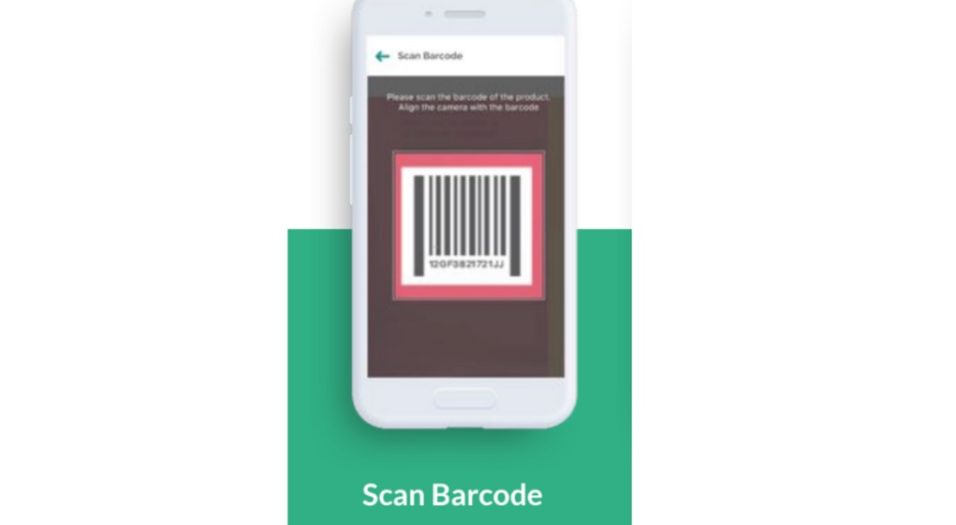
    The new tool, which is set to launch at the end of April, can supposedly tell users if a food product is likely to be halal or not – just by scanning its barcode or ingredients list.

    The Halal Scanner will be integrated into the existing WhatsHalal app, which was designed as a halal food guide for consumers, businesses and enterprises.

    The WhatsHalal app was launched in February last year, around four months after entreprenuers Azman Ivan Tan and Salehin Amat Kamsin first co-founded the tech company.

    Although the app offers four other key services to consumers – a halal restaurant listing, food delivery, takeaway food orders and restaurant reservations – only the listing service is available now due to a revamp of the app.

    A beta version of the upcoming Halal Scanner is expected to be launched in all of WhatsHalal’s available countries – Singapore, Malaysia, Indonesia and Australia.

    In an interview with Business Insider, Azman, who is now CEO, and Salehin, who serves as chief operating officer, said that they are expecting at least 50,000 products to be scanned in the first few months after the launch.

    During this phase, the WhatsHalal team will identify scanned ingredients which require halal verification. According to Salehin, about 150,000 potential ingredients are expected to surface for validation.

    How it works

    The scanner has three identification methods – product image, barcode and ingredients list – and all of them work based on community-driven data collected over time.

    Users first take a photo of a product in the app. If WhatsHalal’s back-end team is able to verify that the product’s packaging contains the Islamic Religious Council of Singapore (Muis) logo, it will automatically accept that the product is halal.

    The data is then stored in WhatsHalal’s system and the next time a user scans a barcode of the same product, the app will immediately indicate that it is halal.

    In cases where a product does not bear a Muis logo, its ingredients list come into play. After a user scans the ingredients list on the app, WhatsHalal automatically conducts an optical character recognition (OCR) on it.

    “If it doesn’t have a Muis logo, what we do is we let the system learn over time. By default, the system knows – if there’s salt and sugar, the system will flash ‘halal’ and ‘halal’. Only when they see pork, it will immediately say ‘not halal’. Very clear cut,” Azman, who has 20 years of experience in technology and business management, said.

    But for ingredients that are in the grey area, more information will be shown so the consumer can make a more informed choice. One such ingredient is gelatin, which can be from different sources such as fish or beef.

    “You can click on that, and we’ll show you a little bit of information, such as gelatin from (a certain country) is likely halal, and (if it’s) from China then it’s likely non-halal,” the 42-year-old said.

    If a significant number of users were to raise their concerns on a particular product, WhatsHalal will engage certified, external halal consultants to conduct thorough checks on whether its ingredients are likely halal or not.

    “So if this (a product) comes from XYZ company, and, say, this company has been certified by a proper certifying body, we’ll take it as yes – our halal consultants don’t need to check all the way. But if it’s not certified they’ll check with manufacturers,” Azman said.

    Salehin, 32, said that while the aim of the Halal Scanner is to verify as many products as possible, there is also a need to be practical by recognising operation constraints.

    “We must put things into perspective – there’s a small number of Muslims in Singapore, but millions in Indonesia and Malaysia,” he said. It is hence not practical to expect the WhatsHalal team to be able to check every single product scan that comes in.

    And that’s where the WhatsHalal database will shine.

    “The more people scan, the more we build up product database,” he said.

    The company is even looking at incorporating a translation feature within the scanner, so that users can scan products bought from other countries and still collect the information they need to make a decision.

    Helping Muslim customers make better decisions faster

    With the Halal Scanner, Azman and Salehin hope to help customers make decisions more quickly by speeding up the halal food identification process.

    “When we go to a supermarket, the first thing we do is look at the ingredients list. As a Muslim, we’re sure that some ingredients are halal, but not so sure of others. So we’ll check online, and that’s a lengthy process sometimes, given that each product has, say, 10 ingredients,” Azman said.

    “So what happens with our system is we actually just speed up the process and make it easy. All the information is at your fingertips,” he added.

    But Azman emphasised that the Halal Scanner is not created to dictate a user’s decision. Rather, it serves as a guide for informed decision-making.

    “We will not be able to tell you that something is 100 per cent halal… we leave it to the end user to make the decision. We are only helping you to map,” he said.


    Source: BusinessTimes
deneme bonusu