Tag: culture

  • Mohd Khair: Singaporeans Are Capable Of Living Together Respectfully, Beyond Mere Tolerance

    Mohd Khair: Singaporeans Are Capable Of Living Together Respectfully, Beyond Mere Tolerance

    it is very HEARTENING indeed when Non-Muslim Singaporeans demonstrate deep understanding and empathy on the issues surrounding the ambiguous halal status of bazaar at Geylang Serai organised in the month of Ramadhan.

    Read the screenshots shared here in this album. They show genuine concern of Non-Muslim Singaporeans on the issue of non-halal status of some foodstalls at Geylang Serai Bazaar, organised in the month of Ramadhan.

    Such demonstration of care and concern is a fine example of how diversity is celebrated in the multiracial and multireligious society of Singapore.

    Underlying such expression of understanding and empathy is the value of RESPECT, going beyond tolerance. Such thinking also reflects maturity living harmoniously together. Together, regardless of race, language or religion, the multiracial and multireligious society of Singapore should move more in this direction in living harmoniously with one another.

    This album is saved here on this HCRS group as it reflects deep halal discernment among Non-Muslim Singaporeans towards the basic dietery needs of the Muslim consumer. Such discernment is very highly appreciated by Muslims who care so deeply on matters pertaining to halal foods.


    Source: Mohd Khair

  • Modern Malay Wedding: Full Karaoke Session, Groupies, Gangster Rituals And “Wedding Critics”

    Modern Malay Wedding: Full Karaoke Session, Groupies, Gangster Rituals And “Wedding Critics”

    If attending a Malay Wedding meant for you to take turns singing and showing off your vocal talent and choosing the most ridiculous unrealistic songs ever, then you are missing the whole point of attending a Wedding. And best of all eating still when the bride and groom arrived displaying ignorance and being disrespectful. Agree not but the Malay Wedding has become a Karaoke session recently. With their grating voice coming from the nose and flat, I wonder what they are smoking before holding those microphone. And most of the time they sounded depressed over the mic instead of singing and all you want to do is throw your fork and spoon at them. I can only feel sorry for these people and those who had to listen while eating and who too could easily choked to death.

    Let’s move on to the way the young people dress – MAT & MINAH. Seriously where are your customs and values? I don’t care how “Gangster” you are or how cool you want to look like but this is someone’s Wedding (I hope you were really invited). Boys you don’t wear bermudas with short sleeves showing off your tattoos swinging your god knows what Logo stickers paste all over your helmet. And girls you don’t wear tight ripped jeans with short sleeves and snicker! And tie up that nasty looking gold yellow hair if you can’t set it nicely please, really.
    What’s wrong with you people? You go to school? Watch TV at least? No?
    I believe you do somehow in that tiny little brain have seen somewhere how the Malay Traditional cloths or a decent cloths people dress for this occasion. You for sure have no respect for the elderly people there, the family members and relatives of the b&g, neither do you have any respect for yourself.

    And then we have those “free lance critics”taking notes about the whole event, from the food to the bride & groom attire. seriously, go kill yourself or attend a funeral. They save money for this special day so shut up and eat or go home drink Dettol and die nicely near your toilet seat.

    Finally, the “groupies” with the same printed logo T-Shirt from Queensway Shopping Center marching in like a Rugby team chanting some kind of poem that gives them a “Super natural power”. Singapore Sports Hub is it? What’s up with that? What are you resembling again? Which community? What group? Groupon? I thought groupies were from the 80s. Next time we all shall clap for them and throw flowers.

    Listen, we all know that Malay Wedding are held mostly in the neighbourhood void deck/halls where everyone could see. And we are quick to react and get upset when other race comment about how we behave, the noise level the ridiculous behaviour and the list could go on. But the fact is, people like this gives the Malay a bad name.

    But of course having said all this, there are those respectful ones though who dress accordingly and behave properly. They are what we call, Civilised people.

    I am not spreading hate here. I am a proud Malay myself. But I feel some of us have tolerated a lot of this kind of nonsense. Not cool man, not cool.

    #So much of preserving our culture.


    Rilek1Corner

    Source: Luciano Lucky

  • Netizen: Singaporeans Should Stop ‘Choping’ Seats With Tissue Paper

    Netizen: Singaporeans Should Stop ‘Choping’ Seats With Tissue Paper

    A netizen, Davi Beschizza, has shared her views about the Singapore culture of reserving seats in crowded eating places using objects such as tissue papers.

    According to Davi, she encountered a young man seated at a hawker centre waiting for 6 of his companions to order their food. She was carrying an umbrella, a handbag and a tray with a bowl of very hot soup and was looking for a seat for herself.

    When she asked the man if the seats were taken, the man replied affirmatively.

    She started to comment that it was not fair for the man to reserve the entire table while his friends were ordering food, and said that it was not fair for her as she did not have the luxury of having someone to “chope” a table for her.

    She and the man got into an argument. Davi eventually forced the entire group to relocate to another table, leaving the table open for herself.

    She wrote: “I do not believe this kind of behaviour is any style at all, let alone “Singapore style”. There are no positives to this habit of reserving tables. It has gone on for long enough.”

    Source: www.allsingaporestuff.com

  • Javanese Spoken To Share Secrets

    Javanese Spoken To Share Secrets

    As a child, Mr Suryakenchana Omar would often eavesdrop on his parents speaking in Javanese from his bedroom.

    “As soon as they realised I was awake, they would switch to Malay,” said the 44-year-old director of a training firm.

    Mr Haider Sahle has similar memories from his childhood spent with his grandaunt. “Whenever my elders didn’t want the children to overhear or understand what they were saying, they would speak in Javanese,” recalled the 36-year-old production editor.

    But eavesdropping helped him to pick up Javanese words and phrases.

    Mr Haider and Mr Suryakenchana serve as vice-president and honorary secretary respectively of the Javanese Association of Singapore, which was formed in 2015.

    There are 89,000 ethnic Javanese in Singapore, according to 2010 census records, making them the largest Malay sub-group here.

    But few speak the language, said Mr Suryakenchana.He added that there may be many more Javanese Singaporeans but they now identify themselves as Malay.

    According to 1825 census reports, there were only 38 Javanese residing in Singapore. But by 1891, the number had climbed to 8,541, with many first moving to Kampung Java. They assimilated quickly, picking up the more commonly spoken languages of Malay and English, said Mr Haider.

    That was what happened with Mr Mohamed Saat Mokhtar’s Javanese father, who emigrated to Singapore as a labourer in the 1940s. Although both Mr Mohamed Saat’s parents were from Java, they spoke to their children in Malay.

    “My father was looking for a better future in an environment that was alien to him,” said the 53-year- old senior manager in an engineering firm. “He had to assimilate into the culture here and make sure that his children also fit in.”

    Now, these men want to rediscover the language and culture.

    Mr Mohamed Saat has been learning Javanese primarily through conversations with his Indonesian domestic helper.

    In 2010, Mr Haider started a Javanese language class with seven others under the tutelage of linguist Gloria Poedjosoedarmo. But in 2014, the classes had to be stopped due to Dr Poedjosoedarmo’s poor health.

    Though many are interested, Mr Suryakenchana said there are few qualified Javanese teachers here, adding that the hierarchical nature of the language makes it difficult to learn.

    There are three different registers – Ngoko, Madya and Krama – and the words used differ based on the status of the audience. Ngoko is used between friends while Madya is used between strangers. Krama is used when speaking to elders and those of higher social standing.

    In Ngoko, the question “What is your name?” would be “Jenengmu sapa?”, while in Madya, it would be “Asmane sampeyan napa?”. The same question, in Krama, would be “Asmanipun panjenengan punapa?”

    Apart from vocabulary, the intonation also differs. While Ngoko is spoken in short bursts, Krama is softer and more nuanced.

    “Just to say one word, you have to think through the three levels for which word to use,” said Mr Suryakenchana, who also researches and gives talks on Malay and Javanese culture.

    He added that while the language may be lost here, the culture lives on in the enduring popularity of batik as well as nasi ambeng, a traditional dish of a mountain of rice served with various meat and vegetable dishes on a communal tray.

    Non-Javanese are also embracing aspects of the culture.

    About a third of the members of the Singa Ngalaras Gamelan Ensemble – a National University of Singapore group which plays traditional Javanese music – are not of Javanese descent.

    They include master’s student Thow Xin Wei, 33, who started playing a decade ago. In 2010, he was given a scholarship by the Indonesian authorities to further his studies in gamelan music in Solo.

    For his 25-year-old daughter’s wedding next month, Mr Mohamed Saat plans to hold a traditional Javanese ceremony complete with unique rituals such as the timbang, where the couple sit on the lap of the bride’s father to symbolise that he will treat both fairly.

    Mr Suryakenchana said the Javanese here have not been as active as other Malay sub-groups in promoting their culture. But he holds to the Javanese philosophy of “sepi ing pamrih, rame ing gawe”. “It means to work without drawing attention to yourself,” he added.

    Balancing two cultural identities – Javanese and Malay – is not a problem. “I’m both. I could be wearing baju kurung in the morning and a batik shirt in the afternoon,” he said.


    Source: www.straitstimes.com

  • Q&A – The Muslim Perspective On Chinese Traditions

    Q&A – The Muslim Perspective On Chinese Traditions

    # Q&A on CNY (Chinese New Year) Celebration ~ answered by Ustaz Hamzah Jummat

    Question 1:

    Assalammualaikum Ustaz,

    What about these questions?

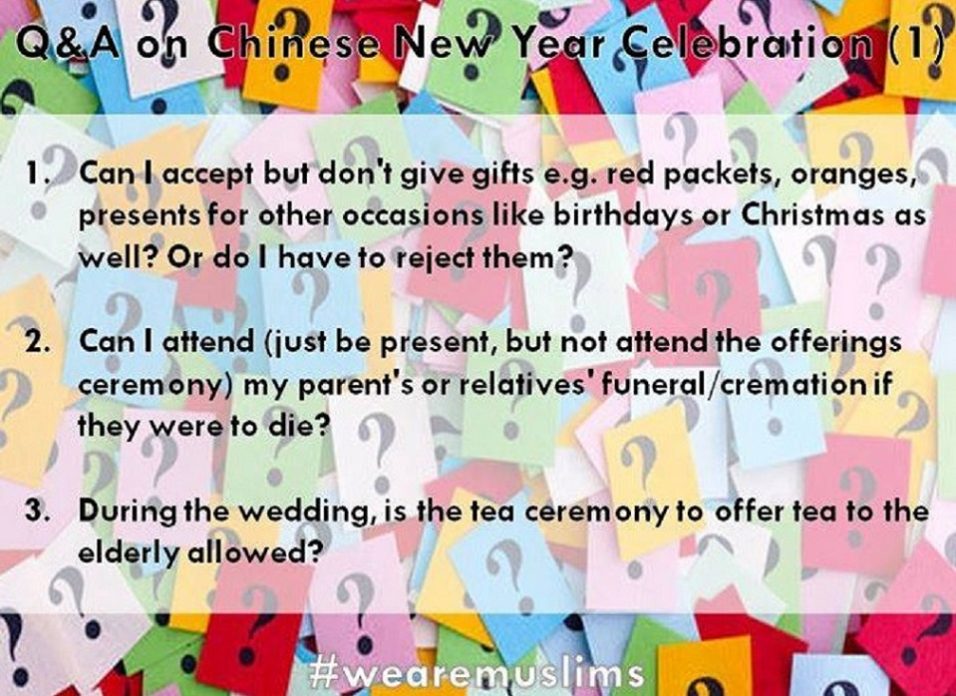
    Can I accept but don’t give gifts e.g. red packets, oranges, presents for other occasions like birthdays or Christmas as well? Or do I have to reject them?

    Can I attend (just be present, but not attend the offerings ceremony) my parent’s or relatives’ funeral/cremation if they were to die?

    During the wedding, is the tea ceremony to offer tea to the elderly allowed?

    I hope your clarifications can help.

    Awaiting for your kind respond.

    JazakALlahul Khairan Kathiran.

    Regards & Salam
    Wendy Ong

    Answer for Question 1:

    Wa’alaykumussalaam wa rahmatuLLaah,

    Bismillah walhamdulillah wassolaatu wassalaam ‘alaa Rasulillaah wa aalihi wa ba’d,

    1. According to some scholars of Islam, as you may read below, it is permissible to accept. But some others were of the view that it is not permissible, and they all unanimously agreed that it is prohibited to give. Please read below. The reason for their dispute in accepting gifts is to those who permitted, one who accept does not in any way commemorate the occasion, whereas those who disallowed viewed that accepting inevitably means agreeing and contributing to the commemoration of the occasion. Wallaahu a’lam. The best is to avoid and even if one were to accept, it is better to explain, since if one were to just accept without explaining one’s stance in this matter, the giver will continuously gives on the occasion on a yearly basis and it becomes a form of observance of the occasion. Wallahu a’lam

    2. Whatever involves rituals and practices or activities related to ways and beliefs not from Islamic teachings, and especially so when they are related to false beliefs against the teachings of Islam. It is obligatory for a true muslim to avoid. The verse in Soorah al-Furqan: 25:72: “And those who do not witness falsehood [al-zoor]…”. Even without doing them and yet to be present when they are being performed is falsehood and a wrong doing. So you are not to be present at the place where they perform the rituals and the procession of the Final Respect and not also the Cremation. But it is permissible for you to be near without having to witness all these. Wallahu a’lam.

    3. I do not know of this ceremony if it has any false belief intertwined with it. If it is just a manifestation of filial piety and respect for both parents, it is permissible Inshaa Allaah, wallaahu a’lam.

    #cny #aqeedah

    Source: http://www.al-jamaah.sg/2016/02/2-questions-on-cny-chinese-new-year.html

    Channel Telegram – https://telegram.me/islamIQsg
    ☢ Channel YouTube – https://www.youtube.com/IslamIQsg


    Source: Islamic SG