Tag: walkover

  • Commentary: The Concrete Plan Behind The Presidential Election (A Malay Edition)

    Commentary: The Concrete Plan Behind The Presidential Election (A Malay Edition)

    1. First they came and tinker with the presidential system to further entrench their grip on power

    2. To do so, they need a pawn to justify the tinkering

    3. Enter the Malays

    4. Offer highest position available in the country

    5. Rationalize by stating that the Malays can never win in an open election

    6. Raise the criteria so that only a selected few would be eligible. Limit suprises

    7. Call for an election

    8. Disqualify anyone not meeting the criteria

    9. Achieve a walkover. It doesnt matter that the preferred candidate will forever carry the burden of not having the mandate of the people. Retain control at all cost

    11. Declare endorsed candidate winner.

    12. Mission accomplished

    Well done!


    Source: Khan Osman Sulaiman

  • How Singapore Elected A President Without A Vote: Only One Eligible Candidate Thus Victorious By Default

    How Singapore Elected A President Without A Vote: Only One Eligible Candidate Thus Victorious By Default

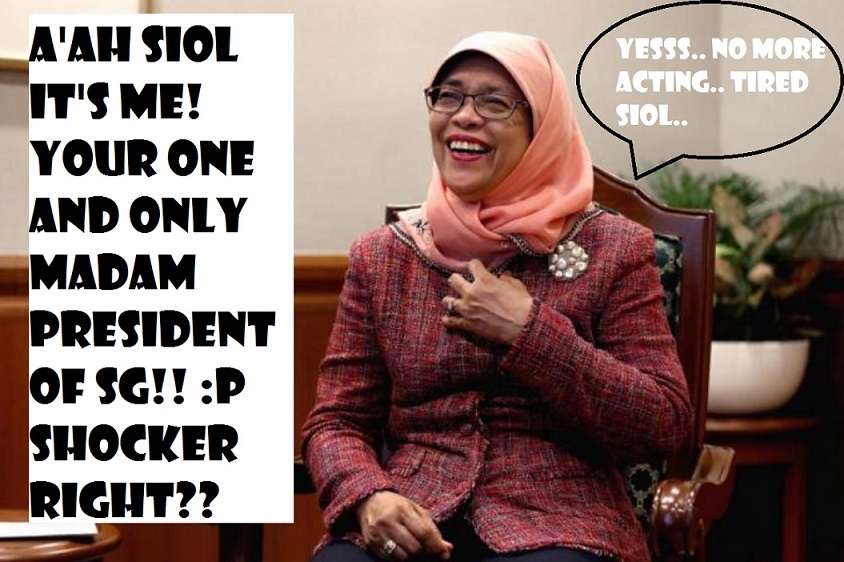
    Singaporeans were meant to go to the polls at the end of next week to vote for a new president, but they’ll no longer have the chance, with only one candidate qualifying for the race. Former Speaker of Parliament Halimah Yacob has emerged victorious by default, after other presidential hopefuls fell foul of new rules.

    “I can only say that I promise to do the best that I can to serve the people of Singapore and that doesn’t change whether there is an election or no election,” she told reporters Monday. What should be a moment of celebration — Halimah will be Singapore’s first female president — has proved contentious for several reasons and appears at odds with Singapore’s reputation as a technocratic and efficient city state. While the office of president is largely a ceremonial role in Singapore, he or she has power to veto some of the government’s decisions, for example in fiscal matters that touch on the country’s reserves, or key appointments in the public service. “The only beneficiaries from this reserved presidential election are Halimah Yacob and her team, as well as Singapore’s opposition, which now has a new line of attack against the PAP (People’s Action Party). The rest of Singapore has suffered,” Sudhir Vadaketh, a Singapore author and commentator, told CNN. Halimah was, until recently, a loyal member of the ruling PAP, which dominates Singaporean politics.
    “All Singaporeans are unhappy that meritocracy and electoral fairness, core Singaporean values, have been eroded to fulfill perceived political goals.”

    Racial politics
    In this election, for the first time, candidates to become Singapore’s president could only come from one racial group: Malays. It’s a radical policy that would likely prove divisive elsewhere but it’s one the Southeast Asian nation said was necessary to ensure better representation among the country’s three main races: Chinese, Indian and Malay.
    “It shows we don’t only talk about multi-racialism, but we talk about it in the context of meritocracy or opportunities for everyone, and we actually practice it,” Halimah told The Straits Times newspaper, before declaring her intention to contest the election.

    The new rules also set stricter criteria on the background of candidates. For example, those from the private sector are required to be a chief executive of a company, with at least $370 million in shareholders’ equity. The two other Malay presidential hopefuls — businessmen Salleh Marican and Farid Khan — failed to gain Certificates of Eligibility from the Presidential Elections Committee on these grounds, although the Presidential Elections Committee could have exercised its discretion to allow them to run for the office. Critics charge that the new rules are a way for the government to stage-manage the election and prevent opponents from running.

    In August, Singapore’s appeal court ruled against a legal challenge to the new system by ruling party lawmaker turned critic, Tan Cheng Bock. Tan had narrowly lost the previous presidential election in 2011 to Tony Tan, a former deputy prime minister widely recognized as the government-favored candidate, and planned to run again. Singapore’s population is 74% Chinese, 13% Malay, 9% Indian and 3.2% are the ambiguously named “Others.”

    New rules
    The announcement late Monday by the Elections Department that only one candidate had qualified marks an underwhelming conclusion to a controversial election carried out under changes to the elected presidency system in Singapore voted through Parliament earlier this year. Specifically, the amendment states that an election will be reserved for candidates from a particular racial group if the previous five elections have not produced a president from that racial group. In Singapore, it’s dubbed a “hiatus-triggered model.”

    “Every citizen, Chinese, Malay, Indian or some other race, should know that someone of his community can become President, and in fact from time to time, does become President,” said Lee Hsien Loong, Singapore’s prime minister, last November before the new rule was introduced. Singapore hasn’t had a Malay president since the country’s first President Yusof Ishak, who served as head of state from 1965 to 1970. Subsequent presidents have been from the Eurasian, Chinese and Indian communities.

    Debate
    The election has also triggered debate on who is Malay and raised questions over how an individual’s race can be determined. Candidates were required to be assessed by a five-member community panel to certify their race as Malay as part of the qualifying criteria. Halimah, who has successfully stood as a Malay candidate in previous general elections, is reported to have an Indian father. Moreover, Salleh Marican also has an Indian father, while Farid Khan’s identity card lists his race as “Pakistani,” the government-controlled Straits Times reported. What’s more, critics point out that, if the goal really was to improve racial representation and justice, more meaningful measures could be adopted.

    The Chinese form the majority in Singapore and often dominate in positions of power and influence. Singapore’s prime minister has always been Chinese, and it was only in 2015 that the country finally had more than one Malay minister in the Cabinet at one time. The Malay community typically have lower incomes and grapple with institutional discrimination, such as in the armed forces.

    “While reserving the presidential elections for only Malays is a highly symbolic gesture, there is a need to do more for concrete issues faced by the Malay community such as discrimination, lack of social mobility and relative poverty,” lawyer Fadli Fawzi told CNN. “I think that it is more important to focus on removing barriers and improving the lot of the man on the street rather than reserving slots for one or two individuals.”

    Speaking at a forum on Friday, Chan Chun Sing, a minister in the Prime Minister’s Office, acknowledged the unpopularity of the new system, saying that it would be a “hard journey” to convince Singaporeans that the change was necessary. He denied accusations that the amendments were made for political gain. “We are prepared to pay the political price, because we think the future of our country is much more important than any political capital that we may have,” he said.
     

    Source: http://edition.cnn.com

  • SDP On EP Walkover: PAP’s Contempt For Our Constitution And Our Flag Must Be Roundly Condemned

    SDP On EP Walkover: PAP’s Contempt For Our Constitution And Our Flag Must Be Roundly Condemned

    Singapore Democrats

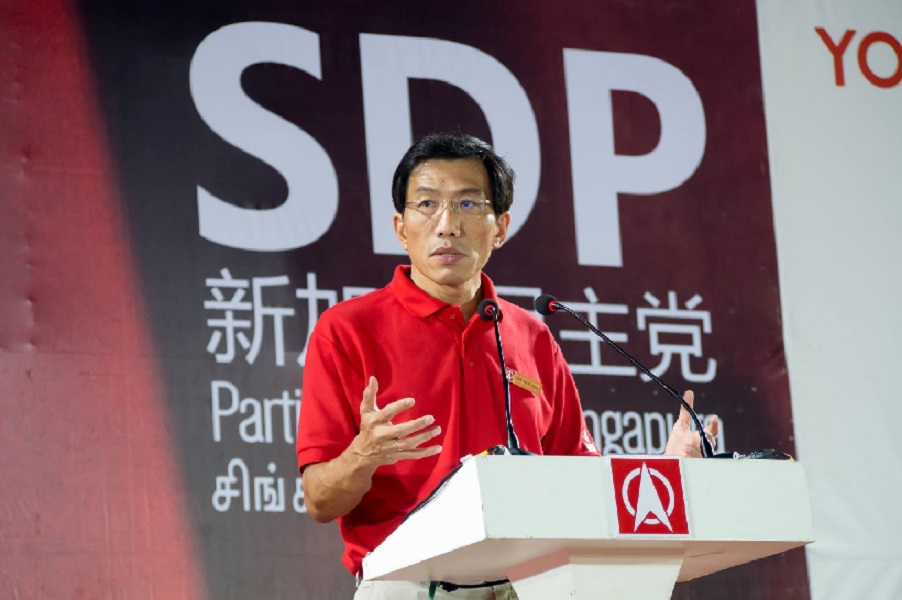
    The walkover of the Presidential Election comes as no surprise. The PAP had changed the rules and revised the criteria of the Elected Presidency to pave the way for Ms Halimah Yacob to assume the office.

    Nevertheless, this is a sad day for Singapore. The rule of law has been mercilessly mocked and denigrated. The contempt the PAP has shown for our constitution and our flag which symbolises the ideals of democracy, unity and progress must be roundly condemned.

    By doing what it has done, the PAP has shown yet again that its only goal is to strengthen its grip on power. That the goal is detrimental to the interests and progress of Singapore is of secondary concern to the party.

    It is bad enough that the PAP has manipulated the system to get one if its own to become the president. That it has dangerously played the race card and divided the people to achieve this must be of grave concern to all Singaporeans.

    The SDP protests this outcome in the strongest manner possible.


    Source: http://yoursdp.org

  • Commentary: All 4 Elected Presidents So Far Are Either Ex-PAP Ministers Or From Gov’s Ranks

    Commentary: All 4 Elected Presidents So Far Are Either Ex-PAP Ministers Or From Gov’s Ranks

    So it is a walkover. Singaporeans will not need to vote for their next President. True to form; a long, iniquitous history of rigging the system. From third world to first economically, and the reverse politically–the country’s lurched from minimalist electoral democracy to illiberal democracy to sham democracy. As Andrew Loh has detailed.:

    “After JB Jeyaretnam won Anson in 1981’s by-election, they introduced the Non-constituency MP (NCMP) scheme in 1984.

    After both JB Jeyaretnam and Chiam See Tong won seats in 1984, they introduced the GRC system in 1988.

    After Low Thia Khiang won Hougang in 1991 and the SDP won 3 constituencies, they increased the size of GRCs from 3-4 to 5-6 in the 1997 GE.

    After the WP won Aljunied in 2011, they announced changes to the Town Council Act.

    After President Ong Teng Cheong became president in 1993 and questioned them about the reserves, they went back and changed the Constitutional powers of the Elected President in 1994, which allowed the govt to bypass the president’s scrutiny when statutory boards and Government companies transfer their reserves to the Government.

    And now, after Tan Cheng Bock almost won the last presidential election, they have – once again – gone back to change the Constitution, to introduce the “Reserved Election” which allows them to bar all Chinese from such an election, including someone like Dr Tan.

    And finally, while the Elected President is said to be a check on the (PAP) Government of the day, all 4 Elected Presidents so far are either ex-PAP ministers (Ong Teng Cheong, Tony Tan, Halimah Yacob, presuming she wins in September), or from the Government’s ranks (SR Nathan).

    Coincidence? Or #OwnselfCheckOwnself taken to its shameless extreme?”

    And to that I add: #reservedforPAP


    Source: Alfian Sa’at

  • PRESIDENTIAL ELECTION WALKOVER; HALIMAH YACOB’S TITLE OF MADAM PRESIDENT NOT A MYTH

    PRESIDENTIAL ELECTION WALKOVER; HALIMAH YACOB’S TITLE OF MADAM PRESIDENT NOT A MYTH

    Singaporeans will not have to vote for their new President as only one Certificate of Eligibility has been issued.

    This was announced by the Elections Department on Monday (Sep 11) in a press release reproduced below:

    Five individuals applied for a Certificate of Eligibility. Of these five individuals, three declared that they belonged to the Malay community and applied for Malay Community Certificates.

    Decisions on Certificate of Eligibility
    The PEC has decided to issue one Certificate of Eligibility.

    Decisions on Community Certificates
    The CC referred all three applications for a Malay Community Certificate to the Malay Community Sub-Committee (MCSC), and the MCSC has concluded that all three applicants belong to the Malay community. The CC will therefore issue three Malay Community Certificates.

    As this Presidential Election is reserved for the Malay community, the CC rejected the two community declarations where the declarants did not declare themselves to be a member of the Malay community.

    Individuals issued with both Certificates
    One individual will be issued with both the Certificate of Eligibility and the Malay Community Certificate.

    Notification to candidates
    The Elections Department has notified all five individuals on the outcome of their applications. Reasons were also given to the unsuccessful applicants for a Certificate of Eligibility. The PEC and the Elections Department will not, in the first instance, publish the names of the unsuccessful applicants or the reasons given to them. This is to give effect to the recommendation of the Constitutional Commission that unsuccessful applicants should not be disclosed to the public, to reduce the prospect of potential applicants being dissuaded from stepping forward to contest the elections. An unsuccessful applicant is free to publish the reasons given to him or her.


    Source: http://www.channelnewsasia.com