Tag: Tamil

  • Thaipusam: Sweet Music, Noise, Or Public Disorder?

    Thaipusam: Sweet Music, Noise, Or Public Disorder?

    By M Ravi

    Thaipusam and the Right to Religious & Cultural Practice in Singapore

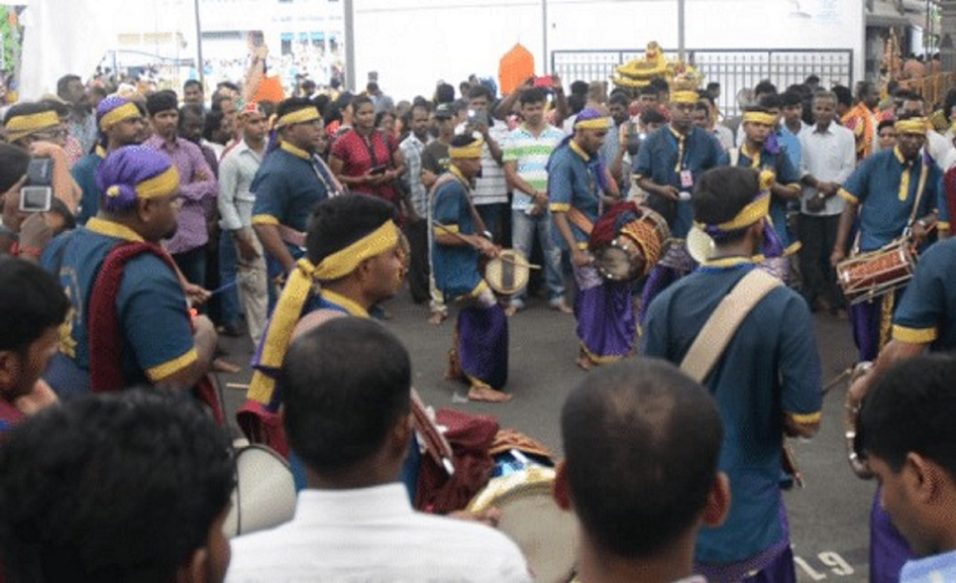
    Thaipusam has been an integral part of my religious and cultural upbringing. As a child, I attended, supported and even participated in the festival. Singapore’s Tourism Board lists Thaipusam as an event in its rich diverse cultural heritage calendar. Each year, the streets are lined with supporters, devotees and curious tourists alike. The festival, however, has been shrouded in controversy in Singapore – the consequence being that thousands of Singaporeans would rather chose to flock to Batu Caves in Malaysia to celebrate the festival.

    The reason for the controversy was a 42-year-old ban on the playing of live music during the festival. First imposed in 1973, the government argued that the blanket ban on loud live music was necessary to quell disorder as several fights often disrupted between competing groups, thus disrupting the procession and risking the lives of spectators and accompanying supporters.

    I have written previously about this “Silenced Festival” in my book Kampong Boy and how in 2011, I myself stepped up as a plaintiff with the Attorney-General’s Office and the Hindu Endowments Board (HEB) that is responsible for running and organising the festival, as the defendants. This was the first time someone challenged the live music ban in court. Unfortunately, my legal action before then Justice Steven Chong, did not succeed due to the points I listed in the book.

    The Legalities

    Article 15(4) of the Constitution gives the executive branch of the government the broad authority to restrict the practice of religion in accordance with the law – the caveat being that the decision-maker’s power to do so may be challenged in Court. Additionally, the Public Order Act and its related regulation empower the Commissioner of Police to impose such conditions as he deems fit for the purposes of making an application for a licence to hold a public assembly or a public procession.

    Of particular relevance to Thaipusam are regulations 8(1)c and 8(2)c which do not permit singing or music, gongs, drums or the playing of music-producing equipment. Also public processions require permits and applications which also have conditions attached.

    2015 Case

    In 2015, three men were arrested during a scuffle which took place during a Thaipusam festival. In the ensuing case, Vijaya Kumar s/o Rajendran v Attorney-General, the three Applicants cited their constitutional rights to freedom of religious practise and equality before the law to challenge the conditions which prohibited the use of musical instruments (other than at certain fixed points) during the procession.

    The Applicants argued that music from an urumi is a fundamental aspect of the religious practice of marching in the Thaipusam procession and that the music conditions imposed constituted a breach of their rights to practice their faith without interference.

    The case raised important questions including firstly, the proper meaning of the term “public order” under Article 15(4) of the Constitution, secondly, the type of state interests which can justify restricting a religious liberty, thirdly, the degree of harm that must be posed by a religious liberty before it can be restricted, and fourthly, whether the possible hostility of third parties to a person’s peaceful exercise of faith can be deemed as constitutionally relevant under the “public order” consideration.

    I got involved in the case through my connections with the legal team at Eugene Thuraisingam LLP representing the Applicants. Everything balanced on being able to prove that the relevance of musical instruments was an integral part of Thaipusam and therefore to the practice and religion of Hinduism. We tried to find experts in Singapore who were able to affirm the position in our favour. We were confronted with the reality that as most temples in Singapore are affiliated to the government’s HEB, no one was willing assist the Applicants. I recall the day, I travelled with Eugene Thuraisingam who led the legal team to seek Hindu experts from across the border who were willing to share the history and origins of the procession and to explain the relevance of music and devotional songs played during the festival. We were thrilled to find Tan Sri Datuk R. Nadarajah, Chairman of the Batu Caves temple in Kuala Lumpur.

    The expert stated that the “playing of the musical instruments forms an integral and inseparable part to the carrying of the Kavadis” because the music facilitates the Kavadi carriers to “enter into a trance” which then enables them to bear the enormous physical burden and pain of weight of the hoisted Kavadi. The music is an essential part not just to the procession but also to the “nature of worship”. The expert’s affidavit went as far as to state that the taking away of the musical instruments would be “traumatic” for the Kavadi carrier as the trance will be broken and he will feel immense physical burden and unbearable pain from the body piercings. Without the music, the devotee is more likely to be “distracted from focusing on the divine”.

    In the end, the High Court dismissed the application on the grounds that the public order proviso to freedom of religion was made out, and the differential treatment was justified. The Applicants appealed, but later decided to withdraw their case in the light of increased dialogue between interested parties and the announcement by the government to relax the live music rule.

    Music to the Ears – Latest Developments

    In 2016, Hindu devotees in Singapore received their first bout of good news. The 42 year old ban on live music was lifted and live music was allowed to be played from 3 stages at different points during the procession. Broadcasted music was also permitted at 7 other locations. The Chairman of HEB was able to proudly announce that “there won’t be a stretch that is without music”. He also added, “The kavadi bearers pierce their bodies, causing enormous pain, as part of the vows they have taken. The music will be useful in reducing the pain and enhancing their spiritual focus throughout their journey.

    The latest bout of good news came last week. This year’s festival which will fall on the 9th of February, will see music broadcasted at 23 points along the 4km stretch. Live music will be continued to be played at 3 stages where musicians will play traditional classical Indian instruments so that the younger generation understands their rich cultural heritage and be interested to learn these instead of the modern western style drums and bongos which have appeared at the festival in recent years.

    No doubt tremendous progress has been made to listen to feedback from the Hindu community and from devotees. Participants are still not yet allowed to bring their own musicians or musical instruments and some restrictions remain. I personally hope some faith will be restored in the celebration of this festival in Singapore and that fewer Singaporean Hindus see the need to cross the border to partake in such a monumental and colourful festival.

    As I wrote in my book, it is hard to think that over 155 years of tradition and devotion could be “cowed into quietude”.


    Source: www.theonlinecitizen.com

  • Deepavali vs Diwali Debate Explains Singaporean Tamils’ Unhappiness With Foreigner Influx

    Deepavali vs Diwali Debate Explains Singaporean Tamils’ Unhappiness With Foreigner Influx

    A Channel NewsAsia’s Deepavali special got my attention today for two reasons. One the news presenter said: “Deepavali also known as Diwali”, and secondly because the presenter also referred to Deepavali as a “Hindu New Year”.

    (You can view the entire segment here: http://bit.ly/2e3oc2T)

    Just like a friend who commented on my Facebook post on the topic, I too have an issue with our national broadcaster needing to translate Deepavali (as it is said in Tamil) into Diwali.

    My friend said: “Tamil is one of our National Languages. I would rather they stick to Deepavali. I am not Tamil myself but grew up with it. I know many don’t see it the way we do and that is their right, But i would like the media to stick with Deepavali.”

    I think my friend is absolutely right when she added: “I don’t think the sudden use of Diwali has anything to do with the considerations of the Singapore bred North Indians…It has to do with the new citizens from North India who have come here.”

    Responding to my post, another friend asked if it was offensive to say ‘seng jia jiu yi’ instead of ‘xing nian kwai le’ (Happy Chinese New Year). I think it is different.
    2Yet another friend chimed in and said that CNA did mention ‘Deepavali’ as well as ‘Diwali’ and so it is ok. He said that if an organisation totally replaces ‘Deepavali’ with ‘Diwali’ it would be wrong and that Jurong Point Shopping Centre has done precisely that.

    Considering that Jurong has Tharman Shanmugaratnam as its anchor-Minister for the constituency, I am surprised that Jurong Point Shopping Centre has done that.

    Some in the Singaporean Tamil community have felt unhappy and sidelined by the non-inclusion of Tamil in certain prominent spaces (like the Changi Airport), which has also made international news. CNA’s production has got to be called out at least for that – because if we keep quiet then it may be accepted as a norm.

    My friend Gangasudhan writing on the same topic last year said that he felt like a second class citizen in his own country.

    “In recent days, many in the Tamil community have had their panties in a bunch because some shopping centres and even Changi Airport have started putting up Christmas decor even though Deepavali is right around the corner – in other words, not a single F was given for this festive occasion. While there is good reason to feel marginalised by this callous attitude in multiracial Singapore that champions racial harmony – complete with a special day each year to wear ‘costumes’ and ‘celebrate’, I am surprised that anyone is surprised by this.”

    The larger issue of course is how uninformed the majority in Singapore is despite 50-years of the Government promoting multi-racialism and multiculturalism. If the national broadcaster can be confused if Deepavali is a Hindu New Year, is it any wonder that local websites like The Smart Local will try and tease a laughter out of its audience by comparing laddoo (a popular Indian sweet) to diarrhoea?

    Yes CNA, Even if the Marwari, Gujarati, and Nepali of the Indian community celebrate their new year around Deepavali they are not the majority even in India.

    Deepavali is not a Hindu New year.


    Source: http://theindependent.sg

  • More Diversity In Voices Need To Be Heard On Racism In Singapore

    More Diversity In Voices Need To Be Heard On Racism In Singapore

    This article, “Racism in Singapore: Stop telling us minorities how to react to it“. has been shared widely, and I definitely think it is an important voice. I see a growing number of articles/conversations about racism, and a wider range of people speaking up, which I think are encouraging signs that there is more awareness and willingness to talk about race in Singapore.

    I hope the conversation doesn’t fixate on or stagnate at individualised, interpersonal instances of microaggressions, exclusion or privilege. Of course, these experiences aren’t separate from systemic racism, and are in fact deeply linked to them, but the connection often isn’t made as strongly as it could be.

    People switching to Chinese in conversations, friends telling racist jokes, etc are definitely significant and we should keep talking about these things and how they affect us, as well as how we can respond to them. We’ve all had these experiences and can feel solidarity around them.

    But I’m also interested in conversations that I don’t hear as much – about how Malay and Tamil people are overrepresented in prisons, whether they’re more likely to be profiled/picked up for certain crimes than Chinese people are, how Malay students are grossly underrepresented in universities, and what the barriers racial minorities face in accessing education, housing and jobs are.

    I’m interested in critiquing more closely, how our cultures and people are portrayed as backward, lazy, violent, uncivilised and parasitic in national narratives, and whether we can organise to push for anti-discrimination laws, for greater political representation and more in-depth analysis on how the media perpetuates harmful stereotypes about race.

    How many of the 1 in 10 families that live in poverty in Singapore are Malay or Tamil, and how much harder is it for racial minorities to experience intergenerational social mobility? The narrative continues to be that minorities need to work harder to catch up, and some minority groups are held up as “model minorities” and pitted against others. The recent study on Singaporeans’ receptivity to a president of a different race showed that both Indian and Malay respondents would prefer a Chinese candidate over each other. Is this what the success of a divide and rule approach looks like? Solidarity amongst racial minorities is low, and there’s plenty of racism to be explored there too.

    Social problems like unplanned teenage pregnancy, drug abuse and gang culture are ghettoised, stigmatised and pinned to the cultural deficit of minority communities rather than to structural discrimination, alienation and poverty. They’re also not given the same centrality in social policy as problems like gambling, that are more common in Chinese communities, are (as Alfian Sa’at’s play ‘GRC’ points out so well).

    Race needs to be a lens we apply to every social phenomenon we study, and we need more race disaggregated data about everything. The government, certain think tanks and the media are quick to look at race when it is to pin an issue as an “Indian problem” or “Malay problem”, but not to pinpoint racial discrimination.

    To take one example, there’s been a lot of discussion about bullying in Singapore schools – if studies on this also looked at whether racial minorities face more abuse/different types of abuse in school (I’m sure it’s true), anecdotes of interpersonal racism that appear in articles like this would have more context and meaning, and we would be able to offer deeper analysis and make stronger arguments for change. It doesn’t just stop at “my friends needs to be more sensitive” but allows us to demand that MOE, schools and educators take a proactive stance in addressing racial discrimination on a nationwide, school-wide or at least classroom-wide level.

    But maybe there is a different point to be made here too. While there is more interest in discussing race, while there are more voices addressing this now than before, are they diverse enough? Many of these voices, including mine, are middle-class voices. And I believe there are more important voices to listen to, when it comes to racism. The same way that middle-class feminism can silence working class women’s struggles, race consciousness that is not informed by class struggle can be a hazard. I am excited to explore possibilities for organising, for collective action, and to not allow individualised identity politics (or the “cult of individualism”) to become self-limiting or deteriorate into navel gazing.


    Source: www.theonlinecitizen.com


  • Taxi Driver Racially Abuses Indian Passenger

    Taxi Driver Racially Abuses Indian Passenger

    Hello SMRT, I just encountered a very racist taxi driver, licence plate SHC 4460T today at around 6pm. After I got into the cab, he asked me if I’m Malay. I said no, I’m Indian.
    He scoffed and said, “No you’re not Indian. Indian people are BLACK you are not black.” I replied that that wasn’t true and decided not to engage him in further conversation.
    Then he asked me if I speak Malay or Chinese. I said, no I don’t, I speak Tamil.

    “Tamil is most useless language. Even all Indian people here speak Malay. If you are in Singapore you must speak Chinese or Malay not Tamil” Again I said, that’s not true. I’m Indian and I don’t speak Malay or Chinese.

    Then we passed a stall selling durians along Serangoon Road and he remarked that the durians at this stall are very cheap but “Chinese people don’t buy from here because Indian people buy.”  He continued and said, “You know in Singapore Chinese people hate Indian people.” And he made hand gestures as if he’s drinking a bottle. “All Indian people know to do is”- continues making those hand gestures. “They don’t know to help” – I’m assuming he meant that Indian people do not contribute to society apart from paying alcohol tax.

    At this point I had had enough and told him I did not appreciate the comments he had been making about Indians and told him to drop me off by the side of the road. As I moved to get out he said “where are you going pay the fare first”. This was still along Serangoon Road and nowhere near my house where he was meant to drop me off, so I told him if he wants the fare he can drive me to the nearest police station where we can both make reports. Needless to say, he must’ve known what he had been saying was clearly wrong because he then told me to get out of the cab.

    It’s a very sad state of affairs, when just less than a week ago we celebrated 51 years of coming together as a nation regardless of race, language or religion.

    I’m sure that SMRT does not condone such racism amongst any of its employees and I would very much appreciate if this matter is followed up with and the taxi driver in question educated on the need to keep his opinions on certain races to himself.

    Thank you.

    EDIT: Hi guys, SMRT has followed up regarding this incident. I’ve attached a screenshot of their response in the comment section. SMRT thank you for assisting me with this. I have no doubt that this was an isolated incident and in no way represents the entirety of your company or employees. 🙂


    Source: Peshhalaa Davendran

  • Dr Tan Cheng Bock: By-Election Result Is Victory For Multiculturalism

    Dr Tan Cheng Bock: By-Election Result Is Victory For Multiculturalism

    A victory for Multiracialism.

    The results of the Bukit Batok by-election clearly show that a minority candidate can win an election on his own.

    This win by Murali is significant because he won his seat as a member of a minority race in a predominantly (75%) Chinese constituency. And the win is even more telling because it was won in a by-election. Recent past by-election results have not been in favour of the ruling party eg Ponggol East by-election.

    Apart from the many other factors that contributed to his win, an important observation was that, race did not affect his performance of 62%. It is a victory for multiracialism and a sign that voters are more discerning and colour blind.

    The fear that a minority candidate cannot win on his own, resulted in the creation of Group Representation Constituency (GRC) after GE1988. The setting up of this GRC was to address this early concern that minority races may not be represented in Parliament if Singaporeans vote along racial lines.

    This victory by Murali has put paid to this fear and should pave the way for the removal of any race-based politics in future.


    Source: Dr Tan Cheng Bock