Tag: Singaporeans

  • New Malay President When Elected Will Be A Shame To The Malay Community

    New Malay President When Elected Will Be A Shame To The Malay Community

    The new malay president when elected will be a shame to the malay community in singapore. Just mark my words. If the current public servants now are talam dua muka, What good is there to look for in a president that is going to be malay just because the government say so.

    Potential candidates (that is likely picked by PAP) who applies for the position is to be assess by the new community committee to be verified of his or her ethnicity and eligibility. How far back are they going to trace his and his family’s DNA to make a sound and accurate assessment? Eligibility wise, Singaporeans generally know who has already been chosen if not yet. What is the point of the elections then right?

    Those whose names was published recently as potential candidates are now in the spotlight. For those who want to contest, i say good luck. But for those who is going to decline to participate or like Yacob in particular who gave his reasons for not doing so are just being a prick. Who would actually believe that anyone given a chance to get a $4 million paycheck for doing nothing will turn it down. Spare us citizens from the lame excuse of liking the work you doing now just because it is “affecting” Singaporeans. It doesn’t even sound right. So much for serving the citizens.

    No point having a Malay president for the sake of almost 50 years of not having one. One statement says it all. The malay taking that role is a shame to our malay community. we never asked for this in this way and there will never be justice in this. I’m sure many feel this way too.


    B. Doh

    Reader’s contribution


  • New Panel To Certify Ethnicity Of Presidential Hopefuls

    New Panel To Certify Ethnicity Of Presidential Hopefuls

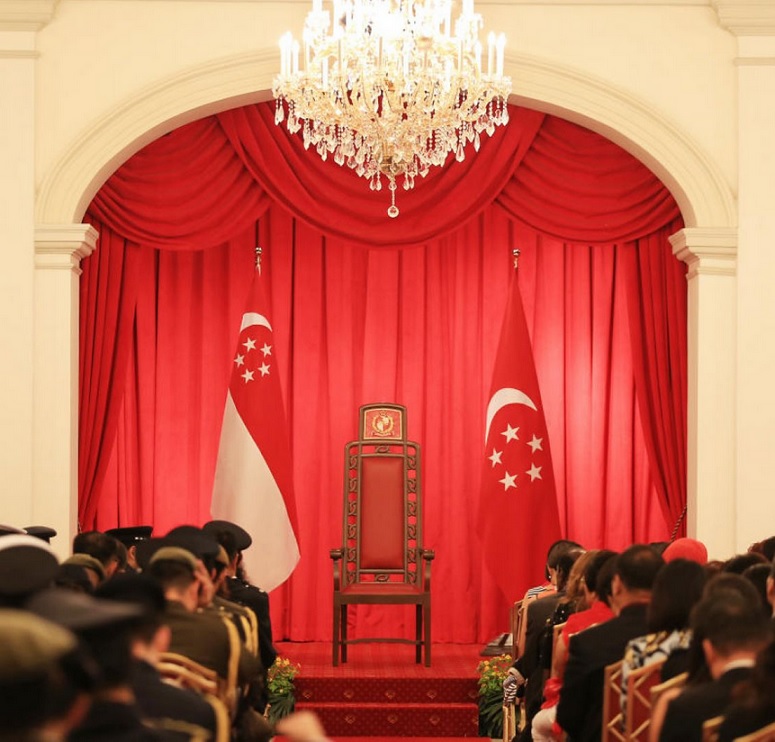
    Potential candidates running for the presidency will need to have their ethnicities certified by a new Community Committee, under proposed legislative amendments tabled on Monday (Jan 9) for the new hiatus-triggered model to ensure the country has a minority President from time to time.

    The proposed Community Committee will be made up of a chairman and five members each from the Chinese, Malay, as well as the Indian and other minority communities. Depending on which ethnicity a prospective candidate submits an application under, the sub-committee for that particular community will determine if the individual belongs to that community.

    The Community Committee members will be appointed by the Prime Minister, on nomination by the Presidential Council for Minority Rights, according to the legislative changes mooted for the Presidential Elections Bill tabled for first reading in Parliament by Minister in the Prime Minister’s Office Chan Chun Sing on Monday.

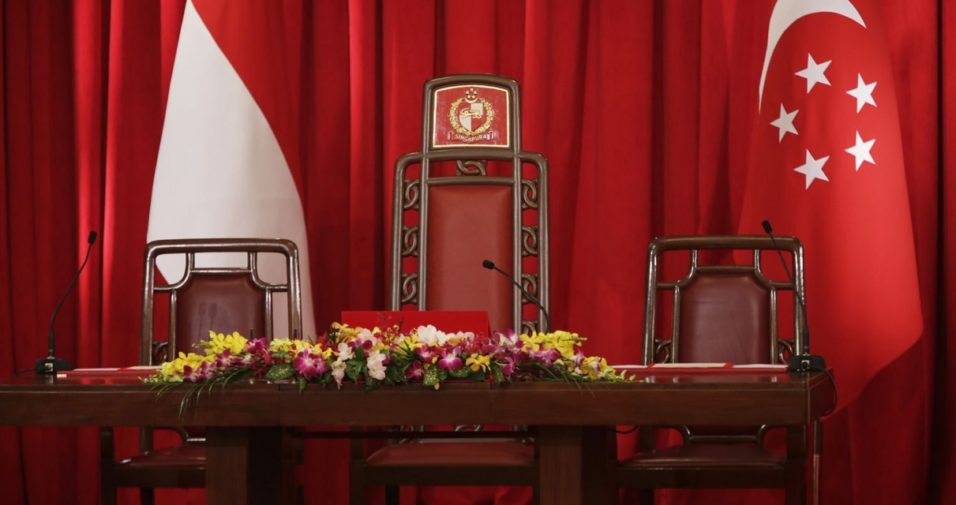
    Last November, changes to the Elected Presidency scheme were passed into law, including instituting a mechanism that reserves an election for a particular ethnicity that has not had an elected representative for five consecutive terms. The upcoming presidential race due in August will be reserved for the Malay community.

    Under the proposed legislative amendments tabled on Monday, all prospective candidates will have to submit a community declaration, on top of the existing application for a certificate of eligibility with the Presidential Elections Committee (PEC). This applies for both open and reserved elections.

    The Elections Department said requiring a community declaration for an open election is needed to operate the hiatus-triggered reserved election process.

    Applicants can be rejected if they fail to submit an application with either committee.

    There is a possibility that in an open election, some candidates are not considered to be members of the three main communities — such as a naturalised citizen — or are rejected in their applications for the community certificates. But they can still contest in an open election as long as they meet the other criteria for the certificate of eligibility.

    In the event that no candidate is successfully nominated at a reserved election, the amendment Bill states that the Prime Minister will issue a fresh writ to call for an open election or a reserved election for the next eligible community.

    The new Community Committee is similar to the Malay and Indian and other minority communities committees found under the Parliamentary Elections Act, which determines if the potential candidate contesting in a particular Group Representation Constituency belongs to these minority groups
    Voters can know who will be on the new committee by May at the latest, just before prospective candidates can start applying for the certification. Applications for such certificates open three months before a sitting President’s term is up. President Tony Tan’s term lasts until end August.

    Given that applicants will need to submit more information to the PEC now that more stringent criteria for potential presidential candidates are in place, the application deadline was proposed to be extended to five days after the writ of election is issued, up from the current three days.

    To give the PEC more time to assess the applications, the Prime Minister’s Office also proposed that Nomination Day falls 10 days after the writ is issued, up from the current five.

    The Second Reading of the Presidential Elections (Amendment) Bill is expected next month.

    Other amendments under the Bill include improvements to the election processes, where the Returning Officer will automatically carry out a recount if the winning margin is 2 per cent or less. This is to avoid unnecessary delays. Currently, a recount is carried out only if a candidate or his counting agent applies for one — provided the winning margin is 2 per cent or less.

    Overseas voters could also have up to two calendar days after the writ is issued to register as an overseas elector, up from the current deadline on the day it was issued. Contingency procedures proposed include allowing the Returning Officer to provide up to an additional seven days for overseas votes to reach Singapore for counting.

    The same amendments for overseas voting processes will be made through future amendments to the Parliamentary Elections Act, which contains the relevant legislation.


    Source: Today

  • Meridians Seeking Help For Hilmi And Family After Bus Crash In Muar

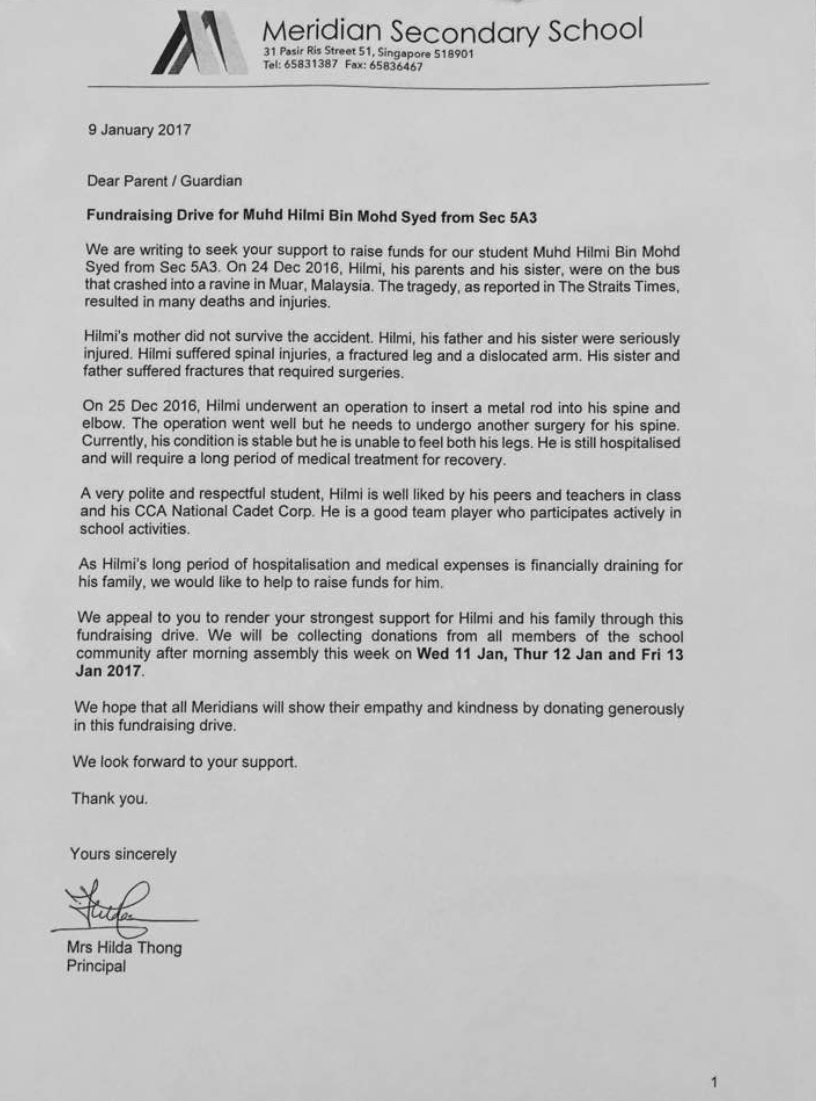
    Meridians Seeking Help For Hilmi And Family After Bus Crash In Muar

    Please help in whatever way we can.
    We will never know when it will be our (loved ones’) turn.
    .
    Can dikir barat teams/badan kebajikan/kesatuan yg ada kelebihan hulurkan bantuan? Tak banyak, sedikit pun jadilah. Kita kotakan kata-kata yg kita laung-laungkan selama ini. Tak mudah buat aku menangis siot. But his plight shattered me.
    .
    Can someone initiate derma kilat di masjid or during the mega event at tamp west cc pada hari sabtu ini? #perihaldk
    .Budak lagi. Baru ‘nak memutik. Sudah mula pincang dlm kehidupan. Nasib anak-anak kita, bagaimana?
    .
    Yes, you may share this post. Please share this post.

    Source: Zaidy Nandir

  • Singapore’s Stagnant Start-Ups

    Singapore’s Stagnant Start-Ups

    Facebook, Amazon, eBay. Other than cultures of innovation, disruption and now serious valuations, something that all these once start-ups now tech-giants have in common is that they aren’t Singaporean.

    Ok, obviously global tech start-ups are largely an American phenomenon. But even at the level of local and regional start-ups, the Little Red Dot is lagging behind with very few recognisable names in the start-up game.

    What about Grab taxi, you ask? Well, it is Malaysian-founded, though now Singaporeanised thanks to investment and this too is another recurring problem where local start-ups are struggling despite Singapore’s financial ecosystem pouring money into regional ventures.

    With strong intellectual property legislation, excellent connectivity, a range of government programs in support of innovation and diverse options for funding, Singapore is — on paper at least — a paradise for start-ups.

    However, as regional ventures have flourished on Singapore’s soil local entrepreneurs appear to be missing out. According to a recent Tech in Asia article, local ventures have raised only a fraction of the funding raised by their foreign counterparts.

    Singapore has much to celebrate and be proud of… but it needs to relook its start-ups policy. This after billions of dollars’ worth of government funding directed at local start-ups for several years.

    To some extent, of course, the discrepancy in the performance between local and regional ventures is inevitable. Start-ups operating in Indonesia, India or China benefit from huge domestic markets and are an attractive proposition to investors.

    Also there are clear gaps to be filled in these markets that don’t always exist in Singapore where international companies already operate comfortably.

    However, Singapore with its sizeable economy and talent pool should be producing internationally and regionally competitive start-ups. Just look at Israel, a country with a similar population, GDP and high-tech base, which is churning out start-ups at a formidable pace including the home-grown navigation app Waze which was bought by Google for US$1 billion (RM4.47 billion).

    Something isn’t quite right, our start-up ecosystem is not working for local entrepreneurs and this is a problem.

    Though some might say it’s simply meritocracy with foreign start-ups having better revenue models and harder working teams, the reality is that Singapore as a nation must develop its core at every level particularly at the level of tech-innovation and entrepreneurship.

    If you look at the labour market, Singaporeans are now heavily favoured — with restrictions on S-passes and employment passes benefiting qualified Singaporeans.

    But in terms of the start-up ecosystem, we seem to be at an active disadvantage, seen as consistently less worthy of investment than those operating in larger markets with lower barriers to entry.
    Here’s my hypothesis:

    1. Singapore start-ups haven’t moved to capitalise on the country’s competitive advantages. While we don’t have a large market we do have a sophisticated research base, and a more complex financial ecosystem than most of our neighbors. This means Singapore can compete in niche products like genetics and robotics, but for too long our local start-up offerings have been along the lines of retail solutions, payment gateways etc. simple clones that haven’t developed deeper technologies even though we should have the talent to do so.

    2. The second problem may also be the government’s own largesse. Billions of dollars’ worth of grants, incubators and ambitious funding programs don’t guarantee success. One of the dangers of these schemes is that a lot of start-ups become vehicles for obtaining funding and don’t have the business plans and commitment needed for success. Better targeted funding which offers to co-fund or match funding raised by founders with clearer milestones is essential to propelling a healthy start-up economy.

    3. The global start-up narrative has focused on a small number of visionaries — fearless leaders in their garages and basements ingeniously disrupting their way to success. It must be noted though that most successful businesses in Asia are family businesses with family and community support structures. It might be time our funding and development models reflected this with family units encouraged to fund projects and ownership structures, loans etc that facilitate this. While this is somewhat unconventional, involving the family/community has the advantage of removing the fear of failure many isolated Singaporean entrepreneurs have — as risks are now shared.

    4. Finally, the key weakness in terms of creating successful start-ups is our increasing distance from  our immediate region. Despite amazing transport connectivity to every part of Asia, Singaporeans are too used to seeing the country as a bubble. As such, Singapore’s conditions do not reflect those of the region and Singaporeans are not geared to solving the regional problems which present the largest opportunities. A population that’s increasingly speaking Mandarin and English but not Malay, leave alone Tagalog or Bengali, is not well-equipped to succeed where we have the greatest competitive advantage – our neighbourhood. Raised to see our neighbours as dirty and dangerous, young Singaporeans are not willing or able to scrap it out on the streets of Jakarta or Dhaka but this is where the opportunities are and if we don’t break down these psychological barriers, start-up success will remain elusive.


    Source: themalaymailonline
  • Aku Tak Kenal Siapa Shia

    Aku Tak Kenal Siapa Shia

    I never had a friend who is Shia or anything other than Sunni. I was brought up in Singapore as a normal Muslim child. went to school, had a decent education and made several friends of different ethnicity.

    As i grew older, i had to fill up more forms like the G50, insurance papers or even resume and interview details of myself, and i got to know about my sect. that was when i learnt that i am a sunni. embarrassingly, i was a drop out from religious school back then when i was younger due to certain circumstances so this was something new to me. “Ini kau letak je sunni”, that was what i was told to write by a friend without any hesitation. And i still remembered it till today.

    So out of curiosity i asked him what the other side of sunni was (if there is any) and i was told about Shia. A small community of muslims that are of different teachings from us that we should not really speak of or supposed to know of. It was a surprise to me but i did not pursue the issue any further. Perhaps i would never know anything more anyway.

    I don’t know anything about shia or who are these shias in singapore. some people say that they may be among us and we would not know it. the question now comes down to how can we effectively embrace everyone in Islam, if there are like “closeted” muslims living around us though abiding by the same religion Islam? can they come out? Or are they not supposed to come out?


    Teh O

    Reader’s Contribution

deneme bonusu