Blog

  • Students Took Issue With UCF Muslim Group’s ‘Try A Hijab On’ Booth And Ignites Twitter Fight

    Students Took Issue With UCF Muslim Group’s ‘Try A Hijab On’ Booth And Ignites Twitter Fight

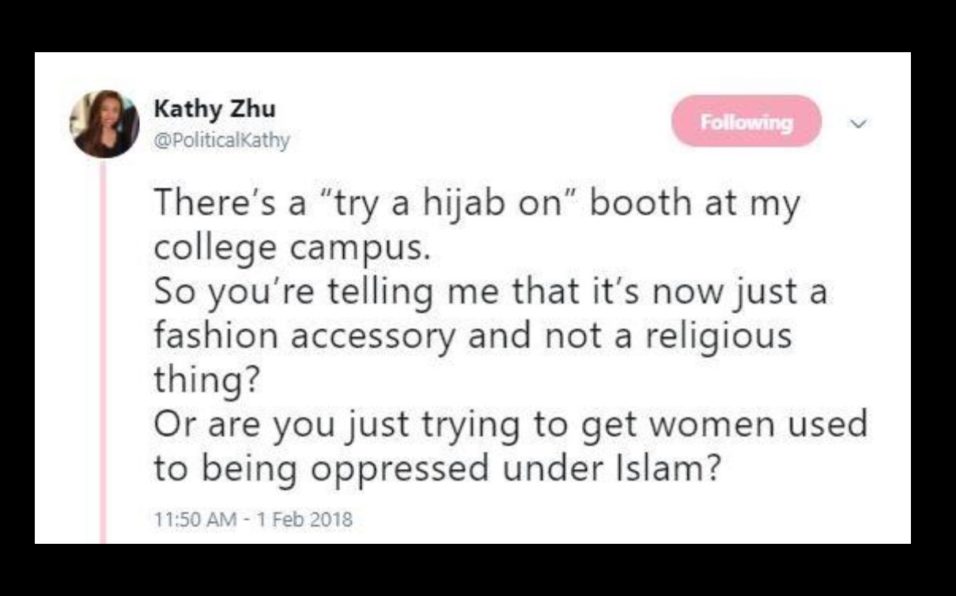
    A University of Central Florida freshman drew national attention this week after she posted on Twitter about a Muslim group at her school offering students the opportunity to try on a hijab.

    Kathy Zhu, 19, said she was walking between classes about noon Thursday, which was annual World Hijab Day, when she passed a Muslim Student Association tent near the Student Union.

    She posted three photos and wrote “there’s a ‘try a hijab on’ booth at my college campus. So you’re telling me that it’s now just a fashion accessory and not a religious thing? Or are you just trying to get women used to being oppressed under Islam?”

    Zhu’s post garnered a quick response, with thousands of Twitter users chiming in, including someone who said she was in one of the photos.

    “I invited you to try one on and you said ‘no thank you,’” the woman wrote. “You didn’t take the time to even ask questions or try to understand what Hijab is. That’s ignorant of you. You literally sprinted after taking the photos. That’s pathetic.”

    In a separate post, the woman urged people to contact the university’s Office of Student Conduct.

    “Let’s get this girl expelled,” she wrote.

    UCF issued a brief statement on Twitter about the matter Friday, saying no action would be taken.

    “The University of Central Florida has received a number of emailed complaints suggesting that disciplinary action be taken against students involved in a disagreement being played out via social media,” the post on the official UCF Twitter account read. “Upon review, neither student’s actions as reported to the university violate our Rules of Conduct.”

    Members of the Muslim Student Association did not respond to requests for comment Friday. The group posted photos on its Facebook page of several people, including at least one man, trying on the head coverings.

    Thursday’s dust-up is one of several social media incidents at UCF during the past year. In July, a student said he was suspended from the school after he posted a marked-up note from his ex-girlfriend on Twitter. The school quickly rescinded his suspension.

    And last March, a post on a private Facebook page inviting members to an event where they would learn how to find and report undocumented immigrants online received national attention. UCF officials said the event did not reflect the school’s values but would not trigger university discipline. The creator of the Facebook post later said the event was a hoax.

    Zhu, who is studying political science at UCF, was born in China and grew up in Kissimmee. She said Friday in an interview that her messages weren’t directed toward a specific student. The woman in the photo calling for her to be expelled, she said, “was way more out of line than what I did.”

    She said she took issue with the idea that students should try on hijabs at UCF, pointing to videos online of women removing or burning the head coverings in protest of a culture or religion they think is oppressive to women.

    One of the photos Zhu posted to Twitter show signs under the Muslim group’s tent saying “My hijab empowers me,” and “My hijab is a symbol of understanding.”

    “The hypocrisy of this is kind of disgusting,” she said.

    Source: orlandosentinel


    Rilek1Corner

  • FFFA Founder Nizar Bigbear: “Beware Of Non-Registered/Regulated Self-Help/Blessing Groups”

    FFFA Founder Nizar Bigbear: “Beware Of Non-Registered/Regulated Self-Help/Blessing Groups”

    “First class manipulator.”

    That was his reaction when ST’s article “$53k raised for baby’s surgery lost to ‘scammer’ on crowdfunding website” was published on 4 Feb.

    Nizar Mohd Shariff or many know him as Bigbear, the founder of FFFA (or Free Food For All) informed R1C that he was also scammed by culprits Ian Ian and Ricky Ng of about $10K (personal loan) due to lack of better judgement.

    Bigbear said that the main culprit Ms Ashley Lee aka Ian Ian operates a group called “Ian Milk Blessing” and also picks her unsuspecting victim from that group itself. “We want to create awareness so that she (Ian Ian) cannot find new victims, and also flush her out of hiding,” he said.

    Her modus operandi? Ms Ashley Lee aka Ian Ian approaches Give.asia to run crowdfunding campaigns for her victims. Afterwards, she will swoop in for the kill. “Yes that’s how they build confidence, they scam both the beneficiary as well as donors,” added Bigbear. Worst, she used Nizar’s prominent name in the volunteer-community to “instill confidence” in others.

    It’s important that we spread the word about these known “culprits”. Its hard nowadays to be wary of such scam through social media right bro? Honestly i would never had guessed someone is daring enough, busuk hati enough too coax victims to crowd fund and then scam that money that was raised.. macam inhumane with no compassion whatsoever.”

    Bigbear responded, “Precisely, new kind of low.”

    To create awareness, he have asked for people to follow the page “Ian Milk Blessing Alert” which has daily updates on the scam cases involving Ian Ian and other accomplices. Photos of them are also available at the page, coz names can also be changed.

    In his closing statement, Bigbear wish to advise the following to the members of the public. “Beware of non registered self help/blessing groups that are not registered or regulated. Unless they have an extensive track record, there is always a risk of abuse.”


    Rilek1Corner


    First class manipulator. For lack of better judgement, i was duped into thinking that she had a heart of gold. Ian Ian and Ricky Ng, come forward and face the issue. Wonder who else has been conned?


    just search “Ian free milk blessing” on your fb search bar and you’ll get the links. Disgusting to think that they’ll prey on the vulnerable like that… how do they even sleep at night!


    After finding out those in need, she approaches them, arrange crowdfunding. Get people to support the cause. Then after the beneficiaries get the funds. She comes in for the Kill. If this is not premeditated, then i dont know what is.

    We need help to CSI on her whereabouts. Ian Ian and Ricky Ng.


    Ricky Ng lives in Taman and Jurong & I think the only person who knows his actual address is Vivian Pan


    Rule #1 – when a person who is seen to be charitable on social media messages u to transfer $ to a ” needy ” person. Please do your due diligence. Why cant they do it themselves?

    Rule #2 – milk powder at 30-50 pct discount, but must buy in cartons, require advance payment. But does the milk ever come? Strange that prey are almost always those who receive funds from crowdfunders.

    Many cheats who prey on the less fortunate. They view them as easy targets. We need to educate ourselves on the potential pitfalls of self help groups. No Regulation means there will always be a chance of abuse. We need to work with the system and that means structure.

    Its time we take evil people off social media who preys on the weak. Anyone with info on Ian Ian and her accomplices, please PM me. Do not be taken in by her offers to help. Its a SCAM !!!


  • Fair To Blame The MUSLIM Community For Subway Singapore’s Going ‘Halal = Not Tasty’?

    Fair To Blame The MUSLIM Community For Subway Singapore’s Going ‘Halal = Not Tasty’?

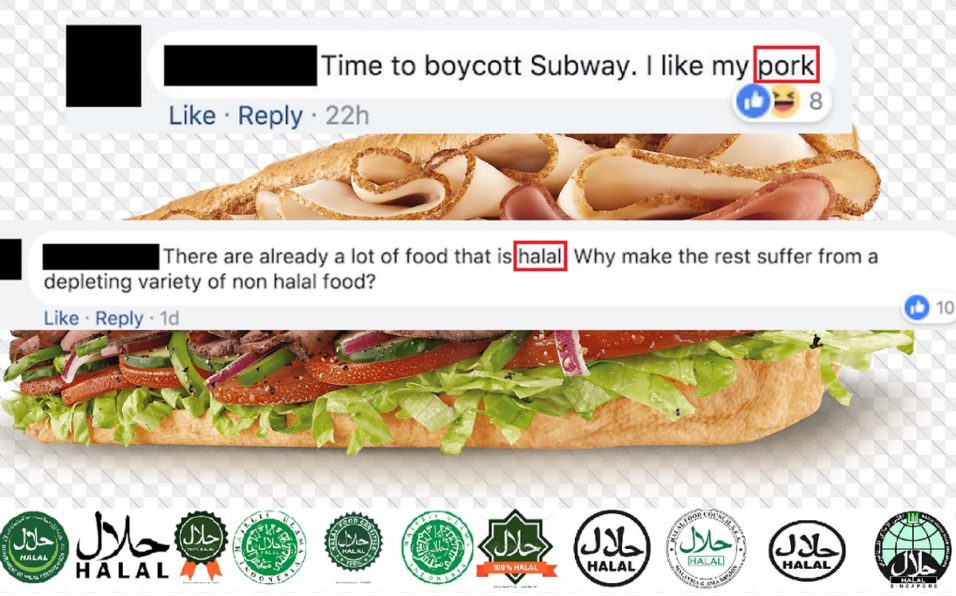
    Why would Subway Singapore want to turn halal?

    A few possible reasons. In recent years, there has been an increasing awareness of halal cuisine (New York’s famous Halal Guys food trucks for example), while Muslim tourism has seen a paradigm shift, with young Muslims worldwide driving a $300 billion boom. You can see that trend here as well, with the advent of popular halal food and travel blogs.

    So it makes sense to jump on the bandwagon — provide Muslim-friendly services to get in on the big, formerly disregarded chunk of pie that is the Muslim market.

    Or it could also be that Subway is losing customers with its mediocre sandwiches (we’ll get to that later) and wants to freshen things up a little.

    So, why are folks angry?

    ‘Halal = Not tasty’

    The general (and admittedly completely subjective) perception here, is that once a non-halal food establishment turns into an official halal-certified one, the nosh just won’t taste as good as before. South Korean fried chicken joint Nene Chicken and Pastamania suffered that fate, with complaints about how their offerings seemed to have reduced in quality. There may actually be some truth to that, given that halal restaurants have to abide by a strict list of ingredients and suppliers put out by MUIS, and sometimes, the results just aren’t as satisfying as before.

    Of course, there are rare cases like Maki-san and 4Fingers Crispy Chicken — both of which went halal and are still loved by all patrons from all backgrounds. It remains to be seen for Subway, though.

    ‘No more Subway classics’

    The most obvious change once Subway goes halal is that the chain will no longer have longtime favorites such as their BLT and Italian BMT. Perhaps they’ll still include those sandwiches, but with halal ingredients instead. But as all pork-loving eaters would proclaim — fuck turkey bacon.

    ‘Muslims are forcing non-practitioners to conform to their standards’

    To be fair, religion is not to blame here — Muslims are not forcing Subway to get a halal certificate to accommodate them. Though the chain did entertain feedback from interested Muslim customers in 2010, it couldn’t find a way to do so back then.

    There are actually already a couple of local halal options for lovers of subs, including Toasties, Watsub Sandwich Bar, and Yellow Submarine Cheesesteaks. They even have the option of hopping the border to Johor if they really want some Subway, where it’s already halal.

    Subway Singapore clearly has reasons of their own to change up their business operations, but regulars are making the argument that the chain should have some outlets be halal-certified, while others stick to the status quo. But there’s the rub. Under the MUIS’ strict policy — if a franchise wants to officially go halal, all of their branches have to be halal, no exceptions.

    Of course, others have argued that Subway should have gone the way of Fatboys and Astons, both of which launched separate halal iterations of their brand in the form of Fatpapas and Andes, respectively.

    ‘Subway is ignoring loyal customers’

    No doubt about it, Subway will lose a significant portion of customers if it does go halal. There’s a reason why some are calling for a boycott — they feel like they didn’t ask for this at all. Mostly because they didn’t.

    On the flip side, what Subway loses in old regulars, they gain in new ones who didn’t have access to their subs here for the past 22 years. Furthermore, the chain still welcomes non-Muslim folks to patronage their outlets, the difference being that now they can dine in with the company of their Muslim friends, albeit without salami.

    But is Subway actually good?

    Ah, the obvious question. Why are people mad that Subway’s no longer selling non-halal food? Their sandwiches are mediocre at best, and no amount of MUIS-approved ingredients will fix shitty fast food. On the list of top sub sandwich restaurant chains in the Unites States, Subway doesn’t even crack the top 10. Hell, there are probably other sub sandwich makers here that do a far better job with halal subs.

    But the Muslim population here isn’t going to care really — they’ll happily flock to whichever spot hangs up a halal certificate, no matter the food quality, and that’s just sad. Because of the strict adherence to that green MUIS sign, they’ve never tasted cuisine from the other side of the fence and will be happy with whatever’s served. They’re the type who’ll say that Le Steak and its overdone beef cuts are the best steaks ever, without knowing how good actual steaks are in actual steakhouses.

    Then again, if Subway Singapore wants to be inclusive for the Muslim population, who’s to deny them that right? It might even be better than their old iteration. MIGHT.

    Source: coconuts


    Rilek1Corner

  • Accuser, Mana ‘Wedding Caterer’ That Dumped Curry Waste Into Pasir Ris River?

    Accuser, Mana ‘Wedding Caterer’ That Dumped Curry Waste Into Pasir Ris River?

    “Just like this picture, we can say many things nowadays through social media. Accuse, report, stomp and simply tarnish someone’s reputation just like that.

    If you have evidence for example pictures of the “caterer” themselves throwing curry waste into the canals that lead to the river, then the necessary actions to be taken by the respective authorities will follow. Else naturally if you don’t have such proof then is it fair to expect people to believe this piece of news?

    Then again, nowadays everything can be made up just to “kill off” somebody for whatever reasons. No justifiable proof, just pick your bullets and post it online. Well maybe this is the Singapura that we know 

    The photo was originally sent in by Shirley Lc Tan.

    “This wedding caterer at the void deck of Blk 408 Pasir Ris (510408) just simply dump their curry gravy into our river next to it. The river where there are plenty of monitor lizards and our beloveds Pasir Ris’ family of otters..”

    Source: Rilek1Corner Reader

    (PS: Please lah Singaporeans don’t anyhow make up stories. When the river colour macam TEH TARIK no one complain.. Rest our case siol!!)


    Rilek1Corner

  • What Lessons Can Be Learned From Singapore’s Religious Regulatory Framework?

    What Lessons Can Be Learned From Singapore’s Religious Regulatory Framework?

    The city-state has developed an interesting model, but one that cannot be lifted wholesale into other environments, writes HA Hellyer.

    In the last year, several cases of abuse perpetrated by Muslim religious figures have been widely discussed in Western Muslim communities. It is not relevant to comment too deeply on those cases in terms of specifics, that requires investigations that others are carrying out, but these examples brought up an interesting question. What do Muslim communities, particularly in the West, do when religious leaders are accused of carrying out ethical violations, which are not necessarily against the law, but are contrary to their commitments as religious leaders?

    As part of a broader project around the engagement of the Islamic tradition with issues of fundamental rights, I was interested in looking at different models that sought to address how ethical violations were being dealt with in Muslim communities. To that end, a very interesting model – if very particular to its own context – is being developed in Singapore.

    The inspiration for Singapore’s religious regulatory framework came from neighbouring Malaysia, where religious activity for Muslim preachers and teachers has been regulated for much longer. Indeed, the initial regulatory instrument of Singapore for Muslim religious activity – the AMLA – was inspired to a very large degree by a similar law in one of Malaysia’s federal states.

    That regulatory instrument brought the Majlis Ugama Islam Singafora (the Islamic Religious Council of Singapore) into life in 1968. Generally, that body did not really regulate religious leaders: it managed items such as zakat, mosques, the existence of a mufti and other administrative functions. That began to change in the late 1990s, when Pergas, an association for religious teachers, sought the establishment of a religious teachers recognition board. There was no particular appetite at the time, and thus it was left by the way side until the 9/11 attacks in the United States.

    It’s unfortunate indeed that it was the threat of extremism that led to this renewed concern in what is essentially a far wider and less negative concern. But nothing induces political will more than threats and in 2005, the Asatizah Recognition Board was formed to oversee the Asatizah Recognition Scheme. It remained a voluntary association for much of its existence and only became a legally established body last year.

    It’s an interesting model. It engages in the training of imams and religious teachers for different skills; it provides for a recognition of religious qualifications that may not come from widely recognised university establishments; indeed, the religious teachers themselves stand to gain a great deal from the model. But the ARB is also a disciplinary institution. It is a place where religious teachers who have been accused of ethical violations may be questioned. It is made up of religious teachers who are widely respected in the Muslim community.

    In that regard, the scheme operates much like a professional syndicate and officials engaged within it openly admit that they took a lot of inspiration from other professional syndicates in terms of what services the ARB ought to provide its membership. Regular skills training is provided and is a condition of membership. The skills are meant to ensure the religious training of the teachers in question are also contextualised to Singapore’s realities – much like how, for example, the Cambridge Muslim College in the UK, or the Zaytuna College in the US, are aimed at ensuring imams and religious teachers are fully aware of the social realities in which they live.

    But here is the catch – membership of the ARS is mandatory for any religious teacher. Without it, they cannot teach. More than that, the ARB can impose penalties on teachers who have run afoul of ethical prescriptions – penalties that can include fines or even imprisonment. There exists no other such regime for other religious communities in Singapore.

    I spoke to several officials and civil society activists engaged in the wider administration of Muslim religious life on a recent trip to Singapore – who, like me, seemed suspicious of any state power being utilised in the regulation of religious life in this manner. Some confided in me that to begin with they had opposed the compulsory nature of the scheme and weren’t entirely happy about certain aspects of how it was being imposed. And yet, at the same time, for those who were particularly engaged, they admitted there were problems with a few religious teachers, whom they thought required a certain heavy-handed approach. It’s clear there are teething problems, but almost no one I met in Singapore considered the existence of a compulsory syndicate for religious teachers to be a bad idea.

    It’s an interesting model and one that cannot be lifted wholesale to other environments. In the UK, for example, a legally imposed syndicate for religious teachers would raise genuine concerns around religious freedom. But the idea of a religious teachers’ syndicate is not so unusual. The main question is how to ensure it gains social credibility among the community it ministers to, and those who are to be its members, because legal compulsion of any kind may not be the answer in many contexts. How that is all to be done, particularly with such variety among Muslim Western communities, is yet to be seen and at the same time, given the clear problems that exist without regulation at all, it is probably only a matter of time before Muslim Western communities themselves create their own mechanisms. As they seek to do so, they might learn certain lessons from their Singaporean co-religionists.

    Source: thenational


    Rilek1Corner