Tag: racial politics

  • PM Lee: Why Didn’t Malay Candidates Come Up In PE2011? Cause They Knew Non-Chinese Have No Chance

    PM Lee: Why Didn’t Malay Candidates Come Up In PE2011? Cause They Knew Non-Chinese Have No Chance

    Prime Minister Lee Hsien Loong made it plain that he knew the reserved presidential election would be unpopular and would cause the ruling party to lose votes, but said it had to be done because it was the right thing to do.

    Addressing the unhappiness over the election for the first time at a dialogue last Saturday (Sept 23), he said: “Did I know that this subject would be a difficult one? That it would be unpopular and would cost us votes? Yes, I knew. If I do not know that these are sensitive matters, I cannot be in politics.”

    “But I did it, because I strongly believe, and still do, that this is the right thing to do,” he added.

    The candid remarks were the first by the Prime Minister, since Madam Halimah Yacob was declared President in a walkover at the election reserved for Malay candidates.

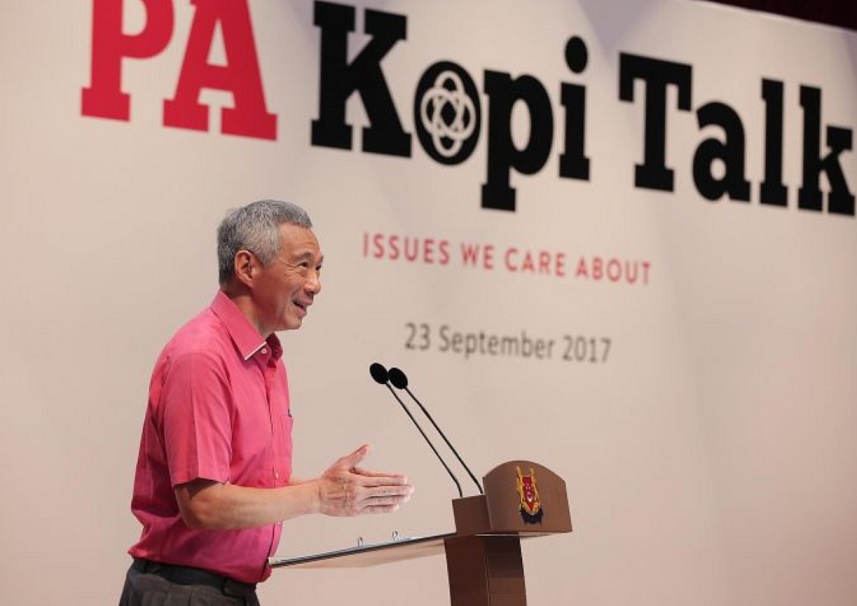
    PM Lee was speaking at a People’s Association Kopi Talk dialogue with about 500 grassroots leaders last Saturday, and the Prime Minister’s Office released an edited transcript on Friday (Sept 29).

    During the dialogue, he spoke about race, multiracialism, terrorism and the elected presidency, and gave a stout defence of why constitutional changes were made to reserve elections for groups that have not held the presidency for some time.

    Acknowledging that there was “some unhappiness” over the election, PM Lee said: “I can feel that; you don’t have to tell me.”

    He noted that the Government had spent nearly two years preparing to make changes to the Constitution, and had discussed and debated the issue continually since he first raised the subject in January 2016 during the opening of Parliament.

    “But it is only now that people are seized with it, after a reserved election in which only one candidate qualified,” he said.

    PM Lee added that while some people think “we may be going backwards towards racial politics”, the reality “is the opposite”.

    In fact, he said, ensuring that minorities are elected president from time to time will strengthen Singapore’s multiracial system.

    The current state of affairs, where Singaporeans of different races and religions live in harmony, is not a given, he said.

    “There is nothing natural about where we are – multiracial, multi-religious, tolerant and progressive. We made it happen, and we have got to protect it, nurture it, preserve it, and never break it.”

    Referring to the recently-concluded reserved election, Mr Lee said that three Malay candidates had put themselves up for the presidency, of whom two did not qualify.

    “But they came forward,” he added.

    In the 2011 presidential election, there was not one Malay candidate, he noted.

    “Was there a Malay candidate? Where were the Farid Khans and the Salleh Maricans? Why didn’t they come? It did not cross their minds? No. So why didn’t they come? Because they knew that in an open election – all things being equal – a non-Chinese candidate would have no chance,” he said.

    Citing President Halimah, who said when she was sworn in that she looked forward to the day when reserved elections are no longer needed, Mr Lee said: “I too hope that we will eventually not need such a mechanism to ensure minority representation.”

    But he said it would take time to work towards this ideal state.

    “In climbing towards that ideal state, we need guide-ropes and guard-rails to help us get there and to prevent us from falling off along the way. The reserved election for the President is one such guard-rail,” he added.


    Source: http://www.straitstimes.com

  • Khan Osman Sulaiman: Those Responsible For Using Racial Politics To Divide And Conquer Gets Away Scott-Free

    Khan Osman Sulaiman: Those Responsible For Using Racial Politics To Divide And Conquer Gets Away Scott-Free

    I was upset when the gov disguise condescension as affirmative action. I was distraught that my community was taken as a pawn in a political manoeuvring. I was disappointed that I can’t partake in democracy when there’s a walkover.

    Now that the charade has completed, I’m apprehensive about the ill effect of such disastrous policy just so that we can have a Malay President.

    The feeble justification by the gov that we need a Malay President can be felt even by those supporting it. The PAP is trying to paint itself as a champion of minority but we know it is all nothing but just political.

    At the top, we are always under-represented. And when they allow one to pass through, it is only because we have ‘progressed’. Not because we are equal in the first place.

    It surely rings hollow that the Malay community desire to have a Malay President but other pressing issues are not met with the same vigour the PAP has, to install a Malay president.

    What worries me the most is how the ill effect of this whole episode will affect the community. Especially my community.

    Given that we are viewed as getting a back door promotion to hold high office and the non-Malays are denied to participate in the presidential election, it is natural that people would feel upset about it.

    There are already fault lines to begin with before the reserved presidential system. With this whole saga playing out, it will only widen the fault lines further and scratch the delicate social fabric we have built on.

    It infuriates me that the one responsible for creating this mess playing racial politics to divide and conquer gets away scott-free. These types of policies pit us against one another.

    The people have to know that after 50 years of PAP rule, we are treated no more than a pawn in a game of chess. To be sacrificed to protect the queen falling from grace.

    The sooner we realise this, the sooner we can change our situation.


    Soon: Khan Osman Sulaiman

  • How Singapore Elected A President Without A Vote: Only One Eligible Candidate Thus Victorious By Default

    How Singapore Elected A President Without A Vote: Only One Eligible Candidate Thus Victorious By Default

    Singaporeans were meant to go to the polls at the end of next week to vote for a new president, but they’ll no longer have the chance, with only one candidate qualifying for the race. Former Speaker of Parliament Halimah Yacob has emerged victorious by default, after other presidential hopefuls fell foul of new rules.

    “I can only say that I promise to do the best that I can to serve the people of Singapore and that doesn’t change whether there is an election or no election,” she told reporters Monday. What should be a moment of celebration — Halimah will be Singapore’s first female president — has proved contentious for several reasons and appears at odds with Singapore’s reputation as a technocratic and efficient city state. While the office of president is largely a ceremonial role in Singapore, he or she has power to veto some of the government’s decisions, for example in fiscal matters that touch on the country’s reserves, or key appointments in the public service. “The only beneficiaries from this reserved presidential election are Halimah Yacob and her team, as well as Singapore’s opposition, which now has a new line of attack against the PAP (People’s Action Party). The rest of Singapore has suffered,” Sudhir Vadaketh, a Singapore author and commentator, told CNN. Halimah was, until recently, a loyal member of the ruling PAP, which dominates Singaporean politics.
    “All Singaporeans are unhappy that meritocracy and electoral fairness, core Singaporean values, have been eroded to fulfill perceived political goals.”

    Racial politics
    In this election, for the first time, candidates to become Singapore’s president could only come from one racial group: Malays. It’s a radical policy that would likely prove divisive elsewhere but it’s one the Southeast Asian nation said was necessary to ensure better representation among the country’s three main races: Chinese, Indian and Malay.
    “It shows we don’t only talk about multi-racialism, but we talk about it in the context of meritocracy or opportunities for everyone, and we actually practice it,” Halimah told The Straits Times newspaper, before declaring her intention to contest the election.

    The new rules also set stricter criteria on the background of candidates. For example, those from the private sector are required to be a chief executive of a company, with at least $370 million in shareholders’ equity. The two other Malay presidential hopefuls — businessmen Salleh Marican and Farid Khan — failed to gain Certificates of Eligibility from the Presidential Elections Committee on these grounds, although the Presidential Elections Committee could have exercised its discretion to allow them to run for the office. Critics charge that the new rules are a way for the government to stage-manage the election and prevent opponents from running.

    In August, Singapore’s appeal court ruled against a legal challenge to the new system by ruling party lawmaker turned critic, Tan Cheng Bock. Tan had narrowly lost the previous presidential election in 2011 to Tony Tan, a former deputy prime minister widely recognized as the government-favored candidate, and planned to run again. Singapore’s population is 74% Chinese, 13% Malay, 9% Indian and 3.2% are the ambiguously named “Others.”

    New rules
    The announcement late Monday by the Elections Department that only one candidate had qualified marks an underwhelming conclusion to a controversial election carried out under changes to the elected presidency system in Singapore voted through Parliament earlier this year. Specifically, the amendment states that an election will be reserved for candidates from a particular racial group if the previous five elections have not produced a president from that racial group. In Singapore, it’s dubbed a “hiatus-triggered model.”

    “Every citizen, Chinese, Malay, Indian or some other race, should know that someone of his community can become President, and in fact from time to time, does become President,” said Lee Hsien Loong, Singapore’s prime minister, last November before the new rule was introduced. Singapore hasn’t had a Malay president since the country’s first President Yusof Ishak, who served as head of state from 1965 to 1970. Subsequent presidents have been from the Eurasian, Chinese and Indian communities.

    Debate
    The election has also triggered debate on who is Malay and raised questions over how an individual’s race can be determined. Candidates were required to be assessed by a five-member community panel to certify their race as Malay as part of the qualifying criteria. Halimah, who has successfully stood as a Malay candidate in previous general elections, is reported to have an Indian father. Moreover, Salleh Marican also has an Indian father, while Farid Khan’s identity card lists his race as “Pakistani,” the government-controlled Straits Times reported. What’s more, critics point out that, if the goal really was to improve racial representation and justice, more meaningful measures could be adopted.

    The Chinese form the majority in Singapore and often dominate in positions of power and influence. Singapore’s prime minister has always been Chinese, and it was only in 2015 that the country finally had more than one Malay minister in the Cabinet at one time. The Malay community typically have lower incomes and grapple with institutional discrimination, such as in the armed forces.

    “While reserving the presidential elections for only Malays is a highly symbolic gesture, there is a need to do more for concrete issues faced by the Malay community such as discrimination, lack of social mobility and relative poverty,” lawyer Fadli Fawzi told CNN. “I think that it is more important to focus on removing barriers and improving the lot of the man on the street rather than reserving slots for one or two individuals.”

    Speaking at a forum on Friday, Chan Chun Sing, a minister in the Prime Minister’s Office, acknowledged the unpopularity of the new system, saying that it would be a “hard journey” to convince Singaporeans that the change was necessary. He denied accusations that the amendments were made for political gain. “We are prepared to pay the political price, because we think the future of our country is much more important than any political capital that we may have,” he said.


    Source: http://edition.cnn.com

  • Khan Osman Sulaiman: Singapore Is Multiracial, Multi-religious Society Yet Debate On Racial Issues @ Speaker’s Corner Not Allowed

    Khan Osman Sulaiman: Singapore Is Multiracial, Multi-religious Society Yet Debate On Racial Issues @ Speaker’s Corner Not Allowed

    Writ for the Reserved Presidential Election has been issued by Prime Minister Lee Hsien Loong yesterday and preparations had been made to carry out our speech at Hong Lim Park this coming Saturday to voice our concerns over the racialised Presidential Election.

    However, we are informed last minute by the National Park that we will require police permits to speak because the topic touch on racial issues.

    It is absurd that the government doesnt allow citizens to discuss/speak/debate on race issues at the speaker’s corner but at the same time, passing a bill that has created much distress on the populace.

    In reserving a Malay candidate for the presidential election, it is inevitable that race will be part of the subject matter should we want to openly call out on the government’s policy. Hence, it can never get debated publicly by citizens due to existing regulations.

    Even when matters are brought up in parliament, we have seen how it will be swiftly shot down as playing racial politics.

    In an open societies, the government is expected to be responsive and tolerant. Its political mechanisms are said to be transparent and flexible.

    To the international community, Singapore is a multiracial and multi-religious society which has enjoyed many years of relative peace. A facade that has been perpetuated by the government.

    In reality, our freedom of speech, freedom of association, are curbed by an invisible hand that are always ready to put us away should we cross the line.

    Such community will never be able to achieve its full potential and will lose it cognitive development over time.

    At the present moment, we have incompetent leaders that are preoccupied with a single cause. Economic satisfaction for its people. They are incapable of solving a nation’s hunger for a multi fold development. We already retard our progression by reserving a Malay candidate for high office.

    My hope is that Singapore will elect a leader that will advocate for change and truly work for the betterment of its people holistically.


    Source: Khan Osman Sulaiman