Tag: Muslims

  • What’s Missing In The Teaching Of Islam

    What’s Missing In The Teaching Of Islam

    There has been much misinformation about Islam. Reports in Western media tend to perpetuate stereotypes that Islam is a violent religion and Muslim women are oppressed. Popular films like “American Sniper” reduce places like Iraq to dusty war zones, devoid of any culture or history. Fears and anxiety manifest themselves in Islamophobic actions such as burning mosques or even attacking people physically.

    At the heart of such fear is ignorance. A December 2015 poll found that a majority of Americans (52 percent) do not understand Islam. In this same poll, 36 percent also said that they wanted to know more about the religion. Interestingly, those under 30 years were 46 percent more likely to have a favorable view of Islam.

    These statistics highlight an opportunity for educators. As a scholar of Islamic art and architecture, I am aware that for the past 20 years, educators have been trying to improve the teaching of Islam – both in high school and college history courses.

    The problem, however, is that the teaching of Islam has been limited to its religious practice. Its impact on the arts and culture, particularly in the United States, is seldom discussed.

    What teaching of Islam misses

    In high school history books, there is little mention of the intertwined histories of Europe, Asia and Africa in the middle ages and the Renaissance. There is even less mention of the flowering of art, literature and architecture during this time.

    In a world history textbook for New York public high schools, for example, the “Muslim World,” appears in the 10th chapter. In condensing a thousand years of history – from the seventh to the 17th century – it focuses only on “Arab armies” and the rise of early modern Muslim empires.

    Palatine Chapel borrowed from the art of the Fatimids.
    Al-dabra, CC BY-NC-ND

    Such narrow focus misses out on the cultural exchanges during this period. For example, in medieval Spain, the Troubadour poetsborrowed their lyrical beauty from Arabic. Arabic was the courtly language of southern Spain until the 15th century. Similarly, the 12th-century Palatine Chapel in Sicily was painted and gilded in the imperial style of the Fatimids, the rulers of Egypt between the 10th and 12th centuries.

    Such exchanges were common, thanks to the mobility of people as well as ideas.

    The point is that the story of Islam cannot be told without a deeper understanding of its cultural history: Even for early Muslim rulers, it was the Byzantine empire, the Roman empire and the Sassanian empire (the pre-Islamic Persian empire) that provided models. Such overlaps continued over the centuries, resulting in heterodox and cosmopolitan societies.

    The term “Middle East” – coined in the 19th century – fails to describe the complex social and cultural mosaic or religions that have existed in the region most closely associated with Islam – and continue to do so today.

    How the arts can explain important connections

    So, what should educators do to improve this literacy?

    From my perspective, a fuller picture could be painted if identities were not to be solely defined through religion. That is, educators could focus on the cross-cultural exchanges that occurred across boundaries through poets and artists, musicians and architects. Both in high school and university, the arts – visual, musical and literary – could illustrate the important connections between Islam and other world histories.

    For example, a class on the Renaissance could explain how the 15th-century Italian painter Gentile Bellini gained famed at the court of Mehmet II, the conqueror of Istanbul. Mehmet II commissioned Bellini to design an imperial portrait that was sent to rulers throughout Europe. His art presents a wonderful example of the artistic exchanges that took place between early modern cities such as Delhi, Istanbul, Venice and Amsterdam.

    It might also help students to know that the Dutch painter Rembrandt collected Mughal miniature paintings. Silks from the Safavid empire (the Iranian dynasty from the 16th to 18th century) were so popular that Polish kings had their coat of arms woven in Isfahan.

    This exchange of art continued into the Age of Enlightenment, a time when ideas around politics, philosophy, science and communications were rapidly being reoriented in Europe. A class on the Enlightenment may highlight the fact that writers like Montesquieuturned to the Middle East to structure a critique of their own religious institutions.

    Goethe found inspiration in Persian poetry.
    kaythaney, CC BY-NC

    A poetry class could similarly show connections between the German author Wolfgang von Goethe’s writings and Islam, as exemplified in his “West-Eastern Diwaan,” a collection of poems. This epitome of world literature was modeled after classical Persian poetry in its style, and inspired by Sufism, the mystical tradition in Islam.

    Most students are open to seeing these connections, even if it might require overcoming their own preconceptions about Islam. For example, when I teach my class on medieval architecture, students are surprised to learn that the two oldest continuously run universities in the world are in North Africa (in Fez – a city in Morocco – and Cairo).

    Indeed, it is not easy to disentangle contemporary politics from historical fact, to teach more fully the culture and diversity of a religion that is almost 2,000 years old.

    Perhaps educators could learn from a recent exhibition at the Metropolitan Museum of Art in New York titled “Jerusalem 1000-1400: Every People Under Heaven.” The show illustrates how Abrahamic religions – that is, Christianity, Judaism and Islam – borrowed freely from each other in the realm of art, music and literature. Jerusalem was home to diverse populations and the arts played an important role within its religious and political life.

    Muslims in America

    It’s not in the past alone. We see these connections continue today – here in America, where Islam is an intrinsic part of the culture and has been for centuries.

    From the Mississippi delta to the Chicago skyline, Muslims have made contributions, which might not be so obvious: West African slaves in the South were central to the development of the blues. Its complex vocalization and rhythms incorporated the rituals of Islamic devotion many of them had to leave behind.

    The same is true of architecture. A quintessential example of modern American architecture is the Sears Tower in Chicago, which was designed by the Bangladeshi-American structural engineer Fazlur Rahman Khan.

    Muslim contributions to art and architecture don’t just reflect the diversity of America, but the diversity of Islam in this country. Muslims in America comprise a rich tapestry of ethnicities, languages and cultures. This knowledge is particularly meaningful for young Muslim Americans, who struggle to claim their place in a country in which they are sometimes made to feel like outsiders.

    Educators, especially within the arts and humanities, have an important role to play in this religious literacy, that helps students understand the unity in the diversity. After all, as the most popular poet in America, the 13th-century Muslim mystic Rumi wrote:

    All religions, all this singing, one song.
    The differences are just illusion and vanity.


    Source: huffingtonpost
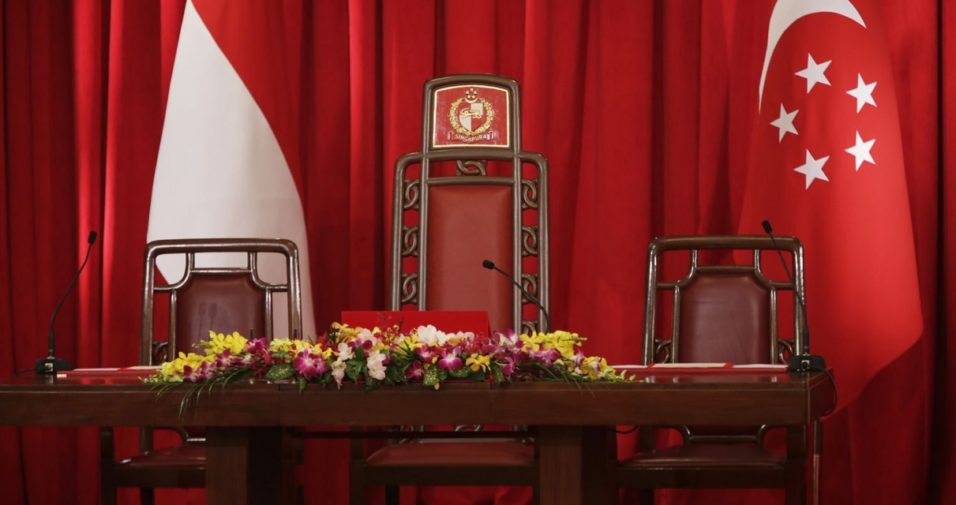
  • New Malay President When Elected Will Be A Shame To The Malay Community

    New Malay President When Elected Will Be A Shame To The Malay Community

    The new malay president when elected will be a shame to the malay community in singapore. Just mark my words. If the current public servants now are talam dua muka, What good is there to look for in a president that is going to be malay just because the government say so.

    Potential candidates (that is likely picked by PAP) who applies for the position is to be assess by the new community committee to be verified of his or her ethnicity and eligibility. How far back are they going to trace his and his family’s DNA to make a sound and accurate assessment? Eligibility wise, Singaporeans generally know who has already been chosen if not yet. What is the point of the elections then right?

    Those whose names was published recently as potential candidates are now in the spotlight. For those who want to contest, i say good luck. But for those who is going to decline to participate or like Yacob in particular who gave his reasons for not doing so are just being a prick. Who would actually believe that anyone given a chance to get a $4 million paycheck for doing nothing will turn it down. Spare us citizens from the lame excuse of liking the work you doing now just because it is “affecting” Singaporeans. It doesn’t even sound right. So much for serving the citizens.

    No point having a Malay president for the sake of almost 50 years of not having one. One statement says it all. The malay taking that role is a shame to our malay community. we never asked for this in this way and there will never be justice in this. I’m sure many feel this way too.


    B. Doh

    Reader’s contribution


  • Aku Tak Kenal Siapa Shia

    Aku Tak Kenal Siapa Shia

    I never had a friend who is Shia or anything other than Sunni. I was brought up in Singapore as a normal Muslim child. went to school, had a decent education and made several friends of different ethnicity.

    As i grew older, i had to fill up more forms like the G50, insurance papers or even resume and interview details of myself, and i got to know about my sect. that was when i learnt that i am a sunni. embarrassingly, i was a drop out from religious school back then when i was younger due to certain circumstances so this was something new to me. “Ini kau letak je sunni”, that was what i was told to write by a friend without any hesitation. And i still remembered it till today.

    So out of curiosity i asked him what the other side of sunni was (if there is any) and i was told about Shia. A small community of muslims that are of different teachings from us that we should not really speak of or supposed to know of. It was a surprise to me but i did not pursue the issue any further. Perhaps i would never know anything more anyway.

    I don’t know anything about shia or who are these shias in singapore. some people say that they may be among us and we would not know it. the question now comes down to how can we effectively embrace everyone in Islam, if there are like “closeted” muslims living around us though abiding by the same religion Islam? can they come out? Or are they not supposed to come out?


    Teh O

    Reader’s Contribution

  • Call To Embrace Diversity In Islam

    Call To Embrace Diversity In Islam

    There is a growing confidence in the Malay-Muslim community about its place in Singapore, said Minister-in-charge of Muslim Affairs Yaacob Ibrahim.

    But even as it enjoys successes, challenges remain, he said, highlighting the need for the community to embrace diversity in Islam.

    In an interview with Malay newspaper Berita Minggu, Dr Yaacob said the community has made progress in three areas.

    First, Malay students are doing better in education. Besides more of them scoring well in national exams at the primary, secondary and polytechnic levels, there were also more who achieved first-class honours in universities last year, he said.

    There was progress made in the religious life of Malay Muslims too, he added. He cited how donations to mosques have increased, and low-income families are getting help through their programmes, among others.

    A third area of progress, which Dr Yaacob described as “more innate”, is that more Malays are stepping forward to do more not just for the community but also for other Singaporeans. Some have launched start-ups, while others do community work such as serving food and cleaning the homes of poor Singaporeans of other races.

    The community has progressed on many fronts, Dr Yaacob said. “Divorce rates are coming down, our educational achievements are going up, home ownership is stabilising, wealth is increasing in the community, (there are) better jobs and there is a greater diversity of talent.”

    But as the community grows in self-confidence, it also has to embrace diversity in Islam. The Islamic faith is “very diverse” and there is a need to respect differences, he said.

    As a vocal minority online and in the region has sought to sow discord against Shi’ites, Dr Yaacob said there is a need to respect minority Shi’ite Muslims in predominantly Sunni Muslim Singapore, noting that senior Muslim scholars have all along considered Shi’ites as part of the mainstream in Islam.

    “They pay MBMF (Mosque Building and Mendaki Fund). They come to our mosques. They pray together with us. They celebrate the same Hari Raya. So why are we not treating them as fellow Muslims but different?” he said.

    He gave the example of how the chairman of the Moulana Mohamed Ali Mosque at UOB Plaza, Mr Mirza Namazie, is Shi’ite while the majority of its board is Sunni. “That’s a great example of how we deal with diversity, and we have to continue with that,” he added.


    Source: The Straits Times

  • Undergrad Part-Time Tutor Rejected By Tuition Agency Due To Parents’ ‘Racial Preferences’

    Undergrad Part-Time Tutor Rejected By Tuition Agency Due To Parents’ ‘Racial Preferences’

    Tuition has become a staple for school-going children in Singapore.

    While it is understandable that each child — and by extension, family — may seek specific tutors for specific needs, one tutor has come forward to share her experience of being repeatedly rejected for tuition jobs — despite being more than qualified for it.

    The tutor is an undergraduate student from a local university and is seeking part-time work at a local tuition agency for extra income.

    The agency essentially acts as a middleman by matching families with the tutors for the required subjects.

    Compiling all the requests of the different families, the tuition agency then sends them out to the tutors under them. Interested parties can apply to take up the vacant slots.

    censored-without-codecensored-without-code-2

    As the tutor in question specialises in English and Literature, she has repeatedly applied for positions that required tutors for those two subjects.

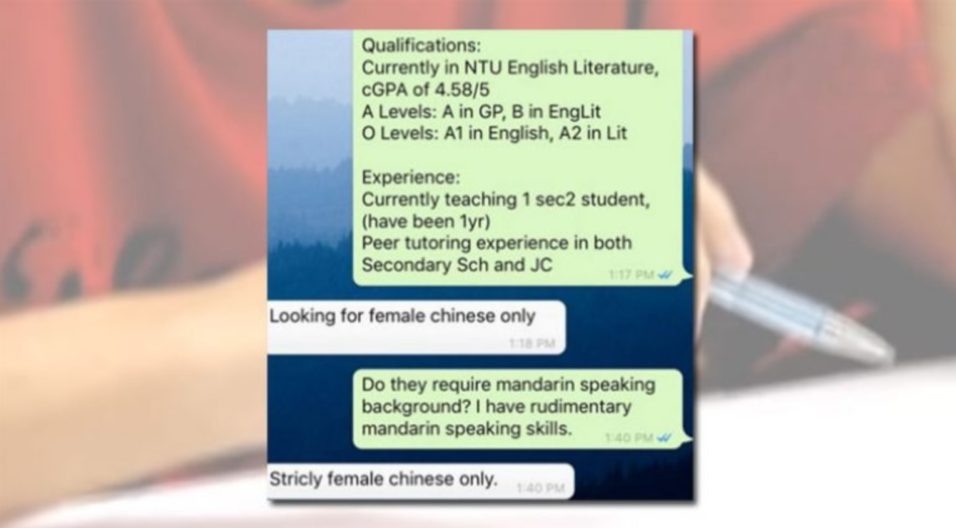
    However, time and time again, she has met with responses from families like the one below:

    rejected-profile-without-code


    Recently, it was more blatantly put across to her:

    screenshot-4


    Deep-rooted problem 

    Speaking to Mothership.sg, the tutor said she feels frustrated that she has to deal with this kind of issue time and time again.

    This is despite the fact that she is a first-class honours student.

    She also related that she has even met with a situation where after she was rejected by the family, the same tuition gig was offered to someone she knew, who is Eurasian Chinese.

    She also said any language or communication barrier with non-English-speaking families should not be a problem, particularly in her case, as she is from a mixed Malay-Chinese family.

    Acknowledging the sensitivity of the issue, she doesn’t demand recourse.

    Instead, she said she understands that some people just don’t feel comfortable with certain races.

    What have the authorities said about such practices

    According to TAFEP’s job advertisement guidelines stated in its fair employment practices handbook,

    “Employers who advertise a position requiring a specific attribute which may be viewed as discriminatory should ensure it is indeed a requirement of the job and state the reason for the requirement in the advertisement…

    Race should not be a criterion for the selection of job candidates as multiracialism is a fundamental principle in Singapore. Selection based on race is unacceptable and job advertisements should not feature statements like ‘Chinese preferred’ or ‘Malay preferred’.

    Religion is unacceptable as a criterion for recruitment except in cases where employees have to perform religious functions as part of the job requirement. In such cases, the requirements should be clearly and objectively presented”.

    But such practices are normalised

    However, a quick check on forums has shown how prevalent racial preference in tuition has become in Singapore.

    screen-shot-2017-01-06-at-11-12-39-amscreen-shot-2017-01-06-at-11-13-55-amscreen-shot-2017-01-06-at-11-19-30-am

    Ultimately, the student tutor said she hopes people, especially parents, can have a more open mindset towards tutors like her.

    She said: “I just wish that it wasn’t this way because it hasn’t changed since my mum’s time.”


    Source: mothership.sg