Tag: race

  • Of TCB And Salleh Marican: Both Directly Associated With The Establishment, Both Blocked From Potentially Contesting The Presidency

    Of TCB And Salleh Marican: Both Directly Associated With The Establishment, Both Blocked From Potentially Contesting The Presidency

    I am one of those who have highlighted the hypocrisy on both sides upon observing both sides and my views are from my personal perspective.

    Categorically, I am against the manipulation of the constitution particularly the reserved election on basis of race by the government of the day to maintain grip of power bases. This however does not automatically mean I am supportive of any claim of an alternative voice challenging the primary power base.

    There are inconsistencies in what have been said, what have been allowed to be said, what have been silence and what have been forced to be silenced.

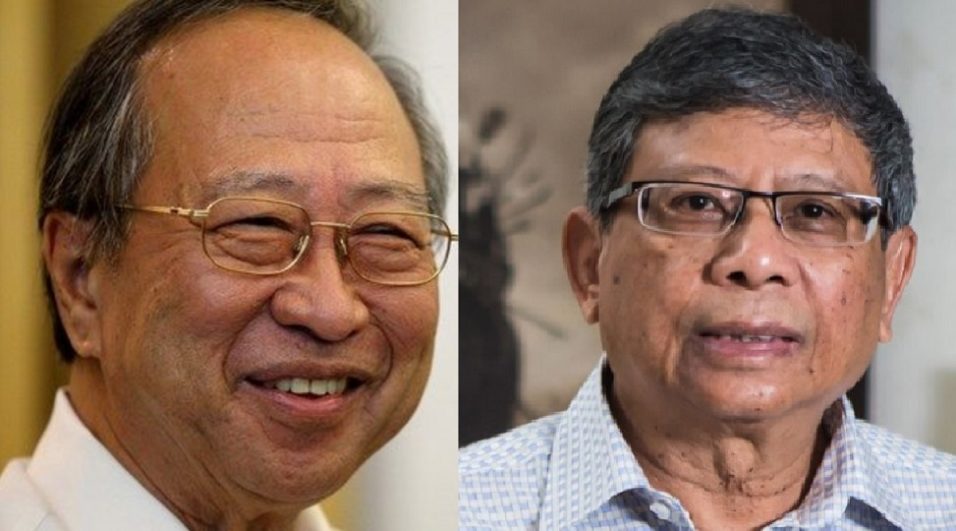
    The example of double standard begins with the hashtag campaign of #notmypresident pointing to the legitimacy of the presidency rather than #notmygovernment or #notmydemocracy that would point to the mechanism and ideology used to manipulate the constitution. The campaign of #notmypresident must be nuanced with an alternative person for presidency. This is perhaps presented in the person of Dr Tan Cheng Bock, the best loser for PE2011. This is with the assumption that an open election by the revised criteria, he would qualify for candidacy. However, the little has been said about the Dr Tan’s capacity to meet the $500m company criteria that saw Mr Salleh and Mr Farid disqualified.

    The #notmypresident campaign was preceded with a spoil your vote campaign which in sum was intended as a protest against the reserved election (almost without mention of the manipulation of the eligibility criteria) simultaneously denouncing the nomination of Mr Salleh and Mr Farid as potential candidates who have stepped forward in full awareness of the changes of the eligibility criteria.

    What makes the movement inconsistent and precursor to double standard is the treatment and opinion accorded to Dr Tan, a former PAP MP who was blocked from contesting primarily on the grounds of a racially reserved election and the treatment and opinion accorded to Mr Salleh, a voluntary director at Temasek Foundation Cares on the grounds of not meeting the $500m criteria.

    Dr Tan was hailed as being robbed of the presidency while Mr Salleh was portrayed as a crony despite both are directly associated with the establishment and both were blocked from potentially contesting the presidency.

    The above inconsistency prompted me to ask if the anger was due to violated principles or violated opportunity of an individual.

    Unreservedly, I am supportive of Dr Tan’s challenge to the presidency. This does not mean that should a more qualified candidate be available, I should ignore.

    For example it has been widely publicised that Mdm Halimah has no financial background to be a custodian of the reserves. However, would Mr Salleh Marican be less qualified than Dr Tan C B in this aspect. What would the principle of meritocracy suggest?

    It is also known that Mdm Halimah is an immediate alumni of the establishment, however between Mr Salleh and Dr Tan, the association to the establishment of Dr Tan is as a former card carrying allowanced PAP MP who has refrained from joining a different political party since stepping down, while Mr Salleh was a volunteer director at a nonprofit community service arm of Temasek. What would the principle of independence suggest?

    Categorically I qualify that I am here not to pit Dr Tan against Mr Salleh but to highlight the tenor and treatment put forth by the alternative movement on two violated candidates, both with sound financial acumen, both with ties with the establishment and both non partisan to any political party at the time of planned candidacy.

    Thus I have to undertake a personal reflection and question aspects of privilege, rights and principles. With that, I need to caution myself against getting caught in a cult of personality because Democracy is not simply the propelling the voice of the majority (in the widest sense) or the rule of majority, democracy stands in symbiotic coupling to ensuring minority (in the widest sense) rights (in a sense just as wide).

    Without the latter, a discourse on Civil Liberties and Civil Rights that ensues will sit on an oppressive high ground as demand for justice on aspects where the majority feels shortchanged are heard loud while privileges that propels benefits to the same majority are retained in silence.


    Source: Rafiz Hapipi

     

  • Singapore F1 Fans Bribed Security Guard To Allow Them In, Even Helped Them Take Epic Photo

    Singapore F1 Fans Bribed Security Guard To Allow Them In, Even Helped Them Take Epic Photo

    The Singapore GP, organisers of the Formula One race here, are investigating a claim that a security guard was bribed into allowing a couple to enter the Marina Bay Street Circuit.

    On Sep 17, All Singapore Stuff published a screenshot of a Facebook post showing the couple in question posing for a picture on the tracks near a Johnnie Walker advertisement board.

    Read a caption on the post:

    “3am in the morning. Bribed the security guard to let us onto track. He not only agreed, he took the photo. Non F1 fans won’t understand this, but most of us will.”

    In response to a media query, the Singapore GP told Stomp that they are looking into the matter.

    Said a spokesman:

    “The safety of our patrons is of utmost priority and we view allegation of bribery seriously. We are working with the appointed security agency assigned to the reported area, to investigate the claim.”


    Source: http://stomp.straitstimes.com

  • Alfian Sa’at: “If There Is A Committee To Certify The ‘Chineseness’ Of Candidates, What Kinds Of Criteria Should We Expect?”

    Alfian Sa’at: “If There Is A Committee To Certify The ‘Chineseness’ Of Candidates, What Kinds Of Criteria Should We Expect?”

    I have so many questions.
    Is a biologically Chinese person adopted into an Indian family still Chinese?
    But what do we mean by ‘biologically’?
    You can adopt a child of a different race in Singapore.
    But can the child ‘adopt’ whatever race it wants to?
    Are Chindians considered Chinese?
    Is a Chindian with a Chinese father considered more Chinese than one with a Chinese mother?
    Because patrilineal descent?
    If a Chindian is raised only by an Indian mother in the absence of a father can this person remove ‘Chinese’ from the IC and replace it with ‘Indian’?
    If a Chindian is raised by a Filipino domestic worker in the absence of both parents who are working overseas, what is this person’s race?

    If there is a committee to certify the ‘Chineseness’ of candidates, what kinds of criteria should we expect?
    Should this person be able to speak Mandarin?
    Should ‘bananas’ be disqualified?
    Is ‘banana’ a slur?
    How about OCBC–‘Orang Cina Bukan Cina’?
    Can something be a slur when used against an Anglophone elite who wield immense political and economic power in Singapore?
    How about Peranakans?
    Which makes them more Chinese: if they introduce themselves as ‘Peranakan Chinese’ or as ‘Chinese Peranakans’?

    And what if the candidate is a Chinese Muslim?
    Who was featured as one of the top Malay PSLE students in Berita Harian, because of a ‘Muslim-sounding’ name.
    And received a MENDAKI scholarship.
    But then attended a SAP school.
    And decided to change his name by deed poll to something more ‘Chinese-sounding’.
    And was then featured in Lianhe Zaobao as one of the top Chinese ‘O’ Level students.
    But still made CPF contributions to the Mosque Building and Mendaki Fund.
    Then married a Chinese Christian woman under civil marriage.
    And then had kids, one of whom wanted to be Muslim, another Christian, and another a Jedi warrior.
    If this person presents himself in front of an esteemed panel of people who are to certify his Chineseness, what will happen?
    I hope at the very least their heads explode.

    I think some of the questions above are ridiculous.
    I think ultimately there is something absurd about the idea of race–or specifically the idea of racial categorisation.
    And honestly I’m quite tired of all the ink spilled on trying to define Mdm Halimah’s race.
    Because the slipperiness and porosity and contradictions of ‘race’ are not specific to Malays or Indians.
    To be exempt from having your racial identity undergo such obsessive vivisection under the public glare is surely one of the manifestations of majority privilege.
    And to be honest the feeling is horrible, as if there is an ‘authentic performance’ of one’s race, or even worse, that one can be viewed as an exemplary or illustrative specimen of one’s racial species.


    Source: Alfian Sa’at

  • How Singapore Elected A President Without A Vote: Only One Eligible Candidate Thus Victorious By Default

    How Singapore Elected A President Without A Vote: Only One Eligible Candidate Thus Victorious By Default

    Singaporeans were meant to go to the polls at the end of next week to vote for a new president, but they’ll no longer have the chance, with only one candidate qualifying for the race. Former Speaker of Parliament Halimah Yacob has emerged victorious by default, after other presidential hopefuls fell foul of new rules.

    “I can only say that I promise to do the best that I can to serve the people of Singapore and that doesn’t change whether there is an election or no election,” she told reporters Monday. What should be a moment of celebration — Halimah will be Singapore’s first female president — has proved contentious for several reasons and appears at odds with Singapore’s reputation as a technocratic and efficient city state. While the office of president is largely a ceremonial role in Singapore, he or she has power to veto some of the government’s decisions, for example in fiscal matters that touch on the country’s reserves, or key appointments in the public service. “The only beneficiaries from this reserved presidential election are Halimah Yacob and her team, as well as Singapore’s opposition, which now has a new line of attack against the PAP (People’s Action Party). The rest of Singapore has suffered,” Sudhir Vadaketh, a Singapore author and commentator, told CNN. Halimah was, until recently, a loyal member of the ruling PAP, which dominates Singaporean politics.
    “All Singaporeans are unhappy that meritocracy and electoral fairness, core Singaporean values, have been eroded to fulfill perceived political goals.”

    Racial politics
    In this election, for the first time, candidates to become Singapore’s president could only come from one racial group: Malays. It’s a radical policy that would likely prove divisive elsewhere but it’s one the Southeast Asian nation said was necessary to ensure better representation among the country’s three main races: Chinese, Indian and Malay.
    “It shows we don’t only talk about multi-racialism, but we talk about it in the context of meritocracy or opportunities for everyone, and we actually practice it,” Halimah told The Straits Times newspaper, before declaring her intention to contest the election.

    The new rules also set stricter criteria on the background of candidates. For example, those from the private sector are required to be a chief executive of a company, with at least $370 million in shareholders’ equity. The two other Malay presidential hopefuls — businessmen Salleh Marican and Farid Khan — failed to gain Certificates of Eligibility from the Presidential Elections Committee on these grounds, although the Presidential Elections Committee could have exercised its discretion to allow them to run for the office. Critics charge that the new rules are a way for the government to stage-manage the election and prevent opponents from running.

    In August, Singapore’s appeal court ruled against a legal challenge to the new system by ruling party lawmaker turned critic, Tan Cheng Bock. Tan had narrowly lost the previous presidential election in 2011 to Tony Tan, a former deputy prime minister widely recognized as the government-favored candidate, and planned to run again. Singapore’s population is 74% Chinese, 13% Malay, 9% Indian and 3.2% are the ambiguously named “Others.”

    New rules
    The announcement late Monday by the Elections Department that only one candidate had qualified marks an underwhelming conclusion to a controversial election carried out under changes to the elected presidency system in Singapore voted through Parliament earlier this year. Specifically, the amendment states that an election will be reserved for candidates from a particular racial group if the previous five elections have not produced a president from that racial group. In Singapore, it’s dubbed a “hiatus-triggered model.”

    “Every citizen, Chinese, Malay, Indian or some other race, should know that someone of his community can become President, and in fact from time to time, does become President,” said Lee Hsien Loong, Singapore’s prime minister, last November before the new rule was introduced. Singapore hasn’t had a Malay president since the country’s first President Yusof Ishak, who served as head of state from 1965 to 1970. Subsequent presidents have been from the Eurasian, Chinese and Indian communities.

    Debate
    The election has also triggered debate on who is Malay and raised questions over how an individual’s race can be determined. Candidates were required to be assessed by a five-member community panel to certify their race as Malay as part of the qualifying criteria. Halimah, who has successfully stood as a Malay candidate in previous general elections, is reported to have an Indian father. Moreover, Salleh Marican also has an Indian father, while Farid Khan’s identity card lists his race as “Pakistani,” the government-controlled Straits Times reported. What’s more, critics point out that, if the goal really was to improve racial representation and justice, more meaningful measures could be adopted.

    The Chinese form the majority in Singapore and often dominate in positions of power and influence. Singapore’s prime minister has always been Chinese, and it was only in 2015 that the country finally had more than one Malay minister in the Cabinet at one time. The Malay community typically have lower incomes and grapple with institutional discrimination, such as in the armed forces.

    “While reserving the presidential elections for only Malays is a highly symbolic gesture, there is a need to do more for concrete issues faced by the Malay community such as discrimination, lack of social mobility and relative poverty,” lawyer Fadli Fawzi told CNN. “I think that it is more important to focus on removing barriers and improving the lot of the man on the street rather than reserving slots for one or two individuals.”

    Speaking at a forum on Friday, Chan Chun Sing, a minister in the Prime Minister’s Office, acknowledged the unpopularity of the new system, saying that it would be a “hard journey” to convince Singaporeans that the change was necessary. He denied accusations that the amendments were made for political gain. “We are prepared to pay the political price, because we think the future of our country is much more important than any political capital that we may have,” he said.


    Source: http://edition.cnn.com

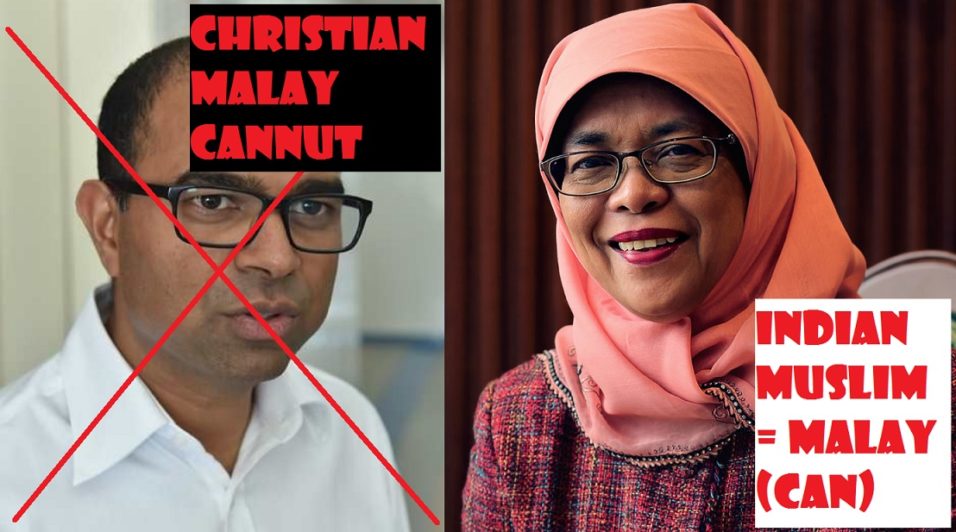
  • Confirmed That Malay Race Is Essentially Muslim, All Indian Muslims Are Malays But Christian Malays Are Not Malays

    Confirmed That Malay Race Is Essentially Muslim, All Indian Muslims Are Malays But Christian Malays Are Not Malays

    At the Institute of Policy forum yesterday (Sep 8), Minister of State Chan Chun Sing and Senior Minister of State Janil Puthucheary both confirmed that the Malay race is essentially Muslim and that all Indian Muslims are Malays, and Christian Malays are not Malays.

    The two Ministers were responding to a Malay Christian IPS professor Dr Mathew Mathews and NUS law professor Dr Kevin Tan. Minister Chan Chun Sing said it is “common-sensical” a person’s race is decided by the 16-member committee under Lee Hsien Loong:

    “A 16-member committee will certify a prospective candidate’s racial group. The very concept of race evolves and the system to determine one’s race should not take a definitive, restrictive, exclusive approach. The community must come to terms (with) who best represents them. If the community accepts someone… then who else outside the community will want to dispute that and who else in the community will want to dispute that? So it’s a very common-sensical way to allow the community to decide for themselves.”

    Senior Minister Janil Puthucheary told Dr Mathew Mathews that he might be a Malay but he will be denied the contest because he is Christian. The Minister then tell the Christian Malay to contest in an “open” election:

    “If the Malay community changes its aspirations and its sense of what makes a Malay five years from now, there should be a way to reflect that in the choice of candidate, without us having to go for a potentially very divisive Constitutional amendment. The hypothetical individual mentioned by Dr Mathew could feel excluded, but the individual could still contest in an open election.”

    NUS law professor Dr Kevin Tan confirmed that the government having the final call on what race a person is is unconstitutional:

    “That the decisions of the Community Committee— which also assesses minority candidates under the Group Representation Constituency system in General Elections — are final, is also a problem. That is probably unconstitutional… The basic fundamental principle about the separation of powers is that if the court has to interpret the constitution, no branch of the Government can tell the court what to do.”


    Source: https://statestimesreview.com